
Story › Napoleon: Larger Than Legend › Part 3 of 6
| Part 3 of 6 |
How did Napoleon seize power?
A tired Directory, a famous general and soldiers at the door.
About This Part
What’s covered
This is chapter 3 of 6 of Napoleon: Larger Than Legend, and it asks one question: how did Napoleon seize power? Since 1795 France had been run by a five-man Directory[1], and by the spring of 1799 it was losing battles abroad and was short of money at home[2, p. 710]. The coup of 18 Brumaire fell on 9 November 1799[3]. That day the Ancients voted to move the legislature to Saint-Cloud and placed General Bonaparte in command of the capital’s forces[4]. At two o’clock the next morning three provisional Consuls took the oath[4]. Legend hands the whole plan to Napoleon alone. This video checks that against the sources, asking whose idea it was, how much of it was legal and how much was soldiers in the corridor, and then follows the road to the imperial crown of 1804[5, p. 273].
Watch
See the part on YouTube
The Story
How the Story Unfolds
From Corsican Cadet to General
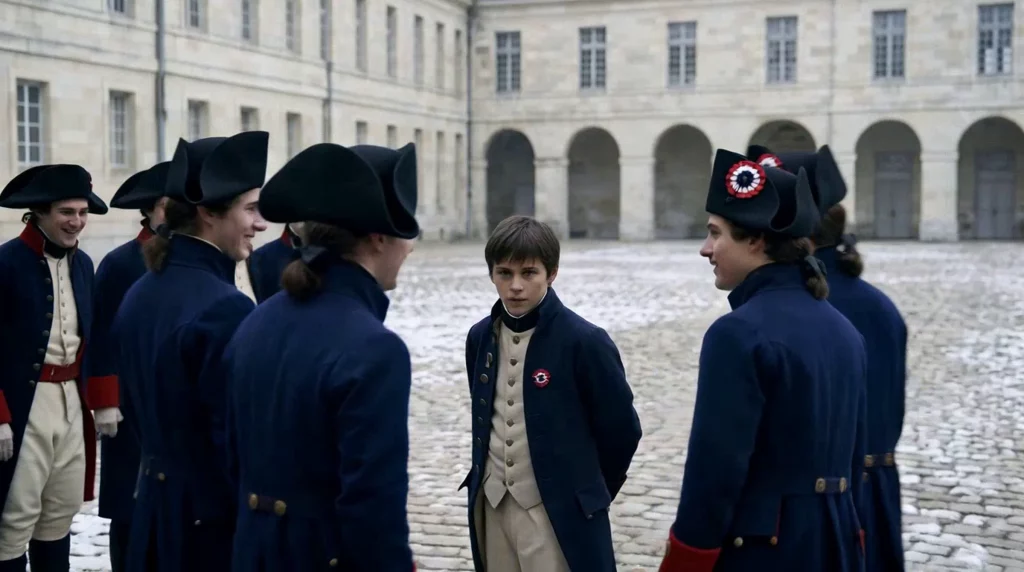
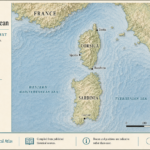
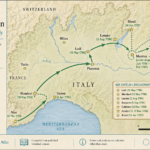
Napoleon Bonaparte was born at Ajaccio in Corsica on 15 August 1769[6, p. 88] and entered the Royal Military School of Brienne in April 1779[6, p. 88]. Las Cases recorded that his Corsican accent earned him a mocking nickname among the other boys[7]. In September 1785, aged sixteen, he became a second lieutenant of artillery[6, p. 88]. At the siege of Toulon he first met Barras[8], who helped overthrow Robespierre on 9 Thermidor in 1794[8]. On 5 October 1795 Napoleon defended the Convention against the revolt of the Sections[6, p. 88]. In March 1796 he married Josephine de Beauharnais[6, p. 88], and the French government appointed him to command the Army of Italy[9]. He reached Nice to take command on 26 March[9]. The campaign ended with the Treaty of Campo Formio in October 1797[2, p. 710].
The Directory Looks for a Sword
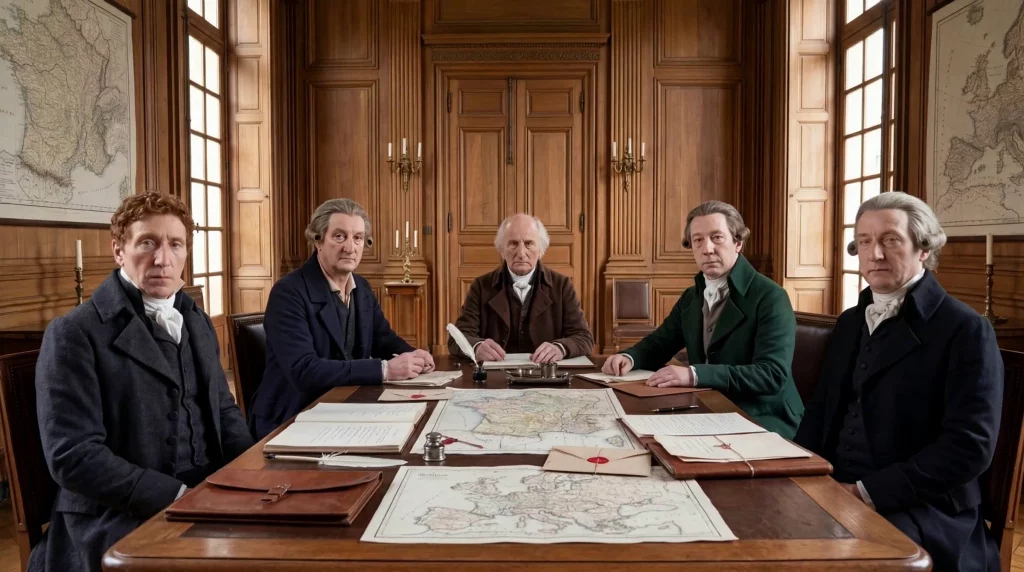
By the spring of 1799 the tide had turned. Jourdan was beaten at Stockach and the defeats in Italy left the peninsula to the Russians and Austrians[2, p. 710], while the Directory, bankrupt since 1797, carried an unavowed deficit of three hundred million francs[2, p. 710]. Emmanuel-Joseph Sieyès was elected to the Directory in May 1799[10]. J. H. Clapham notes that any new combination needed a man of action first, a fellow in epaulets[11, p. 79]. Sieyès’s first choice was Joubert, who fell fighting at Novi[11, p. 79]. Meanwhile Napoleon embarked from Alexandria on 23 August 1799, having already handed command of his army to Kléber[12]. Zweig writes that on 11 October the Directory heard he had landed at Fréjus without waiting to be recalled[13, p. 268]. Geer describes the deputies on their feet, shouting and cheering, when the news reached the Councils[4].
Two Days at Saint-Cloud
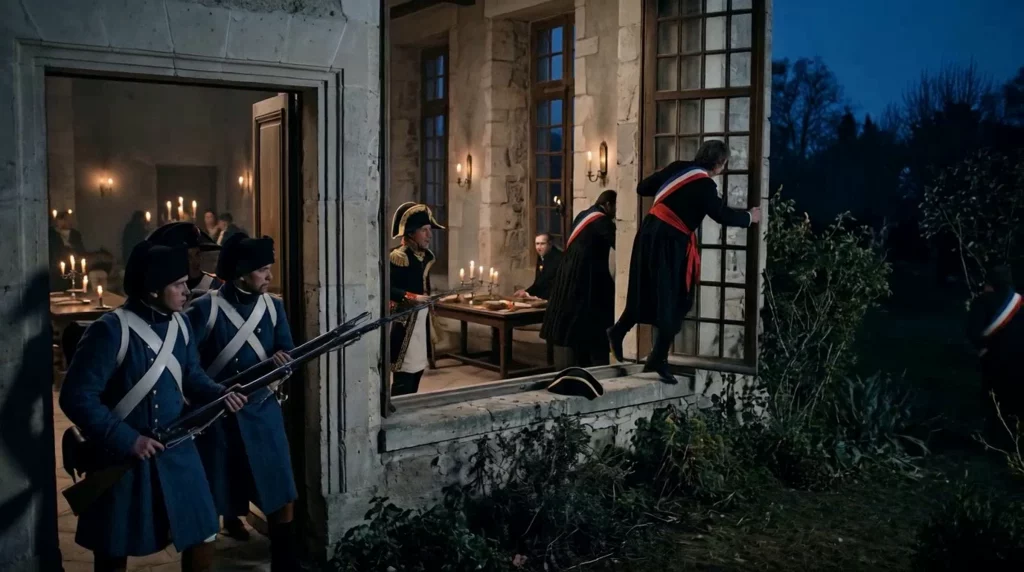
The plan, in Geer’s account, was to force Barras to resign, buy off Gohier, and have the two Councils vote the change at Saint-Cloud under the guard of troops[4]. On 18 Brumaire the Ancients voted to move there and put Bonaparte in command of the capital’s forces[4]. Sieyès and Ducos handed him their resignations[14]. Barras was talked into resigning by Talleyrand[14]. Gohier and Moulins refused[14]. On 19 Brumaire the plan nearly collapsed. In the Ancients’ chamber he launched into a tornado of language and was virtually dragged out by his dismayed companions[14]. In the Orangery the Five Hundred shouted ‘Outlaw him!’ and Murat and Lefebvre forced their way in to rescue him[4]. Lucien then told the troops that deputies armed with daggers were terrorising the chamber[4]. Grenadiers under Murat cleared the hall, and members dropped out of the low windows[4]. Bainville says the outcome stayed in doubt until the last moment[15].
From First Consul to Emperor
The new Constitution of the Year VIII went to the nation on 15 December 1799, and Sloane notes the general apathy, with only about three million votes cast[14]. Sieyès, the man who had hunted for the sword, sank into the shadows in the year of the Consulate[11, p. 79]. In 1802 a plebiscite on making Napoleon Consul for Life gave him over three and a half million votes against fewer than nine thousand[16], and on 2 August the Senate declared it, with the power to name his successor[16]. The Senate then invited him to take a royal title, and a plebiscite approved it by more than 3,000,000 votes to fewer than 3,000[5, p. 273]. On 2 December 1804 he was crowned Emperor of the French in the presence of Pope Pius VII[5, p. 273], whom he had begged to come to Paris to consecrate him[17].
Historical Context
What was going on
The Revolution began in 1789, and the Republic was proclaimed in September 1792[4]. Robespierre was overthrown on 9 Thermidor in 1794[8]. In 1795 a new constitution gave France a Directory of five members, with the Councils of Five Hundred and of the Ancients as its legislature, and the public treasuries were empty[1]. By 1799 Barras was the only director from 1795 still in office[4]. The Directory’s strength had come from French victories, so the defeats of that spring exposed it, and a group in the Councils wanted a more stable and orderly government through a revision of the constitution[2, p. 710]. Sloane adds the fear of a rising new Jacobinism[14], which sent well-to-do men looking to Sieyès and Barras to prevent a new Terror[14]. The French historian Jacques Bainville argued that Brumaire was not a reactionary attack, because the Revolution itself needed a sword, a soldier and a coup d’état[15]. He also noted that the Senate which declared Napoleon deposed on 31 March 1814 was the residue of the Councils of 1799[15].
Quick Facts
The essentials
Quick Facts
Sieyès Wanted Joubert, Not Napoleon
Napoleon was the understudy, Roger. Lord Acton says Sieyès wanted a sword and fixed first on Joubert, sending him to fight in Italy[18]. J. H. Clapham adds that Joubert fell fighting Suvorov at Novi, so the work had to be done over again[11, p. 79].
Roger Learns Brumaire Means Fog
Roger, the coup came exactly one month after the landing. The Cambridge Modern History has Napoleon landing at Fréjus on 9 October 1799, and the Directory overthrown on 9 November, which was 18 Brumaire, Year VIII[19, p. 603]. Brumaire was the Fog month of the new calendar[20, p. 19]. Keith says a coup in the fog is on brand.
Lucien Draws a Sword on Napoleon
Roger adores this scene. At Saint-Cloud, the Cambridge Modern History says, Lucien Bonaparte asked for a sword, pointed it at his brother's breast and swore to kill him if he ever attacked the liberties of France[2, p. 710]. It calls the melodrama cheap but effective. Keith calls it family theatre.
Landslide Votes for Consul for Life
Walter Geer reports that the 1802 plebiscite making Napoleon Consul for Life brought over three and a half million votes in favour and fewer than nine thousand against[16]. William Sloane notes that Lafayette was among the few thousand No votes[14]. Keith would still like to see the ballot box.
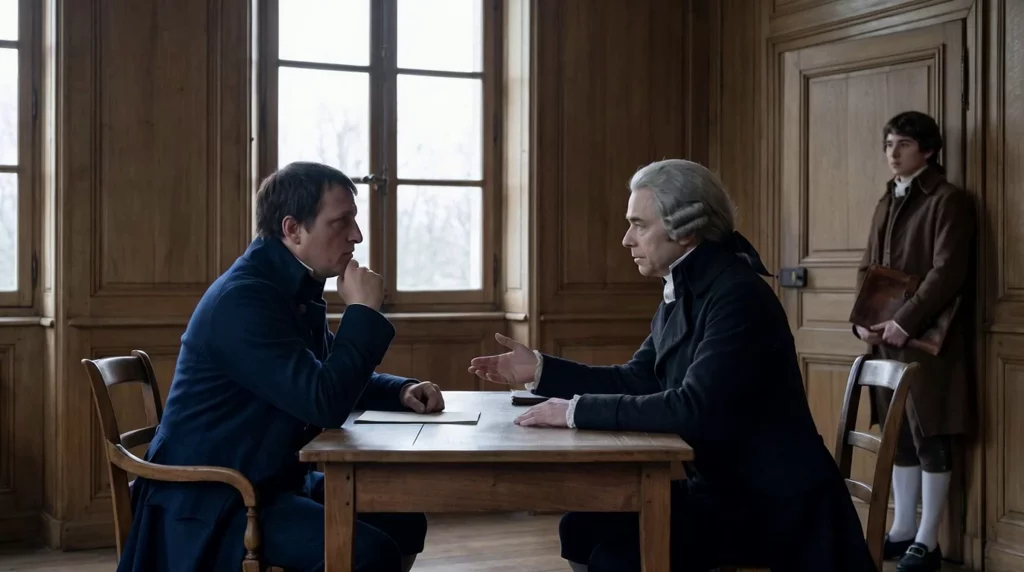
I swear I would strike down my own brother should he ever endanger the liberties of the French!
Lucien Bonaparte, president of the Council of Five Hundred, as reported by William Milligan Sloane
Sloane reports Lucien saying this at Saint-Cloud on 19 Brumaire, 10 November 1799, as he pointed a bystander’s drawn sword at his brother’s chest to rouse the hesitating grenadiers[14].
Who Is in This One?
The people you'll meet







Timeline
How it unfolded
27 October 1795
The Directory Is Installed
The Directory, the weak executive that superseded the National Convention, was installed on 27 October 1795. It was the government Napoleon would overthrow four years later.[21]
March 1796
Napoleon Takes Command in Italy
In February 1796 General Scherer, resigning the Army of Italy, begged the Directory to send a general Bonaparte.[9] Bonaparte left Paris on 21 March 1796 and, aged twenty-six, took command.[22]
23 August - 16 October 1799
Napoleon Returns from Egypt
Napoleon left Egypt on 23 August 1799 and reached France in early October.[23] He left his army in Kleber's charge[24] and arrived in Paris on 16 October.[25, p. 288]
9 November 1799
First Day of the Coup of 18 Brumaire
Sieyes, a sitting Director, was reportedly after a sword to enforce his plans.[15] On 18 Brumaire (9 November) the Anciens voted to move the legislature to Saint-Cloud and put General Bonaparte in command of the capital's troops.[4][25, p. 288]
10 November 1799
Soldiers Clear the Chambers at Saint-Cloud
At Saint-Cloud the Five Hundred met Bonaparte with cries of "Down with the Cromwell".[26] His brother Lucien, presiding, appealed to the troops[14], and Murat's soldiers then cleared the hall at bayonet point.[4]
13 December 1799
Bonaparte Becomes First Consul
Bonaparte was placed at the head of the government as First Consul on 13 December 1799.[25, p. 288] According to Terry, his power was absolute, only thinly concealed by association with a Second and Third Consul.[27]
August 1802
Napoleon Made Consul for Life
According to Geer, the Senate declared Napoleon Consul for Life on 2 August 1802, with the power to name his successor. The plebiscite gave him over three and a half million votes against fewer than nine thousand.[16]
18 May 1804
Napoleon Proclaimed Emperor of the French
A Senate decree of 18 May 1804 entrusted the government to an Emperor of the French and declared the imperial dignity hereditary.[19, p. 603] A plebiscite approved it by more than 3,000,000 votes to fewer than 3000.[5, p. 273]
2 December 1804
Coronation of Napoleon at Notre-Dame
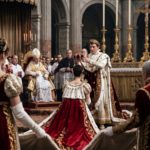
On 2 December 1804, in the presence of Pope Pius VII, Napoleon crowned himself Emperor of the French.[5, p. 273] Masson traces the story that he seized the crown without warning the Pope to a legend begun by Thiers.[17]
What Happens in This One?
The moments it covers





Myth-buster
Think you know this one?
Keith, the coup of 18 Brumaire was Napoleon’s masterpiece. One man, one plan, one afternoon. He sailed home from Egypt, dreamed up the whole thing alone and took France single-handed. Nobody else mattered, Keith. Nobody.
Roger, ‘alone’ is exactly where it falls over. The plan was Sieyès’s, and Joubert was his first selected sword until he fell at Novi[11, p. 79]. On the day, Lucien took the chair, then rallied the grenadiers outside[4]. Geer calls it an exaggeration that Lucien alone saved the day, which tells you how many hands were on this one[4]. Single-handed? He needed a Director, a brother and a regiment, Roger.

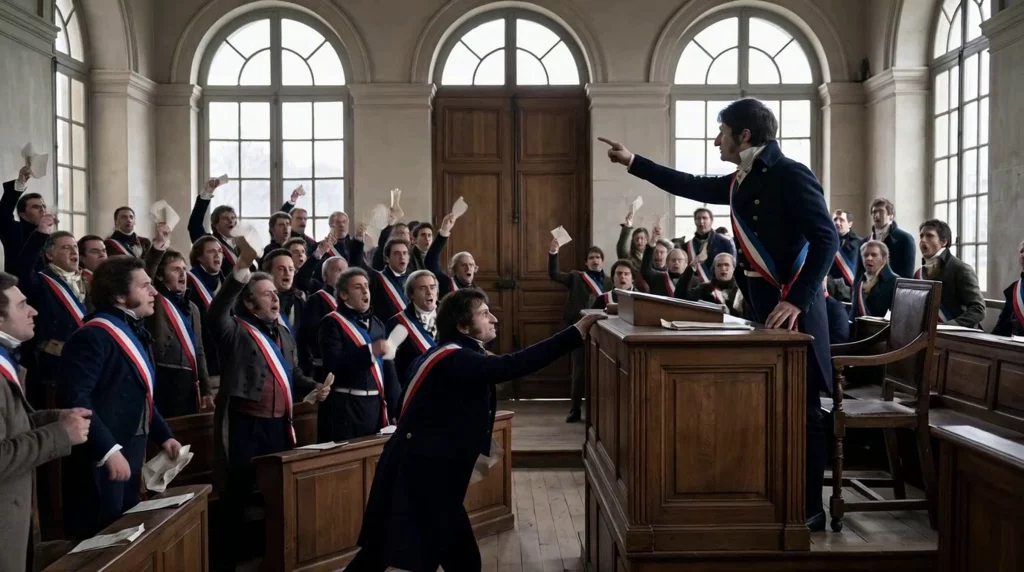
Keith, here is the thrilling bit. In the Orangery the Council of Five Hundred voted to outlaw Napoleon, the old death sentence of the Terror, and he escaped with grenadiers at his heels. Outlawed by the French legislature, Keith! A fugitive general who still took the country!
Roger, ‘voted’ is the word that does not hold up. Deputies shouted ‘Outlaw him!’ and demanded a motion be put[14], and they pressed Lucien to put a decree of proscription to the vote[28, p. 179]. But the Cambridge Modern History calls the report that outlawry had been voted exaggerated[2, p. 710]. A roar, Roger, not a verdict.



Keith, the moment of moments! At Notre-Dame Napoleon snatched the crown straight out of the Pope’s hands and crowned himself, a total surprise. The poor Pope was stunned. Power grabbed by force, Keith, right to the very end!
Roger, ‘snatched’ and ‘surprise’ are the parts to drop. Frédéric Masson called the version where Napoleon seized the crown without forewarning the Pope entirely imaginary[17]. The ceremonial had the Emperor take the crown and place it on his own head, and the points were settled with the Pope’s consent[17]. It was choreography, Roger, not robbery.



Dig Deeper
Copy any prompt below into your favourite AI chat to keep exploring.
What actually happened during the Coup of 18 Brumaire?
Walk me through what happened when the legislature was moved to Saint-Cloud in November 1799, and how Lucien Bonaparte responded when the deputies resisted.
Break down why Napoleon wanted Pope Pius VII in Notre-Dame for his 1804 coronation, and what the ceremony was designed to tell Europe about the new empire.
How did Jacques-Louis David's painting shape Napoleon's image?
Debate whether the Coup of 18 Brumaire was an attack on the Republic or an attempt to rescue it, given that a sitting Director helped plan it.
Debate whether the 1804 coronation betrayed the French Revolution, or completed its demand for strong and stable government after a decade of turmoil.
Did Napoleon really faint during his own coup?
Roleplay Sieyès, the man who went hunting for a sword, realising the general he hired plans to run the new government himself.
Convince me the 1804 coronation was the most carefully planned surprise in history, using what the agreed ceremony actually required of Napoleon and the Pope.

Further Reading
Where to read more
From Life Consulship to the hereditary Empire (1802-1804), Fondation Napoléon
A timeline from the Fondation Napoléon covering the Life Consulship plebiscite of 1802, the sénatus-consulte of 18 May 1804 proclaiming Bonaparte Emperor of the French, the second plebiscite count, and the coronation at Notre-Dame on 2 December 1804.
Why look at this: Keith runs from First Consul to Consul for Life in 1802 to Emperor in 1804. This timeline lays out each step and the votes cast, so you can see how France, after a revolution against one-man rule, was asked to approve one again.
https://www.napoleon.org/en/history-of-the-two-empires/timelines/from-life-consulship-to-the-hereditary-empire-1802-1804Le Sacre ou le Couronnement de Napoléon (David’s sketch for Napoleon’s Consecration or Coronation), Fondation Napoléon
A short essay by Louvre curator Sylvain Laveissière, translated for napoleon.org in 2013, on David’s signed 1805 sketch of the coronation, which shows the Emperor crowning himself, and on why the finished painting changed the gesture.
Why look at this: Roger says Napoleon famously placed the crown on his own head, and the script flags that wording for checking. This page shows David’s sketch of exactly that gesture, the Pope’s part in the scene, and why the final painting showed something different.
https://www.napoleon.org/en/history-of-the-two-empires/paintings/le-sacre-ou-le-couronnement-de-napoleon-napoleons-consecration-or-coronation/Le coup d’État de Brumaire (9-10 novembre 1799), 1 : Origines (video, Thierry Lentz, Fondation Napoléon)
A 3 minute 46 second educational video in French by Thierry Lentz, director of the Fondation Napoléon, explaining the origins of the Brumaire coup. A second video covers the course of events, and an infographic is linked from the page.
Why look at this: Roger and Keith set the scene quickly: a Directory struggling to hold France together and Sieyès hunting for a general. This short video covers the origins of the coup in minutes, for viewers who follow French and want the setup before the Saint-Cloud drama.
https://www.napoleon.org/en/enseignants/documents/video-le-coup-detat-de-brumaire-9-10-novembre-1799-1-origines-3-min-46/18 Brumaire: the context and course of a coup d’État (Eymeric Job, Fondation Napoléon)
A long-form article of roughly two thousand words, translated for napoleon.org, that follows the Directory, Sieyès’s plan, the move of the assemblies to Saint-Cloud, the two days of 18 and 19 Brumaire, and the roles of Lucien Bonaparte and Roger Ducos.
Why look at this: The video says Lucien called in the soldiers and that Sieyès and Roger Ducos were in on it. This article sets out who did what on each day, including Napoleon’s faltering speech at Saint-Cloud, so you can judge the two day takeover for yourself.
https://www.napoleon.org/en/history-of-the-two-empires/articles/18-brumaire-the-context-and-course-of-a-coup-detat/Coup of 18 Brumaire (Harrison W. Mark, World History Encyclopedia)
A long, illustrated encyclopaedia article of about 2,500 words with citations, covering the background, the conspirators, the plot, both days of the coup in Paris and Saint-Cloud, and the aftermath. Free to read, licensed CC BY-NC-SA 4.0.
Why look at this: Keith asks how a revolution against a king ends with an emperor. This article follows Sieyès joining the Directory to undo it from within, and shows how Bonaparte fitted into the plot, a second telling to set beside the Fondation Napoléon’s.
https://www.worldhistory.org/Coup_of_18_BrumaireThe French Civil Code or Code Civil, 21 March 1804: an overview (Irène Delage, Fondation Napoléon)
A short overview article, translated for napoleon.org, on earlier attempts to codify French law, the drafting commission under Cambacérès and the Conseil d’État debates, the Code’s treatment of family, divorce and inheritance, and its legacy.
Why look at this: Roger jokes about a strict promotion schedule, but the new regime also built something lasting. This article shows the Code drafted under the Consulate and issued in 1804, the year of the coronation, so you can see what Napoleon did with power once he had it.
https://www.napoleon.org/en/history-of-the-two-empires/articles/the-french-civil-code-or-code-civil-21-march-1804-an-overviewBrumaire: Bonaparte’s Justification (proclamation of 19 Brumaire Year VIII, 10 November 1799), Liberty, Equality, Fraternity
An English translation of Bonaparte’s own proclamation after the coup, dated 19 Brumaire Year VIII (10 November 1799), reproduced from John Hall Stewart’s 1951 Documentary Survey of the French Revolution on the George Mason University and CUNY teaching site.
Why look at this: Here is the coup in Napoleon’s own words: he says he entered the Five Hundred alone and unarmed and met raised stilettos. Read it beside Keith’s joke about soldiers in the corridor, and remember it is his account, written to justify what he had done.
https://revolution.chnm.org/d/461Constitution of the Year VIII, 13 December 1799 (The Constitutions and Other Select Documents Illustrative of the History of France, 1789-1907), Wikisource
The full text of the Consulate’s constitution in seven titles and 95 articles, from Frank Maloy Anderson’s 1908 collection, covering the First Consul, the Conservative Senate, the Tribunate and the Legislative Body, with a note on the vote that accepted it.
Why look at this: Roger says First Consul sits somewhere between a Prime Minister and a President. Read the articles giving the First Consul the main executive power, then notice that the Legislative Body votes without debating and the Tribunate debates without deciding.
https://en.wikisource.org/wiki/Constitution_of_the_Year_VIIIMemoirs of Napoleon Bonaparte, Complete (Louis Antoine Fauvelet de Bourrienne), Project Gutenberg
The complete English text of the memoirs of Bonaparte’s former private secretary, free on Project Gutenberg. Chapters XXIV and XXV cover the morning of 18 Brumaire, Bonaparte at Saint-Cloud, the Council of the Five Hundred, and Murat’s soldiers driving it out.
Why look at this: A contemporary’s version of the soldiers at the door that Roger describes. Bourrienne’s memoirs are a contested source, so read these chapters alongside Bonaparte’s own proclamation and the Fondation Napoléon article, and weigh each account against the others.
https://www.gutenberg.org/files/3567/3567-h/3567-h.htmSources
- DocumentCatholic Encyclopedia (1913)/French Revolution ↑
- BookThe Cambridge Modern History : The French Revolution by A. W. Ward Lord Acton. Page 710. ↑
- BookJoseph Bonaparte by John S. C. Abbott ↑
- BookThe French revolution : a historical sketch by Walter Geer ↑
- BookA short history of Europe, from the fall of the Eastern empire to the dissolution of the Holy… by Charles Sanford Terry. Page 273. ↑
- BookA Life of Napoleon Bonaparte, with a Sketch of Josephine, Empress of the French. by Ida M. Tarbell. Page 88. ↑
- BookMemorial de Sainte Helene : journal of the private life and conversations of the Emperor Napoleon at Saint… by Emmanuel-Auguste-Dieudonné Las Cases ↑
- BookA dictionary of Napoleon and his times by Hubert N.B Richardson ↑
- BookNapoleon's Campaigns in Italy 1796-1797 and 1800 by R.G. Burton ↑
- BookThe Life of Napoleon I (Complete) by J. Holland Rose ↑
- BookThe Abbé Sieyès : an essay in the politics of the French revolution by J. H. Clapham. Page 79. ↑
- BookThe works of James Gillray, the caricaturist :with the history of his life and times /edited by Thomas… by Thomas Wright, Thomas Wright and Joseph Grego ↑
- BookJOSEPH FOUCHE THE PORTRAIT OF A POLITICIAN STEFAN ZWEIG by STEFAN ZWEIG. Page 268. ↑
- BookThe Life of Napoleon Bonaparte. Vol. 2 (of 4) by William Milligan Sloane ↑
- BookLe Dix-huit Brumaire (French) by Jacques Bainville ↑
- BookNAPOLEON AND JOSEPHINE THE RISE OF THE EMPIRE by WALTER GEER ↑
- BookNapoleon and his coronation by Frédéric Masson and Frederic Cobb ↑
- BookLectures on the French Revolution by Baron John Emerich Edward Dalberg Acton Acton ↑
- BookCambridge Modern History Vol.9 (napoleon) by A.w. And Prothero Ward. Page 603. ↑
- BookRobespierre and the red terror; by Jan ten Brink and J. Hedeman. Page 19. ↑
- BookCorrespondence on the French Revolution, 1789-1817 by William Augustus Miles and Charles Popham Miles ↑
- BookMemoirs Of Napoleon Bonaparte (1851) by Victorian Vault ↑
- BookEnglish caricature and satire on Napoleon I by John Ashton ↑
- BookTalleyrand, a biographical study by Joseph McCabe ↑
- BookMemoirs of the Prince de Talleyrand (Putnam 1891 ed. by Duc de Broglie; Cornell scan) by Talleyrand, tr. Mrs Angus Hall and intro Whitelaw Reid. Page 288. ↑
- BookMemoirs of Madame Junot (Duchesse D'Abrantès) (vol 1) by Laure Junot Abrantès ↑
- BookA short history of Europe from the dissolution of the Holy Roman empire to the outbreak of the… by Charles Sanford Terry ↑
- BookMemoirs of the Duke of Rovigo (M. Savary) Vol. 1 by Anne-Jean-Marie-René Savary duc de Rovigo. Page 179. ↑