
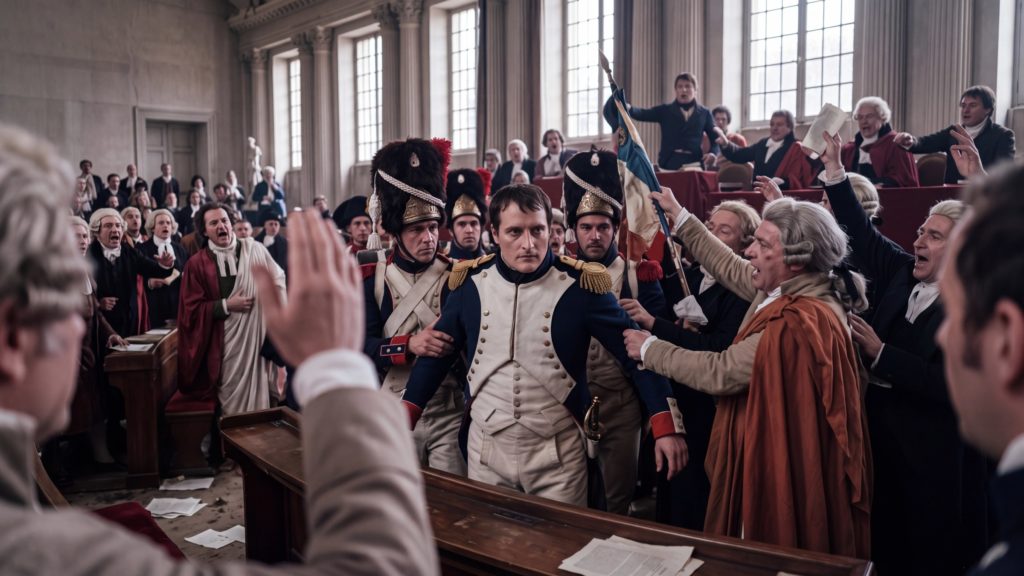
AI reconstruction based on Francois Bouchot's "Bonaparte au Conseil des Cinq-Cents à Saint-Cloud, 10 novembre 1799" (1840), from the perspective of a deputy standing on a bench inside the hostile crowd to see over the crush.
A sitting government minister recruited Napoleon to be his political 'sword' - and within weeks the sword had taken over the country instead.[1]
What Happened
The story
By the autumn of 1799 France's five-man Directory government was widely despised: corrupt, dependent on annual purges of the legislature, and losing ground abroad to a new European coalition[2, p. 273]. One of the sitting directors, the Abbe Emmanuel-Joseph Sieyes, wanted a stronger executive in its place, and had spent months looking for a popular general to supply the force his plan needed. «Il me faut une épée» - “What I need is a sword” - he is recorded as saying[1]. Napoleon Bonaparte, freshly returned from Egypt and still a national hero, fit the role exactly.
On 18 Brumaire (9 November) the plotters had the legislature moved from Paris to the chateau of Saint-Cloud and secured Napoleon command of the local troops. The next day, addressing the hostile Council of Five Hundred, Napoleon was jostled and shouted down, and by most accounts briefly lost his composure[3]. His younger brother Lucien, presiding over that chamber, is said to have seized a bystander's drawn sword and brandished it before the assembled grenadiers to turn them against the deputies[3].

With the grenadiers cleared the hall, a rump of intimidated deputies voted that night to abolish the Directory and hand power to three provisional consuls: Napoleon, Sieyes and Roger Ducos[3]. Talleyrand and Fouche, both closely involved in preparing the coup, remained close at hand throughout the two days at Saint-Cloud[1]. Sieyes had expected to dominate the arrangement he had engineered.
Instead, within weeks Sieyes found himself outmanoeuvred. Napoleon emerged as First Consul under the new Constitution of the Year VIII, which concentrated executive authority in his hands far beyond anything Sieyes had envisaged[3]. The Directory, and with it the Revolution's decade of open political contest, was over.
Quick Facts
The essentials
Quick Facts
The Brumaire conspirators
Leadership
Abbe Emmanuel-Joseph Sieyes and General Napoleon Bonaparte[3]
Forces
The director Sieyes and his allies; Napoleon Bonaparte and loyal troops; director Roger Ducos[3]; Talleyrand and Fouche as facilitators[1]; Lucien Bonaparte presiding over the Council of Five Hundred[3].
Objective
Replace the Directory with a stronger executive - which each principal partner intended to control himself
The Bigger Picture
Part of the French Revolution's final, unstable years, when the five-man Directory struggled against corruption, war reverses and repeated factional coups[2, p. 273].
How It Came To This
The Directory's chronic corruption and financial weakness[2, p. 273]; the director Sieyes's search for a general to serve as the 'sword' behind a stronger constitution[1]; and Napoleon's sudden availability and popularity on his return from Egypt in October 1799[2, p. 273].
What Actually Happened
18 Brumaire is a coup engineered from inside the system rather than mounted against it: a sitting director recruited a general to supply force his own plan lacked, then had the result dressed up in legal form once it succeeded[1]. Napoleon's own performance on the day was, by most accounts, poor - he rambled before the Council of Five Hundred and had to be physically extracted, rescued only by his brother's intervention with the troops outside[3]. The composed strongman of later legend is substantially a retrospective construction. What made the coup stick was not the chaotic scene at Saint-Cloud but the settlement that followed it: a new constitution with almost no institutional check on the First Consul, endorsed by a plebiscite that drew only modest turnout[3][3]. Sieyes, who had spent months hunting for his 'sword', found the general he recruited had no intention of serving as anyone's instrument. Historians continue to debate whether Brumaire ended the Revolution outright or preserved its central gains under an increasingly personal, authoritarian government.
Why It Still Matters
Ended the Directory and the Revolution's decade of open political contest; installed Napoleon as First Consul under the Constitution of the Year VIII[3]; and set the template - a popular general, an engineered emergency, a plebiscite - that his nephew Napoleon III would copy almost exactly in 1851.
Quick Facts
Roger would like you to know...
Napoleon didn't plan this coup - he was recruited into it. Sieyes, one of the sitting directors, had spent months hunting for a popular general to supply the force his plan needed: “What I need is a sword,” he said[1].
Keith checked the sources...
Napoleon's own performance at Saint-Cloud was a shambles. He rambled before a hostile Council of Five Hundred, was jostled and shouted at, and had to be physically pulled out - hardly the composed strongman of the legend[3].
One for the Ageonauts...
‘Brumaire’ - roughly ‘foggy month’ - was a month name from the French Republican calendar. The coup's date, 18 Brumaire Year VIII, corresponds to 9 November 1799 on the ordinary calendar[5, p. 84].
Roger has entered the historical rabbit hole...
Napoleon's brother Lucien was president of the Council of Five Hundred that day. When the chamber turned on Napoleon, Lucien reportedly seized a bystander's drawn sword and brandished it at the assembled grenadiers to rally them[3].
Keith would like to clarify...
The coup itself was almost bloodless. What actually removed the Directory was a vote by a rump of intimidated deputies later that night, handing power to three provisional consuls: Napoleon, Sieyes and Roger Ducos[3].
History gets strange here...
Talleyrand and the police minister Fouche - both deeply involved in preparing the coup - stayed close at hand throughout the two days at Saint-Cloud, ready to manage the outcome whichever way it broke[1].
Keith has spotted the problem...
Two of the five sitting directors, Gohier and Moulin, were warned the coup was coming and simply ignored it, seemingly unable to believe their own government was actually about to fall[4].
Roger said it. Keith checked it...
Sieyes spent months hunting for a general to be his 'sword' against the Directory. He got one - and within weeks Napoleon had shouldered him out of the new government entirely[3].
A small fact with a very large consequence...
The new Constitution of the Year VIII gave the First Consul such sweeping power that it set the template for Bonapartist rule: a popular general, a stage-managed emergency, a plebiscite - a pattern Napoleon's own nephew would copy in 1851[3].
Meanwhile, in history...
When the new constitution went to a plebiscite, only around three million votes were cast at all amid general apathy - hardly the enthusiastic mandate the takeover is sometimes remembered as receiving[3].
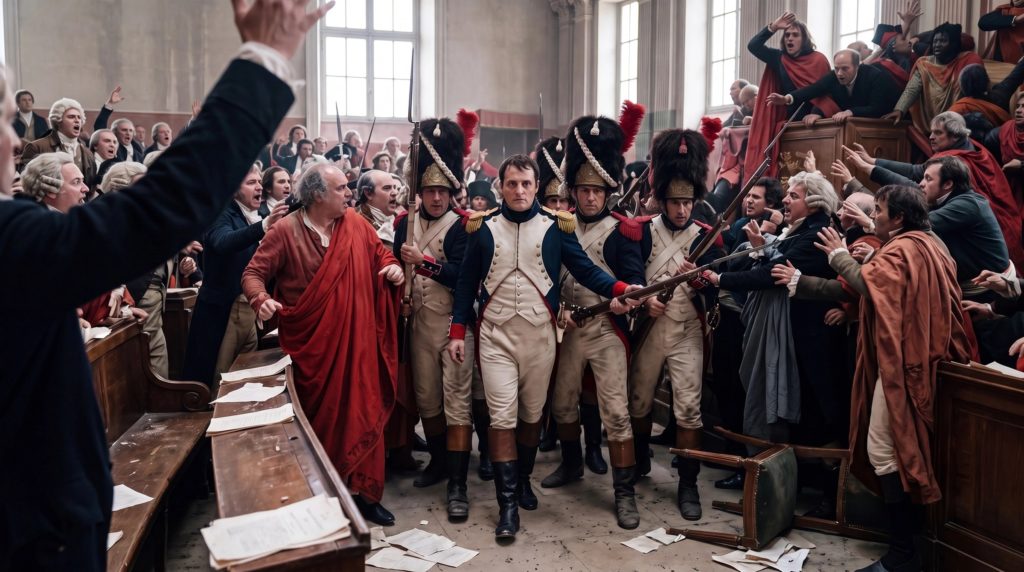
« Il me faut une épée. » (“What I need is a sword.”)
Attributed to Abbe Emmanuel-Joseph Sieyes, autumn 1799[1]
Sieyes, the coup's chief architect, said this while searching for a popular general to supply the force his plan needed.
Timeline
How it unfolded
May 1799
Sieyes Elected to the Directory
In May 1799 the lot chose Reubell to retire from the Directory and Sieyes was elected in his place.[4] Geer says his colleagues generally opposed his election and that from the first he showed hostility to the Government, which he wished to overthrow.[4] Clapham notes that the election to the Directory fell due in May.[6, p. 79]
18 June 1799
Coup of 30 Prairial
Mignet dates the 30th Prairial to 18 June 1799 and calls it an act of reprisal by the Councils against the Directory for the earlier coups of Fructidor and Floreal.[7] Two Directors, Merlin and La Revelliere, were denounced in the Five Hundred and, persuaded by Barras and Sieyes, resigned; Roger Ducos and General Moulin replaced them.[4][4]
15 August 1799
Joubert Killed at Novi
Sieyes wanted a general to help overthrow the Government and his first choice was Joubert, who was killed at the battle of Novi on 15 August 1799.[4][6, p. 79] Geer says he then made overtures to Moreau, who did not prove very amenable.[4] Geer's chronology also dates Joubert's death at Novi to 15 August.[4]
16 October 1799
Bonaparte Returns to Paris
Bonaparte, who had landed at Frejus on 9 October 1799, made his entry into Paris on 16 October.[8] Geer has him arriving early on the sixteenth and going to his little hotel in the Rue de la Victoire.[4]
9 November 1799
Ancients Move the Councils to Saint-Cloud
On 18 Brumaire (9 November 1799) a decree of the Ancients transferred the legislature to Saint-Cloud, to meet at noon the next day, and placed General Bonaparte in command of all the military forces of the capital.[4] Geer says the plotters intended the Councils, meeting at Saint-Cloud under the guard and restraint of the troops, to vote in favor of the change in government.[4] Geer's chronology and his Napoleon and Josephine both give 9 November for 18 Brumaire.[4][9]
10 November 1799
Saint-Cloud and the Provisional Consulate
On 19 Brumaire (10 November 1799) the members of the Councils repaired to Saint-Cloud, where Sieyes and Roger Ducos accompanied Bonaparte.[7] In the Five Hundred cries of 'Down with the dictator' and 'Outlaw him' went up when Bonaparte appeared, and Murat's troops then cleared the hall of deputies.[4][4] Mignet puts the end of the representation at half-past five that day.[7] The Ancients' committee proposed three temporary Consuls, Bonaparte, Sieyes and Ducos.[4]
c. 15 December 1799
Constitution of the Year VIII
Sloane has the constitution of 22 Frimaire, Year VIII, which replaced the provisional consulate, coming into operation on 15 December 1799.[3] Lester has it published on 14 December, with the Consuls declaring that the revolution was established on the principles from which it originated and was ended.[10][10]
Dig Deeper
Copy any prompt below into your favourite AI chat to keep exploring.
Explain how Sieyes recruited Napoleon as the 'sword' behind the 18 Brumaire coup, and why the plan then slipped out of Sieyes's own control within weeks.
Debate whether Napoleon planned to seize power all along at Brumaire, or simply took an opportunity that Sieyes handed him.
Roleplay as Sieyes on the morning after 18 Brumaire, realising the general he hired just became his boss.

Further Reading
Where to read more
Coup of 18 Brumaire - World History Encyclopedia
A concise, free overview of the two-day coup that ended the Directory and brought Napoleon to power.
Why look at this: Explains why the plotters invented a fake Jacobin plot to justify moving the legislature to Saint-Cloud, and how that pretext set the whole coup in motion.
https://www.worldhistory.org/Coup_of_18_Brumaire/18 Brumaire: The Context and Course of a Coup d'Etat - Fondation Napoleon (napoleon.org)
A detailed, free, hour-by-hour account of both days of the coup, from the Fondation Napoleon.
Why look at this: Covers Lucien Bonaparte's dramatic vow to run his brother through rather than see him betray liberty - the same moment behind this page's Lucien fact, told in full.
https://www.napoleon.org/en/history-of-the-two-empires/articles/18-brumaire-the-context-and-course-of-a-coup-detat/Memoirs of Lucien Bonaparte (Prince of Canino), Written by Himself
The 1836 English translation of Lucien Bonaparte's own memoirs, freely digitised on the Internet Archive.
Why look at this: Lucien presided over the Council of Five Hundred on 19 Brumaire and, by most accounts, personally saved the coup when it was going wrong - this is his own first-hand telling of it.
https://archive.org/details/memoirslucienbo00bonagoogRelated
Keep exploring





Places





Can be seen in
Where this shows up

References
Sources
Sources
- BookLe Dix-huit Brumaire (French) by Jacques Bainville ↑
- BookA short history of Europe, from the fall of the Eastern empire to the dissolution of the Holy… by Charles Sanford Terry. Page 273. ↑
- BookThe Life of Napoleon Bonaparte. Vol. 2 (of 4) by William Milligan Sloane ↑
- BookThe French revolution : a historical sketch by Walter Geer ↑
- BookThe great French revolution, 1789-1793 by Petr Alekseevich Kropotkin and N. F Dryhurst. Page 84. ↑
- BookThe Abbé Sieyès : an essay in the politics of the French revolution by J. H. Clapham. Page 79. ↑
- BookThe French revolution from 1789 to 1815 by M. Mignet and James Westfall Thompson ↑
- BookThe memoirs of Joseph Fouché, duke of Otranto, minister of the General police of France by Joseph Fouché and Alph. de Beauchamp ↑
- BookNAPOLEON AND JOSEPHINE THE RISE OF THE EMPIRE by WALTER GEER ↑
- BookThe Napoleon dynasty: or, The history of the Bonaparte family. An entirely new work by C. Edwards Lester and Edwin Williams ↑