
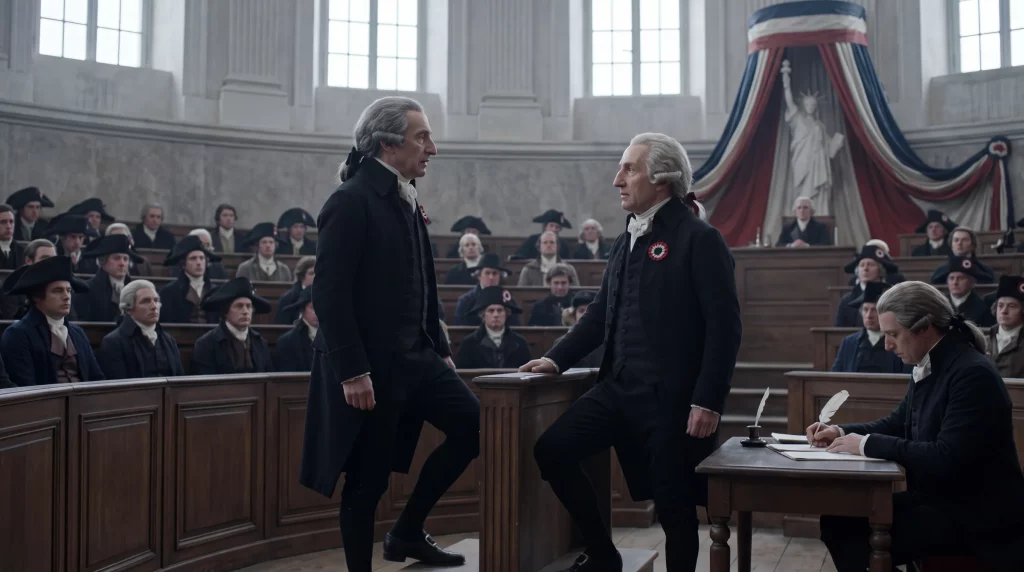
The Directory governed France from 1795 to 1799, with executive power split among five Directors so no single man could dominate — shown here, five men in plain coats around a table of maps and sealed letters.
A five-man government built so no one man could seize power[1] ended up surviving four years only by repeatedly overturning its own elections[2].
What Happened
The story
The Constitution of the Year III, adopted after the fall of Robespierre, replaced revolutionary emergency rule with a deliberately divided government: a Directory of five men, at least forty years old, chosen by two elected legislative councils[1]. To keep the new regime staffed by revolutionaries rather than returning royalists, the outgoing Convention attached the so-called Decree of the Two-Thirds, reserving most legislative seats for its own former members[3]. The arrangement pleased almost no one and was contested from the moment it began.
Unable to govern through ordinary majorities, the Directory turned repeatedly on its own legislature. On 18 Fructidor Year V (4 September 1797), it moved against a resurgent royalist bloc, expelling 197 deputies from the two Councils by proscription or invalidation[2]. Less than a year later, on 22 Floreal Year VI (11 May 1798), it turned the same weapon on the left, annulling the election of some sixty Republican deputies judged too radical[2].

Each coup preserved the Directory in the short term while hollowing out its legitimacy, since a government that could simply cancel results it disliked no longer answered to the electorate it claimed to represent. By 1799, renewed war against the Second Coalition was going badly for French arms[3], and the director Sieyes had concluded the Constitution itself needed replacing - he had already drafted a new one and was searching for a general willing to enforce it[4, p. 273].
When Napoleon landed back in France from Egypt that October, contemporary newspapers were already treating him as the man of the moment: he went straight to Barras, described as 'President of the Directory and his personal friend', and was soon being called 'the Dictator of Europe' in the French press[5, p. 186]. Within weeks the Directory itself would be swept away at Brumaire.
Quick Facts
The essentials
Quick Facts
The Directory and its governing faction
Leadership
Paul Barras, President of the Directory[5, p. 186]
Forces
The five Directors and their allied deputies in the two Councils; the army units used to enforce Fructidor and Floreal[2]
Objective
Preserve the Republic against both royalist restoration and a renewed Jacobin ascendancy, by whatever means the Constitution allowed - or didn't
The Directory's parliamentary opponents
Forces
Royalist deputies purged in the coup of 18 Fructidor Year V[2]; radical Republican deputies annulled in the coup of 22 Floreal Year VI[2]
Objective
Restore either the monarchy or a more radical revolutionary government through the legal electoral process
The Bigger Picture
Established by the Constitution of the Year III as the Revolution's attempt at a stable, non-monarchical executive after the Terror[6, p. 138], the Directory governed through years of continued war with the rest of Europe, culminating in the Second Coalition's renewed offensive against France in 1799[3].
How It Came To This
The Constitution of the Year III split executive power among five co-equal Directors answerable to two legislative councils[1]; a built-in 'Decree of the Two-Thirds' that forced most seats in the new legislature to go to outgoing Convention members, undermining the new regime's legitimacy from its first day[3]; and a persistent royalist opposition that the Directory itself judged dangerous enough to justify repeated coups against its own elected deputies[1].
What Actually Happened
The Directory's five-man executive was constitutionally built to prevent any single figure from dominating, which instead produced chronic deadlock between the Directors and the two Councils. Rather than govern through ordinary politics, the regime resorted to coup after coup to settle disputes it could not win at the ballot box: on 18 Fructidor Year V it purged 197 deputies as royalists[2], and on 22 Floreal Year VI it annulled the election of some sixty Republican deputies judged too radical[2]. Each intervention weakened the Directory's claim to constitutional legitimacy even as it protected the regime in the short term. By 1799, with war going badly against the Second Coalition[3], even its own members - Sieyes chief among them - were openly hunting for a general to help dismantle the constitution the Directory itself was supposed to embody[4, p. 273].
Why It Still Matters
Discredited representative government by coup for a generation, and left the door open for Napoleon, who arrived back from Egypt to find Barras - the Directory's president and Napoleon's own friend - already treating him as the man of the hour[5, p. 186].
Quick Facts
Roger said it. Keith checked it...
The Directory's five-man executive was designed specifically so no single person could dominate it - which instead produced a government so deadlocked it resorted to purging its own elected deputies twice within a year[2].
Keith checked the sources...
The 'Decree of the Two-Thirds' meant most of the Directory's first legislature wasn't newly elected at all - it was reserved for outgoing members of the old Convention, undermining the new regime's legitimacy from day one[3].
One for the Ageonauts...
The coup of 18 Fructidor Year V - 4 September 1797 in the ordinary calendar - saw the Directory expel 197 of its own deputies as royalists in a single stroke[2].
History gets strange here...
Less than a year after purging royalists, the same Directory turned the same trick on the political left: the coup of 22 Floreal Year VI annulled the election of around sixty Republican deputies it judged too radical[2].
Keith would like to clarify...
By 1799 one of the Directory's own five members, the Abbe Sieyes, had already drafted a replacement constitution and was hunting for a general to help force it through[4, p. 273].
A small fact with a very large consequence...
When Napoleon arrived back in Paris from Egypt in October 1799, he went straight to Paul Barras, described in the press of the day as 'President of the Directory and his personal friend'[5, p. 186] - a friendship that did the Directory no favours a few weeks later.
Roger has entered the historical rabbit hole...
French newspapers were already calling Napoleon 'the Dictator of Europe' within days of his return from Egypt in 1799 - weeks before he actually took power at Brumaire[5, p. 186].
Meanwhile, in history...
The Directory governed under renewed pressure from a Second Coalition of European powers formed against France in 1799, just as its internal legitimacy was at its weakest[3].
Keith has spotted the problem...
A constitution meant to prevent any one person seizing power instead produced two separate coups against the legislature within its first four years - the very outcome it had been designed to avoid[2].
The familiar story leaves this out...
The Constitution of the Year III required every Director to be at least forty years old[1] - a rule that, by design, kept the 30-year-old General Bonaparte himself ineligible for the very body he would soon overthrow.

The French people have entrusted the custody of their Constitution primarily to the fidelity of the Legislative Body and the executive power.
Proclamation of the Directory to the French People, 9 September 1797 (23 Fructidor Year V), in John Hall Stewart, A Documentary Survey of the French Revolution (1951)[7]
Issued after the Directory annulled the election results and announced it had uncovered a royalist plot, this proclamation shows the Directory presenting its own seizure of power as the defence of the Constitution.
Timeline
How it unfolded
22 August 1795
Constitution of the Year III
The Constitution of the Year III is dated 22 August 1795 (5 Fructidor, Year III).[6, p. 138] It delegated executive power to a Directory of five members, appointed by the Legislature.[1]
5 October 1795
13 Vendemiaire Insurrection Crushed
On 13 Vendemiaire (5 October 1795) an insurrection of the sections provoked by the decree ordering the re-election of two-thirds of the retiring deputies was dispersed by Barras with the aid of Napoleon Bonaparte.[1] Geer describes Bonaparte bringing forty cannon to the Tuileries by six o'clock that morning.[3] Geer's chronology dates the day to 5 October.[3]
November 1795
Directors Elected and Installed
The Council of Ancients elected the first Directory on 1 November 1795, Carnot taking the place of Sieyes who declined to serve.[3] According to Geer the Directors met in the Tuileries on 4 November and set out for the Luxembourg.[3]
4 September 1797
Coup of 18 Fructidor
The coup d'etat of 18 Fructidor (4 September 1797) began at three o'clock in the morning with government troops drawing a cordon around the Tuileries.[3] When a caucus of the two Councils decided on 3 September to accuse the directorial triumvirate, Barras and La Revelliere met at Reubell's house and summoned Augereau and the Ministers, and as a result 140 deputies were deprived of their seats.[3][3]
17 October 1797
Peace of Campo-Formio
Geer's chronology dates the Peace of Campo-Formio to 17 October 1797.[3] By its terms Austria ceded Belgium and the left bank of the Rhine to the French Republic and acquired Istria, Dalmatia, the city of Venice and the mainland of Venetia.[3]
May 1799
Sieyes Joins the Directory
In May 1799 the lot chose Reubell to retire from the Directory and Sieyes was elected in his place.[3] Geer says his colleagues generally opposed his election and that from the first he showed hostility to the Government, which he wished to overthrow.[3] Clapham notes that the election to the Directory fell due in May.[8, p. 79]
18 June 1799
Coup of 30 Prairial
In the coup d'etat of 30 Prairial, Year VII (18 June 1799), two Directors, Merlin and La Revelliere, were denounced in the Council of Five Hundred and Barras, aided by Sieyes, persuaded them to resign.[3] Roger Ducos replaced Merlin and General Moulin replaced La Revelliere.[3] Mignet dates the 30th Prairial to 18 June and calls it an act of reprisal by the Councils against the Directory for the earlier coups of Fructidor and Floreal.[9]
10 November 1799
End of the Directory
Geer's chronology dates the 18 Brumaire coup to 9 November 1799 and Bonaparte's consulship to 10 November.[3] Mignet puts the end of the representation, driven from the Orangery at Saint-Cloud, at half-past five on 19 Brumaire, Year VIII (10 November 1799).[9] Aulard reckons the Legislature's life under the Constitution of the Year III as running to that day.[1]
Dig Deeper
Copy any prompt below into your favourite AI chat to keep exploring.
Explain how a five-man government that had run France since 1795 ended up lasting, in the script's own words, 'a committee meeting that somehow lasted four years'.
Debate whether the Directory's four years of survival through coups against its own deputies counts as government at all, or just organised crisis management.
Pitch me the Directory like you're explaining to a new employee why the 'five-man committee that's run this place since 1795' keeps cancelling its own votes.
Further Reading
Where to read more
French Directory - World History Encyclopedia
A free, concise encyclopedia overview of the Directory's structure, unpopularity and eventual overthrow.
Why look at this: Explains why a government built to prevent any one person seizing power ended up unpopular with almost everyone across the political spectrum.
https://www.worldhistory.org/French_Directory/Structure of the Directory - Lumen Learning, History of Western Civilization II
A fuller, free course-textbook treatment of exactly how the Directory's two councils and five-man executive were meant to work.
Why look at this: Sets out the Council of Five Hundred and Council of Ancients mechanism this page's account of the Directory's structure and coups depends on.
https://courses.lumenlearning.com/suny-hccc-worldhistory2/chapter/structure-of-the-directory/Memoirs of Barras, Member of the Directorate
Paul Barras's own memoirs, freely digitised on the Internet Archive - the single richest library source for this event, written by one of the five Directors himself.
Why look at this: Barras was the Directory's president throughout its final years and Napoleon's own patron; this is his first-hand account of the regime's coups and its fall.
https://archive.org/details/cu31924020335455Related
Keep exploring









Can be seen in
Where this shows up

References
Sources
Sources
- BookThe French Revolution: A Political History, 1789-1804. Volume III: The Revolutionary Government, 1793-1797 (cites Moulin's role in the… by François-Alphonse Aulard ↑
- BookMemoirs of Barras Member of the Directorate (vols 2-3) by Paul Barras ↑
- BookThe French revolution : a historical sketch by Walter Geer ↑
- BookA short history of Europe, from the fall of the Eastern empire to the dissolution of the Holy… by Charles Sanford Terry. Page 273. ↑
- BookThe Anti-Jacobin, or, Weekly examiner by William Gifford. Page 186. ↑
- BookThe Constitutions and Other Select Documents Illustrative of the History of France 1789-1907 by Frank Maloy Anderson. Page 138. ↑
- Websiterevolution.chnm.org: D / 457 ↑
- BookThe Abbé Sieyès : an essay in the politics of the French revolution by J. H. Clapham. Page 79. ↑
- BookThe French revolution from 1789 to 1815 by M. Mignet and James Westfall Thompson ↑