
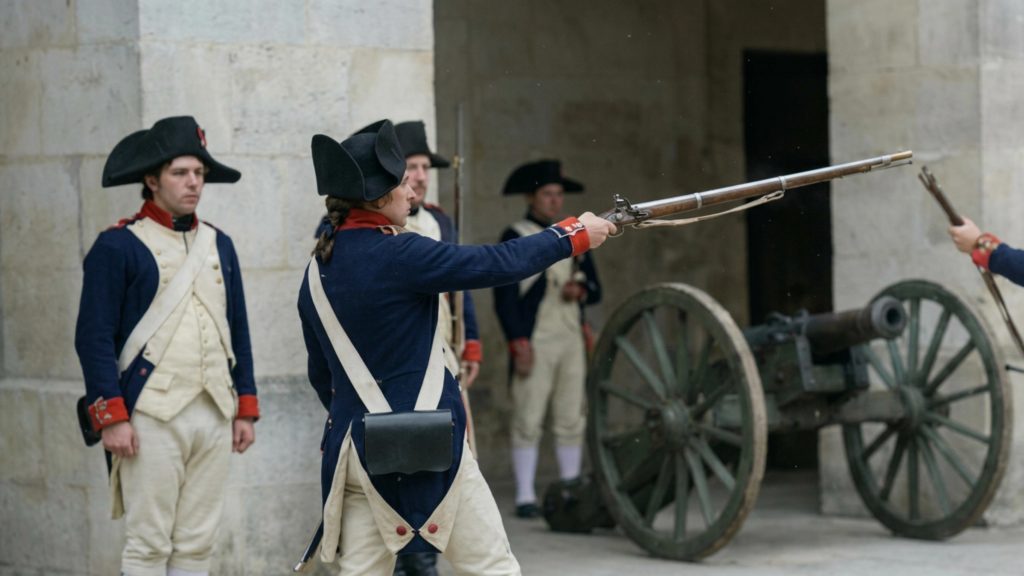
A young Napoleon stands apart as gunners drill behind him in the school courtyard, the world 'Napoleone' di Buonaparte entered aged nine in May 1779.
Brienne-le-Château is the small French town whose military school first took in a young Napoleon Bonaparte, freshly arrived from Corsica, from 1779 to 1784[1].
About the Place
Why it matters
Brienne-le-Château's military school was not built from nothing: it grew out of an existing religious house, run day-to-day by the Minim friars — the Order's own official programme for the school names the "RR. PP. Minimes" as the teaching order responsible for pupils[2]. Like several other provincial academies of the period, it combined a monastic setting with formal military instruction, preparing sons of the lesser nobility for army careers rather than the aristocracy's grander Parisian schools.
Before Napoleon ever arrived, Brienne was already established as one of France's provincial military schools, training boys destined for army commissions rather than sending every candidate straight to the capital. Multiple later historians treated the school as significant enough to warrant its own dedicated study — one nineteenth-century account was built specifically "d'après des documents authentiques et inédits" (from authentic, previously unpublished documents)[1], suggesting a school whose records were considered worth preserving well beyond its most famous pupil.
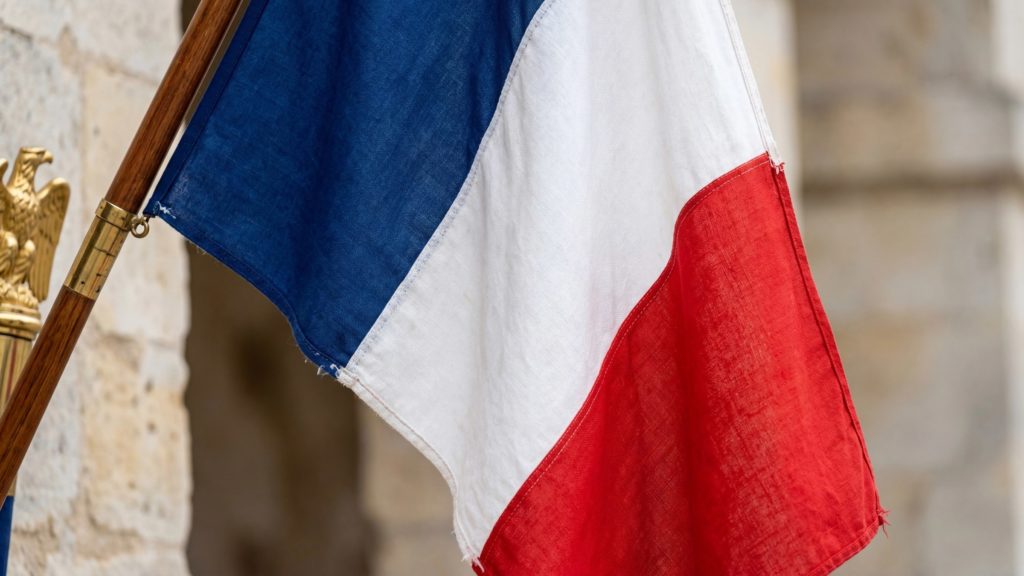
For five years, between 1779 and 1784, Brienne-le-Château was simply where a young Napoleon Bonaparte went to school[1]. Whole works of history have since been built specifically around these years, drawing on what one nineteenth-century study called "documents authentiques et inédits" — authentic, previously unpublished papers — to reconstruct his time here in detail[1]. He arrived a boy from Corsica among the sons of French provincial families, and left a trained cadet.
What happened to the school buildings across the nineteenth and twentieth centuries is not something this library can currently confirm in detail. One thing it does confirm: by the mid-1940s, Brienne-le-Château's name was appearing in wartime records as the site of a prisoner-of-war camp[3] — a strikingly different kind of institution from the school Napoleon once attended. The town itself remains on the map in the Aube département of north-eastern France today.
Legacy & Reputation
What’s the verdict?
Brienne-le-Château’s whole historical reputation rests on one thing: it is the place popularly credited with turning an obscure Corsican boy into a French army cadet. That association has proved durable enough that historians were still combing “authentic, previously unpublished documents” about Napoleon’s Brienne years more than a century after he left[1]. Beyond that specific claim to fame, this library currently holds little to weigh the town’s reputation against — a gap flagged here rather than filled with guesswork.
Myth-buster
Think you know this one?
Popular retellings often flatten Napoleon’s five years at Brienne into one long story of bullying and isolation — but this library currently holds no verified source detailing exactly what happened to him day-to-day there, so that specific story is flagged as unconfirmed rather than corrected.
Quick Facts
The essentials
Quick Facts
One for the Ageonauts
One for the Ageonauts: the Brienne school's own official programme doesn't credit the French crown alone — it names the Minim friars, the "RR. PP. Minimes", as the religious order actually responsible for teaching the pupils, Napoleon included[2].
Keith checked the sources
Keith checked the sources: more than one archival history agrees Napoleon's Brienne years ran precisely from 1779 to 1784 — five exact years, not a rounded-off guess, turning an island boy into a trained artillery cadet[1].
History gets strange here
History gets strange here: wartime records list a prisoner-of-war camp at Brienne-le-Château in the mid-1940s — a very different institution from the monk-run military school Napoleon once attended in the same small town[3].
Roger would like you to know
Roger would like you to know an entire nineteenth-century book was devoted to Napoleon's five years at this one small school, built specifically "d'après des documents authentiques et inédits" — from genuine, previously unpublished papers[1].
A fact worth digging into
A fact worth digging into: Brienne-le-Château sits in the Aube département, whose own official administrative yearbook once kept records for the town — a reminder this is a real, mapped place in Champagne, not just a name in a Napoleon story[4].
Keith would like to clarify...
He was not a friendless genius sulking in a corner. He read constantly and was mocked for his accent, but he also organised a full-scale snowball battle with trenches and fortifications in the hard winter of 1783 - a story every biography repeats, and which rests entirely on much later recollections.
Roger has a theory...
The classmate who wrote most about the young Napoleon was Louis-Antoine de Bourrienne, who later became his private secretary, was dismissed, and then published his memoirs. A great deal of what we think we know about Brienne comes from a disgruntled colleague.
File under: surprisingly true...
Napoleon fought a battle at his old school. Retreating across France on 29 January 1814, he attacked the allied armies at Brienne, took the town, and slept in the chateau he had known as a boy. Three days later he lost at La Rothiere.
Down the rabbit hole we go...
Brienne was only the preparatory stage. In Paris he compressed the two-year artillery course at the Ecole Militaire into one, passing out in 1785 ranked 42nd of 58 - the first Corsican ever commissioned into the French artillery.
Meanwhile, in history...
The chateau above the town was never the school; the school stood below it. A surviving wing has held the Musee Napoleon since 1969, which means the building that took in a nine-year-old outsider is now a museum about him.
As regards my thinking, it is not Corsica but Brienne that is my native land, because it was there that I formulated my first opinions of mankind.
Napoleon Bonaparte
Inscribed on the base of the statue of Napoleon (aged 15, in Military School uniform) erected outside the town hall in Brienne in 1859, funded from the million francs Napoleon bequeathed to the town from Saint Helena; a direct statement of the place's hold on him, from Fondation Napoleon's own account of the town.
Timeline
How it unfolded
1210
John of Brienne becomes King of Jerusalem
Brienne was the centre of the medieval County of Brienne, whose lords had a claim to the Kingdom of Jerusalem, and John of Brienne reigned as King of Jerusalem from 1210 to 1225.[5] Tout's history of the empire and the papacy likewise refers to John de Brienne as the ex-king of Jerusalem.[6, p. 301]
1776
Royal military schools opened in the provinces
The Minim order settled at Brienne at the end of the seventeenth century, and in 1776 Louis XVI had twelve royal military schools opened in the provinces.[7] According to Tarbell, the Minim Brothers had charge of the school at Brienne.[8]
1779
Napoleon enters the royal military school
Napoleon attended the military school at Brienne between 1779 and 1784.[5] Tarbell's chronology dates his entry to 23 April 1779 and his move to the Royal Military School of Paris to October 1784.[8, p. 88]
29 January 1814
Battle of Brienne
The indecisive Battle of Brienne was fought on 29 January 1814, when the Sixth Coalition was invading France.[9, p. 312][5] Henderson writes that Blucher escaped capture at the chateau there only by the narrowest of margins.[10]
1926
Town regains the old military school
The town took possession of the former school again in 1926, and the school was classified as a historic monument in 1933.[7]
1969
Musee Napoleon opens
The Napoleon Museum opened its doors in 1969 in a building of the former military school.[7][11]
27 January 2018
Musee Napoleon reopens after renovation
On 27 January 2018 the Napoleon Museum reopened after 18 months of renovation work costing 1.7 million euros.[11]
Dig Deeper
Copy any prompt below into your favourite AI chat to keep exploring.
Explain how a Catholic order of Minim friars came to run a royal military academy training French army cadets, including the young Napoleon Bonaparte.
What does a religious order running the military school that trained the future Napoleon teach us about the blurred line between Church and state in pre-Revolutionary France?
Pitch me the recruitment speech a Minim friar might have given wary parents nervous about sending their son to a monk-run military academy.
Further Reading
Where to read more
Museum of Napoleon I – Brienne-le-Château
Fondation Napoléon's own overview of the Brienne-le-Château museum, covering Napoleon's schooling there (1779-1784) and his two later visits, in 1805 and 1814.
Why look at this: Fastest way to see why Brienne mattered to Napoleon personally — reputedly the one place, besides Corsica, he singled out from exile.
https://www.napoleon.org/en/magazine/places/museum-of-napoleon-i-brienne-le-chateau/L'histoire du musée — Musée Napoléon Brienne-le-Château
The official museum's own history page, tracing the site from its origins as a Minimes monastery through its life as a royal military school, its 1793 suppression, later use as barracks, and its transformation into today's museum.
Why look at this: Fills in exactly what happened to the school buildings after Napoleon left — the gap this row's own library research couldn't confirm.
https://www.musee-napoleon-brienne.fr/lhistoire-du-museeNapoléon Ier à l'école royale militaire de Brienne, d'après des documents authentiques et inédits, 1779-1784 (Alexandre Assier, 1874)
The full digitized text of Assier's 1874 study, hosted on Gallica (Bibliothèque nationale de France) — the same title already used as a located-record citation throughout this row.
Why look at this: This is literally the book whose existence backs this row's 1779-1784 date range and "documents authentiques et inédits" claims — reading it in full would let a future pass upgrade several softened sentences to fully-sourced ones.
https://gallica.bnf.fr/ark:/12148/bpt6k870138p.texteImageRelated
Keep exploring

Places
Can be seen in
Where this shows up

References
Sources
Sources
- BookNapoléon Ier à l'École Royale Militaire de Brienne d'après des documents authentiques et inédits. 1779-1784 by Alexandre ASSIER ↑
- BookProgramme de l'École royale militaire tenue à Brienne par les RR. PP. minimes ↑
- BookAlliierte Kriegsverbrechen ↑
- BookAnnuaire administratif, statistique et commercial du Département de l'Aube by Departement Aube ↑
- Websiteen.wikipedia.org: Brienne le Château ↑
- BookThe empire and the papacy, 918-1273 by T. F. Tout. Page 301. ↑
- Websitemusee-napoleon-brienne.fr: Lhistoire du musee ↑
- BookA Life of Napoleon Bonaparte, with a Sketch of Josephine, Empress of the French. by Ida M. Tarbell. Page 88. ↑
- BookThe confidential correspondence of Napoleon Bonaparte with his brother Joseph, sometime king of Spain : selected and translated… by Emperor of the French Napoleon I and King of Spain Joseph Bonaparte. Page 312. ↑
- BookBlücher and the uprising of Prussia against Napoleon, 1806-1815 by Ernest F. Henderson ↑
- Websiteculture.gouv.fr: Label Musees de France Reouverture du musee Napoleon de Brienne le Chateau Aube ↑