
Crowned with a golden laurel wreath and wrapped in ermine, Napoleon sits enthroned as Emperor of the French, the title he assumed in 1804.
Emperor of the French
The Corsican artillery officer who seized power in a coup, crowned himself Emperor, rewrote Europe's laws, and then lost it all twice — first to Russia's winter, and finally on a Belgian field called Waterloo.[1]
Bio
Who they were
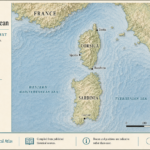
Napoleon Bonaparte was born on 15 August 1769 in Ajaccio, on the island of Corsica[2, p. 135], only a year or so after Corsica passed from Genoese to French control[3] — meaning he narrowly escaped being born a foreign national rather than a Frenchman. His father, Carlo Buonaparte, belonged to a family of minor Corsican nobility[4, p. 1], and his mother, Maria Letizia Ramolino, was married very young, "a beautiful child of fifteen" according to one account[5]. Napoleon grew up in a large, ambitious but not wealthy household, noble but poor, French but Corsican — a shaky, in-between status that shaped his early hunger to prove himself.
As a boy Napoleon was sent away to French military schools[6], training as an artillery officer while the old French monarchy around him began to collapse. The Revolution of 1789 tore up the normal career ladder for a minor noble like him, and he seized the opening. In 1793 he made his name as a young captain of artillery at the siege of Toulon[1], using cannon placement to help break a royalist- and British-held port — a small, technical victory that got him noticed by Revolutionary leaders. Rapid promotion followed, and by 1796 he was given command of France's army in Italy[7, p. 240], still only in his twenties.
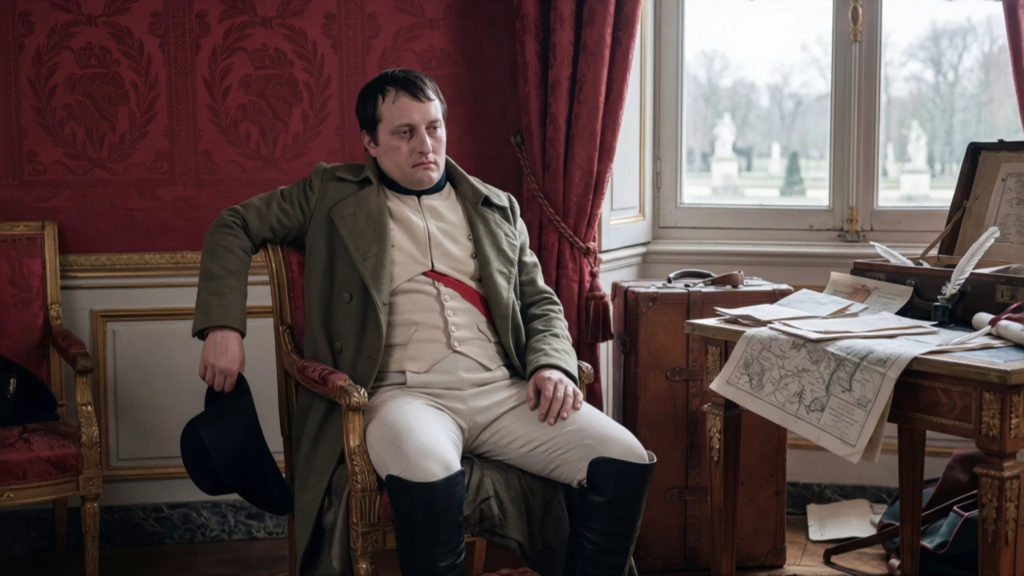
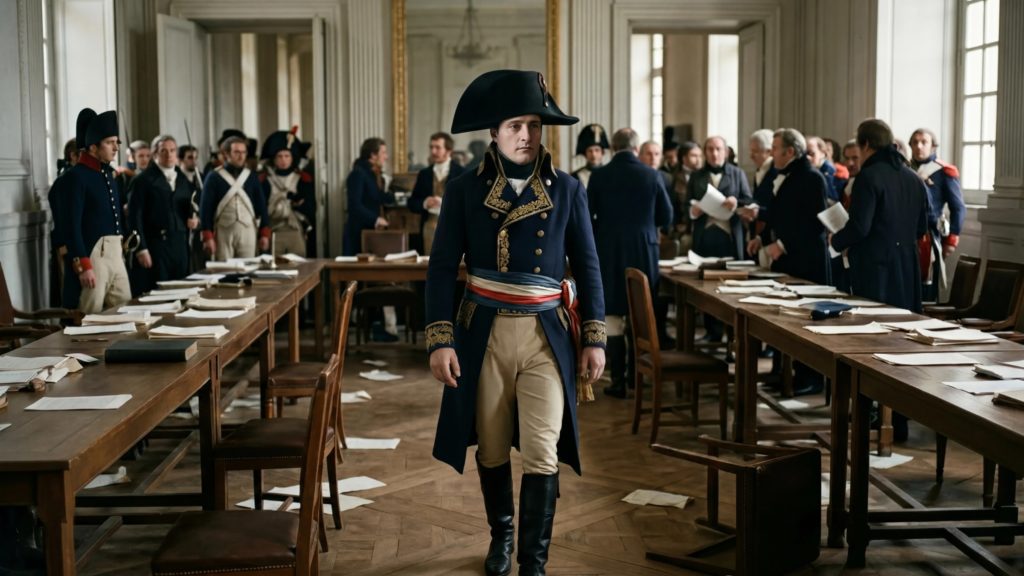
Command in Italy turned into a run of victories that made Napoleon a national hero, followed by an ambitious, ultimately doomed invasion of Egypt in 1798[7, p. 240]. Back in Paris, he took power in the coup of 18 Brumaire (November 1799)[1], becoming First Consul, then in 1804 had himself crowned Emperor at Notre-Dame[8]. That same year he issued the Napoleonic Code, a single unified system of civil law[9, p. 6]. His armies then dominated continental Europe, crushing Austria and Russia at Austerlitz in 1805[1] and squeezing Britain economically through the Continental System[10] — the peak of his power.
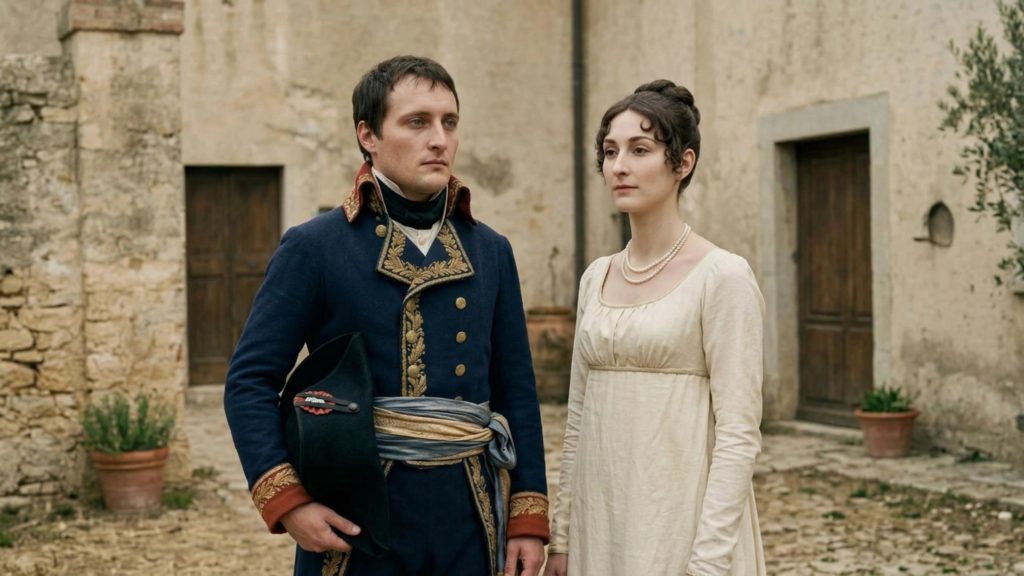
Napoleon's fortunes reversed in 1812, when his invasion of Russia ended in a catastrophic retreat[11], followed by defeat at the "Battle of the Nations" at Leipzig in 1813[12, p. 25]. He abdicated in 1814 and was exiled to Elba[13], then briefly returned to power for the Hundred Days before his final defeat at Waterloo on 18 June 1815[1]. Exiled again, to the remote island of St Helena, he died there in 1821[13]; his exact cause of death is still debated by historians.
Napoleon's most lasting legacy isn't military — it's legal. The Napoleonic Code, issued in 1804[9, p. 6], standardized civil law and property rights and went on to influence legal systems across Europe and beyond, an influence that outlived his empire by centuries. His campaigns also permanently redrew the map of Europe, breaking up the old Holy Roman Empire and stirring the nationalism that would reshape Germany and Italy decades later. Even his defeats mattered: Waterloo[1] became shorthand across many languages for a final, decisive downfall.
Despite his towering reputation, Napoleon was of unremarkable stature for his time — about five feet seven inches tall[3], not short. His soldiers affectionately nicknamed him "the Little Corporal"[1], a term of camaraderie from his early days as a hands-on young officer, not a comment on his height. He also wrote startlingly tender letters to his first wife, Josephine, once calling her "sweet and incomparable"[14].
Legacy & Reputation
What’s the verdict?
Napoleon’s most durable legacy may be legal rather than military. A modern study notes that the egalitarian ethos of the Napoleonic Code kept strengthening the Rechtsstaat, the idea of a law-governed state, even after his territorial empire collapsed in 1815[15, p. 4]. Walter Scott, writing soon after Napoleon’s death, judged that the good effects of his reign on other countries were only then beginning to be felt, though not in the way he had intended[16, p. 220].
Myth-buster
Think you know this one?
Napoleon is remembered as unusually short — in fact he stood about five feet seven inches, close to average for a Frenchman of his era[3]. The myth likely grew from confusion between French and English measurement units and from British wartime caricatures.
Quick Facts
The essentials
Quick Facts
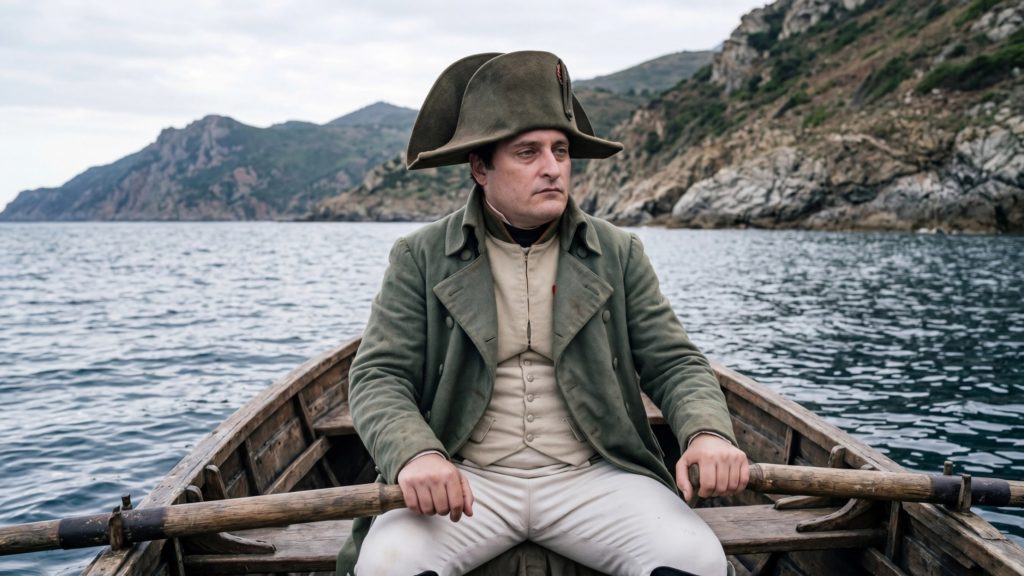
Roger would like you to know…
Napoleon wasn't just a soldier in 1796 — he was smitten. He signed the marriage contract with Josephine de Beauharnais on the 8th of March that year and left for his Italian campaign within days[17, p. 240]. Honeymoon later; empire first.
Keith found the footnote…
Before Josephine, there was Désirée Clary — Napoleon's first serious love, and very nearly his wife[17]. He moved on; she didn't do badly either, marrying Marshal Bernadotte and eventually becoming Queen of Sweden — a rather spectacular consolation prize.
History gets strange here…
At his 1804 coronation, Napoleon didn't wait for Pope Pius VII to crown him — he took the crown himself and placed it on his own head[8]. A carefully staged message: this emperor owed his throne to nobody.
Keith would like to clarify…
Popular trivia insists Napoleon was terrified of cats. Historian Katharine MacDonogh, who researched pets at European courts, found no record of him either liking or hating them[18]. The real ailurophobe was his nephew, Napoleon III — the phobia simply migrated to the wrong emperor.
One for the Ageonauts…
In 1802, Napoleon instituted the Legion of Honour — a merit-based order open, in theory, to any citizen regardless of birth[19]. Over two centuries on, France still awards it today, one of the few things he built that never needed restoring.
Roger has entered the historical rabbit hole…
In 1809 at Schönbrunn Palace, Napoleon played the Mechanical Turk — a chess 'automaton' that had already beaten Benjamin Franklin. He tried an illegal move; the machine swept the pieces off the board[20]. He lost anyway. Decades later, a hidden human chess master was found working it from inside.
File under: surprisingly true…
In 1810, Napoleon divorced Josephine — not from cruelty, but because she couldn't give him an heir[8]. She kept the title Empress, the Château de Malmaison, and, by most accounts, his genuine affection until the end.
Roger insists this matters…
On the 18th of January 1800, Napoleon founded the Bank of France[10]. It was meant to steady a currency wrecked by revolution and war — and, more than two centuries later, it's still the institution setting French monetary policy.
Keith has spotted the problem…
Napoleon's sister Pauline Borghese scandalised Europe by posing for the sculptor Antonio Canova bare to the waist as the goddess Venus, in the statue 'Venus Victrix'[21, p. 43]. Even by the standards of an image-conscious imperial family, it was a genuinely bold career move.
The past has entered the chat…
On Saint Helena, Napoleon spent his final years dictating his version of events to the loyal Comte de Las Cases[22]. The resulting 'Mémorial de Sainte-Hélène' became a runaway bestseller after his death — arguably doing more to build the Napoleon legend than any battle.
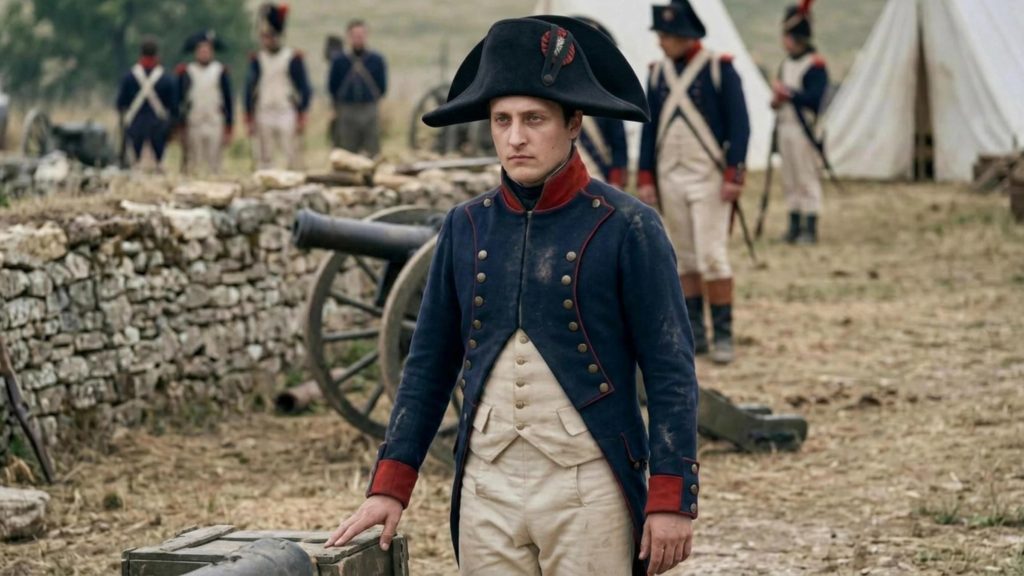
Sweet and incomparable Josephine, what an extraordinary influence you have over my heart.
Napoleon Bonaparte
From a letter Napoleon wrote to his wife Josephine, part of a surviving series of love letters[14].
Timeline
How it unfolded
15 August 1769
Birth of Napoleon Bonaparte
Napoleon was born at Ajaccio in Corsica, the second son of Charles Marie Bonaparte and Maria Laetitia Ramolino.[8] The family name was originally spelled Buonaparte, and he dropped the u during his first campaign in Italy.[2, p. 135]
19 December 1793
Recapture of Toulon
As an artillery officer commanding part of the guns before Toulon, Napoleon saw the city retaken on 19 December 1793.[23] His recapture of Toulon from the English revealed his military genius at the age of twenty-four and brought him promotion to general of brigade in the artillery.[8]
12 April 1796
Italian Campaign Opens at Montenotte
The Directory gave the Army of Italy a new general and appointed Bonaparte to the command.[24] His first Italian campaign against the Austrians and the Sardinians began with the battle of Montenotte on 12 April 1796.[23][25]
21 July 1798
Battle of the Pyramids
Napoleon embarked for Egypt on 19 May 1798, and the capture of Alexandria on 2 July followed by victory at the battle of the Pyramids gave him mastery of Cairo.[8]
9 November 1799
Coup of 18 Brumaire
On 18 Brumaire, 9 November 1799, the coup against the Directory began, and it was completed on the day of Saint-Cloud, 19 Brumaire, 10 November.[26][27] Napoleon seized power and a provisional Consulate was formed of Napoleon, Sieyes and Roger Ducos.[23]
2 December 1804
Coronation of Napoleon as Emperor
Napoleon was proclaimed Emperor of the French on 18 May 1804 and crowned on 2 December.[23] According to Madame Junot, the Pope crowned him in Notre Dame.[28]
2 December 1805
Battle of Austerlitz
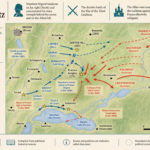
On the first anniversary of his coronation Napoleon lured the Allies into an attack on his right and then struck their centre, winning a decisive victory over the combined armies of Francis and the Tsar.[19] Austerlitz is a small town in Moravia near which he defeated the Austrians and Russians.[29]
24 June 1812
Invasion of Russia
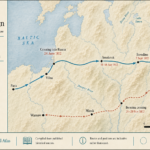
Napoleon crossed the Niemen on 24 June 1812, fought the battle of Borodino on 7 September and entered Moscow on 14 September. He left Moscow on 19 October, crossed the Berezina on 26 November and left the remains of the Grand Army on 5 December.[30, p. 312]
18 June 1815
Defeat at Waterloo
After leaving Elba on 26 February 1815 and landing near Cannes on 1 March, Napoleon entered Paris on 20 March.[23] In June he defeated Bluecher at Ligny on the 16th and was beaten on the 18th by Wellington at Waterloo, abdicating again on the 22nd.[3]
5 May 1821
Death of Napoleon on Saint Helena
Napoleon died on the island of Saint Helena on 5 May 1821.[8] He had left France on 15 July 1815.[16, p. 220] The Northumberland sailed on 8 August and reached Saint Helena on 15 October.[31, p. 274]
Dig Deeper
Copy any prompt below into your favourite AI chat to keep exploring.
Explain how a mix-up between British and French measurement systems helped turn a tailoring mishap into a two-century myth about Napoleon's height.
What does the Napoleon height myth teach us about how a small, joke-worthy detail can end up defining a person's entire reputation?
Convince me Napoleon's trousers were the real diplomatic casualty of the Anglo-French rivalry.
Further Reading
Where to read more
Napoleon I - Britannica
Encyclopaedia Britannica's reference biography of Napoleon, tracing his Corsican birth in 1769 through his rise in the Revolutionary army, the 1799 coup, his self-coronation as Emperor in 1804, and his fall after the Russian invasion and Waterloo.
Why look at this: A fast, reliable way to get the full arc of Napoleon's life straight before going deeper - including the 18 Brumaire coup that first put him in power and the 1804 coronation where he famously took the crown from the Pope's hands and crowned himself.
https://www.britannica.com/biography/Napoleon-INapoleon: A Life by Andrew Roberts
Award-winning one-volume biography (2014) built on the Fondation Napoleon's publication of Napoleon's 33,000 surviving letters. Roberts visited 53 of Napoleon's 60 battle sites while researching it.
Why look at this: Uses Napoleon's own newly-published correspondence to reconstruct his decision-making at Austerlitz, Borodino and Waterloo in detail - showing the calculations behind the legend rather than just the legend itself.
https://www.penguinrandomhouse.com/books/307215/napoleon-by-andrew-roberts/Memorial de Sainte Helene, by Emmanuel de Las Cases
The primary-source journal kept by Las Cases, Napoleon's companion in exile, recording his near-daily conversations with Napoleon on Saint Helena between 1815 and 1818. Free full text on the Internet Archive.
Why look at this: This is Napoleon narrating his own downfall in his own words - dictating his account of Waterloo and his career to Las Cases in exile, in the very process that built the 'Napoleonic legend' still argued over today.
https://archive.org/details/memorialdesainte00lascRelated
Keep exploring












Can be seen in
Where this shows up
References
Sources
Sources
- BookA dictionary of Napoleon and his times by Hubert N.B Richardson ↑
- BookMemoirs of Napoleon Bonaparte — Complete by Louis Antoine Fauvelet de Bourrienne. Page 135. ↑
- BookNapoleon and the end of the French revolution by Charles F. Warwick ↑
- BookThe second empire: Bonapartism, The prince, The president, The emperor by Philip Guedalla. Page 1. ↑
- BookThe Life of Napoleon Bonaparte. Vol. 1 (of 4) by William Milligan Sloane ↑
- BookLife of Napoleon Bonaparte, Volume II. by Walter Scott ↑
- BookA life of Napoleon Bonaparte; with a sketch of Josephine, empress of the French by Ida M. Tarbell. Page 240. ↑
- DocumentCatholic Encyclopedia (1913)/Napoleon I (Bonaparte) ↑
- WebsiteHeritage Classical Curriculum - Modern Europe - Napoleon. Page 6. ↑
- BookThe Life of Napoleon Bonaparte. Vol. 2 (of 4) by William Milligan Sloane ↑
- BookThe Life of Napoleon Bonaparte. Vol. 3 (of 4) by William Milligan Sloane ↑
- WebsiteJournal of Military and Strategic Studies Vol 18 Issue 3 (1812 logistics). Page 25. ↑
- BookThe Life of Napoleon Bonaparte. Vol. 4 (of 4) by William Milligan Sloane ↑
- BookNapoleon's Letters to Josephine, 1796-1812 by Emperor of the French Napoleon I ↑
- WebsiteNapoleon Bonaparte and the Origins of Modern Europe. Page 4. ↑
- BookLife of Napoleon Bonaparte, Volume V. by Walter Scott. Page 220. ↑
- BookA Life of Napoleon Bonaparte, with a Sketch of Josephine, Empress of the French. by Ida M. Tarbell. Page 240. ↑
- Websiteearth.com: Ailurophobia did napoleon really have a pathological fear of cats ↑
- BookA short history of Europe from the dissolution of the Holy Roman empire to the outbreak of the… by Charles Sanford Terry ↑
- Websitechess.com: Turk chess automaton ↑
- BookBonaparte's park, and the Murats by E. M. Woodward. Page 43. ↑
- BookLife of Napoleon Bonaparte, Volume III. by Walter Scott ↑
- BookMemoirs Of Napoleon Bonaparte - I And Ii by Louis Antoine Fauvelet De Bourrienne ↑
- BookMemoirs Of Napoleon Bonaparte (1851) by Victorian Vault ↑
- BookThe Campaigns of Napoleon Bonaparte of 1796-1797 by G.J. Fiebeger ↑
- BookA full and circumstantial account of the memorable battle of Waterloo: the second restoration of Louis XVIII; and… by Christopher Kelly ↑
- BookThe memoirs of Joseph Fouché, duke of Otranto, minister of the General police of France by Joseph Fouché and Alph. de Beauchamp ↑
- BookMemoirs Of The Emperor Napoleon - I by Madame Junot ↑
- BookThe poetry of Victor Hugo by Victor Hugo, Pelham Edgar and John Squair ↑
- BookThe confidential correspondence of Napoleon Bonaparte with his brother Joseph, sometime king of Spain : selected and translated… by Emperor of the French Napoleon I and King of Spain Joseph Bonaparte. Page 312. ↑
- BookHistory of the Captivity of Napoleon at St Helena Vol. 1 by William Forsyth. Page 274. ↑