
About This Map
What it shows
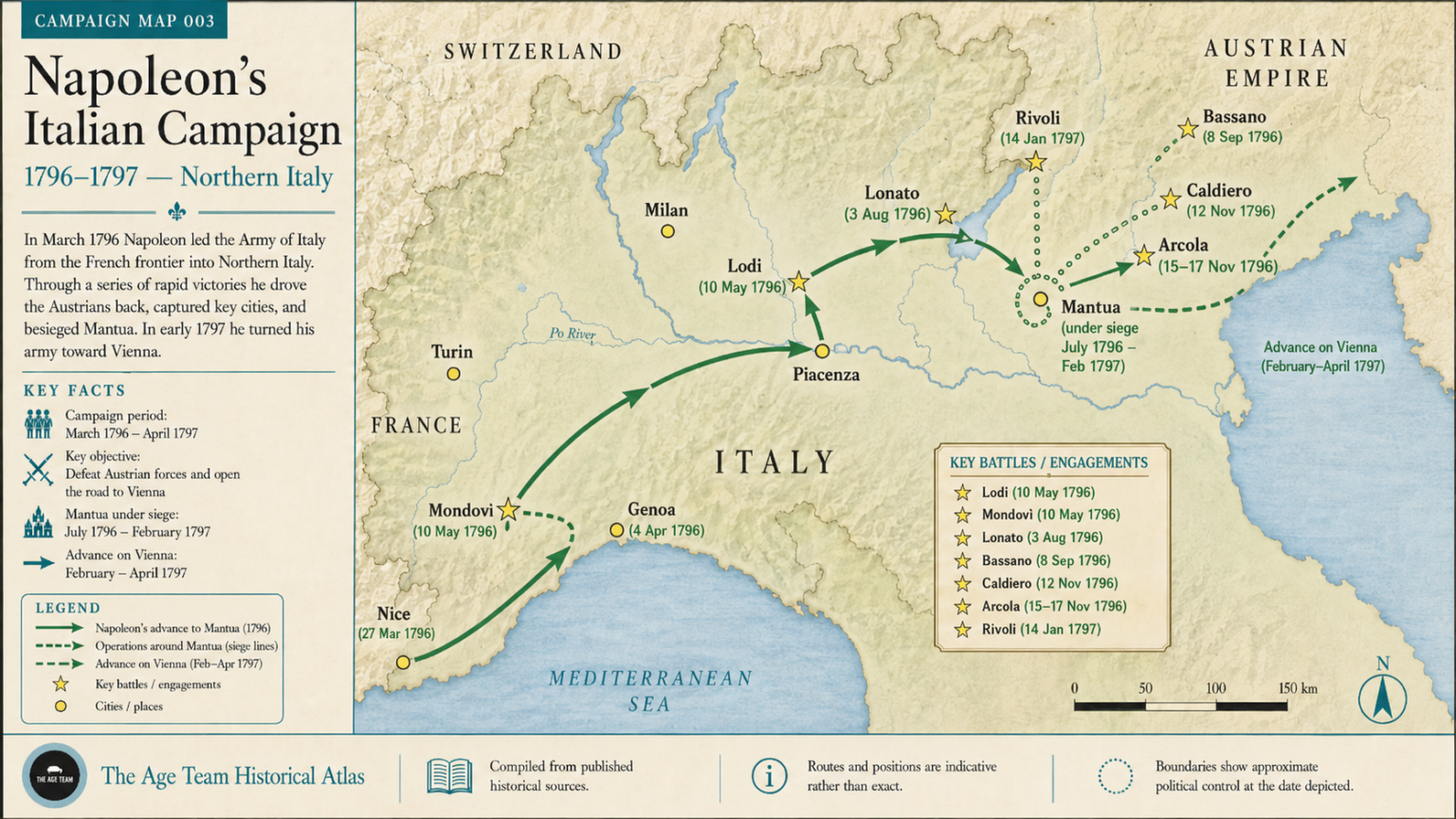
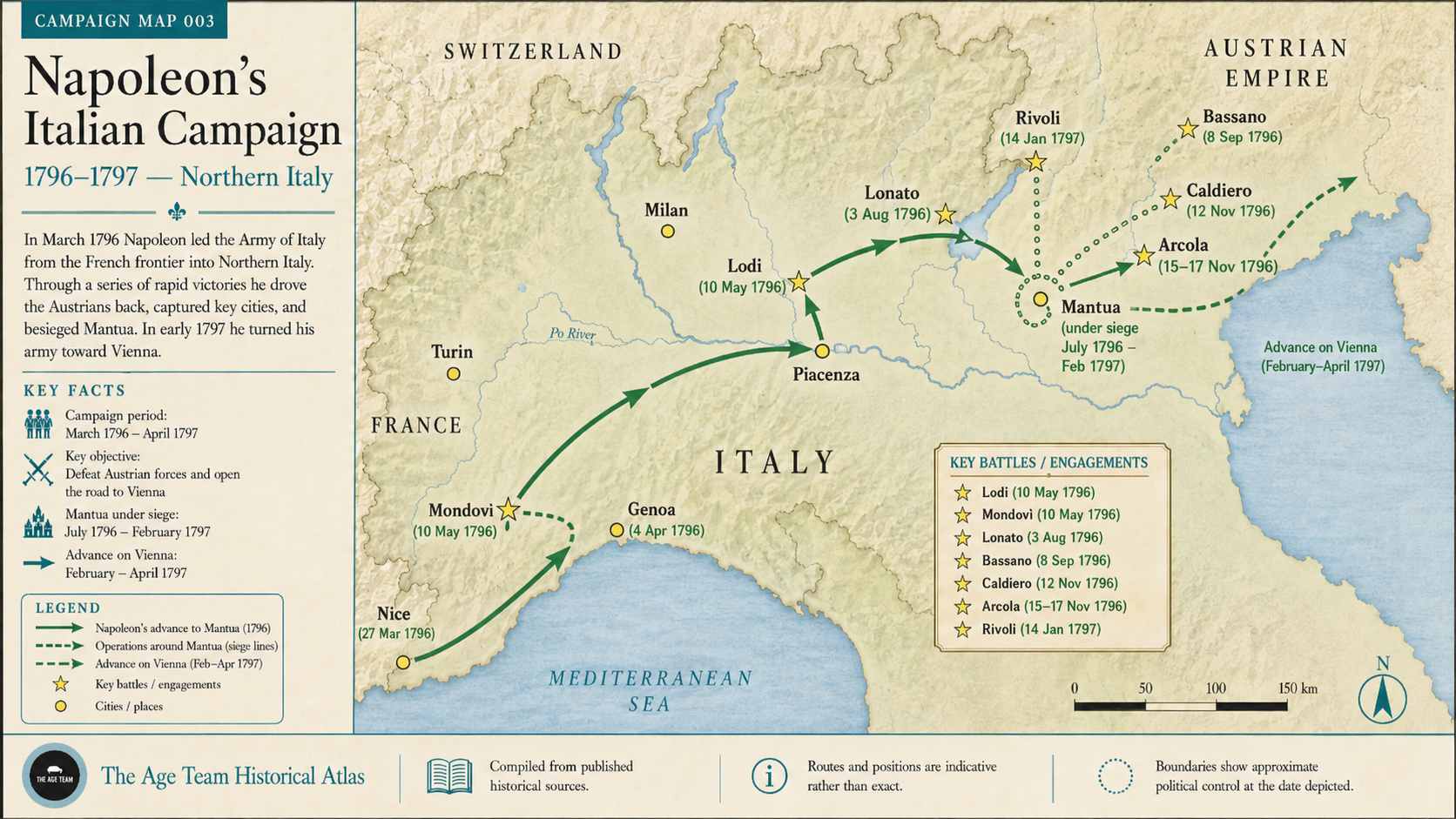
This map traces Napoleon Bonaparte's first independent command: the twenty-six-year-old artillery officer's fourteen-month sweep through northern Italy for the French Republic, from his April 1796 knockout of Piedmont-Sardinia to the fall of the Austrian fortress-city of Mantua in February 1797. It follows the route through Montenotte, Lodi, and Milan, then the long siege of Mantua and the string of battles fought to break four separate Austrian attempts to relieve it — Lonato and Castiglione, Bassano, Caldiero and Arcola, and finally Rivoli. The campaign built Bonaparte's public reputation as much through stage-management as through fighting: he founded two army newspapers to control how his victories reached Paris, turning a hard, improvised war into a story of destiny. It ended not on a battlefield but at the negotiating table, where Bonaparte — largely on his own authority — dictated peace terms to Austria at Campo Formio in October 1797.
Quick Facts
The essentials
Quick Facts
"Soldiers, you are naked and ill-fed! Government owes you much and can give you nothing. The patience and courage you have shown in the midst of these rocks are admirable; but they gain you no renown; no glory results to you from your endurance. It is my design to lead you into the most fertile plains of the world. Rich provinces and great cities will be in your power; there you will find honor, glory, and wealth. Soldiers of Italy! will you be wanting in courage or perseverance?"
Napoleon Bonaparte
Delivered (in substance) at Nice as Bonaparte took command of the ragged, unpaid Army of Italy on 27 March 1796. Note for accuracy: this widely-quoted polished English version comes from Napoleon's own later dictation on St Helena (published 1823); the terser document actually filed with the Directory in 1796 opened instead by declaring "This is no longer a defensive war; this is a war of invasion" — flagged here rather than presented as a verbatim 1796 field transcript.
Timeline
How it unfolded
2 March 1796
Napoleon Appointed to the Army of Italy
Tarbell's chronology dates Napoleon's appointment as Commander-in-Chief of the Army of Italy to 2 March 1796.[1, p. 240] Fiebeger adds that the post fell vacant when General Scherer, the fifth commander of the army since its organization, asked to be relieved.[2]
27 March 1796
Circular to the Army of Italy at Nice
On taking command of the Army of Italy at Nice, Napoleon issued a circular to it on 27 March 1796.[2] Fiebeger describes an army in poor shape: one artillery company had sold its cannon to get food, and Napoleon had to disband a battalion at Nice that refused to march to the front until it was paid.[2]
12 April 1796
Battle of Montenotte Opens the Campaign
Tarbell lists the battle of Montenotte on 12 April as the first of the engagements of Napoleon's first Italian campaign against the Austrians under Beaulieu and the Sardinians under Colli, followed by Millesimo on 14 April and Dego on 14 and 15 April.[1, p. 240]
28 April 1796
Armistice of Cherasco with Piedmont
After the battle of Mondovi on 22 April, Tarbell dates the armistice of Cherasco with the Sardinians to 28 April.[1, p. 240]
10 May 1796
Battle of Lodi
French troops reached Lodi on 10 May and found its 250-yard wooden bridge over the Adda undestroyed but defended by a rear guard of twelve battalions and fourteen guns.[2] Tarbell notes that the Austrians were beaten out of Lombardy and Mantua besieged.[1, p. 240]
15-17 November 1796
Battle of Arcola
Tarbell places Arcola, fought on 15, 16 and 17 November, in the third Austrian attempt to relieve Mantua, with Alvinzi driven off.[1, p. 240]
14 January 1797
Battle of Rivoli
Tarbell's chronology puts Rivoli on 14 January 1797 in the fourth Austrian attempt to relieve Mantua, with Alvinzi again driven off.[1, p. 240] Warwick's history likewise has the combatants meeting at Rivoli on 14 January 1797.[3]
2 February 1797
Wurmser Surrenders Mantua
Tarbell records that Wurmser surrendered Mantua with eighteen thousand men on 2 February 1797.[1, p. 240]
17 October 1797
Treaty of Campo Formio
Tarbell dates the treaty of Campo Formio between France and Austria to 17 October 1797, replacing that of Leoben, with Venice partitioned.[1, p. 240] Gutteridge likewise dates the treaty to 17 October 1797.[4]
Dig Deeper
Copy any prompt below into your favourite AI chat to keep exploring.
Napoleon 1796 Italian campaign Lodi Mantua Arcola Rivoli Campo Formio
the campaign that built a legend one bulletin at a time
the general who ran his own newspaper about himself
Further Reading
Where to read more
Napoleon's Campaign in Italy, 1796-97 (History of War)
A free, detailed battle-by-battle narrative of the entire campaign, from the opening Montenotte offensive through the Mantua siege to the advance on Vienna.
Why look at this: Lays out all four Austrian relief attempts on Mantua in sequence, so it's the quickest way to see how Lonato/Castiglione, Bassano, Arcola, and Rivoli actually connect to one seven-month siege.
https://www.historyofwar.org/articles/campaign_napoleon_italy_1796.htmlThe Road to Rivoli: Napoleon's First Campaign, by Martin Boycott-Brown (Cassell, 2001)
A full-length modern history of the 1796-97 campaign, built from French and Austrian eyewitness memoirs and letters — the first dedicated treatment of the campaign in decades.
Why look at this: Reconstructs Rivoli — the battle Napoleon himself reportedly ranked as the victory he prized most highly — from the ordinary soldier's viewpoint as well as the general's.
https://www.abebooks.com/9780304353057/Road-Rivoli-Napoleons-First-Campaign-0304353051/plpNapoleon's 1796 Italian Campaign, by Carl von Clausewitz, trans. Nicholas Murray & Christopher Pringle (University Press of Kansas, 2018)
The first full English translation of Clausewitz's own operational study of this campaign, written in the late 1820s, with the French General Staff's later critical notes retained.
Why look at this: Clausewitz's dry aside on General Augereau's self-glorifying report from the Mantua fighting — "War is generally not as theatrical as people often imagine" — is a contemporary military theorist's own rebuttal to exactly the kind of self-mythologising Napoleon's bulletins built into legend.
https://kansaspress.ku.edu/9780700626762/Related
Keep exploring




Can be seen in
Where this shows up

References
Sources
Sources
- BookA life of Napoleon Bonaparte; with a sketch of Josephine, empress of the French by Ida M. Tarbell. Page 240. ↑
- BookThe Campaigns of Napoleon Bonaparte of 1796-1797 by G.J. Fiebeger ↑
- BookNapoleon and the end of the French revolution by Charles F. Warwick ↑
- BookNelson and the Neapolitan Jacobins; documents relating to the suppression of the Jacobin revolution at Naples, June, 1799 (edited by H. C. Gutteridge) ↑