
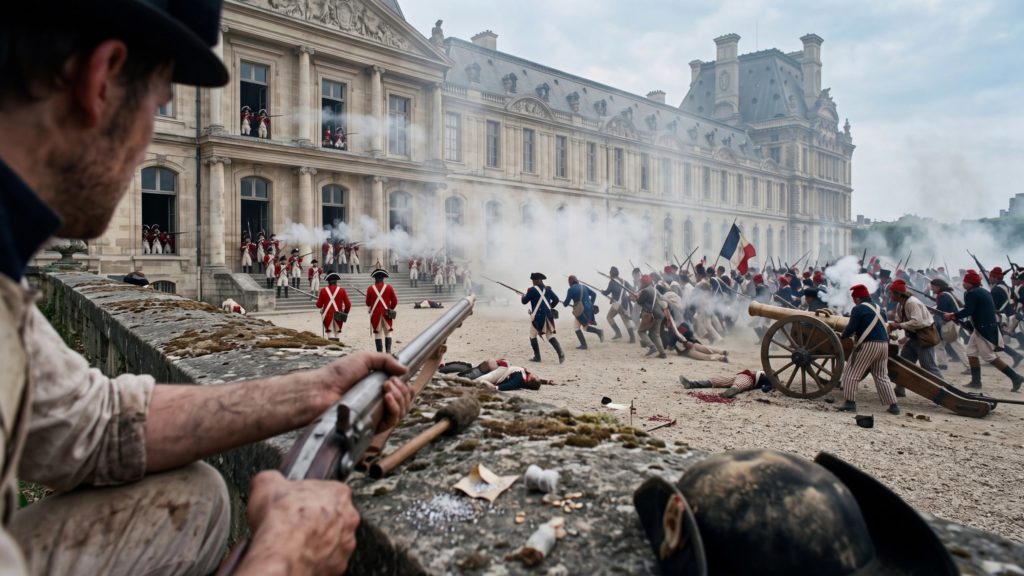
AI reconstruction based on Jean-Pierre Houël's "Prise de la Bastille (The Storming of the Bastille)" (1789), from the perspective of a Paris militiaman crouched behind an overturned cart in the outer courtyard, roughly twenty metres from the raised drawbridge.
A king summoned a medieval assembly to fix his finances[1, p. 202], and within months the assembly had declared itself the nation[2].
What Happened
The story
By January 1789, facing a treasury it could no longer manage under a tax system that spared the nobility and let the clergy assess themselves[3], King Louis XVI called elections for an Estates-General - a body that had not convened since 1614[1, p. 202]. Voters across France drew up cahiers de doleances, lists of grievances, with striking unanimity[4]. When the Estates met at Versailles in May, a dispute over whether the three orders would vote by head or by estate proved impossible to resolve.
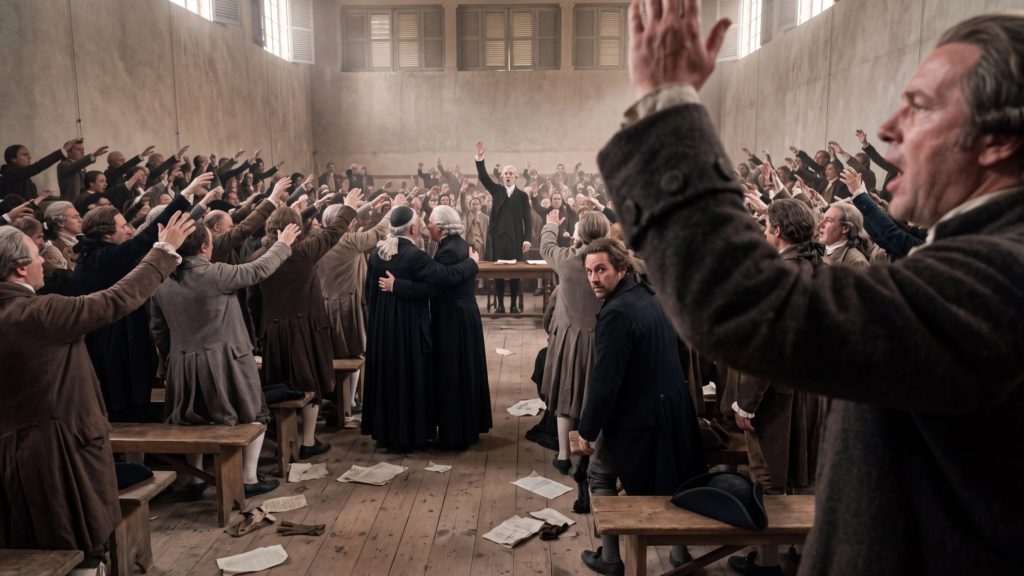
In June the Third Estate's deputies broke the deadlock by declaring themselves the National Assembly, the nation's true representative body, and swore on a tennis court not to disperse until France had a constitution[2]. Alarmed by troop movements around Paris and Necker's dismissal, crowds searching for arms and gunpowder converged on the Bastille on 14 July[5]. After a day's fighting the garrison's governor, the Marquis de Launay, surrendered the fortress[4].
Inside, the crowd found only seven prisoners - four forgers, two men held for madness, and one nobleman confined at his own family's request[5]. De Launay was killed by the mob after his surrender[6, p. 408]. The Assembly pressed on regardless: on the night of 4 August it abolished the feudal privileges of the nobility and clergy outright[7, p. 90], and on 26 August adopted the Declaration of the Rights of Man and of the Citizen[8, p. 138].
Louis XVI accepted the new order under pressure, moving to Paris after a women's march on Versailles that October[5]. Within two years his own attempted flight to Varennes, and his capture there, had all but destroyed public trust in a constitutional monarchy[6, p. 408], setting the course toward war, the fall of the monarchy, and the Terror that followed.
Quick Facts
The essentials
Quick Facts
The revolutionaries
Leadership
Abbe Emmanuel-Joseph Sieyes in 1789[9, p. 273]; Maximilien Robespierre and the Committee of Public Safety by 1793-94[10]
Forces
The Third Estate and its self-declared National Assembly[2]; the Parisian crowd that took the Bastille[5] and the National Guard raised in the capital soon after[6, p. 408]; and the newly-elected deputies of the later National Convention[3]
Objective
Replace absolute monarchy and aristocratic privilege with a constitutional or republican order answerable to the nation
The monarchy and the old order
Leadership
King Louis XVI; the Bastille's governor the Marquis de Launay[4]
Forces
King Louis XVI and the royal court; the Bastille's garrison of Invalides and Swiss troops[4]; emigre nobles and, from 1792, the coalition of foreign monarchies at war with France
Objective
Preserve royal authority and the existing social and fiscal order against reform or overthrow
The Bigger Picture
Part of the wider crisis of the old European monarchies, in which a nearly bankrupt Bourbon state, its nobility exempt from taxation and its clergy taxing only themselves[3], could no longer govern through the unreformed institutions of the ancien regime.
How It Came To This
A tax system that left the nobility exempt and the clergy self-assessed while ordinary subjects carried the burden[3]; a king forced in January 1789 to call elections for an Estates-General that had not met in over a century[1, p. 202]; and the Third Estate's own conviction, voiced in Abbe Sieyes's pamphlet that it was 'everything' yet counted for 'nothing' in the existing order[9, p. 273].
What Actually Happened
The Revolution did not run in a straight line from grievance to republic; it moved in lurches, each one radicalising the last. A parliamentary dispute over voting by head or by order tipped into the Third Estate simply declaring itself the nation's National Assembly[11]; a Parisian panic over troop movements and rumours of a royal crackdown tipped into the crowd's search for gunpowder ending at the Bastille, a fortress holding just seven prisoners but a great deal of powder[5][4]. Each phase then produced the instability that justified the next: the king's own flight and capture at Varennes in 1791 destroyed what remained of trust in constitutional monarchy[6, p. 408], and war with the rest of Europe from 1792 gave the increasingly radical Convention the emergency powers, and the enemies, that the Terror was built on[10]. Historians still divide over whether the Terror was the Revolution's logical outcome or a wartime aberration grafted onto it.
Why It Still Matters
Ended a thousand years of unbroken French monarchy, abolishing royalty outright in September 1792[2], and is conventionally bookended at its far end by Napoleon's own seizure of power in 1799[1, p. 10] - the general the Revolution's own instability had produced.
Quick Facts
Roger would like you to know...
The Bastille was stormed for its gunpowder, not really its prisoners. When the crowd broke in they found only seven men held there: four forgers, two people confined for madness, and one nobleman locked up at his own family's request[5].
Keith checked the sources...
The Bastille's garrison on 14 July 1789 was hardly a fortress under siege: eighty Invalides pensioners and thirty Swiss guards, with only two days of provisions and no reinforcements sent[4].
One for the Ageonauts...
"What is the Third Estate? Everything. What has it been? Nothing." is usually credited to Abbe Sieyes's own pamphlet[12] - though at least one contemporary claimed he'd supplied Sieyes the line himself, a dispute historians still can't fully settle[12].
History gets strange here...
The famous Tennis Court Oath happened purely by accident of geography: locked out of their usual hall, the deputies simply ran to the largest building nearby they could find - an indoor tennis court[4].
Keith would like to clarify...
The nobility's 'sacrifice' of feudal privilege on the night of 4 August 1789 wasn't as selfless as legend has it - some historians argue it was really a concession forced by an unwinnable vote already underway on the Declaration of Rights[7, p. 90].
A small fact with a very large consequence...
France's tax system before 1789 left the nobility completely exempt and let the clergy set their own contributions as 'free gifts' - a structural imbalance historians point to as a root cause of the whole crisis[3].
Roger has entered the historical rabbit hole...
The Revolution eventually threw out the calendar itself, replacing it with a new Revolutionary calendar - which is why Napoleon's later coup is remembered by its date in that scheme, 18 Brumaire, rather than by its November date[4].
Meanwhile, in history...
The Bastille's governor, the Marquis de Launay, surrendered the fortress after a day's fighting - and was killed by the crowd afterward regardless[6, p. 408].
Keith has spotted the problem...
Robespierre's own Law of 22 Prairial, which stripped defendants of the right to counsel, is generally seen as his bid for near-absolute power over the Revolutionary Tribunal - not long before his own fall[5].
The familiar story leaves this out...
Louis XVI's flight to Varennes in 1791 - his attempt to escape Paris in disguise - collapsed what remained of confidence in constitutional monarchy long before his trial and execution followed[6, p. 408].
"What is the Third Estate? Everything. What has it been hitherto in our political system? Nothing."
Abbe Emmanuel-Joseph Sieyes, in his 1789 pamphlet 'What Is the Third Estate?'[12]
Sieyes wrote this opening formula months before the Estates-General met, arguing that the commoners who did the nation's work had none of its formal standing.
Timeline
How it unfolded
22 February 1787
Assembly of Notables Meets at Versailles
Calonne's reform plan would have put part of the weight on the privileged classes, and because he expected the parlement to reject it he turned to an assembly of notables, which met at Versailles on 22 February 1787.[3] Wheeler likewise dates its first meeting at Versailles to 22 February 1787, opened by the King.[6, p. 428]
5 May 1789
Estates-General Opens at Versailles
The Estates-General met at Versailles on 5 May 1789, which Scott calls indisputably the first day of the Revolution.[13] At that first session the king read his speech and put on his hat, and the Third Estate, in defiance of royal etiquette, followed the nobility in covering their heads.[11]
20 June 1789
Tennis Court Oath
On 20 June 1789 the deputies of the National Assembly took the oath of the Tennis Court, swearing never to separate and to reassemble whenever circumstances required until the constitution of the kingdom was established.[11]
14 July 1789
Fall of the Bastille
The citizens of Paris stormed and took the Bastille on 14 July 1789.[14, p. 22] The fortress was held by a garrison of eighty Invalides and thirty Swiss under the governor, M. de Launay.[4]
22 September 1792
French Republic Proclaimed
The National Convention, at its first meeting in the Manege, voted to abolish royalty and to date the years from the Year One of the Republic, a day Geer gives as 22 September 1792.[4][4]
21 January 1793
Execution of Louis XVI
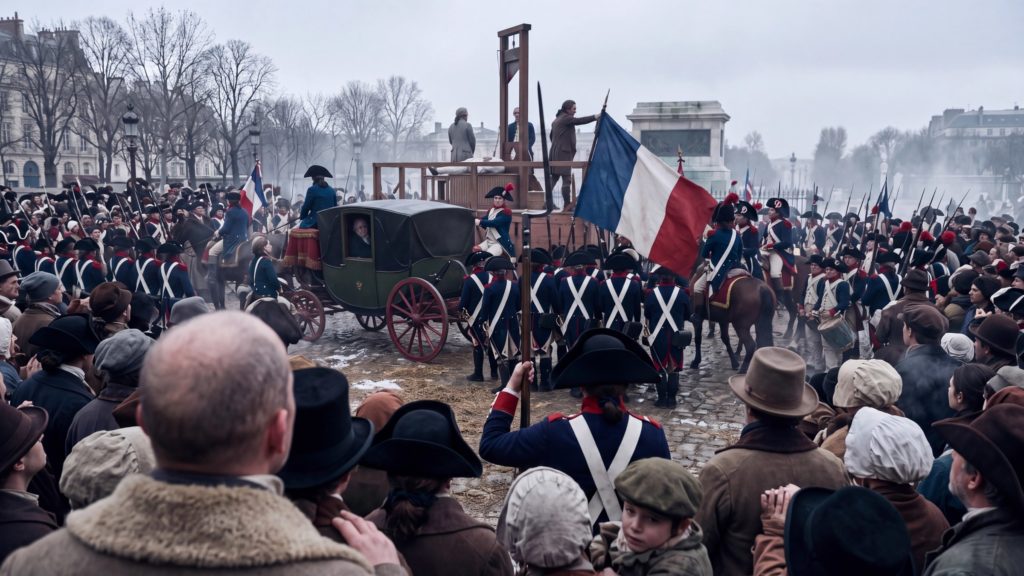
Louis XVI was executed on 21 January 1793, and according to Mignet he had ceased to live shortly after ten o'clock that morning.[3] Geer describes the King rising early that day at six o'clock and hearing Mass before being taken to the scaffold.[4]
27 July 1794
Fall of Robespierre
On 9 Thermidor (27 July 1794) the Convention turned on Robespierre: Tallien and Billaud-Varenne interrupted Saint-Just's report, and Robespierre's own attempt to speak from the tribune was drowned by cries of 'a bas le tyran'.[15, p. 3] Geer's chronology also records the fall of Robespierre on 27 July.[4]
November 1795
Directors Elected and Installed
Under the Constitution of the Year III the Council of Ancients elected the five-man Directory on 1 November 1795, Carnot taking the place of Sieyes who declined to serve.[4] According to Geer the Directors met in the Tuileries on 4 November and set out for the Luxembourg, their official residence.[4]
9 November 1799
Coup of 18 Brumaire
On 18 Brumaire (9 November 1799) a decree of the Ancients moved the Councils to Saint-Cloud and placed General Bonaparte in command of the military forces of the capital.[4] That night the Ancients adopted, with only one dissenting vote, a decree appointing three temporary Consuls, Bonaparte, Sieyes and Ducos.[4] Geer closes his narrative here, ten years, six months and six days after the States-General assembled at Versailles, saying the curtain had rung down on the last scene of the French Revolution.[4]
Dig Deeper
Copy any prompt below into your favourite AI chat to keep exploring.
was the Terror built into the Revolution or a wartime aberration
the day the Third Estate refused to leave the room
the metric system and the calendar the Revolution tried to reset
Further Reading
Where to read more
French Revolution - World History Encyclopedia
A free, comprehensive encyclopedia overview of the Revolution's full 1789-1799 arc, from its financial origins to Napoleon's rise.
Why look at this: Lays out how a state already near bankruptcy, with a nobility exempt from taxation, tipped into the Estates-General crisis this page opens with.
https://www.worldhistory.org/French_Revolution/The French Revolution: History, Timeline, Causes, and Outcomes - History Cooperative
A fuller, free treatment covering the Revolution's causes, key events from the Estates-General through Napoleon's rise, and its major figures.
Why look at this: Walks through the abolition of feudal privileges and the Declaration of the Rights of Man in more depth than a single encyclopedia entry allows.
https://historycooperative.org/the-french-revolution/The French Revolution: A History, by Thomas Carlyle
Carlyle's famous 1837 narrative history, freely digitised on Project Gutenberg - one of the library's own richest sources for this event.
Why look at this: The classic full-length telling behind many of this page's Bastille and Terror details, in Carlyle's own vivid nineteenth-century voice.
https://www.gutenberg.org/ebooks/1301Related
Keep exploring



Places


Can be seen in
Where this shows up
References
Sources
Sources
- ResearchThe French Revolution as a Moment of Respatialization. Pages 10, 202. ↑
- BookThe first French Republic : A study of the origin and the contents of the declaration of the… by Horace Mann Conaway ↑
- BookThe French revolution from 1789 to 1815 by M. Mignet and James Westfall Thompson ↑
- BookThe French revolution : a historical sketch by Walter Geer ↑
- BookThe French Revolution : a study in democracy by Nesta Helen Webster ↑
- BookThe French revolution from the age of Louis 14 to the coming of Napoleon by Harold Felix Baker Wheeler. Pages 408, 428. ↑
- BookThe great French revolution, 1789-1793 by Petr Alekseevich Kropotkin and N. F Dryhurst. Page 90. ↑
- BookThe Constitutions and Other Select Documents Illustrative of the History of France 1789-1907 by Frank Maloy Anderson. Page 138. ↑
- BookA short history of Europe, from the fall of the Eastern empire to the dissolution of the Holy… by Charles Sanford Terry. Page 273. ↑
- BookA History Of The French Revolution Vol Ii by H Morse Stephens ↑
- BookRobespierre and the French revolution by Charles Franklin Warwick ↑
- BookThe Abbé Sieyès : an essay in the politics of the French revolution by J. H. Clapham ↑
- BookLife of Napoleon Bonaparte, Volume I. by Walter Scott ↑
- BookThe life and character of Maximilian Robespierre : proving by facts and arguments, that that much-calumniated person was… by James Bronterre O'Brien. Page 22. ↑
- BookThe principal speeches of the statesmen and orators of the French Revolution, 1789-1795 by Henry Morse Stephens. Page 3. ↑