
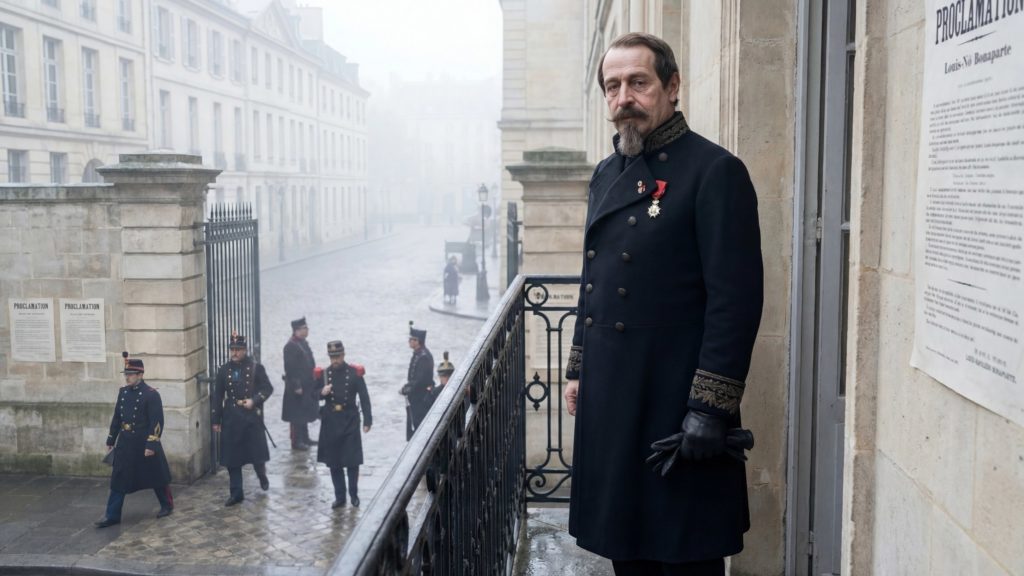
Napoleon III sits under Prussian guard after his surrender at Sedan, September 1870; the capture ended the Second Empire and his reign.
President of the Second Republic, then Emperor of the French
A political prisoner who escaped a French fortress disguised as a workman in 1846[1] went on to become an elected president and then, by his own declaration, an emperor who insisted his empire meant peace[2].
Bio
Who they were
Charles Louis Napoléon Bonaparte was born in Paris on 20 April 1808[3], the third son of Louis Bonaparte, King of Holland, and Hortense de Beauharnais[4] — making him a nephew of Napoleon I. As a member of a deposed imperial family after 1815, he grew up largely outside France, carrying the Bonaparte name into a Europe that had exiled it.
As a young man he tried twice to seize power by force: a failed rising at Strasbourg in October 1836[2], and another failed attempt at Boulogne in August 1840[5, p. 169]. The second attempt led to his imprisonment in the fortress of Ham[4], where he spent six years that he used productively, writing on politics and economics rather than sitting idle[6]. On 25 May 1846 he escaped, disguised as a workman known as "Badinguet"[1]. Two years later, the 1848 revolution that toppled the French monarchy opened the door he had twice failed to force.

Elected to the National Assembly and then, in 1848, President of the Second Republic[2], he staged a coup d'état in late 1851[5] and had himself proclaimed Emperor on 2 December 1852[7]. Addressing fears that his new empire meant renewed war, he told a crowd at Bordeaux, "The Empire is peace"[2][8]. In practice his reign saw France fight in the Crimean War from 1854[2] and, in 1870, war with Prussia — a war that ended his rule. At the Battle of Sedan, fought from 5 a.m. on 1 September 1870[9], his army was trapped and defeated, and Napoleon III surrendered to the Prussian King William, becoming a prisoner of war at Wilhelmshöhe[2].
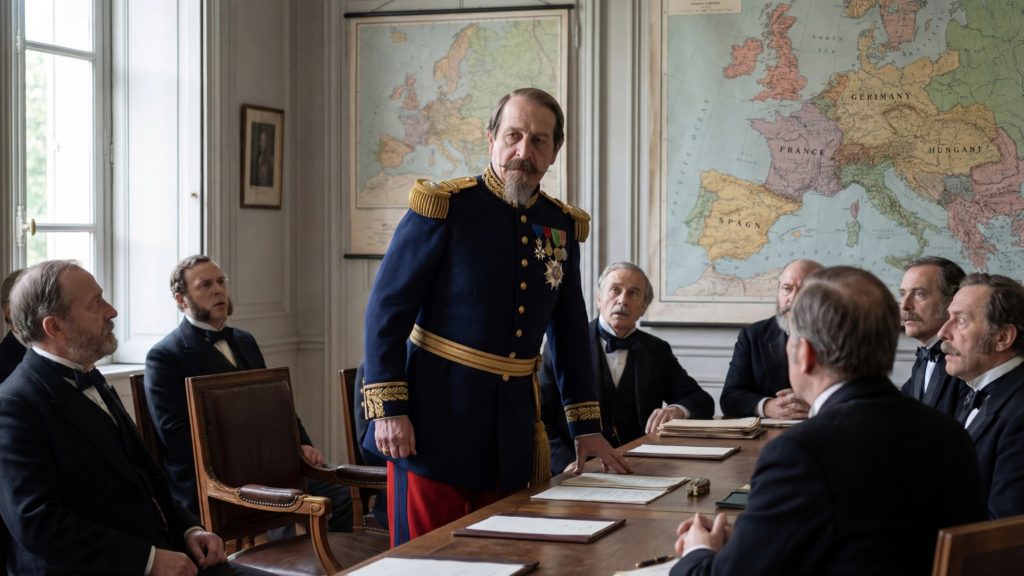
The defeat at Sedan ended the Second Empire immediately; a republic was declared in Paris while Napoleon III remained a prisoner in Germany[2]. Released after the war, he joined his family in exile in England. He died on 9 January 1873[10, p. 572][11], at Chislehurst[12], following surgery. His fall closed the Bonaparte dynasty's second and final chapter as rulers of France.
Napoleon III's Second Empire is remembered as a period of rapid economic and industrial change in France, alongside an active, sometimes reckless, foreign policy that included the Crimean War[2] and ultimately the catastrophic war with Prussia that destroyed his regime. His career — twice failed coup attempts followed by an elected presidency, a self-declared empire, and a collapse in a single battlefield defeat — is often cited as a case study in how quickly personal rule built on plebiscite and prestige can unravel once military success stops.
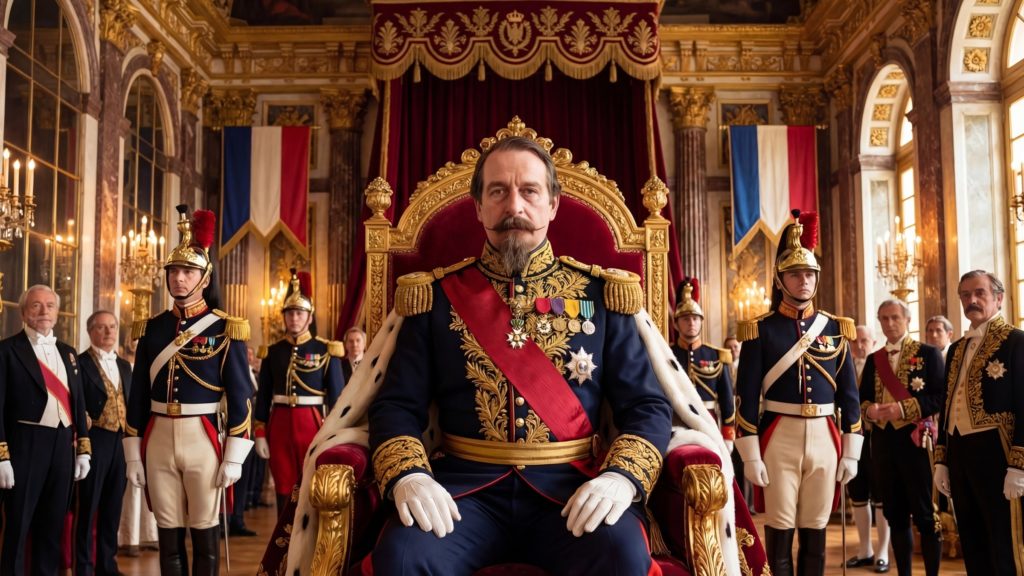
The man who insisted his empire meant peace had, a generation earlier, tried twice to seize power by armed force at Strasbourg and Boulogne[2][5, p. 169] — and spent six years in prison for it, escaping disguised as a laborer under the alias "Badinguet"[1], a nickname that stuck with him for the rest of his political career.
Legacy & Reputation
What’s the verdict?
Historians differ sharply on Napoleon III depending on which decade of his rule they weigh most heavily: contemporary and near-contemporary writers such as the biographer in Napoleon III and His Court[13, p. 96] treat the 1852 Bordeaux “peace” pledge as sincere, while accounts of the Crimean and Franco-Prussian wars[2] show a ruler whose foreign adventures repeatedly undercut that promise. His reputation has swung between “moderniser” and “adventurer” largely on this evidence.
Myth-buster
Think you know this one?
Myth: Napoleon III is sometimes remembered as a minor, almost accidental ruler who simply traded on his uncle’s name. Correction: he first tried to seize power by force twice, at Strasbourg in 1836 and Boulogne in 1840, and spent six years imprisoned for the second attempt before escaping and later winning election as President in 1848[2][5, p. 169][2] — his path to power was long, deliberate, and twice failed before it succeeded.
Quick Facts
The essentials
Quick Facts
One for the Ageonauts…
Louis Napoleon spent six years imprisoned at the fortress of Ham after his failed 1840 coup — long enough that contemporaries nicknamed it his "University of Ham." He read voraciously there, and emerged, by most accounts, a far more serious political thinker than the man who went in[2].
Roger has a theory…
Was Napoleon III even a Bonaparte by blood? A persistent rumour credited his real father to a Dutch admiral close to his mother, Queen Hortense — a suspicion strong enough that King Louis Bonaparte hesitated for years before formally acknowledging the boy as his own son[6].
History gets strange here…
In 1848, Louis Napoleon was a near-unknown whose two previous coup attempts had flopped badly. Universal suffrage handed him the presidency anyway — peasant voters, this account says, needed no introduction to a name their fathers had followed to Austerlitz and Jena[2].
Keith checked the sources…
Before he ever wore a crown, Louis Napoleon twice tried to seize power by force — a botched rising at Strasbourg in 1836, then a landing at Boulogne in 1840 — and lost both times. Failure, twice over, is not usually how emperors get made[14].
Roger has entered the historical rabbit hole…
While imprisoned at Ham, the future emperor found time to write an entire artillery manual, the "Manuel d'Artillerie," alongside his political manifesto "Des Idées Napoléoniennes." Louis Blanc, no natural ally, admitted it was written "in a fine, clear, and precise style"[15].
Keith would like to clarify…
Napoleon III didn't build the Suez Canal, but he gave real support to the men who did[16, p. 92] — and his wife, the Empress Eugénie, crossed Europe specially to attend its 1869 opening, alarming the British ambassador along the way[17, p. 1].
This sounds invented, but…
At the surrender of Sedan in 1870, one eyewitness claimed the Emperor's cheeks had been rouged to look "juvenile, and even jovial." Whether that's true is disputed — the author reporting the claim admits he never actually got close enough to check for himself[18].
Roger said it. Keith checked it…
Napoleon III died at Camden Place, Chislehurst, in January 1873, in the English exile that followed Sedan. His son, the Prince Imperial, learned of his father's death while training as a cadet at Britain's own Royal Military Academy, Woolwich[2].
Roger insists this matters…
Paris as visitors know it today — the wide boulevards, the parks, the sewers — is largely Napoleon III's doing. He set Baron Haussmann loose on the medieval city, and Haussmann, in one contemporary's words, went "hacking his ways through Paris"[19].
Keith has spotted the problem…
The 1851 coup that turned Louis Napoleon's presidency into an empire was documented, and condemned, in his own lifetime, by the Paris journalist Eugène Tenot — whose account ran to thirteen French editions before an English translation even appeared[5].

I say that the Empire means peace.
Napoleon III
From his speech at Bordeaux in 1852, addressing public fears that his new Empire would mean renewed war with Europe[2][8].
Timeline
How it unfolded
20 April 1808
Birth of Louis-Napoleon Bonaparte
The future Napoleon III was born in Paris, the third son of Louis Bonaparte, King of Holland, and Hortense de Beauharnais, daughter of the Empress Josephine.[14][2][4]
6 August 1840
Boulogne Attempt and Imprisonment at Ham
Louis-Napoleon's expedition from England upon Boulogne in August 1840 was his second attempt to restore the throne of Napoleon, after the Strasbourg attempt of October 1836.[20] He was a prisoner at Ham from 7 October 1840 until he escaped on 25 May 1846.[2]
10 December 1848
Election as President of the French Republic
After the Revolution of 1848 Louis-Napoleon returned to Paris, became a member of the Constituent Assembly, and was elected President of the Republic by 5,562,834 votes on 10 December 1848.[14][21]
2 December 1851
Coup d'Etat of 2 December 1851
By the coup d'etat of 2 December 1851 Louis-Napoleon dissolved the Assembly, and he then appealed to the French people by plebiscite as to the justice of that act.[14][2]
2 December 1852
Proclamation of the Second Empire
The Second Empire was proclaimed on 2 December 1852, and the Empire was established that month after a second plebiscite.[2][21] A plebiscite on 21 November 1852 had given the prince-president 7,481,231 votes.[14]
Dig Deeper
Copy any prompt below into your favourite AI chat to keep exploring.
Explain how Louis-Napoléon Bonaparte escaped from the fortress of Ham disguised as a workman in 1846, years before he became Napoleon III.
What does it mean that a man who twice failed to seize power by force eventually became emperor anyway?
Roleplay the prison guards at Ham realizing, too late, that the workman who just walked out was actually their prisoner.
Further Reading
Where to read more
Napoleon III | Biography, Significance, Death, & Facts
Britannica's overview of Louis-Napoléon Bonaparte's path from Swiss exile and two failed coup attempts to President of the Second Republic and, from 1852, Emperor of the French.
Why look at this: Lays out the December 1851 coup d'état by which he dissolved the very republic that had elected him president, then made himself emperor a year later.
https://www.britannica.com/biography/Napoleon-III-emperor-of-FranceLife and Reign of Napoleon III
A detailed, year-by-year chronology from the Fondation Napoléon tracing his exile, presidency, imperial reign, and downfall in far more granular detail than a standard encyclopedia entry.
Why look at this: Pinpoints the exact moment his empire ended - his capitulation and surrender to the Prussians at the Battle of Sedan on 2 September 1870 - and traces his final years in English exile at Chislehurst.
https://www.napoleon.org/en/history-of-the-two-empires/timelines/life-and-reign-of-napoleon-iii/Extinction du paupérisme (1844)
The original pamphlet Louis-Napoléon Bonaparte wrote himself while imprisoned at the Fort of Ham, setting out his ideas for eliminating poverty through state-organized labor colonies (in French; public-domain scan).
Why look at this: This is the text that built his popular reputation as a social reformer and helped win him election by universal male suffrage in December 1848, years before he became emperor.
https://archive.org/details/NLBonaparte.ExtinctionPauperisme1844Related
Keep exploring


Places
Can be seen in
Where this shows up

References
Sources
Sources
- BookNapoléon III, and Italy. A brief historical survey by Robert Holmes Edleston ↑
- BookNapoleon the Third; the romance of an emperor by Walter Geer ↑
- BookNapoleon the Little by Victor Hugo ↑
- BookThe history of Napoleon III, emperor of the French. Including a brief narrative of all the most important… by John S. C. Abbott ↑
- BookParis in December, 1851; or, The coup d'tat of Napoleon III by Eugène Ténot, Sherman W. Adams and A. H Brandon. Page 169. ↑
- BookThe history of the Franco-German War of 1870-'71 : comprising a detailed description of its origin and causes… by L. P. Brockett and John S. C. Abbott ↑
- BookRecollections of the court of the Tuileries by Madame Carette and Elizabeth Phipps Train ↑
- BookThe life of Napoleon the Third by Archibald Forbes ↑
- BookThe Comedy & Tragedy of the Second Empire by Edward Legge ↑
- BookThe life of an empress (Eugénie de Montijo) by Frédéric Loliée and Bryan O'Donnell. Page 572. ↑
- BookEugenie, Empress of the French by Clara Tschudi ↑
- BookThe Empress Eugénie, 1870-1910: Her Majesty's life since "the terrible year." Together with the statement of her case… by Edward Legge ↑
- BookNapoleon III and his court by Imbert de Saint-Amand. Page 96. ↑
- DocumentCatholic Encyclopedia (1913)/Napoleon III ↑
- BookLouis Napoleon and the genesis of the Second Empire; being a life of the emperor Napoleon III to… by Frank Halliday Cheetham ↑
- BookThe rise of Louis Napoleon by F. A. Simpson. Page 92. ↑
- BookThe second empire: Bonapartism, The prince, The president, The emperor by Philip Guedalla. Page 1. ↑
- BookThe comedy and tragedy of the Second Empire : Paris Society in the sixties; including letters of Napoleon… by Edward Legge ↑
- BookLouis Napoleon & the recovery of France, 1848-1856 by F. A. Simpson ↑
- BookThe Eighteenth Brumaire of Louis Bonaparte by Karl Marx ↑
- BookIntimate memoirs of Napoleon III, personal reminiscences of the man and the emperor by baron d' Ambès and others ↑