
Joseph Bonaparte rides into a Spanish town as King Jose I, the throne his brother forced on him in 1808 and which he never controlled beyond his soldiers' reach.
King of Naples, then King of Spain
Napoleon's older brother trained as a small-town lawyer[1], yet wore two European crowns before quietly retiring to a country estate outside Philadelphia[2].
Bio
Who they were
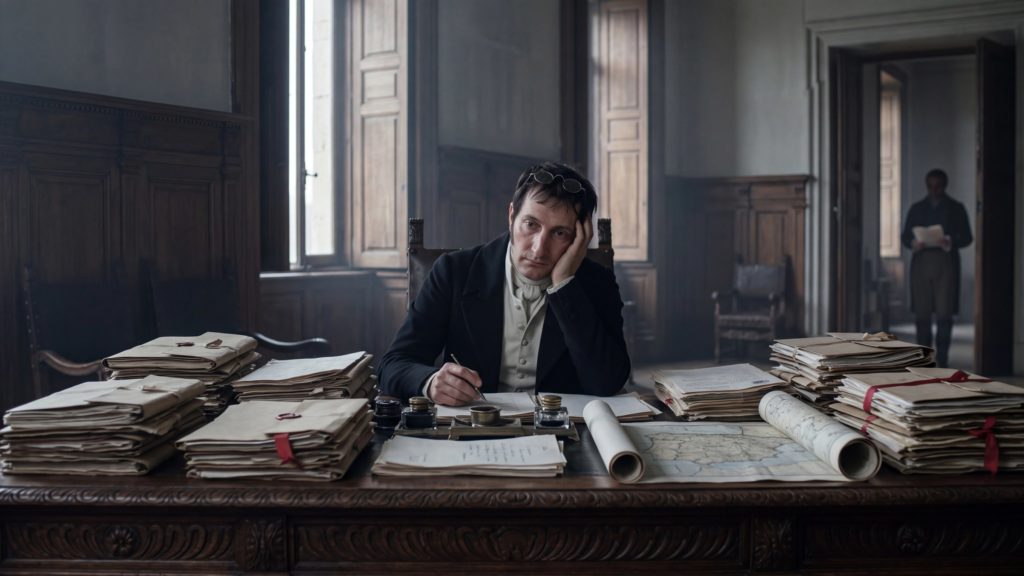
Joseph Bonaparte was born on 7 January 1768 in Corsica, the first-born child of Carlo and Letizia Buonaparte[3][4, p. 247], making him Napoleon's elder brother. He trained for a modest legal career expected of a respectable but not wealthy Corsican family, studying law at Pisa and qualifying as a barrister at Bastia[1]. In 1794 he married Julie Clary[5, p. 88], whose sister Désirée had earlier been linked romantically with Napoleon.
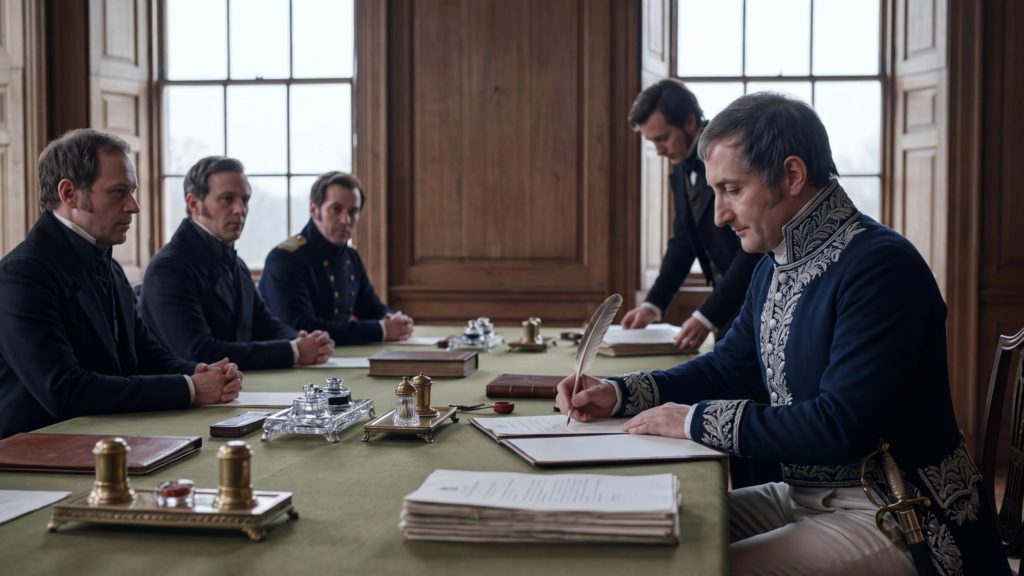
As Napoleon's influence grew, Joseph moved from provincial law into public life, serving on the staff of the army's major-general early in his brother's rise[2] and later handling sensitive diplomatic negotiations on France's behalf. He earned a reputation as the more conciliatory Bonaparte, at one point even declining an offer of the Crown of Lombardy[4, p. 247]. When Napoleon began placing relatives on Europe's thrones, Joseph was the natural first choice: in March 1806 Napoleon issued a decree declaring him King of Naples[3], a crown accepted more from family duty than personal ambition.
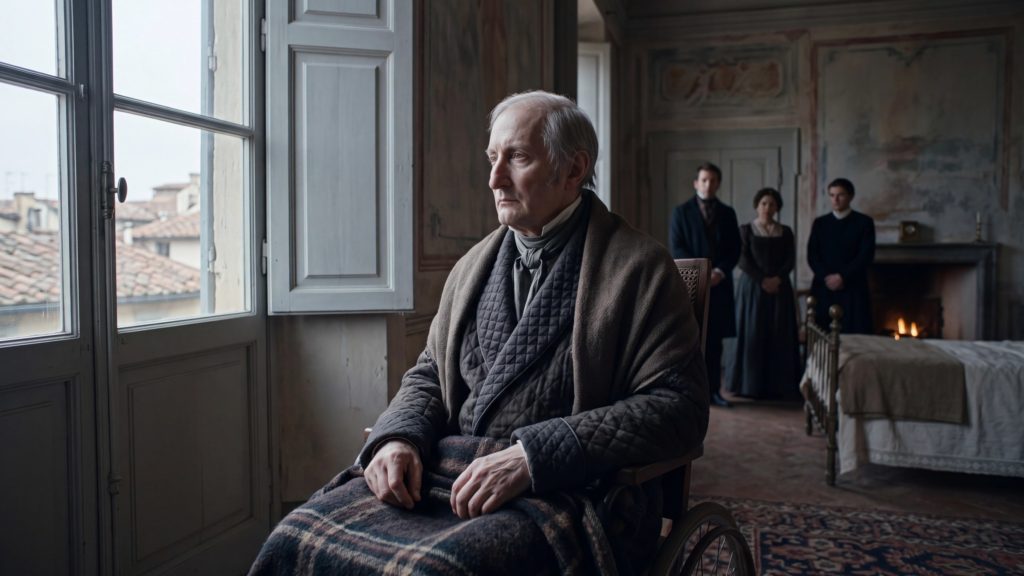
Two years later Napoleon moved him again. After forcing the abdication of Spain's Bourbon king Ferdinand VII, Napoleon installed Joseph as King of Spain in 1808[3]. He inherited a country in open revolt: Spanish guerrilla bands kept up resistance across the countryside even after regular Spanish armies had been defeated[2]. His reign was fought for at every turn, contested by Spanish insurgents and by Wellington's advancing army. It effectively ended at the Battle of Vitoria in June 1813, where Joseph reviewed the field and called his marshals into action before the French position collapsed in a decisive defeat[6, p. 114]. He never ruled from Madrid again.

After Napoleon's final fall, Joseph left Europe for the United States, eventually settling on an estate at Point Breeze in New Jersey under the adopted title Count de Survilliers[2][4, p. 43]. He lived there for years as a private landowner. He later returned to Europe and died at Florence on 23 July 1844[3][2], his death drawing far less attention than his brother's had.
Joseph's reign in Spain is remembered less for what he built than for what it provoked: prolonged Spanish guerrilla resistance to his rule became a case study in how occupied populations can wear down a conventional occupying army[2]. His later years in New Jersey also gave the young United States an unusual footnote — a former European king living quietly as a private citizen and landowner[2], part of America's early fascination with exiled Bonapartes.
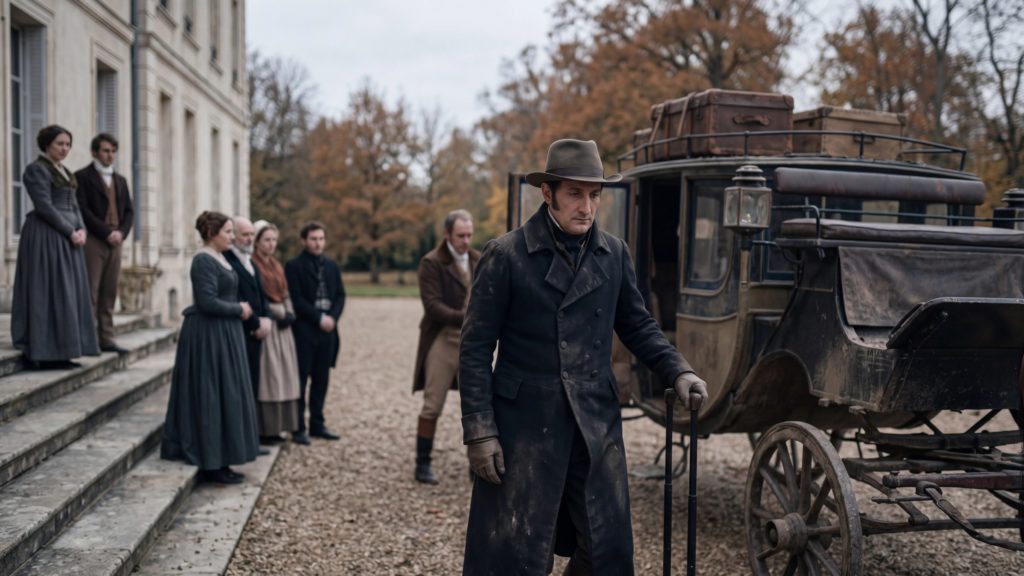
Despite having ruled two kingdoms, Joseph seems to have preferred ordinary life to court ceremony: at Point Breeze he settled into the role of country gentleman rather than angling for any return to power[2]. Even his chosen title, Count de Survilliers, was a modest, self-picked name rather than a grand royal one[4, p. 43] — a quiet contrast with two brothers who spent their lives chasing crowns.
Legacy & Reputation
What’s the verdict?
Early biographers such as John S. C. Abbott generally present Joseph as the most reluctant of Napoleon’s siblings — a man placed on thrones rather than one who sought them[3]. This framing is not the only one available in the sources: some accounts emphasize genuine legal and administrative reforms attempted during his Naples and Spain reigns rather than treating him purely as a placeholder ruler. His reputation has, however, always been read chiefly through his brother.
Myth-buster
Think you know this one?
Myth: Joseph Bonaparte is sometimes assumed to have been a passive figurehead entirely of Napoleon’s making. Correction: he trained independently as a lawyer years before Napoleon’s rise to power[1], and later lived for decades on his own initiative in the United States, well outside his brother’s control[2].
Quick Facts
The essentials
Quick Facts
Keith checked the sources…
Point Breeze, Joseph Bonaparte's New Jersey estate, gathered a very energetic local mythology: secret river tunnels, sentries watching for enemy fleets. Keith checked. The estate's own historian dismisses these as tales from "sensational writers"; the truth, he insists, was rather quieter than the legend[4, p. 40].
Roger has entered the historical rabbit hole…
After Waterloo, Joseph offered to swap places with his brother — pretending to be ill in bed at Bordentown while Napoleon sailed for America in disguise, using Joseph's own passport. Napoleon refused it as beneath a soldier's dignity, and surrendered to the British instead[7].
History gets strange here…
In 1806 Napoleon made Joseph King of Naples and Sicily by decree, declaring the crown hereditary through his line. The deposed Bourbon queen had been so widely detested that even her own grandees were, by this account, glad to see her go[3].
Keith found the footnote…
Handing Joseph the Spanish crown in 1808, Napoleon later admitted his real motive at Saint Helena: the Spanish royal family were tearing themselves apart. "When I saw those imbeciles quarrelling," he said, "I thought I might as well take advantage of it"[3].
Roger would like you to know…
Joseph did not want the Spanish crown. He was on the road to Bayonne, "in heart very reluctant," when Napoleon rode out to meet him — sacrificing his own preferences, once again, to help his younger brother's grander plans succeed[3].
One for the Ageonauts…
When fire threatened Point Breeze in 1820, Bordentown's townspeople rushed in unasked to save Joseph's furniture, statues, silver and books before the flames reached them. He later wrote that it proved "men are generally good" when not spoiled in youth[7].
The past has entered the chat…
Stripped of two crowns, Joseph settled in America as the "Comte de Survilliers" and was, by every account, warmly esteemed by everyone who met him — a former king who traded an empire for a genuinely happy corner of New Jersey[7].
Keith would like to clarify…
Joseph's wife, Queen Julie, never actually joined him in America — her health kept her in Europe for the whole of his long exile. The picture of a royal couple settled by the Delaware together is, in reality, just Joseph[7].
Roger has misplaced a crown…
By the time Joseph reached Spain, the country was already in chaos: Charles IV had abdicated, Ferdinand VII had been cheered as king, and the hated minister Godoy had been arrested. Joseph inherited a throne that was contested before he ever sat on it[3].
Roger said it. Keith checked it…
Naples, then Spain: Joseph twice found himself governing a kingdom he had not asked for, on his brother's orders. Contemporaries record him touring Naples in person, seeking out officials of "integrity, intelligence, and influence" — diligence Napoleon rarely gets credited with inspiring in him[3].
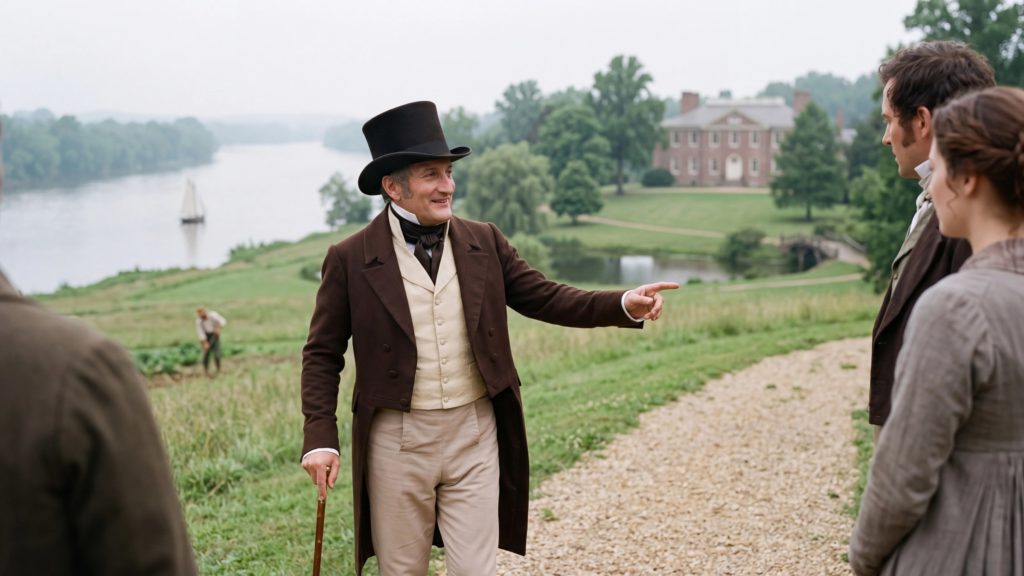
Leave me to be King of Mortefontaine. I am much happier in that domain, the boundary of which it is true I can see, but where I know myself to be diffusing happiness.
Joseph Bonaparte
Joseph's own words, reportedly said to Napoleon, revealing his real preference for his quiet French estate over the thrones his brother kept thrusting on him, first in Naples and then in an increasingly hostile Spain.
Timeline
How it unfolded
7 January 1768
Birth of Joseph Bonaparte
Joseph Napoleon Bonaparte was the first-born child of Charles Bonaparte and Letitia, born on 7 January 1768 about a year after their marriage, and Napoleon was born nineteen months later.[2] He was born at Corte, Corsica.[8]
1794
Marriage to Julie Clary
Joseph married Julie Clary, daughter of one of the wealthiest capitalists of Marseilles.[2] Her sister Eugenie, to whom Napoleon was at that time much attached, afterward married Bernadotte, later King of Sweden.[3]
15 February 1806
Joseph Enters Naples as King
Joseph entered Naples as King in February 1806.[9] He had placed himself at the head of forty thousand French troops and entered the kingdom, where the Neapolitans could make no effectual resistance.[2]
June 1808
Proclaimed King of Spain
At Bayonne in June 1808 courtiers accepted Joseph Bonaparte as King of Spain and gave the country a parliamentary constitution.[10] He arrived in Madrid on 20 July and found insurrection rising against him in the provinces.[3]
21 June 1813
Defeat at the Battle of Vittoria
King Joseph's army was caught and routed by Wellington's allies at Vittoria on 21 June 1813.[11, p. 166][9]
28 August 1815
Landing in New York
Joseph sailed for the United States with four of his suite on board the bark Commerce and landed at New York on 28 August 1815.[3]
Dig Deeper
Copy any prompt below into your favourite AI chat to keep exploring.
Explain why installing Joseph Bonaparte as King of Spain in 1808 triggered a guerrilla war that badly weakened Napoleon's empire.
What does the Spanish reaction to Joseph Bonaparte's crown teach us about the limits of installing a ruler a country never chose?
Pitch Joseph Bonaparte's new job in Spain like the least-wanted corporate relocation in history.

Further Reading
Where to read more
Joseph Bonaparte | King of Spain, Naples & France
Britannica's concise biographical overview of Joseph Bonaparte's career as a lawyer, diplomat, and Napoleon's eldest surviving brother, covering his reigns as King of Naples (1806-08) and King of Spain (1808-13).
Why look at this: Explains the awkward, subordinate position Napoleon kept him in as king - Joseph offered to abdicate the Spanish throne four times before finally losing it after Vitoria.
https://www.britannica.com/biography/Joseph-BonaparteJoseph Bonaparte (Thierry Lentz, 2016)
A 752-page scholarly biography by Thierry Lentz, director of the Fondation Napoléon, drawing on fifteen years of archival research to treat Joseph as a significant figure in his own right rather than only in his brother's shadow.
Why look at this: Focuses on Joseph's own diplomatic record - including negotiating treaties with the United States, Austria, and England - showing the statesman behind the reluctant king.
https://www.napoleon.org/en/magazine/publications/joseph-bonaparte/Guide to the Papers of Joseph Bonaparte, Exiled King of Spain, Brother of Napoleon (MG 62)
The New Jersey Historical Society's finding aid to its collection of Joseph Bonaparte's personal correspondence and estate business records from his years of American exile, 1816-1836.
Why look at this: Documents his life after Europe as the 'Comte de Survilliers' at Point Breeze, the 1,700-acre Bordentown, New Jersey estate he built and rebuilt after its mansion burned down soon after completion.
https://jerseyhistory.org/guide-to-the-papers-of-joseph-bonaparteexiled-king-of-spain-brother-of-napoleon1816-1917bulk-1816-1836/Related
Keep exploring



Events

Can be seen in
Where this shows up

References
Sources
Sources
- BookA dictionary of Napoleon and his times by Hubert N.B Richardson ↑
- BookJoseph Bonaparte by John S. C. Abbott ↑
- BookHistory of Joseph Bonaparte, king of Naples and of Italy by John S. C. Abbott ↑
- BookBonaparte's park, and the Murats by E. M. Woodward. Pages 40, 43, 247. ↑
- BookA Life of Napoleon Bonaparte, with a Sketch of Josephine, Empress of the French. by Ida M. Tarbell. Page 88. ↑
- BookThe life of Wellington : the restoration of the martial power of Great Britain by Herbert Maxwell. Page 114. ↑
- BookJoseph Bonaparte in Philadelphia and Bordentown by Charlemagne Tower ↑
- BookNapoleon the Third; the romance of an emperor by Walter Geer ↑
- BookMemoirs Of Napoleon Bonaparte - I And Ii by Louis Antoine Fauvelet De Bourrienne ↑
- BookA short history of Europe from the dissolution of the Holy Roman empire to the outbreak of the… by Charles Sanford Terry ↑
- WebsitePeninsular War thesis (FSU repository). Page 166. ↑
- BookThe history of Napoleon III, emperor of the French. Including a brief narrative of all the most important… by John S. C. Abbott ↑