
About This Map
What it shows
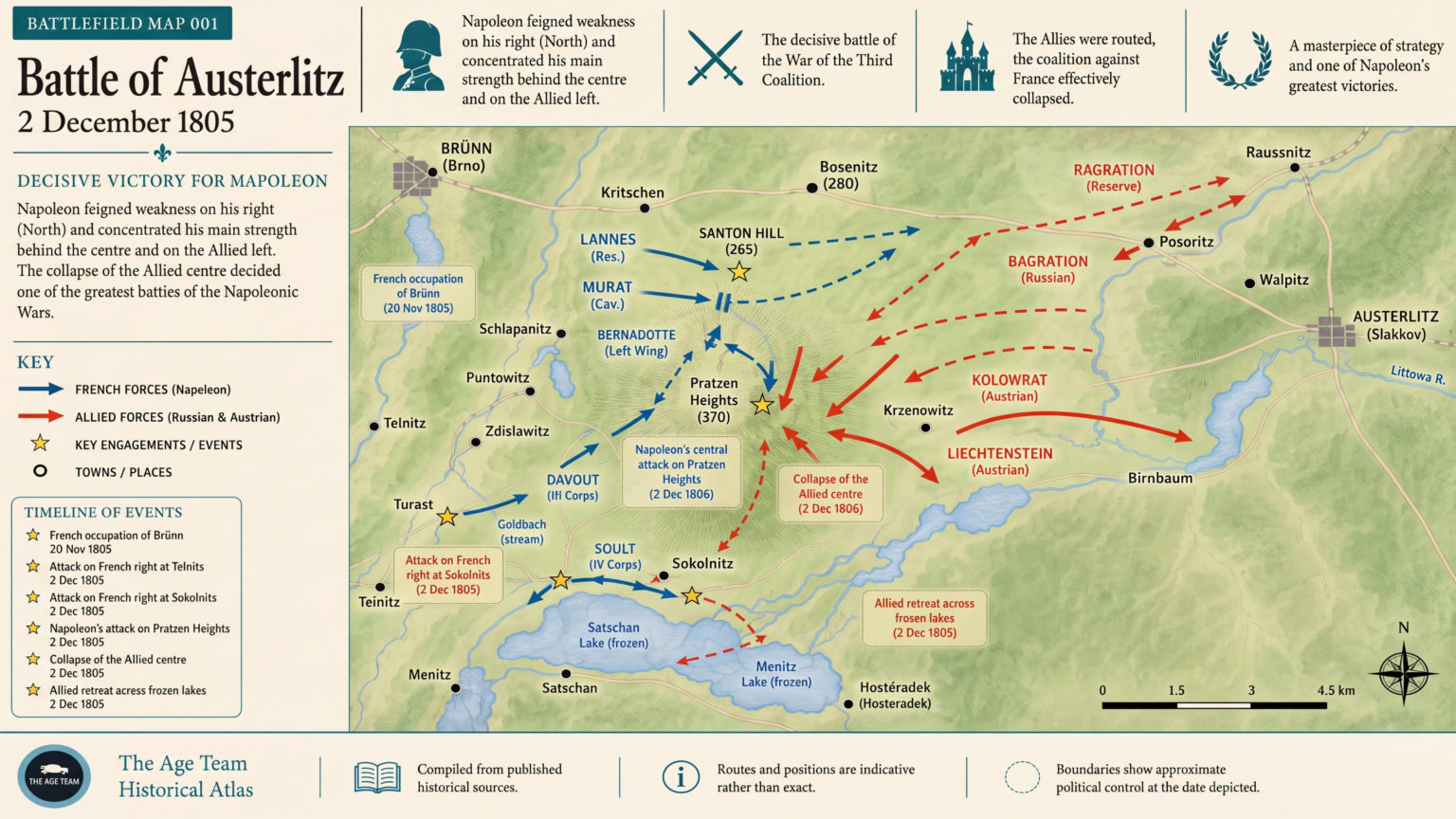
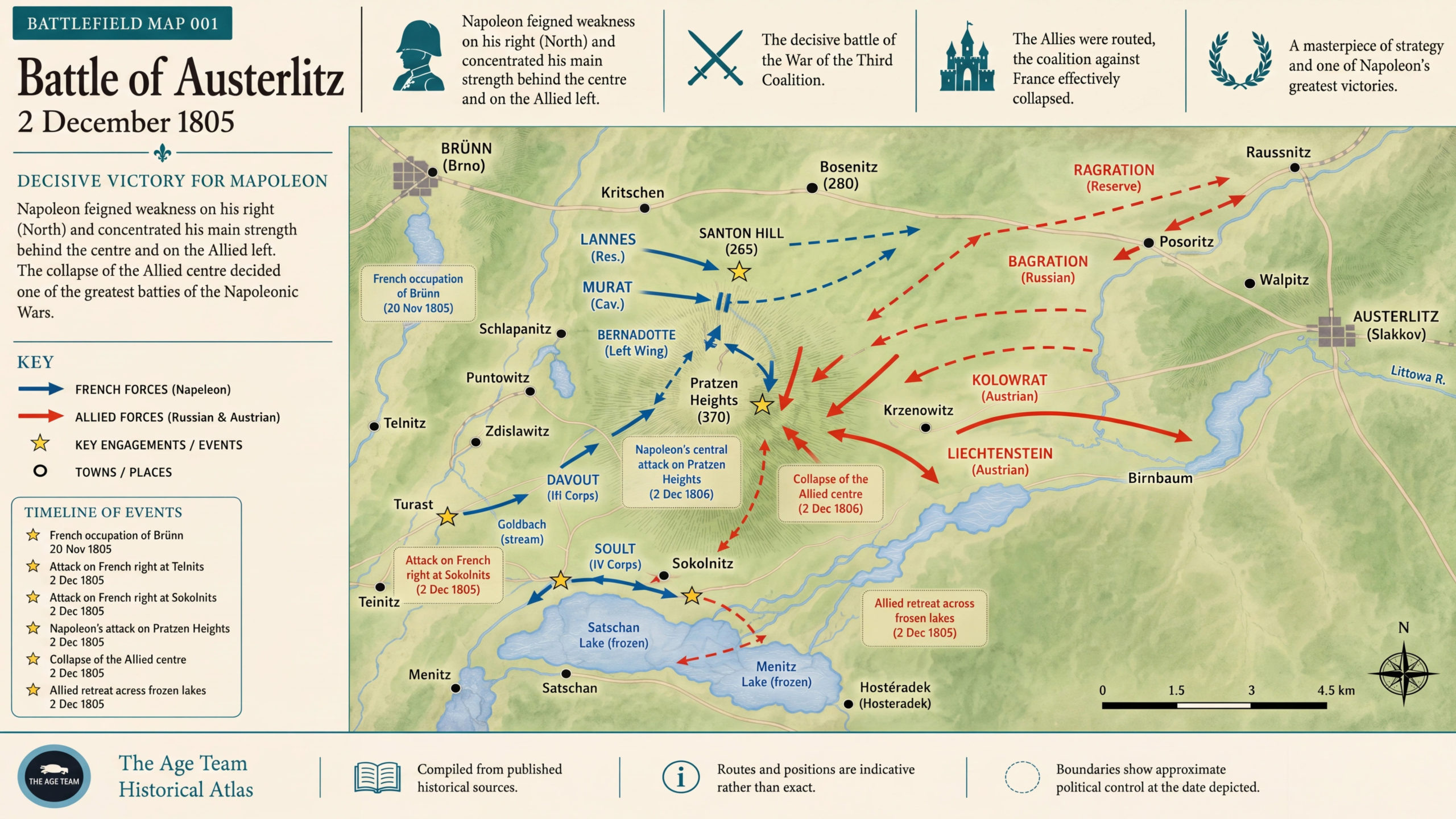
This map traces the trap Napoleon set on 2 December 1805, deliberately thinning his own right flank at Telnitz and Sokolnitz so that the Russian and Austrian columns would commit south, away from the high ground he actually wanted them to leave. It marks the feigned withdrawal from the Pratzen Heights in the days before the battle, the move that convinced the Allied command the French army was weaker than it was. Once the Allied centre had thinned itself to reinforce that southern push, the map shows Soult's corps climbing back through the morning fog to retake the Heights and split the Allied army in two. Fought exactly a year after Napoleon's coronation, with the Holy Roman Emperor and the Tsar of Russia both present, it became known as the Battle of the Three Emperors, and the ground shown here forced Austria out of the war within weeks.
Quick Facts
The essentials
Quick Facts
It will be enough for one of you to say, 'I was at the battle of Austerlitz,' for all your fellow-citizens to exclaim, 'There is a brave man.'
Napoleon Bonaparte
From the proclamation Napoleon issued to the Grande Armée on 3 December 1805 (12 Frimaire, Year XIV), the day after the battle this map traces. It is the promise behind Keith's line about tricking two empires - that the day would be worth dining out on for the rest of a soldier's life.
Timeline
How it unfolded
April 1805
Formation of the Third Coalition
Great Britain and Russia formed the Third Coalition by the Treaty of Petrograd, aiming to release North Germany, Holland, Switzerland and Italy from French influence, and the Italian situation then added Austria to it.[1]
20 October 1805
Capitulation of Ulm
The Austrian army in Ulm filed past Napoleon, some 27,000 men with 80 guns, according to Burton.[2] Napoleon had outwitted General Mack by striking the Danube in his rear, and Mack, cut off from Vienna, capitulated.[1]
21 October 1805
Battle of Trafalgar
On 21 October the combined French and Spanish fleets were destroyed off Trafalgar by Nelson's English fleet.[2] Burton judged that this did not affect the military situation on the Continent, although it dimmed to some degree the lustre of Napoleon's arms.[2]
13 November 1805
Napoleon Enters Vienna
Napoleon entered the Austrian capital and then marched into Moravia to meet the Russians, round whom the defeated Austrian troops had rallied.[3] A chronology in an edition of his letters to Josephine also records Vienna entered and the bridge over the Danube seized on this day.[4]
1 December 1805
Allied Columns March Past the French Lines
On Sunday 1 December the Russian army streamed past within six miles of the French position, intent only on getting between Napoleon and Vienna.[5] Napoleon had thrown Davout's corps back at an angle on his right so as to induce the enemy to extend widely on that side.[5]
2 December 1805
Battle of Austerlitz
On the first anniversary of his coronation Napoleon lured the combined armies of Francis and the Tsar into trying to turn his right and then hurled an attack on their centre, and his victory was decisive.[1] Fraser records that the Pratzen heights had been left unoccupied in the Allies' haste to attack the French right wing, and that Soult's corps was ordered down into the valley under cover of the morning mist to seize them.[5]
26 December 1805
Treaty of Pressburg
Austria's treaty with Napoleon is printed in Anderson's collection of documents under this date.[6, p. 138] It compelled Francis to recognise Napoleon's territorial changes in Italy and to give up Venetia with Istria and Dalmatia, which were attached to the Kingdom of Italy.[1]
6 August 1806
Francis II Resigns the Imperial Dignity
Francis the Second, by a declaration dated 6 August 1806, resigned the imperial dignity, considering the bonds that attached him to the Germanic body to be dissolved.[7, p. 119]
Dig Deeper
Copy any prompt below into your favourite AI chat to keep exploring.
Battle of Austerlitz 1805 Pratzen Heights tactics explained
how giving up the high ground can be the smartest move on the board
the battle napoleon won by pretending to lose first
Further Reading
Where to read more
Battle of Austerlitz — Encyclopaedia Britannica
Free, concise account of the 2 December 1805 engagement, covering the Allied advance off the Pratzen Heights and the French counterattack that split their line.
Why look at this: Fills in the wider campaign context around the weakened French right and the Pratzen breakthrough this map traces, in a two-minute read with no sign-up required.
https://www.britannica.com/event/Battle-of-AusterlitzAusterlitz 1805: The Fate of Empires — Ian Castle
A 2002 Osprey Campaign volume built on Austrian as well as French archives, giving a more balanced account of the battle than the French-bulletin version most popular histories repeat.
Why look at this: Goes corps by corps through the exact movements this map shows - the false weakness at Telnitz and Sokolnitz, the fight for the Pratzen Heights - from the Allied side as well as Napoleon's. Widely available secondhand and through most library systems.
https://www.ospreypublishing.com/us/austerlitz-1805-9781841761367/A Detailed Account of the Battle of Austerlitz — Karl Freiherr von Stutterheim (1807)
A near-contemporary account by an Austrian staff officer who was present at the battle, translated into English within two years of the event by a British Assistant Quarter-Master-General.
Why look at this: The closest thing to a staff-level Allied eyewitness for the exact collapse this map depicts - written by someone on the losing side of the Pratzen breakthrough before the myths, French and Allied alike, had time to set. Free to read in full, no account or login required.
https://www.gutenberg.org/ebooks/66641Related
Keep exploring






Can be seen in
Where this shows up

References
Sources
Sources
- BookA short history of Europe from the dissolution of the Holy Roman empire to the outbreak of the… by Charles Sanford Terry ↑
- BookFrom Boulogne to Austerlitz, Napoleon's campaign of 1805 by Reginald George Burton ↑
- BookThe French revolution from 1789 to 1815 by M. Mignet and James Westfall Thompson ↑
- BookNapoleon's Letters to Josephine, 1796-1812 by Emperor of the French Napoleon I ↑
- BookThe war drama of the Eagles : Napoleon's standard-bearers on the battlefield in victory and defeat from Austerlitz… by Edward Fraser ↑
- BookThe Constitutions and Other Select Documents Illustrative of the History of France 1789-1907 by Frank Maloy Anderson. Page 138. ↑
- BookThe Holy Roman Empire by James Bryce. Page 119. ↑