
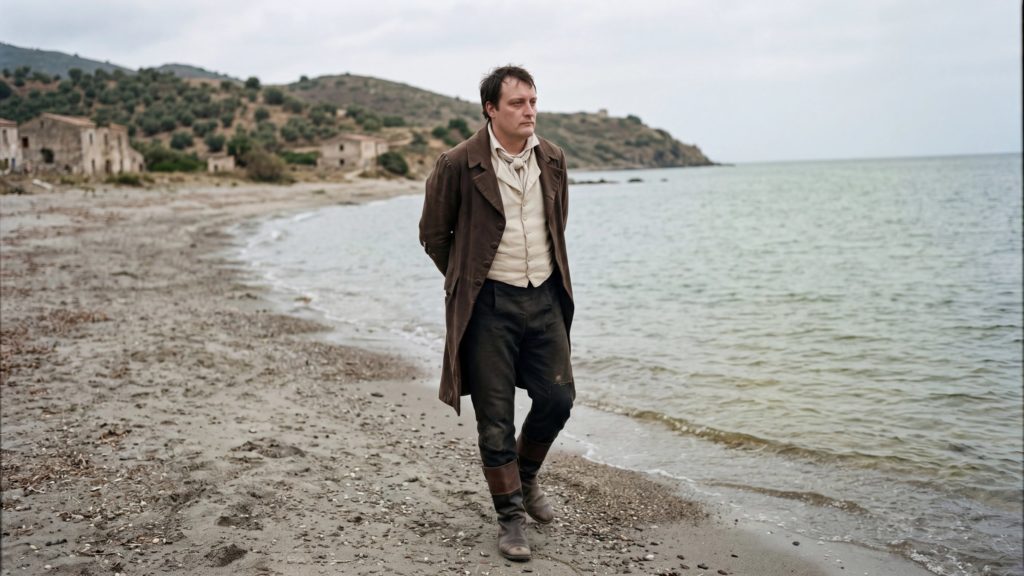
Napoleon at the oars off Elba's rocky coast, the sovereign principality left to him by the Treaty of Fontainebleau of 11 April 1814.
This small island was meant to be the end of Napoleon's story — instead it became the launchpad for one last chapter.
About the Place
Why it matters
Elba is a small island in the Mediterranean, a short sea crossing off the coast of Italy rather than a remote outpost in open ocean. That proximity to the mainland is the detail worth sitting with: whatever the Allied powers hoped to achieve by choosing it, this was not a place built to be escape-proof. Beyond its geography, this project's sources do not currently support firm claims about Elba's earlier history or governance, so those specifics are left for a later, better-sourced pass rather than guessed at here.
The exile began on paper: the Treaty of Fontainebleau, signed in April 1814, settled Napoleon's abdication and the terms of his removal, with a portion of the settlement made specifically for him[1]. Contemporary chroniclers treated the treaty as the hinge of the whole affair, discussed and re-discussed for years afterward[1]. This project's sources do not currently confirm the precise terms of his authority over the island itself, so those details are held back rather than assumed.
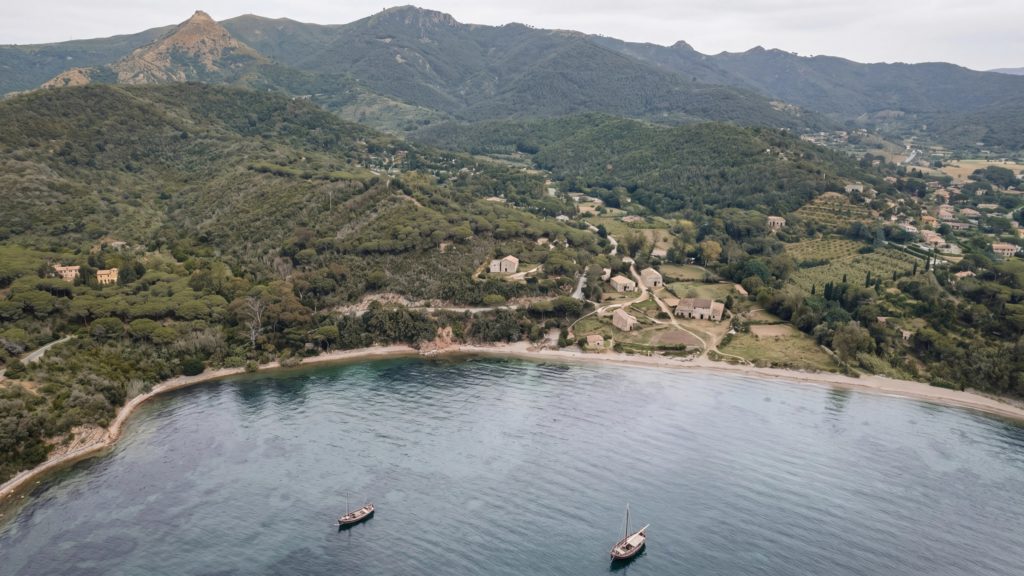
The moment this island is remembered for begins with a small boat rather than an army. Napoleon leaves Elba and comes ashore back in France not near his old exile route but at the Golfe Juan, close to Cannes[1]. Contemporary accounts frame what follows as its own named chapter — Les Cent Jours, the Hundred Days[1] — the sprint back to Paris and, eventually, to Waterloo. The exact date of departure is not confirmed in this project's current sources and is left open rather than stated as fact.
Elba is still an island people travel to today, marketed to visitors well into the twenty-first century — a 2009 island tourism and flying guide is one small piece of evidence of that ongoing pull[2]. This project's sources do not yet confirm specific present-day sites tied to Napoleon's residence there, such as any surviving villa, so those details are left for a later, better-sourced pass.
Legacy & Reputation
What’s the verdict?
Napoleon’s Elba exile sits awkwardly in his story: not quite punishment, not quite retirement, and — as later writers kept returning to it — never quite settled as a verdict on the man[1]. Was it the Allies’ fair compromise or their fatal mistake? Contemporary chroniclers were already replaying the abdication and its aftermath within a generation, treating it as unfinished business rather than a closed chapter[1] — and historians have kept arguing about it since.
Myth-buster
Think you know this one?
Myth: “The Hundred Days” sounds like a precise scorecard, as if someone counted. In fact, French writers were already using “Les Cent Jours” as a chapter title and rhetorical label for the whole return-to-Waterloo episode within decades of the event, not as a literal day-count[1].
Quick Facts
The essentials
Quick Facts
Roger would like you to know
Napoleon's ship into exile was a Royal Navy warship, HMS Undaunted, commanded by Captain Thomas Ussher, who gave up his own cabin for the fallen emperor. Napoleon reportedly told Ussher he had never slept so soundly[3].
Keith would like to clarify
The Briton assigned to keep watch over Napoleon on Elba was a real officer, Sir Neil Campbell, and his own diary of the exile was later published as Napoleon on Elba[4], giving historians an eyewitness's account from inside the exile itself.
One for the Ageonauts
Whole books exist about just the few weeks of the getaway itself, not the wider exile — Norman MacKenzie's The Escape from Elba covers nothing else[5]. If you want the blow-by-blow of the boat ride alone, that is where to start digging.
History gets strange here
The label "Les Cent Jours" — the Hundred Days — was not coined later for drama; French writers were already using it as a chapter heading within decades of the event[1], treating it as the era's own shorthand rather than a modern nickname.
Roger has a theory
Roger has a theory that Napoleon nearly detoured home: en route to Elba he asked his British captors to stop at Ajaccio, his Corsican birthplace, but stormy weather ruled it out[3]. So close, and yet so much sea.
Keith checked the sources
Keith checked the sources: when Napoleon slipped back into France, he did not retrace his old exile route at all. He came ashore at the Golfe Juan, near Cannes, hundreds of miles up the coast from Elba[1].
One for the geologists
Elba's fame is not only Napoleonic. The island's mineral-rich granite is still a live research subject, with geologists mapping its laccolith complex and iron-bearing rock in detail long after the emperor left[6].
Roger would like it on record
Roger would like it on record that Sir Walter Scott — yes, that Walter Scott — wrote about Napoleon's downfall and escape from Elba too, folding it into his sprawling Life of Napoleon Buonaparte[7].
Surviving the shelves
Books plainly titled Napoleon's Elba are not a recent publishing trend — one was already being catalogued over a century ago, in 1914[8], proof the story has been irresistible to writers for generations.
Keith found the paperwork
Keith found the paperwork: the settlement that sent Napoleon to Elba was not an informal understanding but a proper treaty, the Treaty of Fontainebleau, still cited by historians for the exact terms of his abdication[1].
“...never slept so soundly.”
Napoleon Bonaparte (as reported by Captain Thomas Ussher)
Reported by Captain Thomas Ussher of HMS Undaunted, describing Napoleon's night aboard ship during the voyage into exile, May 1814[3]
Timeline
How it unfolded
c. 8th century BC
Etruscans begin mining Elba's iron
The Etruscans began exploiting Elba's mines as early as the 8th century BC, and the island's mineral trade made the Etruscan aristocracy rich.[9] Another local history places the start at the end of the Iron Age, in the ninth to eighth century BC.[10]
1548
Cosimo I de' Medici founds Portoferraio
Portoferraio, Elba's main town, was founded by Cosimo I de' Medici, Grand Duke of Tuscany, in 1548 under the name Cosmopoli.[11] Bourrienne notes that Elba belonged to the Medici ducal house as an integral part of Tuscany.[12, p. 15]
4 May 1814
Napoleon arrives on Elba under the Treaty of Fontainebleau
Under the Treaty of Fontainebleau of 11 April 1814 Napoleon received Elba for life, and he landed there on 4 May 1814.[13][14] He embarked at Porto Ferrajo again on 26 February 1815, ending the exile.[15, p. 1]
1815
Congress of Vienna gives Elba to Tuscany
At the Congress of Vienna, Elba was given to the Grand Duchy of Tuscany.[16]
1860
Elba joins the Kingdom of Italy
In 1860 Elba became part of the newly unified Kingdom of Italy.[16]
Dig Deeper
Copy any prompt below into your favourite AI chat to keep exploring.
Walk me through how Napoleon slipped past the Royal Navy's watch around Elba and reached the French coast at the Golfe Juan undetected.
Debate whether granting Napoleon sovereignty over a small island so close to France was a fair peace settlement or a mistake that made his return almost inevitable.
Roleplay as one of Napoleon's Elba watchers, explaining to your superiors how the entire exile plan sailed off without you.
Further Reading
Where to read more
Elba
Britannica's encyclopaedia entry on the island of Elba, covering its geography and its year as Napoleon's principality in exile.
Why look at this: A fast, reliable orientation stop before diving into the escape story — good for checking the basic who/where before the drama starts.
https://www.britannica.com/place/Elba-island-ItalyNapoleon on Elba: Diary of an Eyewitness to Exile
The Fondation Napoléon's page on Sir Neil Campbell's published diary — the British commissioner who was actually stationed alongside Napoleon on the island.
Why look at this: This is the "who was watching him" angle: a first-hand account of the tensions, gossip and escape plotting the show only has time to summarise.
https://www.napoleon.org/en/magazine/publications/napoleon-on-elba-diary-of-an-eyewitness-to-exile/Treaty of Fontainebleau, 11 April 1814
The full primary-source text of the treaty that ended Napoleon's rule and sent him to Elba, including Article III granting him sovereignty over the island.
Why look at this: The actual paperwork behind bio_text_2 — useful for anyone who wants the legal terms of the exile rather than the summary of them.
https://www.napoleon-empire.org/en/official-texts/treaty-of-fontainebleau-1814.phpRelated
Keep exploring
People
Places



Can be seen in
Where this shows up

References
Sources
Sources
- BookSouvenirs contemporains d'histoire et de littérature by M. Villemain ↑
- BookFly To Holiday Elba Island Tourism Brochure. by www.flytoelba.com ↑
- Websiteneh.gov: Napoleon went exile aboard ship called undaunted ↑
- BookNapoleon on Elba by Neil Campbell ↑
- BookThe Escape from Elba by Norman MacKenzie ↑
- ResearchThe magmatic evolution of the late Miocene laccolith–pluton–dyke granitic complex of Elba Island, Italy by Andréa Dini, F. Innocenti and Sergio Rocchi ↑
- BookThe downfall of Napoleon: his escape from Elba, the battle of Waterloo, captivity in St. Helena, and death.… by Walter Scott ↑
- ArchiveNapolean's Elba ↑
- Websiteinfoelba.com: Rio marina iron capital ↑
- Websiteelbaworld.com: P 378 etruscans on elba ↑
- Websiteen.wikipedia.org: Portoferraio ↑
- BookMemoirs Of Napoleon Bonaparte - Iii And Iv by Louis Antoine Fauvelet De Bourrienne. Page 15. ↑
- BookMemoirs Of Napoleon Bonaparte - I And Ii by Louis Antoine Fauvelet De Bourrienne ↑
- BookNapoleon and the end of the French revolution by Charles F. Warwick ↑
- BookThe campaign of 1815, chiefly in Flanders by Walter Haweis James. Page 1. ↑
- Websiteen.wikipedia.org: Wiki / Elba ↑
- Websiteislepark.it: Decreti istitutivi ↑
- Websiteen.wikipedia.org: Arcipelago Toscano National Park ↑