
About This Map
What it shows
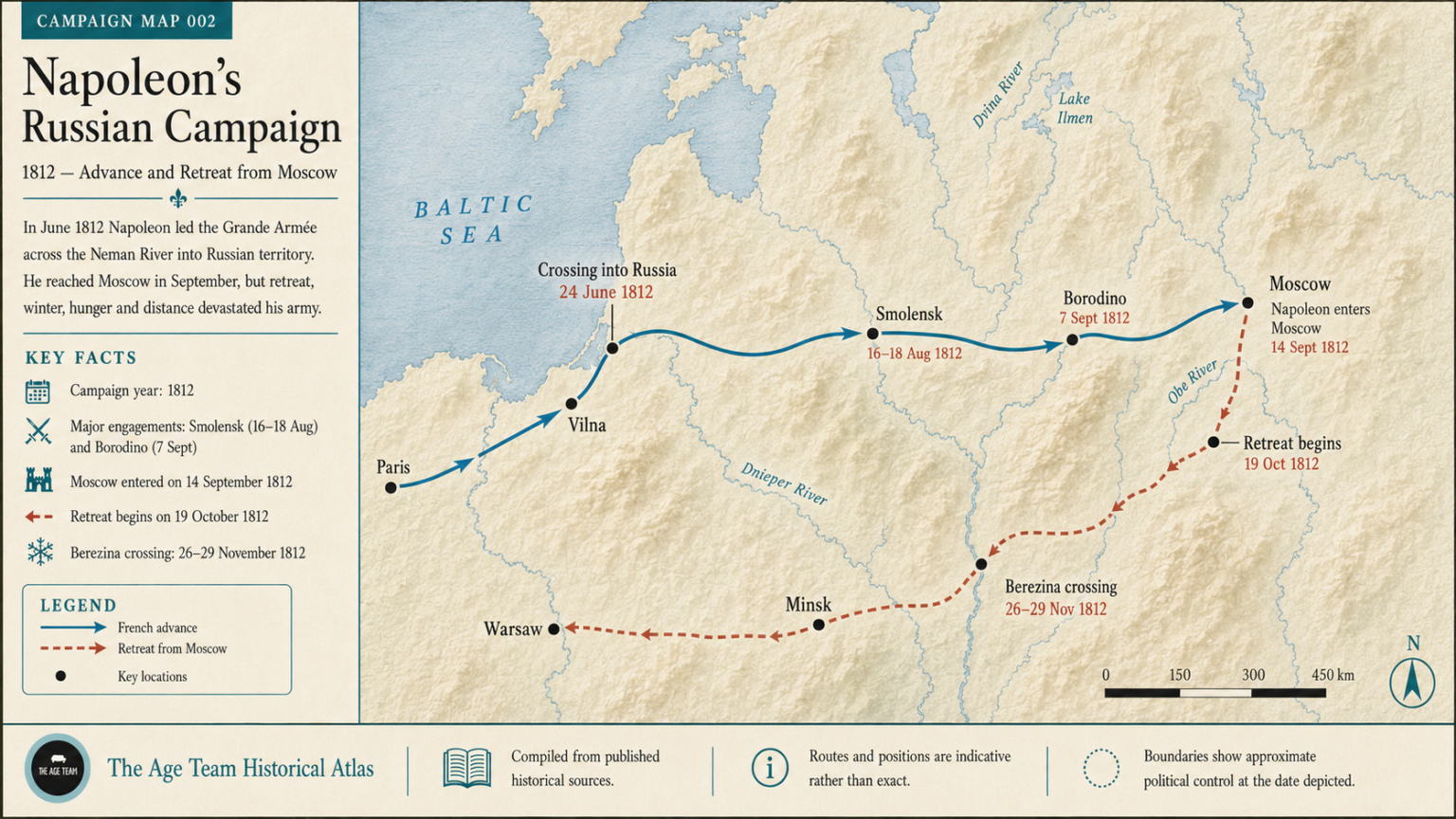
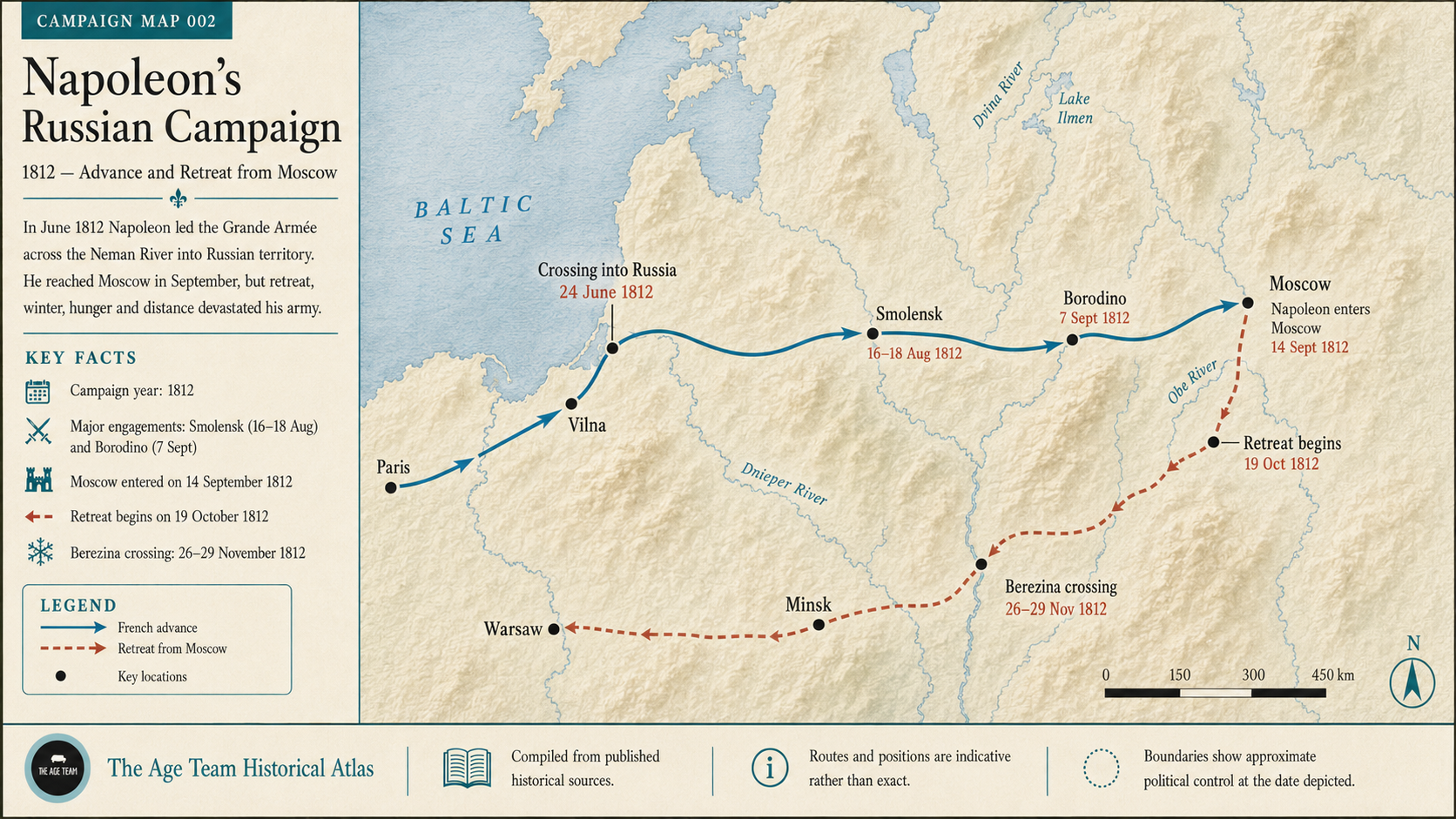
This map plots two very different lines of the same campaign on the same ground: the confident advance that crossed the Niemen on 24 June 1812 and pushed east through Smolensk to Borodino and Moscow, and the ragged retreat that retraced much of that route from 19 October, ending in catastrophe at the Berezina between 26 and 29 November. It shows why the campaign is remembered less for any single battle than for geography and logistics — the sheer distance from France to Moscow, and the fact that Kutuzov's blocking move at Maloyaroslavets forced Napoleon back onto a road his own army had already stripped bare on the way in. Tracking Smolensk, Borodino, and Moscow as waypoints on the advance, then watching the same names reappear on the retreat, makes visible how a Grande Armée roughly 600,000 strong was reduced to a fraction of that number by the time survivors reached Prussian territory in December. It is a campaign map of an army's arc from confidence to collapse, not just a record of troop movements.
Quick Facts
The essentials
Quick Facts
"There is but one step from the sublime to the ridiculous."
Napoleon Bonaparte, as recorded by the Abbé de Pradt
Said in Warsaw around 10 December 1812, during Napoleon's rushed journey back to Paris after abandoning the army at Smorgon; de Pradt — his ambassador to the Duchy of Warsaw — published the remark afterward, and it stands as Napoleon's own verdict on how fast the campaign had turned from triumph to disaster.
Timeline
How it unfolded
7 July 1807
Treaty of Tilsit Binds Russia to the Continental System
Napoleon and Alexander I signed the first of the Treaties of Tilsit on 7 July, meeting on a raft in the middle of the Neman.[1] Ségur called the treaty the date of Russia's submission to the continental system.[2, p. 1]
31 December 1810
Alexander I Abandons the Continental System
Ségur reports Napoleon's complaint that Alexander, by his ukase of 31 December 1810, had abandoned the continental system and by his prohibitions declared an actual war against French commerce.[2, p. 1]
24 June 1812
Grande Armée Crosses the Niemen
Wilson records that French troops crossed the Niemen under Napoleon's immediate orders on 24 June 1812, commencing the invasion of Russia, and that Napoleon established his headquarters at Kowno that evening.[3, p. 20]
7 September 1812
Battle of Borodino
Ségur's contents list places the battle of Borodino on 7 September.[2] Wilson describes the French opening fire from their right battery at six that morning, with a thousand French guns against 640 Russian.[3, p. 20]
14 September 1812
French Enter Moscow
Caulaincourt's editor dates Murat's entry into Moscow to midnight on 14 September 1812.[4, p. 403] Ségur says Murat's cavalry found the city in complete solitude and that Napoleon did not enter until after dark, when he was warned of preparations for a conflagration.[2, p. 1]
19 October 1812
Napoleon Leaves Moscow
Ségur records that Napoleon left Moscow on 19 October, announcing his intention to return to the frontiers of Poland by Kalouga and Smolensk.[2, p. 1]
26-29 November 1812
Crossing of the Berezina
The Battle of the Berezina between the Grande Armée and the Imperial Russian Army took place from 26 to 29 November 1812.[5] Ségur describes the bridges at Studzianka breaking down repeatedly, and the Russians attacking them from both banks on 28 November.[2, p. 1]
14 December 1812
Grande Armée Reduced to a Remnant
Wilson states that on 14 December the central body of the army that had crossed the Niemen on 24 June mustered only four hundred infantry and six hundred cavalry.[3, p. 20]
30 December 1812
Yorck's Convention at Tauroggen
Wilson prints Yorck's letters of 30 December 1812 from Tauroggen, telling Marshal Macdonald and the King of Prussia that he had concluded a convention with the Russian Major-general Diebitch rather than sacrifice his troops.[3, p. 20]
Dig Deeper
Copy any prompt below into your favourite AI chat to keep exploring.
1812 French invasion of Russia retreat Berezina crossing
the map where the arrow forgets the way home
spot the exact spot the road gets used twice
Further Reading
Where to read more
French Invasion of Russia (Britannica)
Britannica's overview of the 1812 campaign, from the Niemen crossing to the retreat's near-annihilation of the Grande Armée.
Why look at this: Confirms the casualty scale in one place — of the roughly 600,000 troops Napoleon led into Russia, around 500,000 became casualties, the overwhelming majority from disease, cold, and starvation rather than combat.
https://www.britannica.com/event/French-invasion-of-RussiaMoscow 1812: Napoleon's Fatal March (US title: 1812: Napoleon's Fatal March on Moscow) by Adam Zamoyski
Zamoyski's widely-praised narrative history of the invasion and retreat, drawing on French, Russian, Polish, German and Italian eyewitness accounts from both sides of the campaign.
Why look at this: Reconstructs the campaign from multiple national perspectives at once, including the Russian side that is largely missing from older French-authored accounts like Foord's or Fézensac's.
https://en.wikipedia.org/wiki/Moscow_1812:_Napoleon%27s_Fatal_MarchA Journal of the Russian Campaign of 1812, by Raymond-Aymery-Philippe-Joseph de Montesquiou-Fézensac (trans. W. Knollys, 1852)
The actual day-by-day campaign journal of a French officer who served through the advance, the occupation of Moscow, and the retreat, including the Berezina crossing — held in full in this project's library.
Why look at this: A genuine eyewitness primary source rather than a later reconstruction: it contains the direct account of Marshal Ney's rearguard actions and the anecdote of Ney arriving at Gumbinnen declaring he had fired the army's last shot at Kovno.
https://archive.org/details/ajournalrussian00montgoogRelated
Keep exploring



Can be seen in
Where this shows up

References
Sources
Sources
- Websiteen.wikipedia.org: Treaties of Tilsit ↑
- BookHistory of the Expedition to Russia Undertaken by the Emperor Napoleon in the Year 1812 by Philippe-Paul de Ségur. Page 1. ↑
- BookNarrative of Events during the Invasion of Russia by Napoleon Bonaparte and the Retreat of the French Army… by Sir Robert Thomas Wilson. Page 20. ↑
- BookWith Napoleon in Russia: The Memoirs of General de Caulaincourt Duke of Vicenza by Armand-Augustin-Louis de Caulaincourt. Page 403. ↑
- Websiteen.wikipedia.org: Battle of Berezina ↑