
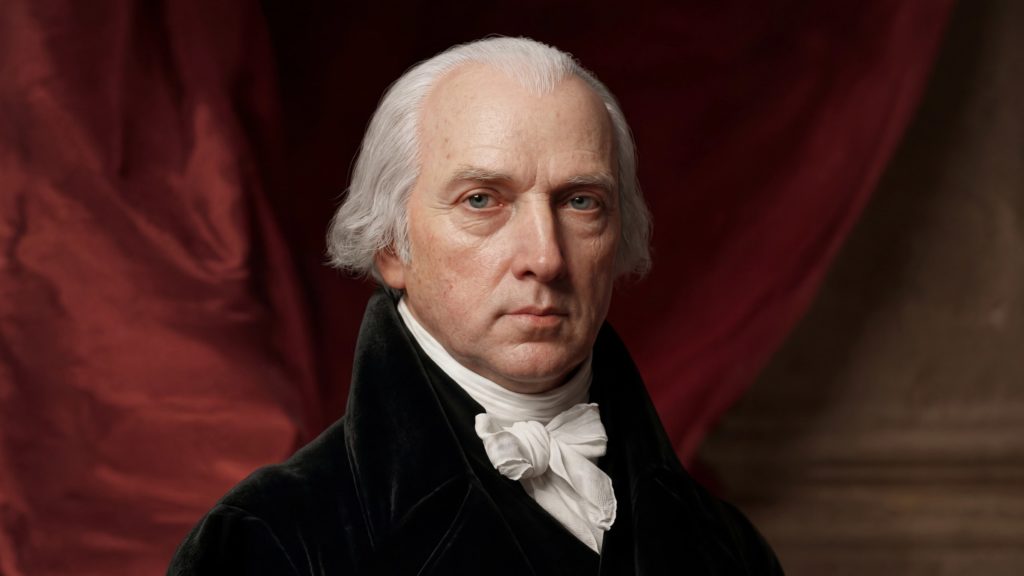
James Madison
Fourth President of the United States; principal architect of the Constitution and the Bill of Rights; co-founder of the Democratic-Republican Party
Small and often unwell[1], the eldest child of a Virginia planter family[1] became the delegate whose own "Virginia Plan"[2, p. 1] shaped the entire Constitutional Convention — then spent his own presidency defending the government he had built, through a war that reached the White House itself[3, p. 22].
Bio
Who they were
James Madison was born on 16 March 1751 at Port Conway, in King George County, Virginia[4, p. 24], the eldest child of the Virginia planter James Madison Sr. and Nelly Conway Madison[5]. He grew up at Montpelier, the family's Orange County plantation, which his father was expanding into the house Madison would call home for most of his life[3, p. 4]. He was small and physically frail as a young man, a description that followed him into adulthood[1]. Despite his health, he was an exceptional student, and in 1769 he travelled north to Princeton, in New Jersey, rather than attending Virginia's own College of William & Mary[6].
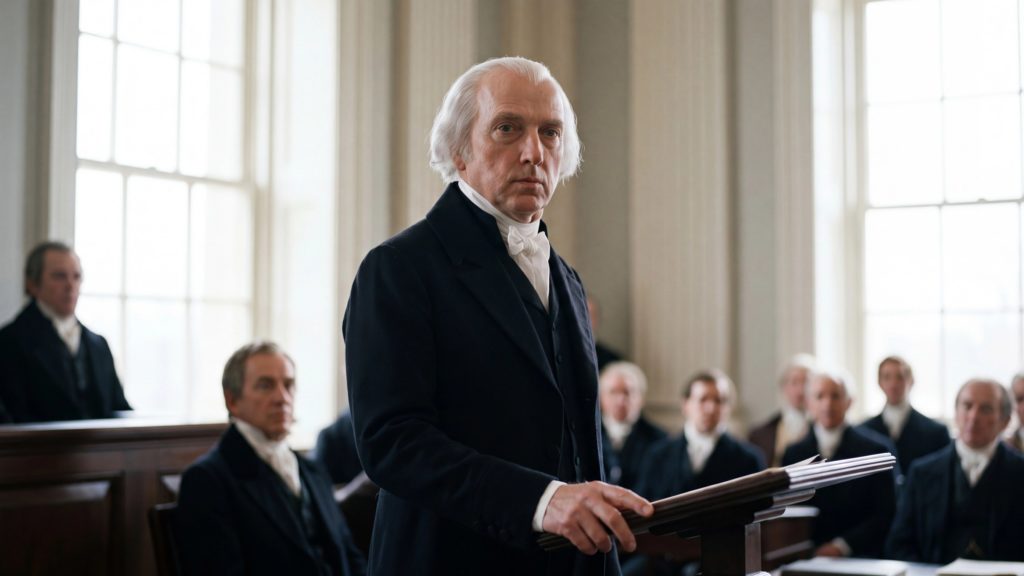
After Princeton, Madison returned to Virginia and threw himself into the politics of the Revolution, serving in the state legislature alongside men twice his age. His real influence began at the 1787 Constitutional Convention in Philadelphia, where he arrived having prepared more thoroughly than almost anyone else in the room. He drafted the "Virginia Plan," a framework for a stronger national government that became the starting point for the entire debate[2, p. 1]. He also kept detailed private notes on the Convention's closed-door debates, which later became the fullest surviving record of how the Constitution was actually argued over[7]. That combination of preparation and record-keeping is why he is remembered as its principal architect[8].
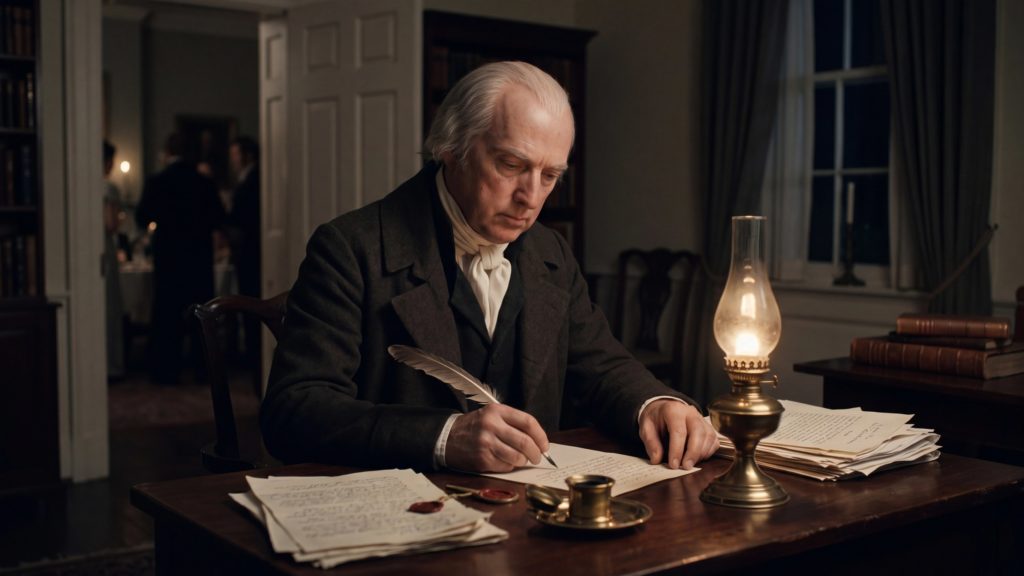
Madison's defining achievement was the Constitution itself: contemporaries and later historians alike called him its "Father," because his Virginia Plan and his convention notes shaped so much of the final document[8]. He then helped sell that Constitution to a skeptical public, co-writing the Federalist Papers with Alexander Hamilton and John Jay — Madison alone wrote twenty-nine of the eighty-five essays[9]. As a new congressman, he kept working: he drafted the Bill of Rights, the first ten amendments guaranteeing rights the original Constitution had left unwritten[8]. Decades later, as president, he led the country through the War of 1812 against Britain, a conflict serious enough that British troops burned Washington's White House in 1814 while he was away with the army near Bladensburg[10, p. 24].
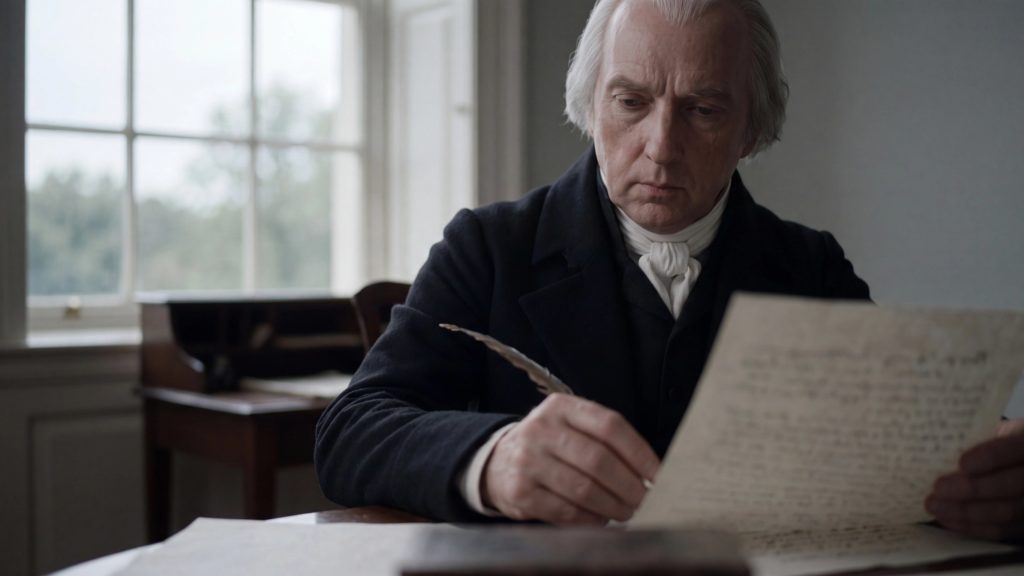
Madison retired from the presidency in 1817 and returned permanently to Montpelier with his wife, Dolley[3, p. 12]. He spent his last two decades farming, managing his correspondence, and defending his own record as the Constitution's framer, growing increasingly frail with age[10, p. 29]. He died at Montpelier on 28 June 1836[11], one of the last major figures still living from the generation that had built the American government from scratch.
Madison's influence outlasted his presidency by design: the Constitution and Bill of Rights he helped shape are still the basic operating document of the United States government, and the party system he helped found — first as the Democratic-Republicans, allied with Thomas Jefferson — set a pattern of organized political opposition that has shaped American politics ever since[8]. His Federalist Papers essays, especially on the dangers of concentrated power, are still assigned reading in law and political science courses, treated as some of the clearest contemporary explanations of why the Constitution was built the way it was[12].
Madison enslaved people throughout his life at Montpelier, including Paul Jennings, who worked in his household and later published his own memoir of the president. Jennings described Madison as a kind master[11] — a description that sits uneasily next to the basic fact of Madison holding him, and others, in bondage while writing some of history's clearest arguments for liberty.
Legacy & Reputation
What’s the verdict?
Historians have increasingly weighed Madison’s towering intellectual legacy against his lifelong ownership of enslaved people at Montpelier, treating that tension as central to understanding him rather than a footnote to set aside[3, p. 12]. His reputation as the Constitution’s sole “Father” has also softened over time: Madison himself rejected the label outright, insisting late in life that the document was “not the offspring of a single brain,” but the work of “many heads and many hands”[13, p. 1833].
Myth-buster
Think you know this one?
Madison is often called the sole “Father of the Constitution,” but he rejected that title himself, writing late in life that the document was not the work of one mind but the offspring of “many heads and many hands”[13, p. 1833].
Quick Facts
The essentials
Quick Facts
Roger would like you to know…
James Madison was small and famously frail his whole life[1] — not exactly the physical presence you'd expect from the man who out-argued an entire room of larger, louder delegates at the Constitutional Convention.
Keith checked the sources…
Madison is remembered as the "Father of the Constitution," but he hated the title. Late in life he insisted the document was "not the offspring of a single brain" but the work of "many heads and many hands"[13, p. 1833].
One for the Ageonauts…
Of the eighty-five essays making up the Federalist Papers, Madison personally wrote twenty-nine, working alongside Alexander Hamilton and John Jay to convince a skeptical public to ratify the very Constitution he had just helped write[9].
Roger has a theory…
Roger reckons drafting your own opening proposal is the ultimate power move — because Madison wrote the "Virginia Plan," the framework that set the terms for the entire Constitutional Convention debate before anyone else got a word in[2, p. 1].
History gets strange here…
As president, Madison watched the War of 1812 reach his own front door: British troops occupied Washington and burned the White House in 1814 while he was away with the army near Bladensburg[10, p. 24].
Keith would like to clarify…
Madison's Bill of Rights wasn't an afterthought bolted onto the Constitution — it was Madison himself, as a freshman congressman, who drafted the first ten amendments to answer critics who said the original document didn't protect individual liberties clearly enough[8].
The past has entered the chat…
Madison enslaved people throughout his life at Montpelier, including Paul Jennings, who later wrote his own memoir describing Madison as a kind master[11] — a verdict that sits oddly next to the basic fact of his enslavement.
Roger says, “Hear me out…”
Madison studied at Princeton rather than Virginia's own College of William & Mary[6] — a choice Roger insists secretly explains half of early American political rivalry, since so many of the Founders seem to have gone to a different college than the one down the road.
Keith has spotted the quotation problem…
There's no reliable record of Madison composing memorable one-liners for effect — that was more Jefferson's department. Madison's most quoted line, about the Constitution not being "the offspring of a single brain," is really him deflecting credit, not claiming it[13, p. 1833].
Meanwhile, in history…
Madison spent his last two decades quietly farming at Montpelier and defending his own record as the Constitution's chief drafter[10, p. 29] — a retirement spent, essentially, fact-checking his own biography before anyone else could get it wrong.
...parchment barriers against the encroaching spirit of power...
Writing as "Publius" in Federalist No. 48[16]
Madison's argument for why a bill of rights written on paper alone would not stop a branch of government from over-reaching — part of the reasoning behind the actual enforcement mechanisms later built into the Constitution.
Timeline
How it unfolded
16 March 1751
Birth of James Madison
James Madison, the first child of his parents, was born on 16 March 1751 (5 March Old Style) at Port Conway, Virginia.[11][11][6][17]
29 May 1787
Virginia Plan at the Constitutional Convention
Edmund Randolph laid the Virginia Plan before the Constitutional Convention on 29 May 1787, a plan whose chief author was Madison, later often called the father of the Constitution.[2, p. 1][1][8]
8 June 1789
Madison Proposes Amendments
Madison proposed amendments to the Constitution in the House of Representatives on 8 June 1789, and ten of the amendments were ratified by 1791 as the Bill of Rights.[18, p. 1][19, p. 434][20]
15 September 1794
Marriage to Dolley Payne Todd
Madison, then forty-three, married the widow Dolley Payne Todd at Harewood on 15 September 1794; Aaron Burr is credited with having introduced them.[17][20]
1801
Madison Becomes Secretary of State
Following Jefferson's election, Madison served as secretary of state under President Thomas Jefferson from 1801 to 1809, the nation's chief diplomat.[17][20]
4 March 1809
Inauguration of James Madison
Madison was inaugurated as the fourth President of the United States on 4 March 1809.[14][1]
18 June 1812
Declaration of War on Britain
The United States declared war on Great Britain on 18 June 1812, the war's declaration carrying Madison's approval as President.[10, p. 21][21, p. 887]
28 June 1836
Death of James Madison
Madison died at Montpelier, his home in Orange County, Virginia, on 28 June 1836.[4, p. 24][1]
Dig Deeper
Copy any prompt below into your favourite AI chat to keep exploring.
Democratic-Republican Party origins, 1790s
why the same men who wrote the rules ended up refusing to follow each other
the constitution's co-author who built a party against his own government
Further Reading
Where to read more
James Madison — Britannica
A concise, single-page overview of Madison's life, from his Virginia upbringing through the Constitutional Convention to his presidency and retirement.
Why look at this: The fastest way to get the full arc of Madison's career in one sitting before going deeper into any single part of it.
https://www.britannica.com/biography/James-MadisonJames Madison — Miller Center Presidential Biography
The University of Virginia's Miller Center biography, with linked essays on Madison's life before the presidency, his domestic and foreign policy, and his legacy, including his relationship to slavery at Montpelier.
Why look at this: Goes well beyond the Constitution to cover the eight years of Madison's actual presidency, including the War of 1812 and the burning of the White House, in more depth than a general overview.
https://millercenter.org/president/madisonThe James Madison Papers — Library of Congress
The Library of Congress's digitized collection of roughly 12,000 original Madison manuscripts, spanning 1723 to 1859, including his own notes on the Constitutional Convention debates.
Why look at this: Lets a reader go past any biography and read Madison's actual convention notes and correspondence — the primary record his "Father of the Constitution" reputation is built on.
https://www.loc.gov/collections/james-madison-papers/Related
Keep exploring





Can be seen in
Where this shows up

References
Sources
Sources
- DocumentThe Presidents of the United States, 1789-1914/James Madison ↑
- WebsiteThe Virginia Plan (1787) and Resource Materials (National Archives). Page 1. ↑
- WebsiteMemories of Montpelier: Home of James and Dolley Madison (National Park Service, Teaching with Historic Places / ERIC). Pages 4, 12, 22. ↑
- BookJames Madison's notes of debates in the Federal convention of 1787 and their relation to a more perfect… by James Brown Scott. Page 24. ↑
- DocumentThe Encyclopedia Americana (1920)/Madison, James ↑
- BookFamous presidents : Washington, Jefferson, Madison, Lincoln, Grant by Helen M. Campbell ↑
- BookThe Journal of the Debates in the Convention which Framed the Constitution of the United States, May-September 1787.… by James Madison and United States. Constitutional Convention ↑
- BookBiographical story of the Constitution, a study of the growth of the American Union by Edward Elliott ↑
- BookJames Madison by Sydney Howard Gay ↑
- WebsiteDolley Madison Program Transcript (PBS American Experience). Pages 21, 24, 29. ↑
- BookJames Madison by Sydney Howard Gay ↑
- BookThe Federalist Papers – Hamilton, Madison & Jay on the U.S. Constitution by James Madison Alexander Hamilton ↑
- BookLetters and other writings of James Madison by James Madison. Page 1833. ↑
- BookTHE LIFE OF JAMES MADISON by GAILLARD HUNT ↑
- BookA Compilation of the Messages and Papers of the Presidents. Volume 1, part 4: James Madison ↑
- BookThe federalist : a collection of essays by James Madison Alexander Hamilton ↑
- Websitepjm.as.virginia.edu: Madison timeline ↑
- WebsiteThe Bill of Rights: Center for Legislative Archives Handout (National Archives). Page 1. ↑
- BookAbraham Lincoln: The People's Leader in the Struggle for National Existence by George Haven Putnam. Page 434. ↑
- Websitemillercenter.org: Life before the presidency ↑
- BookHistory of the wars occasioned by the French revolution, from the commencement of hostilities in 1792, to the… by C. H Gifford. Page 887. ↑