
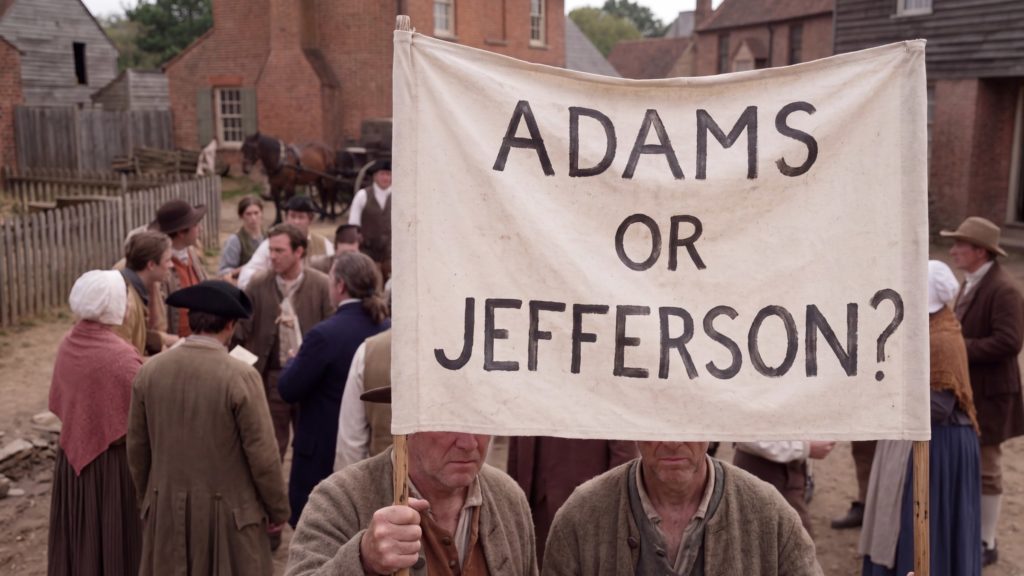
Presidential Election of 1800
A tie nobody planned for nearly broke America's brand-new system of government: Jefferson and his own running mate tied in the electoral college.[1, p. 236]
What Happened
The story
In 1800, incumbent Federalist President John Adams faced Democratic-Republican challenger Thomas Jefferson in a bitterly contested rematch[2, p. 13], fought amid deep rivalry between the two young parties[3].
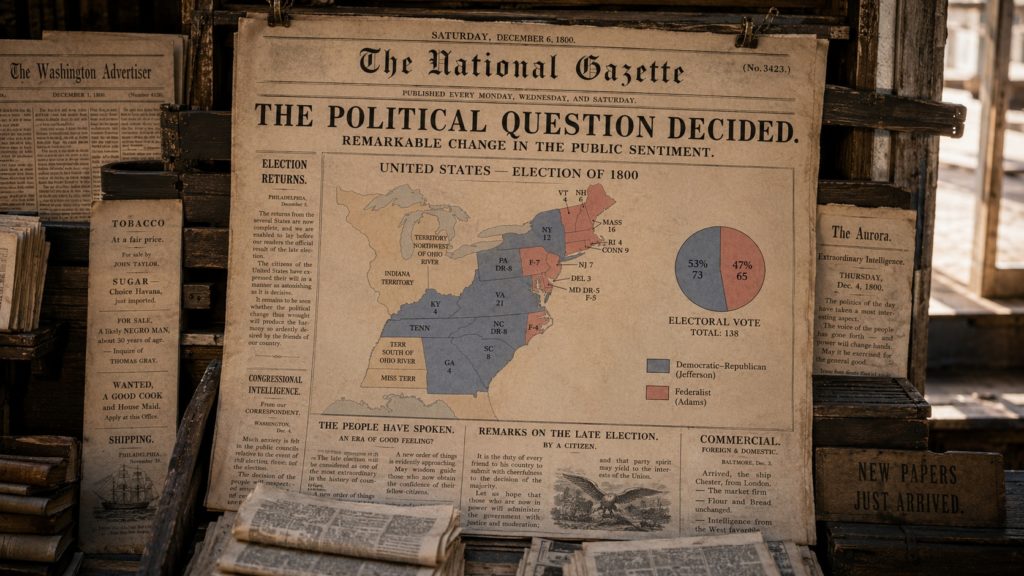
Under the electoral system then in force, each elector cast two undifferentiated votes for president, with no separate ballot for vice president. Jefferson's running mate Aaron Burr ended up matching him vote for vote[1, p. 236], producing an unintended tie between the two Democratic-Republicans rather than a clear Jefferson win.
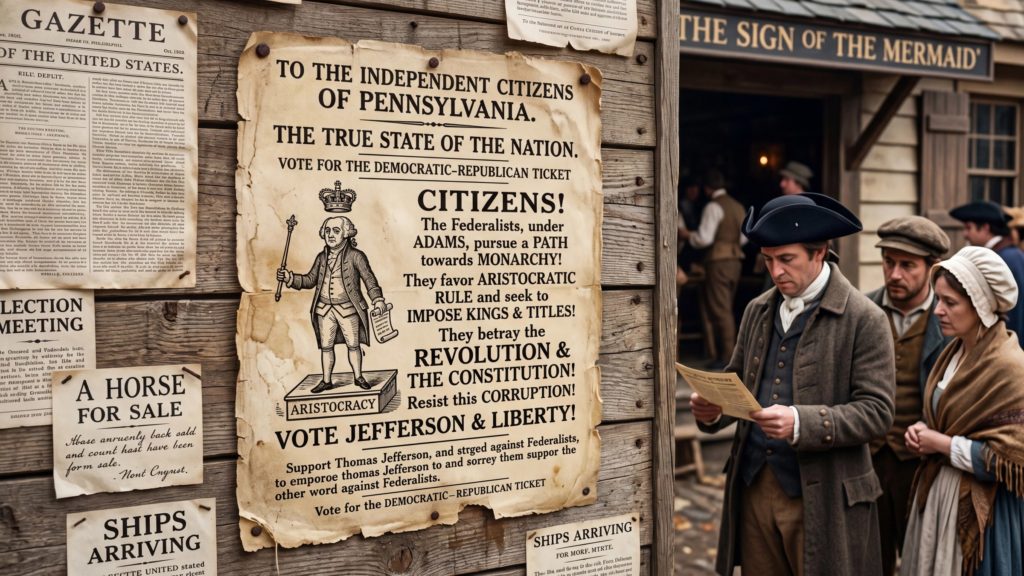
With neither candidate holding a majority, the deadlocked election was thrown to the House of Representatives to decide[4, p. 3]. After a prolonged standoff, Alexander Hamilton, though no ally of Jefferson, reluctantly threw his influence behind him over Burr, finally breaking the tie[5].
Jefferson was declared president in early 1801. Historians have since described the peaceful resolution of the crisis as a moment that helped secure the American Revolution's republican experiment[2, p. 25]. The near-crisis also exposed a flaw in the electoral system, corrected by Congress with the Twelfth Amendment, ratified in 1804[6, p. 1].
Quick Facts
The essentials
Quick Facts
Democratic-Republican Party
Leadership
Thomas Jefferson, who was declared president in early 1801.[8]
Forces
Thomas Jefferson and Aaron Burr[2, p. 13], and their party's electors
Objective
To win the presidency for the Democratic-Republican party
Federalist Party
Leadership
John Adams, the incumbent Federalist president.[2, p. 13]
Forces
John Adams and the Federalist party's electors[2, p. 13]
Objective
To retain the presidency for the Federalist party
The Bigger Picture
Fought amid deep partisan rivalry between the young Federalist and Democratic-Republican parties[3].
How It Came To This
Under the electoral system then in force, each elector cast two undifferentiated votes for president, with no separate ballot for vice president; Jefferson's running mate Aaron Burr ended up matching him vote for vote[1, p. 236], producing an unintended tie.
What Actually Happened
Incumbent Federalist President John Adams faced Democratic-Republican challenger Thomas Jefferson[2, p. 13]. Jefferson and his running mate Aaron Burr tied in the electoral college[1, p. 236], and with neither holding a majority, the deadlocked election was thrown to the House of Representatives to decide[4, p. 3]. After a prolonged standoff, Alexander Hamilton, no ally of Jefferson, reluctantly threw his influence behind him over Burr, finally breaking the tie[5].
Why It Still Matters
Historians have described the peaceful resolution of the crisis as a moment that helped secure the American Revolution's republican experiment[2, p. 25]. The near-crisis also exposed a flaw in the electoral system, which Congress corrected with the Twelfth Amendment, ratified in 1804, requiring separate ballots for president and vice president[6, p. 1].
Quick Facts
Roger has counted the votes…
Jefferson and his own running mate Aaron Burr tied at 73 electoral votes each in 1800, with Adams trailing on 65[9, p. 142] — meaning Jefferson's biggest rival for the presidency wasn't Adams at all, but his own ticket.
Keith counted the ballots…
Breaking that tie took the House of Representatives thirty-six separate ballots[10, p. 447], spread across nearly a week of deadlock while the young republic waited to find out who would actually be president.
One for the Ageonauts…
Alexander Hamilton, no friend of Jefferson's, lobbied fellow Federalists to back him over Burr anyway in 1801, judging Burr the more dangerous man to hand the presidency to[11, p. 525].
Keith found the fine print…
The mess exposed a real flaw in the Constitution: electors hadn't been voting separately for president and vice-president at all[12, p. 7], a gap patched only in 1804 by the Twelfth Amendment[6, p. 1].
Roger has entered the newsroom…
Journalist James Callender published attacks on Adams so scurrilous that even Jefferson's own allies grew uneasy about the assistance he'd given him[13] — nasty campaign press is not a modern invention.
Meanwhile, history was watching…
By 4 March 1801, the United States had pulled off something no other nation had yet managed: a first peaceful transfer of executive power between rival parties, described by one modern account as the first in the western world[14, p. 5].
Keith has spotted Delaware's decisive vote…
One state broke the deadlock. Delaware's sole House member, Federalist James Bayard, was among the holdouts whose shift finally handed Jefferson the majority he needed on 17 February 1801[11, p. 525].
Roger insists this matters…
Adams and Jefferson had been close revolutionary allies before becoming bitter rivals by 1800, a personal falling-out serious enough that historians still treat their contest as a case study in how friendship curdles into politics[2, p. 1].
Down the rabbit hole we go…
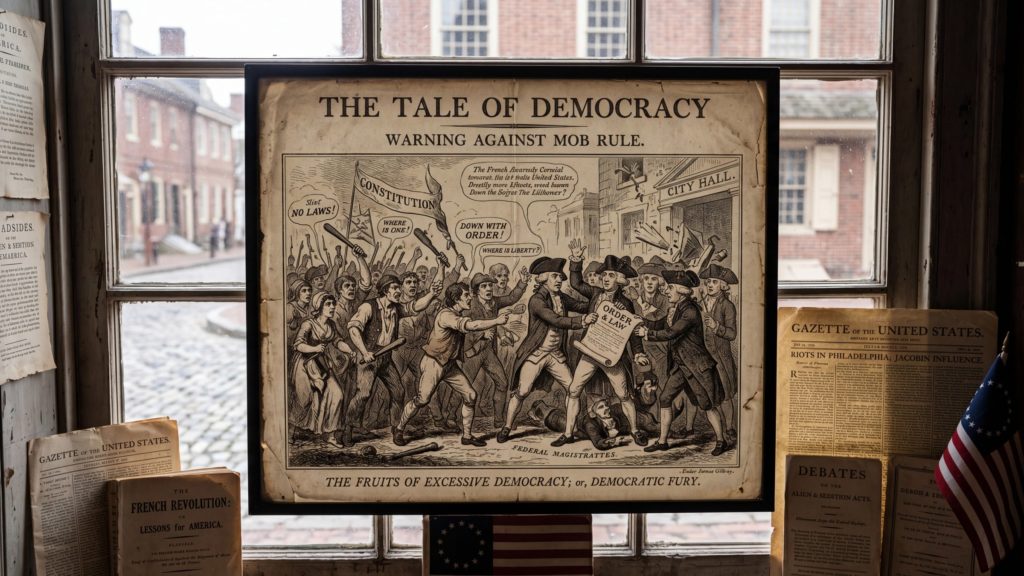
The bitterness of 1800 had roots in 1798's Alien and Sedition Acts, which let the Adams administration prosecute critics for seditious writings, feeding Democratic-Republican fears that Federalists meant to silence all opposition[15].
History has added a footnote…
George Washington's own Farewell Address in 1796 had already warned against the ‘spirit of party’ dividing the young republic[16, p. 19]. By the next election, the very fight he feared was the biggest show in American politics.
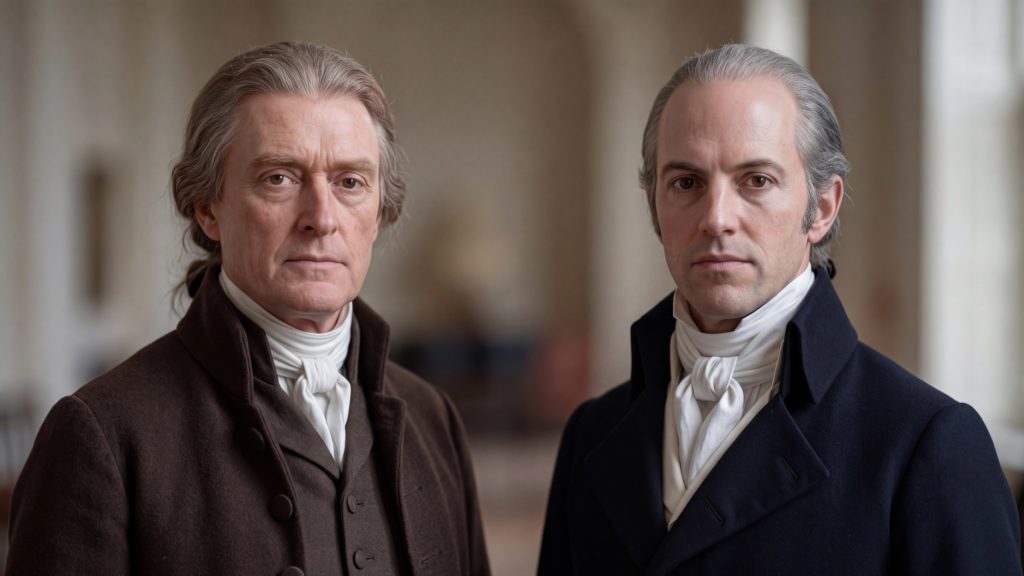
That was as real a revolution in the principles of our government as that of 1776 was in its form.[7, p. 202]
Thomas Jefferson
Jefferson's own later description of his 1800 election victory, reflecting on the significance of the peaceful transfer of power from the Federalists to his Democratic-Republicans[7, p. 202].
Timeline
How it unfolded
14 July 1798
Sedition Act Enacted
The Federalist Congress enacted the Sedition Act, making any false, scandalous and malicious writing against the government a high misdemeanor.[17, p. 7] Federalists overreached with the Alien and Sedition Acts, which contributed largely to the downfall of their party.[18]
December 1800
Hamilton Urges Federalists to Back Jefferson
Alexander Hamilton, no friend of Jefferson, warned fellow Federalists that Burr was the more dangerous man, though many dismissed his advice.[2, p. 30]
3 December 1800
Electors Cast Their Ballots
Presidential electors cast their votes in the states by 3 December 1800, each casting two votes with no distinction between president and vice president.[19] Every Republican elector voted for both Jefferson and Burr, so the two finished level on 73 votes, ahead of John Adams with 65.[11][20]
11 February 1801
Electoral Votes Counted and House Balloting Begins
The count of electoral votes confirmed the tie between Jefferson and Burr, and the Federalist-controlled House began voting by state during a snowstorm.[21][22] On the first ballot Jefferson carried eight states, Burr six, and two were divided.[23]
17 February 1801
House Elects Jefferson on the 36th Ballot
After thirty-five deadlocked ballots, Jefferson was declared elected on the thirty-sixth, winning ten states to Burr's four while Delaware and South Carolina cast blank ballots.[24, p. 282] Burr's own memoirs also date the thirty-sixth ballot to 17 February.[8] The deadlock ended after Federalists, including James Bayard of Delaware, abstained, possibly influenced by Hamilton.[22]
4 March 1801
Jefferson's Inauguration
Jefferson took the oath of office before both houses of Congress and delivered his inaugural address, with Burr as vice president.[25, p. 277] Jefferson later called the change of 1800 as real a revolution in the principles of the government as that of 1776 was in its form.[26]
12 December 1803
Twelfth Amendment Proposed
The alarm caused by Burr's rivalry with Jefferson led Congress to propose an amendment requiring electors to name their choices for president and vice president separately.[27] The Eighth Congress proposed it to the state legislatures on 12 December 1803.[12, p. 7]
25 September 1804
Twelfth Amendment Declared Ratified
The Secretary of State proclaimed the Twelfth Amendment ratified by three-fourths of the states, ending the tie-prone double-vote system of 1800.[12, p. 7] It was ratified by fourteen of the then seventeen states in 1804.[28]
Dig Deeper
Copy any prompt below into your favourite AI chat to keep exploring.
Explain exactly how the electoral tie between Jefferson and Aaron Burr happened in 1800, and how the House of Representatives finally broke it.
What does it say about the Constitution's design that a mechanical flaw, not a political disagreement, nearly decided who became president in 1800?
Roleplay Alexander Hamilton trying to convince fellow Federalists that Aaron Burr is somehow the worse option.
Further Reading
Where to read more
United States presidential election of 1800 — Britannica
Encyclopaedia Britannica's overview of the 1800 election, its candidates, the Jefferson-Burr electoral tie, and its outcome.
Why look at this: A clear, concise walk-through of how a straightforward Jefferson-versus-Adams contest turned into a constitutional crisis over Jefferson's own running mate.
https://www.britannica.com/event/United-States-presidential-election-of-1800How the Rivalry Between Hamilton and Burr Influenced the Election of 1800 — Monticello (Thomas Jefferson Foundation)
A fuller narrative from the Thomas Jefferson Foundation on how Alexander Hamilton's long-running hostility toward Aaron Burr shaped the outcome of the House's deadlocked vote.
Why look at this: Explains the personal rivalry behind the numbers — why a Federalist who despised Jefferson's politics still worked to hand him the presidency over Burr.
https://www.monticello.org/stories/how-the-rivalry-between-hamilton-and-burr-influenced-election-of-1800Election of 1800 — Creating the United States, Library of Congress
A Library of Congress exhibit drawing on its manuscripts, broadsides, newspapers and government documents from the 1800 campaign and the House's February 1801 resolution.
Why look at this: Puts the actual campaign material — broadsides, partisan newspapers, and the official House records of the thirty-six ballots — in front of you rather than a modern retelling.
https://www.loc.gov/exhibits/creating-the-united-states/election-of-1800.htmlRelated
Keep exploring





Can be seen in
Where this shows up

References
Sources
Sources
- BookThe greatest American, Alexander Hamilton; an historical analysis of his life and works together with a symposium of… by Arthur H. Vandenberg. Page 236. ↑
- WebsiteAlexander Hamilton's Rhetorical Abilities (Jennifer Patterson, Western Oregon University, HST 499). Pages 1, 13, 25, 30. ↑
- BookLife and public services of John Quincy Adams, sixth President of the United States, with the eulogy delivered… by William H. Seward ↑
- WebsiteAlexander Hamilton Curriculum (Museum of American Finance). Page 3. ↑
- BookERIC ED461607: Tally of the 1824 Electoral College Vote. The Constitution Community: Revolution and the New Nation (1754-1820s). by ERIC ↑
- WebsiteThe Burr Treason Trial: Federal Trials and Great Debates Teacher Handout (Federal Judicial Center). Page 1. ↑
- BookThe writings of Thomas Jefferson : being his autobiography, correspondence, reports, messages, addresses, and other writings, official and… by Thomas Jefferson. Page 202. ↑
- BookMemoirs of Aaron Burr, Complete by Aaron Burr ↑
- BookMemoirs of Aaron Burr : with miscellaneous selections from his correspondence by Aaron Burr and Matthew L. Davis. Page 142. ↑
- BookMemoirs of John Quincy Adams, comprising portions of his diary from 1795 to 1848 by John Quincy Adams. Page 447. ↑
- BookAaron Burr, his personal and political relations with Thomas Jefferson and Alexander Hamilton by Isaac Jenkinson. Page 525. ↑
- WebsiteConstitution of the United States of America - 1787 (Library of Congress, U.S. Code 1952 ed.). Page 7. ↑
- BookThomas Jefferson The Apostle Of Americanism by Gilbert Chinard ↑
- WebsiteFoundation Document Overview - Independence National Historical Park. Page 5. ↑
- BookThe Jeffersonian Cyclopedia : a comprehensive collection of the views of Thomas Jefferson by Thomas Jefferson and John P Foley ↑
- WebsiteWashington's Farewell Address to the People of the United States (106th Congress Senate Document). Page 19. ↑
- WebsiteThe Alien and Sedition Acts of 1798. Page 7. ↑
- DocumentThe Presidents of the United States, 1789-1914/John Adams ↑
- Websiteen.wikipedia.org: 1800 United States presidential election ↑
- BookThe life of Thomas Jefferson, third president of the United States, 1801-1809 by Edward Sylvester Ellis, G. Mercer Adam and Isidore A Zacharias ↑
- Websitegeorgewbush-whitehouse.archives.gov: Text / 0211 ↑
- Websiteconstitutioncenter.org: On this day a true constitutional crisis ends in the washington ↑
- BookThe national Capitol : its architecture, art and history by George Cochrane Hazelton ↑
- BookThe life and writings of Thomas Jefferson : including all of his important utterances on public questions, compiled… by Samuel Eagle Forman. Page 282. ↑
- BookLives of the signers to the Declaration of independence by Charles A. Goodrich. Page 277. ↑
- BookHistory of the United States of America, Volume 1 (of 9) : $b During the first administration of… by Henry Adams ↑
- BookHistory of the United States of America, Volume 2 (of 9) : $b During the first administration of… by Henry Adams ↑
- Websiteebsco.com: United states presidential election 1800 ↑