
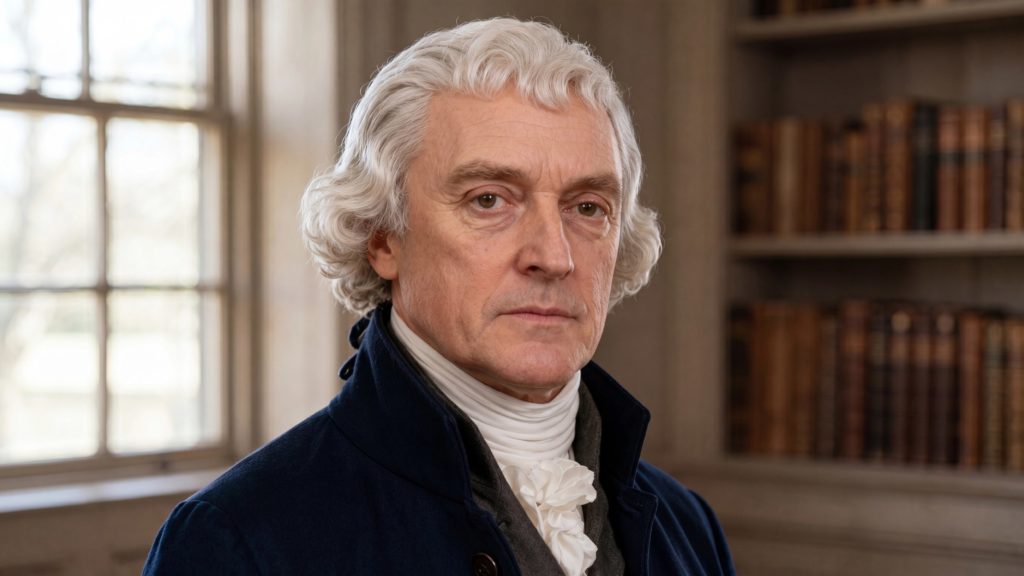
Thomas Jefferson
3rd President of the United States (1801-1809); principal author of the Declaration of Independence
The Virginia lawyer who wrote that "all men are created equal" while personally holding around 150 people in slavery at Monticello — a contradiction historians still wrestle with[1, p. 17][2, p. 212].
Bio
Who they were
Thomas Jefferson was born on 13 April 1743 (New Style) at Shadwell, his father's plantation in Albemarle County, Virginia[3][4]. His father, Peter Jefferson, was a self-made planter and surveyor known for his great physical strength[5][3]. Jefferson grew up in a household of considerable wealth built on enslaved labour and land, and received a classical education. In 1770 the house at Shadwell burned down, destroying his childhood home and many of his books[2, p. 354]. He went on to study at the College of William and Mary in Williamsburg[4].
After William and Mary, Jefferson trained as a lawyer and was elected to Virginia's colonial legislature, the House of Burgesses[6]. He built a reputation as a clear, persuasive writer rather than a forceful public speaker. Sent to the Continental Congress in 1775, he impressed colleagues with his prose. In 1776, at just 33, he was chosen for the five-man committee tasked with drafting a declaration explaining the colonies' break with Britain, alongside John Adams and Benjamin Franklin[7]. He later served as Governor of Virginia during the Revolutionary War[6, p. 99], then as a diplomat in France, and as the new nation's first Secretary of State under George Washington[8].
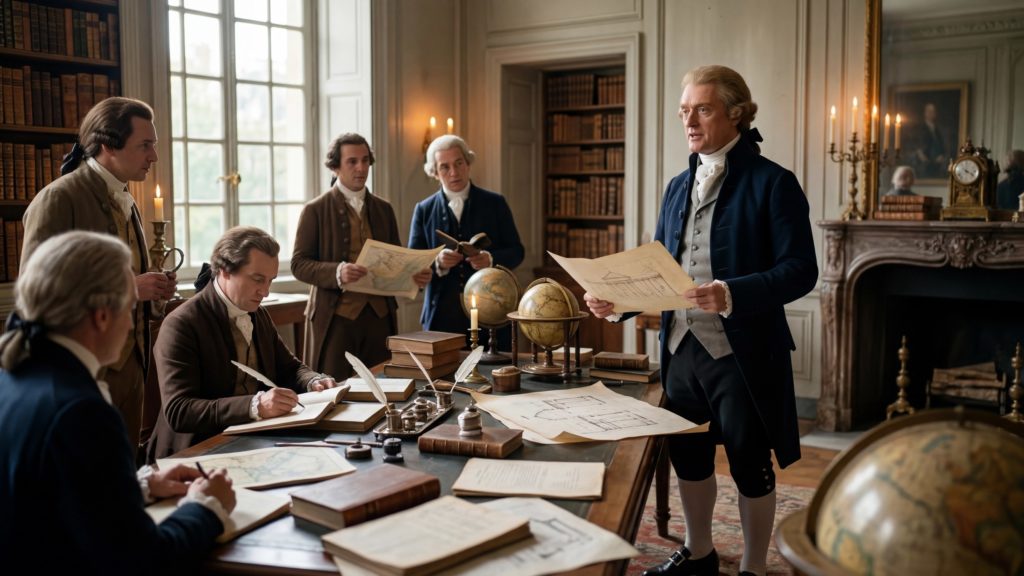
Jefferson is best remembered as the principal author of the Declaration of Independence, adopted on 4 July 1776, with its enduring claim that "all men are created equal"[9][2, p. 212]. After defeating John Adams in the bitterly fought election of 1800, Jefferson became the third President in 1801[10, p. 87]. His presidency is defined by the Louisiana Purchase of 1803, which roughly doubled the size of the United States through a single deal with France[11]. He also founded the University of Virginia in 1819[12] and personally designed his mountaintop home, Monticello, having taught himself architecture largely from books[13].
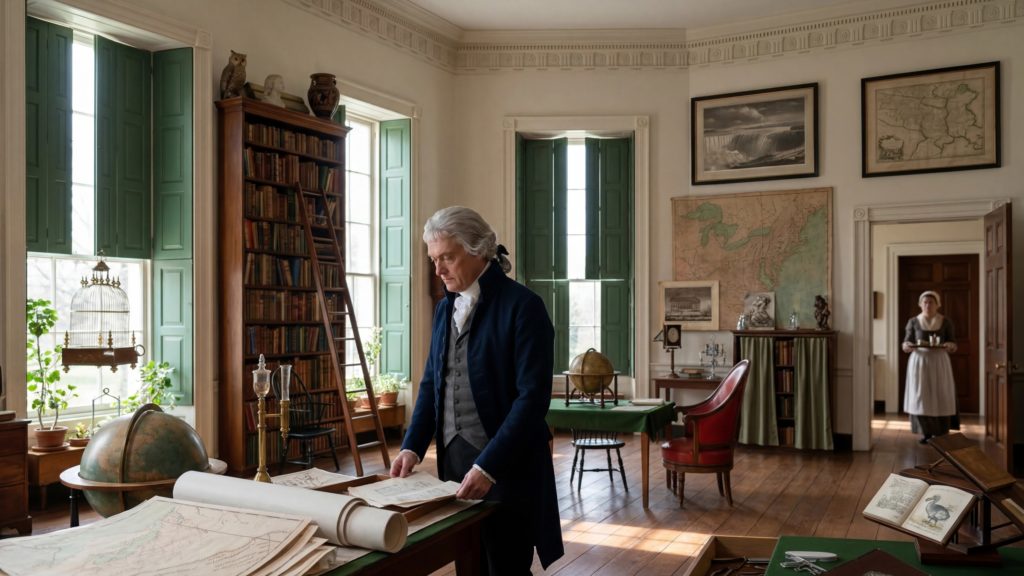
Jefferson left the presidency in 1809 and retired to Monticello, where he spent his final years deeply in debt[14]. He died on 4 July 1826, aged 83, just hours before his old friend and rival John Adams — the fiftieth anniversary of the Declaration of Independence[2, p. 401][15]. Jefferson had written his own epitaph, choosing to be remembered as author of the Declaration of Independence, of Virginia's statute for religious freedom, and father of the University of Virginia — leaving the presidency itself off the list[16].
The Declaration's language of natural rights and equality became a touchstone for later reform movements, even though Jefferson did not extend it to the people he enslaved. The Louisiana Purchase reshaped the map of North America, and the University of Virginia he founded remains a major public university today[12]. His decades-long, sometimes bitter rivalry with John Adams — followed by a remarkable reconciliation carried out almost entirely through letters between 1812 and 1826 — is now seen as one of the defining relationships of the founding era[17].
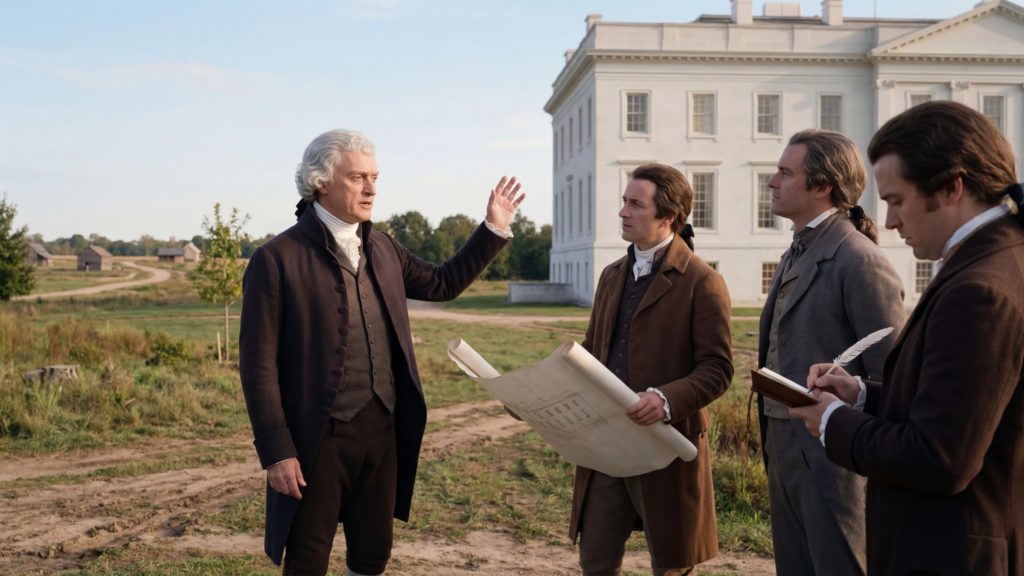
Jefferson was as much a hobbyist as a statesman. Family tradition holds that he liked to bring out his violin and play music with visitors at Monticello[3], and his interest in architecture and mechanical invention ran through his letters and his design work at Monticello for decades[6, p. 55].
Legacy & Reputation
What’s the verdict?
Jefferson’s reputation is genuinely divided among historians. He is credited with shaping the founding language of American liberty, founding the University of Virginia, and doubling the young nation’s territory through the Louisiana Purchase[12][11]. Yet the same man held around 150 enslaved people at Monticello[1, p. 17], and documentary and DNA research gathered since the 1990s has led most historians to now accept that he fathered children with Sally Hemings, an enslaved woman in his household[18, p. 9][18, p. 12].
Myth-buster
Think you know this one?
Quick Facts
The essentials
Quick Facts
Roger would like you to know…
Roger would like you to know that Jefferson taught himself architecture largely from books, then used what he learned to design his own mountaintop home, Monticello, over several decades[13].
Keith checked the sources…
Keith checked the sources: the man who wrote "all men are created equal" held around 150 enslaved people at Monticello at any one time — a contradiction Jefferson himself never resolved[1, p. 17][2, p. 212].
This sounds invented, but…
This sounds invented, but it's well attested: Jefferson was a keen amateur violinist, and family accounts describe him bringing out his violin to play music with visitors at Monticello[3].
One for the Ageonauts…
One for the Ageonauts: after the British burned Washington in 1814, Jefferson sold the bulk of his personal library to Congress to help rebuild its collection — the seed of today's Library of Congress[20, p. 368].
Roger has entered the historical rabbit hole…
Roger has entered the historical rabbit hole: Jefferson wrote his own epitaph, listing himself as author of the Declaration of Independence, of Virginia's law for religious freedom, and founder of the University of Virginia — and left the presidency off the list entirely[16].
Keith has spotted the quotation problem…
Keith has spotted the deeper record: DNA and documentary evidence gathered since the 1990s have led most historians to accept that Jefferson fathered children with Sally Hemings, an enslaved woman in his household[18, p. 9][18, p. 12].
File under: surprisingly true…
File under: surprisingly true. The 1803 Louisiana Purchase, negotiated under Jefferson, roughly doubled the size of the United States in a single deal with France[11].
Roger insists this matters…
Roger insists this matters: Jefferson didn't just found the University of Virginia in 1819, he helped design its buildings and shaped much of its original curriculum himself[12].
History has added a footnote…
History has added a footnote: despite his elegant home and grand career, Jefferson died deeply in debt, and Monticello's contents — including many enslaved people — were sold off after his death to pay it[14].
Keith remains unconvinced…
Keith remains unconvinced that everything at Monticello is original: Jefferson's actual childhood home at Shadwell burned to the ground in 1770, destroying his early books and papers years before Monticello was built[2, p. 354].
Here was buried Thomas Jefferson, author of the Declaration of American Independence, of the Statute of Virginia for religious freedom, and father of the University of Virginia.
Thomas Jefferson, writing his own epitaph
Jefferson composed this epitaph himself for his tombstone at Monticello, deliberately leaving the presidency off the list of achievements he wanted remembered[16][1, p. 419].
Timeline
How it unfolded
13 April 1743
Birth of Thomas Jefferson
Thomas Jefferson was born at Shadwell, his father Peter Jefferson's plantation in the hill country of central Virginia.[21] The date is 13 April by the modern calendar and 2 April Old Style, the form engraved on his tomb.[22][16]
1 January 1772
Marriage of Thomas Jefferson and Martha Skelton
Jefferson married Mrs. Martha Skelton, widow of Bathurst Skelton and daughter of John Wayles of The Forest in Charles City County.[6, p. 95][23] Through her he later came into the Poplar Forest plantation.[24]
4 July 1776
Adoption of the Declaration of Independence
The Second Continental Congress adopted the Declaration of Independence on 4 July 1776, in a text written primarily by Jefferson.[25] He had been named on 11 June to the five-man drafting committee, on which he is listed first.[26, p. 155]
10 March 1785
Jefferson Succeeds Franklin as Minister to France
Congress appointed Jefferson minister plenipotentiary to France as Franklin's successor, after he had already spent seven months in the country on a commission.[27, p. 5] According to Abbott's biography of Franklin, when the Count de Vergennes remarked that he replaced Franklin, Jefferson answered that he succeeded him because no man could replace him.[28]
21 March 1790
Jefferson Joins Washington's Cabinet
Appointed Secretary of State by Washington immediately on his return from France, Jefferson arrived in New York on 21 March 1790 to take up the post.[29] The opposition between him and Alexander Hamilton was not slow in developing.[29]
4 March 1801
Jefferson Inaugurated as President
Jefferson and Aaron Burr received an equal number of electoral votes in the 1800 election, and the House of Representatives chose Jefferson on 17 February 1801 on the thirty-sixth ballot.[30][3] He was inaugurated on 4 March 1801, with John Marshall administering the oath, while John Adams was setting out for New England.[31, p. 375]
30 April 1803
Louisiana Purchase Treaty
American envoys Robert Livingston and James Monroe concluded with France the treaty ceding Louisiana to the United States, which is dated 30 April 1803.[32] Chinard notes that it was in fact concluded and signed a few days into May but antedated.[5]
21 January 1812
Jefferson Answers Adams's Letter
Pleased by the homespun and note that John Adams had sent on 1 January, Jefferson replied the moment the letter reached Monticello, reviving the friendship between the two former presidents.[17] The surviving exchange of letters runs from 1812 to 1826.[17]
25 January 1819
Charter of the University of Virginia
The Commonwealth of Virginia chartered the University of Virginia at Charlottesville on 25 January 1819.[33] Jefferson devoted the last years of his life to its foundation and success.[34, p. 41]
Dig Deeper
Copy any prompt below into your favourite AI chat to keep exploring.
Thomas Jefferson childhood Shadwell plantation Virginia
what growing up on a Virginia plantation taught Jefferson about liberty, and what it left out
the Virginia plantation upbringing that turned a teenager into a walking Enlightenment library
Further Reading
Where to read more
Thomas Jefferson — White House Historical Association
An official biography covering Jefferson's presidency, his authorship of the Declaration of Independence, and his life at Monticello.
Why look at this: Addresses Jefferson's role as the largest enslaver among U.S. presidents directly, rather than leaving it out of the story.
https://www.whitehousehistory.org/bios/thomas-jeffersonThomas Jefferson — American Experience, PBS
A feature companion page to Ken Burns's documentary on Jefferson, exploring the contradictions between his ideals and his life as a slaveholder.
Why look at this: Goes further than a standard biography into how Jefferson "proclaimed that all men are created equal, yet owned more than 100 slaves" — the central tension of his legacy.
https://www.pbs.org/wgbh/americanexperience/features/adams-thomas-jefferson/Founders Online: The Papers of Thomas Jefferson — U.S. National Archives
A free, searchable digital archive of Jefferson's correspondence and writings, drawn from the letterpress editions published by Princeton University Press.
Why look at this: Lets you read the actual letters Jefferson exchanged with John Adams during their 1812-1826 reconciliation, transcribed in full.
https://founders.archives.gov/about/JeffersonRelated
Keep exploring
People
Can be seen in
Where this shows up
References
Sources
Sources
- BookThe Domestic Life of Thomas Jefferson Compiled From Family Letters and Reminiscences by Sarah N. Randolph. Pages 17, 419. ↑
- BookThe life and writings of Thomas Jefferson : including all of his important utterances on public questions, compiled… by Samuel Eagle Forman. Pages 212, 354, 401. ↑
- BookThe true Thomas Jefferson by William Eleroy Curtis ↑
- BookJefferson and Monticello by Paul Wilstach ↑
- BookThomas Jefferson The Apostle Of Americanism by Gilbert Chinard ↑
- BookThe life of Thomas Jefferson by Henry Stephens Randall. Pages 55, 95, 99. ↑
- BookLife and public services of John Quincy Adams, sixth president of the United States by William Henry Seward ↑
- DocumentThe Encyclopedia Americana (1920)/Jefferson, Thomas ↑
- DocumentEncyclopædia Britannica, Ninth Edition/Thomas Jefferson ↑
- BookThe Jeffersonian Cyclopedia : a comprehensive collection of the views of Thomas Jefferson by Thomas Jefferson and John P Foley. Page 87. ↑
- BookHistory of the United States of America during the first administration of Thomas Jefferson [to the second administration… by Henry Adams ↑
- BookHistory of the University of Virginia, 1819-1919 : the lengthened shadow of one man by Philip Alexander Bruce ↑
- BookThomas Jefferson as an architect and a designer of landscapes by W. A. Lambeth and Warren H. Manning ↑
- BookJefferson at Monticello : the private life of Thomas Jefferson : from entirely new materials, with numerous facsimiles by Hamilton W. Pierson and others ↑
- BookSix historic Americans; Paine, Jefferson, Washington, Franklin, Lincoln, Grant, the fathers and saviors of our republic, freethinkers by John Eleazer Remsburg ↑
- BookThe house in which Thomas Jefferson wrote the Declaration of Independence by Thomas Donaldson ↑
- BookCorrespondence of John Adams and Thomas Jefferson by John Adams ↑
- WebsiteReport of the Research Committee on Thomas Jefferson and Sally Hemings. Pages 9, 12. ↑
- BookThe pilgrimage to Monticello, the home and tomb of Thomas Jefferson by St. Louis Jefferson club association ↑
- BookJefferson, Cabell and the University of Virginia by John S. Patton. Page 368. ↑
- BookThe life of Thomas Jefferson, third president of the United States, 1801-1809 by Edward Sylvester Ellis, G. Mercer Adam and Isidore A Zacharias ↑
- BookThe Life And Writings Of Thomas Jefferson by S.E.Forman ↑
- BookThe Ladies of the White House; Or, in the Home of the Presidents by Laura C. Holloway ↑
- BookSigners of the Declaration: Historic Places Commemorating the Signing of the Declaration of Independence by Robert G. Ferris ↑
- DocumentUnited States Declaration of Independence ↑
- BookBiographical sketches of the signers of the Declaration of American Independence ... by Benson John Lossing. Page 155. ↑
- BookThe writings of Benjamin Franklin; by Benjamin Franklin and Albert Henry Smyth. Page 5. ↑
- BookBenjamin Franklin: A Picture of the Struggles of Our Infant Nation One Hundred Years Ago by John S. C. Abbott ↑
- BookBiographical story of the Constitution, a study of the growth of the American Union by Edward Elliott ↑
- BookShout treason : $b the trial of Aaron Burr by Francis F. Beirne ↑
- BookThomas Jefferson, the Apostle of Americanism by Gilbert Chinard. Page 375. ↑
- BookThe Federal and State constitutions : colonial charters, and other organic laws of the States, territories, and Colonies… by Francis Newton Thorpe ↑
- Websiteen.wikipedia.org: University of Virginia ↑
- BookLetters and addresses of Thomas Jefferson by Thomas Jefferson, William B Parker and Jonas Viles. Page 41. ↑