
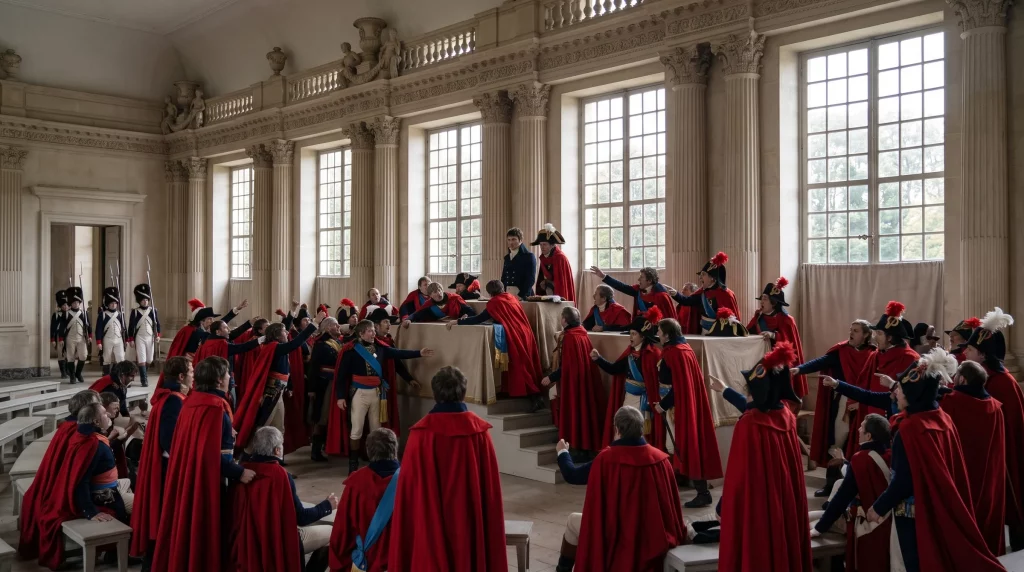
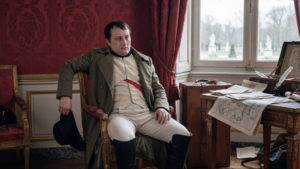
On 21 and 22 June 1815, with the choice at Napoleon's door between a bold stroke against the chambers or abdication, Lucien urged him to decide at once — shown here pressing his case in an Élysée salon as a crowd gathers outside. Sources differ on who wrote the abdication act.
French politician and diplomat; younger brother of Napoleon Bonaparte
Napoleon's younger brother, who was presiding over the Council of Five Hundred on the day of the Brumaire coup[1, p. 135], and who later left France for Rome rather than give up his marriage[2].
Bio
Who they were
Lucien Bonaparte was born in Ajaccio, Corsica, on 21 May 1775[3]. He was the third son of Charles Buonaparte[2]. Like his elder brothers Joseph and Napoleon, he was sent to the schools at Autun and Brienne[3]. Poor eyesight and a restless nature turned him from an army career towards the priesthood, according to Hubert Richardson's Dictionary of Napoleon[3]. The Fondation Napoléon says he entered the seminary at Aix in 1786 but left in 1789[2]. In his own memoirs he recalls that, as a mere boy, he threw himself into the popular societies, the political clubs of the Revolution[4].
In 1791 Lucien became secretary to Pasquale Paoli, the veteran Corsican leader[2]. His memoirs say Paoli praised a speech he made at seventeen and called him his little Tacitus[4]. In May 1793 Lucien publicly denounced Paoli and fled to the mainland[2]. At Saint-Maximin he rose to preside over the local revolutionary committee[4]. In 1794 he married Christine Boyer, an innkeeper's daughter, without telling his family[2]. In April 1798 he was elected for Liamone, in Corsica, to the Council of Five Hundred, a chamber of the French legislature[2].

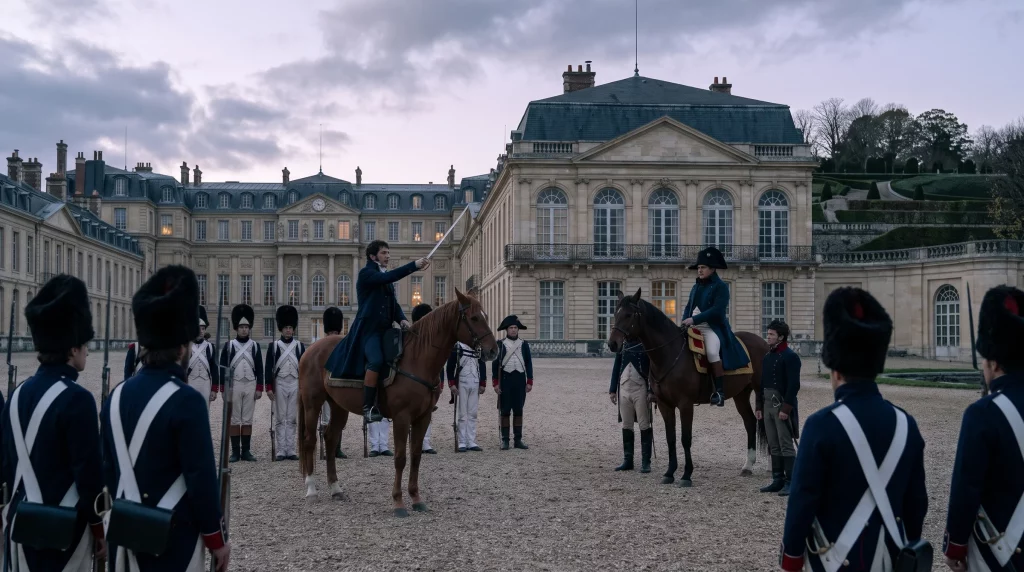
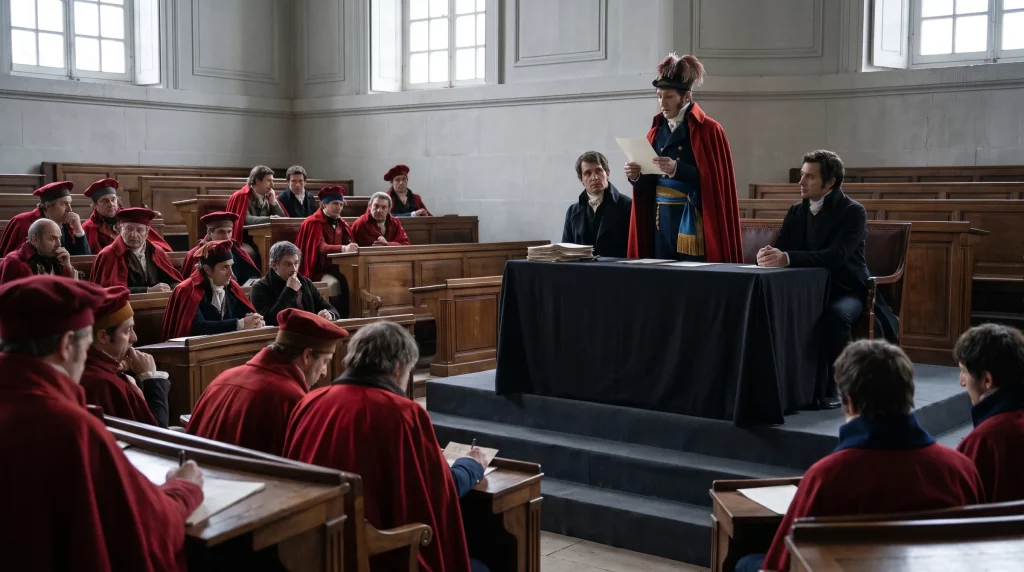
In October 1799 Lucien was elected president of the Council of Five Hundred and joined the plot against the Directory[2]. On 18 Brumaire (9 November) he spread a pamphlet describing a false Jacobin plot, which helped justify moving the councils to Saint-Cloud[2]. Next day he presided over the stormy session there. The official minutes say deputies called for Napoleon to be declared an outlaw[5, p. 14]. Lucien then laid down his toga and sash[5, p. 15]. Bourrienne wrote that Napoleon sent in soldiers who carried Lucien out, after which he addressed the troops on horseback[1, p. 135]. A note in the 1905 edition adds that Lucien himself stated he had demanded a grenadier escort as president[1, p. 135]. By early on 20 Brumaire the remaining deputies had agreed three provisional consuls[2].
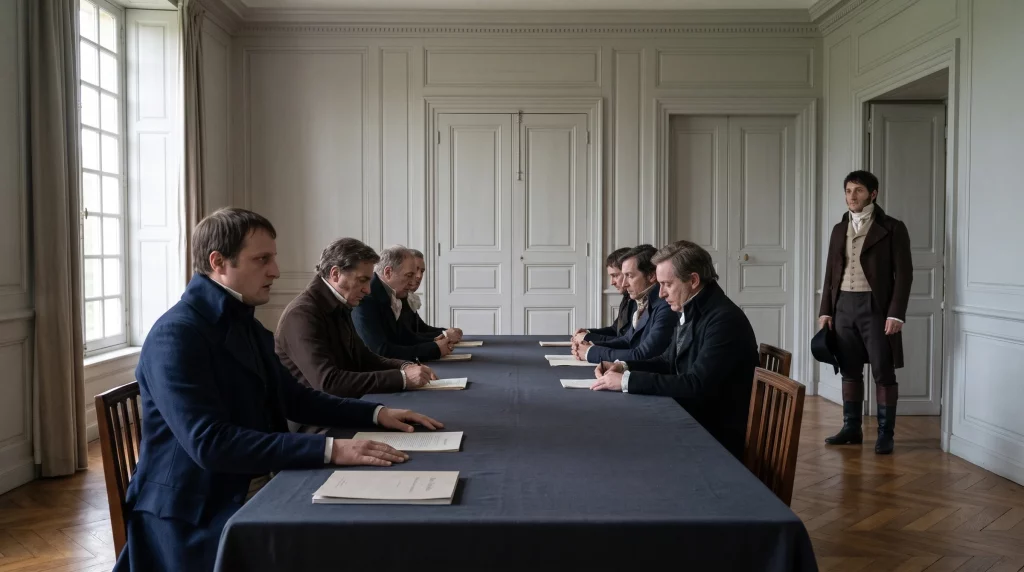
In 1803 Lucien married Alexandrine de Bleschamp, widow of a currency dealer named Jouberthon[6]. The marriage crystallised his long quarrel with Napoleon, and after Lucien refused to divorce he left for Rome in April 1804[2]. The British captured him at sea in 1810, as he tried to sail for America, and held him in Malta and then England[2]. In 1814 the Pope made him hereditary Prince of Canino[2]. He rejoined Napoleon in the Hundred Days and, on 23 June 1815, wrote the act of abdication under dictation[2]. He died at Viterbo on 29 June 1840, though one Fondation Napoléon biography gives 30 June[7][2].
As Minister of the Interior from December 1799, Lucien had a hand in choosing the first prefects, the officials who governed each département for the central state[2]. His critical report on French education also left its mark[2]. As ambassador in Madrid he secured the Treaty of Aranjuez in March 1801, which created the kingdom of Etruria[2]. Back in the Tribunate in 1802, he helped pass the laws on the Concordat, the agreement with the Pope, and on the Legion of Honour[7]. In exile near Canino he searched for Etruscan antiquities[7].
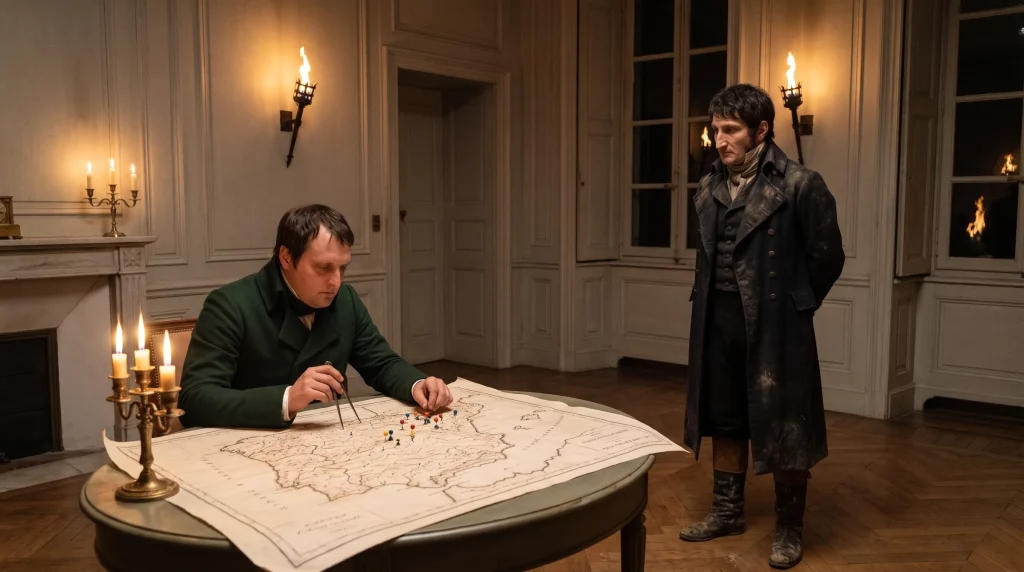
Lucien was too young to sit in the Council of Five Hundred in 1798. Napoléon et Empire reports that he got round the age rule with his marriage certificate, itself obtained with his brother Napoleon's birth certificate[7]. He was so short-sighted that he could not serve as a soldier[2]. During his years of house arrest in England he published an epic poem, Charlemagne, which was highly thought of[2].
Legacy & Reputation
What’s the verdict?
Judgements of Lucien’s part in 1799 differ. Bourrienne wrote that the success of 19 Brumaire must be attributed to Lucien’s nomination and exertions[1, p. 135]. Napoleon told Lucien in 1807 that it was not so clear to him that Lucien had saved him that day[1, p. 135]. The Fondation Napoléon notes that Lucien’s role was ignored or minimised even in the official account of the day, which fed his frustration with his brother[2]. It adds that the Memorial of St Helena judged him an ornament of any political assembly[2].
Myth-buster
Think you know this one?
It is often said that dagger-wielding deputies attacked Napoleon at Saint-Cloud. The Fondation Napoléon calls the dagger attack a myth, which it traces to Lucien’s own cry for protection from the ‘representatives of the dagger’[2].
Quick Facts
The essentials

Quick Facts
Roger would like you to know about Brutus…
As a young Jacobin, Lucien called himself 'Brutus Bonaparte, citizen sans-culotte', after a famous Roman. His letters to brother Joseph already showed a distrust of Napoleon, who he thought was 'headed towards becoming a tyrant'[2]. Brutus kept his own counsel until 1799.
Keith found the footnote…
In May 1793 Lucien publicly denounced Paoli, the veteran Corsican leader[2], and the Bonapartes left the island. Atteridge wrote that the almost penniless family were welcomed by Lucien, 'whose oratorical effort had precipitated the crisis', yet had no word of reproach for him[8].
The familiar story leaves this out…
Lucien spent part of 19 Brumaire in the saddle. Bourrienne recalled that, after soldiers carried him out of the council, Lucien was reinstalled as president but discharged his duties 'not in the President's chair, but on horseback', at the head of troops[1, p. 135]. Parliamentary procedure was, shall we say, flexible.
Roger has a theory about daggers…
The official minutes of the Saint-Cloud session say some deputies rushed Napoleon armed with pistols and daggers, and that two grenadiers shielded him[5, p. 14]. They are signed by Lucien as president[5, p. 15]. The Fondation Napoléon calls the dagger attack a myth[2]. Keith is still looking for the daggers.
File under: surprisingly true…
Napoleon made kings of other brothers, but the Fondation Napoléon calls Lucien the only brother he never gave a crown. At Mantua in December 1807 he offered Lucien thrones in Italy, Spain or Portugal in a four-hour meeting. Lucien still refused to divorce[2].
Keith has inspected the receipts…
Lucien's Madrid posting was lucrative. The Fondation Napoléon notes that large diplomatic gifts of paintings and diamonds from Godoy and the Portuguese were probably linked to how quickly he signed the Treaty of Badajoz[2]. Jung wrote that the penniless Brutus Bonaparte became the millionaire Lucien, richest of the family[9].
A small pamphlet with a very large consequence…
In 1800 an 'anonymous' pamphlet, actually by Fontanes, praised the First Consul while fretting about his lack of an heir[2]. Thiers records that Lucien, as Minister of the Interior, spread it across France while hiding its origin[10]. An embassy to Spain followed[10].
Roger says, 'Hear me out…'
In August 1810 Lucien set sail for America to escape a French arrest warrant. Britain had refused him a passport, yet its navy captured his ship, and he was held in Malta before house arrest in England. Napoleon's 1811 Almanach Impérial did not even list him as one of the brothers[2].
One for the Ageonauts…
Lucien's memoirs have a tangled history. A New York edition of 1836 calls itself 'Part the First', 'written by himself'[4]. Théodore Jung, who studied Lucien's papers in the French archives, found manuscripts labelled as already published in 1836 and called that label false[9].
The President of the Council of the Five Hundred declares to you that the majority of that Council is at this moment held in terror by a few representatives of the people, who are armed with stilettoes
Lucien Bonaparte
Lucien's address on horseback to the troops at Saint-Cloud on 19 Brumaire (10 November 1799), after he had left the president's chair, as reported in Bourrienne's Memoirs (English edition, 1905)[1, p. 135].
Timeline
How it unfolded
21 May 1775
Birth of Lucien Bonaparte
Lucien Bonaparte was born at Ajaccio, Corsica, on 21 May 1775[3]. He was the third son of Charles Buonaparte, and so a younger brother of Napoleon[2].
May 1793
Denunciation of Paoli
In May 1793 Lucien publicly denounced the veteran Corsican leader Paoli, then fled to the mainland, where he fought hard for the Jacobin cause in the south of France[2].
April 1798 - October 1799
Council of Five Hundred and its presidency
Elected deputy for Liamone to the Council of Five Hundred in April 1798, Lucien became its president in October 1799[2]. Bourrienne wrote that the appointment mattered greatly to Napoleon[1, p. 135].
9-10 November 1799
Coup of 18-19 Brumaire at Saint-Cloud
On 9 November Lucien circulated a pamphlet about a false Jacobin plot, which helped justify moving the councils to Saint-Cloud[2]. Next day, presiding there as deputies called for Napoleon to be outlawed[5, p. 14], he laid down his toga and sash[5, p. 15].
December 1799 - November 1800
Minister of the Interior
Lucien replaced Laplace as Minister of the Interior in December 1799[2]. He had a hand in choosing the first prefects, and held the post until November 1800[7].
November 1800
Embassy to Spain
Appointed ambassador to Madrid in November 1800, Lucien persuaded Godoy to sign the Treaty of Aranjuez in March 1801, which created the kingdom of Etruria[2].
April 1804
Break with Napoleon
Lucien remarried in 1803[6]. After a dramatic meeting with Napoleon at Saint-Cloud, where he refused to divorce, he left for Rome in April 1804[2], retiring to the Papal States[1, p. 135].
August 1810
Captured by the British
Taking ship in August 1810 to escape a French arrest warrant, Lucien was seized by a British vessel and held in Malta, then under house arrest in England. In 1814 the Pope made him hereditary Prince of Canino[2].
Dig Deeper
Copy any prompt below into your favourite AI chat to keep exploring.
Explain what Lucien Bonaparte did as president of the Council of Five Hundred on 19 Brumaire, and why accounts of how the soldiers were called in differ.
Debate whether Lucien or Napoleon deserves more credit for the success of the Saint-Cloud coup, given that Lucien's own memoirs and the official account tell it differently.
Pitch me a courtroom drama in which Lucien Bonaparte sues his brother Napoleon for playing down his role in the official story of 19 Brumaire.
Further Reading
Where to read more
Lucien Bonaparte, Prince of Canino - Napoléon et Empire
A short biography by two French researchers, following Lucien from Ajaccio through the Directory, the Consulate, exile in Italy and England and the Hundred Days to his death at Viterbo in 1840.
Why look at this: Explains in a few lines how Lucien took the presidency of the Council of Five Hundred on the eve of 18 Brumaire, and how his remarriage to Alexandrine de Bleschamp crystallised the quarrel that sent him to Rome.
https://www.napoleon-empire.org/en/personalities/lucien_bonaparte.phpLucien Bonaparte (Prince of Canino), 1775-1840, Minister - Fondation Napoléon
A long biographical essay from the Fondation Napoléon, covering Lucien's Corsican youth, his part at Saint-Cloud, his years as minister and ambassador, the break with Napoleon, captivity in England and the Hundred Days.
Why look at this: Sets Lucien's own version of 19 Brumaire against the official account that played down his role, and describes the four-hour meeting at Mantua in December 1807 where Napoleon offered him a throne and he still refused to divorce.
https://www.napoleon.org/en/history-of-the-two-empires/biographies/lucien-bonaparte-prince-of-canino-1775-1840-ministerLe dix-huit Brumaire, ou Tableau des événemens qui ont amené cette journée - Vincent Lombard de Langres, Paris, an VIII (1799-1800), Zentralbibliothek Zürich (e-rara)
A digitised French book printed in 1799-1800, within months of the coup, free to read and download from the Swiss e-rara platform. Its supporting documents include the official record of the Saint-Cloud sessions.
Why look at this: Lets you read the printed minutes of the Council of Five Hundred for 19 Brumaire, headed 'Présidence de Lucien Bonaparte', which record the cries to outlaw Napoleon and Lucien laying down his toga and sash.
https://doi.org/10.3931/e-rara-26631Related
Keep exploring



Places






Can be seen in
Where this shows up
References
Sources
Sources
- BookMemoirs of Napoleon Bonaparte (vol 1) by Louis Antoine Fauvelet de Bourrienne and Ramsay Weston Phipps. Page 135. ↑
- WebsiteLucien Bonaparte (Prince of Canino), 1775-1840, Minister (napoleon.org) ↑
- BookA dictionary of Napoleon and his times by Hubert N.B Richardson ↑
- BookMemoirs of Lucien Bonaparte (Prince of Canino) Written by Himself by Lucien Bonaparte ↑
- WebsiteConseil des Cinq-Cents seance de Saint-Cloud 19 brumaire an VIII (e-rara). Pages 14, 15. ↑
- WebsiteLucien BONAPARTE (napoleon.org) ↑
- WebsiteLucien Bonaparte (napoleon-empire.org) ↑
- BookNapoleon's brothers by A. Hilliard Atteridge and King of Westphalia Jérôme Bonaparte ↑
- BookLucien Bonaparte et ses mémoires, 1775-1840, d'après les papiers déposés aux archives étrangères et d'autres documents inédits ..… by Th. Jung ↑
- BookHistory of the consulate and the empire of France under Napoleon (vol 1 and 2) by Adolphe Thiers, D. Forbes Campbell and John Stebbing ↑