
About This Map
What it shows
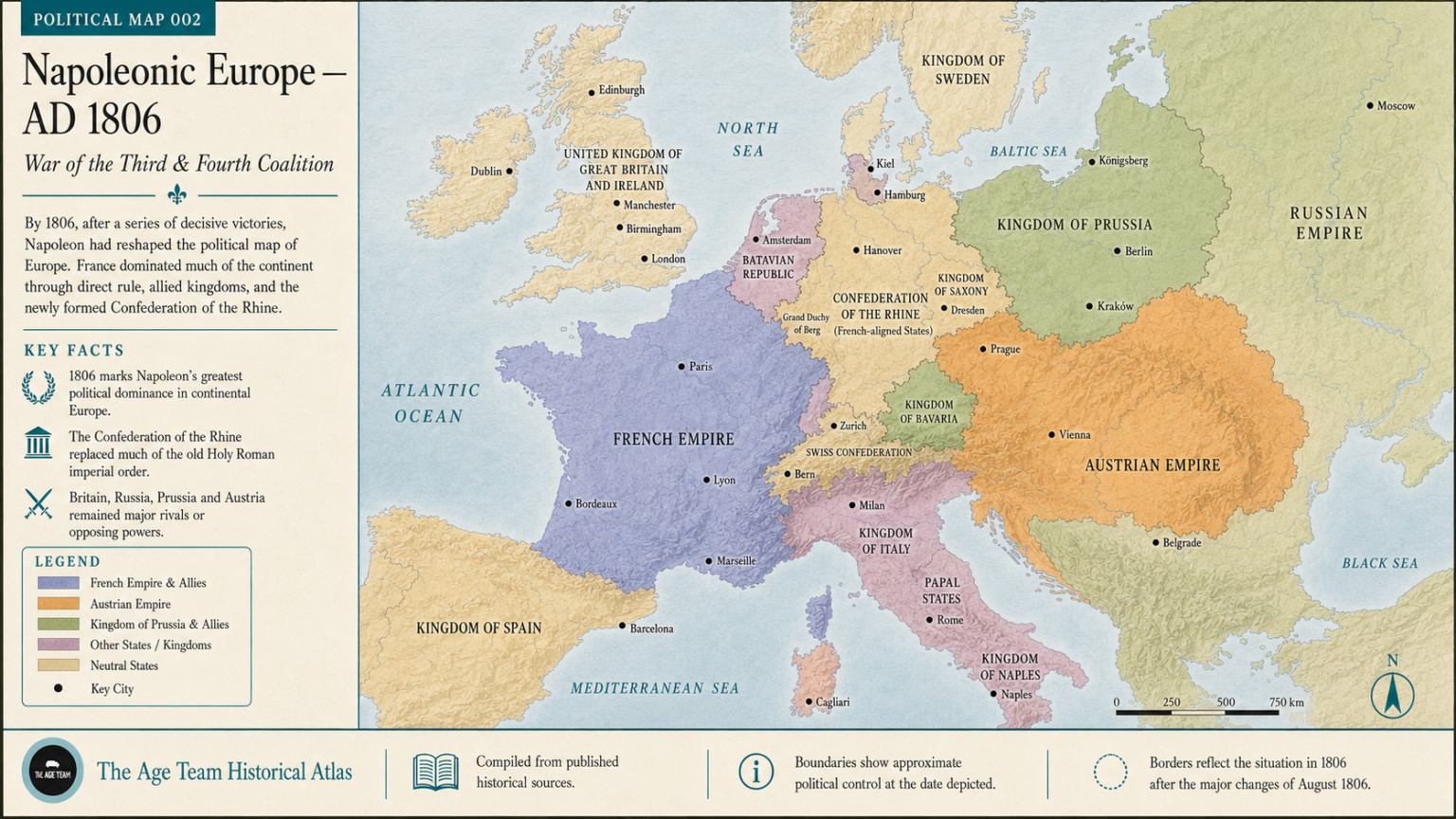
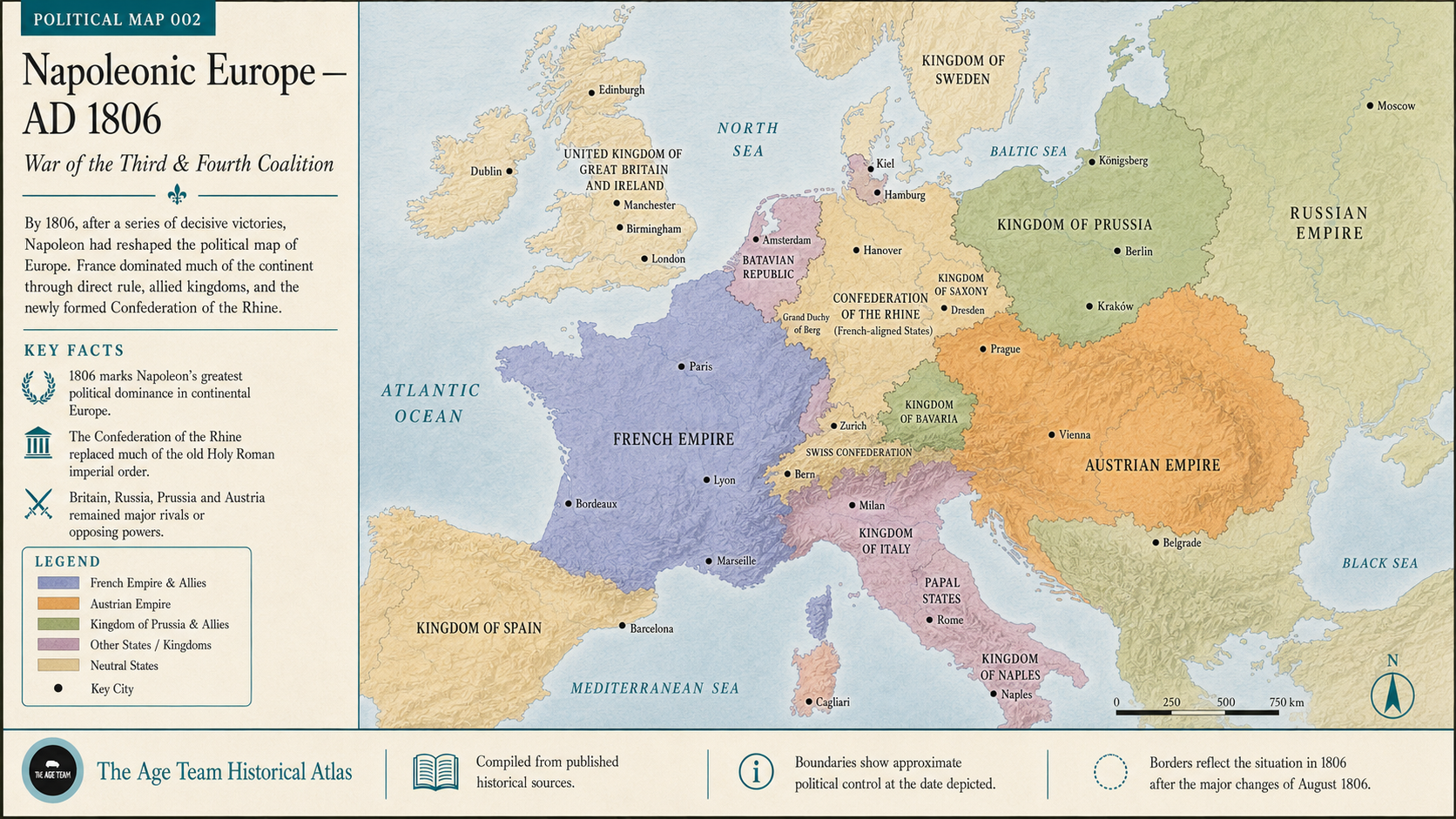
This map captures the high-water mark of Napoleon's remaking of Europe. In the west and south, French satellite kingdoms ruled by Napoleon's own relatives (Holland, Naples, Italy, soon Westphalia) replaced older dynasties, while in the German lands the Confederation of the Rhine, founded July 1806, absorbed the territory of princes who renounced the Holy Roman Emperor. That renunciation forced Emperor Francis II to dissolve the thousand-year-old Holy Roman Empire on 6 August 1806, ending an institution that had survived since Charlemagne. What remained standing against this new French-dominated order were Austria, Prussia, and Russia — the powers this map shows hemmed in on France's new frontier.
Quick Facts
The essentials
Quick Facts
"They have all really been kings, thanks to my labours; all have enjoyed the advantages of royalty; I alone have known its cares."
Napoleon Bonaparte (as recorded by Emmanuel de Las Cases)
Said in exile on St Helena (recorded by Las Cases and published in his Mémorial de Sainte-Hélène, 1823), as Napoleon looked back ruefully on having placed his brothers on the very satellite thrones — Holland, Westphalia, Naples — shown on this map.
Timeline
How it unfolded
2 December 1804
Coronation of Napoleon as Emperor
Napoleon's coronation took place in Notre Dame on 2 December 1804.[1] Terry notes that the victory at Austerlitz came on its first anniversary.[2]
2 December 1805
Battle of Austerlitz
On 2 December 1805, after luring the Allies into an effort to turn his right, Napoleon hurled an attack upon their centre and won a decisive victory.[2] Terry puts the Allied loss at about 26,000 men, 40 standards and nearly 200 guns.[2]
26 December 1805
Treaty of Pressburg
Austria accepted the terms granted by Napoleon in the Treaty of Pressburg, dated 26 December 1805.[3, p. 138] It compelled Francis's recognition of Napoleon's territorial changes in Italy, and Venetia, Istria and Dalmatia were attached to the Kingdom of Italy.[2]
30 March 1806
Joseph Bonaparte made King of Naples
On 30 March 1806 Napoleon issued a decree declaring Joseph Bonaparte king of Naples, after Joseph had marched into the city at the head of his troops on 15 February.[4]
5 June 1806
Louis Bonaparte proclaimed King of Holland
After Austerlitz Napoleon began forming a ring of states surrounding and in close alliance with the French Empire, and on 5 June 1806 he proclaimed his brother Louis King of Holland.[5]
12 July 1806
Confederation of the Rhine founded
The treaty of 12 July 1806, prompted by Napoleon, constituted a Confederation of fifteen German states, which Terry describes as a buffer-state between France, Austria and Prussia.[2]
6 August 1806
End of the Holy Roman Empire
On 1 August the Confederation's members proclaimed at Ratisbon their secession from the Holy Roman Empire, and on 6 August Francis II resigned the Roman crown, ending an institution one thousand years old.[2][2] Francis's own declaration is dated Vienna, 6 August 1806.[3, p. 138]
14 October 1806
Battles of Jena and Auerstedt
On the morning of 14 October 1806 the battle of Jena opened, and in Warwick's account the French greatly outnumbered the Prussians and overwhelmed them after a short conflict.[1]
Dig Deeper
Copy any prompt below into your favourite AI chat to keep exploring.
Confederation of the Rhine Holy Roman Empire dissolution 1806 satellite kingdoms
when big brother redraws the map and calls it a family favor
the year europe's landlords all became named bonaparte
Further Reading
Where to read more
The Confederation of the Rhine
A concise overview from the Fondation Napoléon on how Napoleon assembled the Rhine states into a French-protected league in 1806.
Why look at this: Explains exactly how Carl Theodor von Dalberg became "Prince-Primate" of the Confederation and why Bavaria, Württemberg, and Baden were first through the door — the piece this map's central puzzle turns on.
https://www.napoleon.org/en/history-of-the-two-empires/articles/the-confederation-of-the-rhine/The Napoleonic Empire (2nd edition) by Geoffrey Ellis
An academic synthesis (Studies in European History series, Palgrave Macmillan, 2003) of how Napoleon actually governed and reorganized conquered and satellite Europe.
Why look at this: Goes well beyond the map's snapshot to assess whether Napoleon's family-kingdom scheme was calculated strategy or, as Ellis argues, largely improvised opportunism.
https://books.google.com/books/about/The_Napoleonic_Empire_Second_Edition.html?id=ZMdpQgAACAAJThe Founding of the Confederation of the Rhine [Rheinbund] on July 12, 1806
A primary-source lithograph and contemporary treaty context from German History in Documents and Images (GHDI), showing the actual 1806 signing.
Why look at this: The closest thing to being in the room for the moment the Confederation's princes renounced the Holy Roman Emperor — the single act that triggered the Empire's dissolution three weeks later.
https://germanhistorydocs.org/en/the-holy-roman-empire-1648-1815/the-founding-of-the-confederation-of-the-rhine-rheinbund-on-july-12-1806-1806Related
Keep exploring










Can be seen in
Where this shows up

References
Sources
Sources
- BookNapoleon and the end of the French revolution by Charles F. Warwick ↑
- BookA short history of Europe from the dissolution of the Holy Roman empire to the outbreak of the… by Charles Sanford Terry ↑
- BookThe Constitutions and Other Select Documents Illustrative of the History of France 1789-1907 by Frank Maloy Anderson. Page 138. ↑
- BookJoseph Bonaparte by John S. C. Abbott ↑
- BookNapoleon the Third; the romance of an emperor by Walter Geer ↑