
AI reconstruction based on an unknown artist's portrait of Francis II, Holy Roman Emperor (c. 1804), from the literal first-person viewpoint of the court painter standing at his easel a few metres in front of the sitter.
It took Napoleon less than a page of diplomacy to end an empire that had lasted, at least on paper, since Charlemagne[1, p. 119].
What Happened
The story
By the summer of 1806 the Holy Roman Empire - a loose federation of German states nominally headed by the Austrian Habsburgs - was already hollow. Austria's defeat at Austerlitz had cost her a sixth of her revenue and cut her off from Italy and Switzerland under the Treaty of Pressburg[2]. Anticipating exactly this collapse, Francis II had pre-emptively taken the separate title of 'Hereditary Emperor of Austria' back in 1804, giving himself a crown that did not depend on the German princes' allegiance[3, p. 273]. Napoleon then moved to formalise western Germany's break from Vienna entirely.
On 12 July 1806, sixteen German states signed the treaty forming the Confederation of the Rhine, recognising Napoleon as their 'Protector' and pledging him a combined force of over 60,000 men[2]. On 1 August, the new Confederation's members formally proclaimed their secession from the Empire at Regensburg, and France's envoy there told the old Imperial Diet that his master no longer recognised the Empire's existence at all[1, p. 119]. Francis II now faced a fait accompli: hold an empty title, or lay it down.
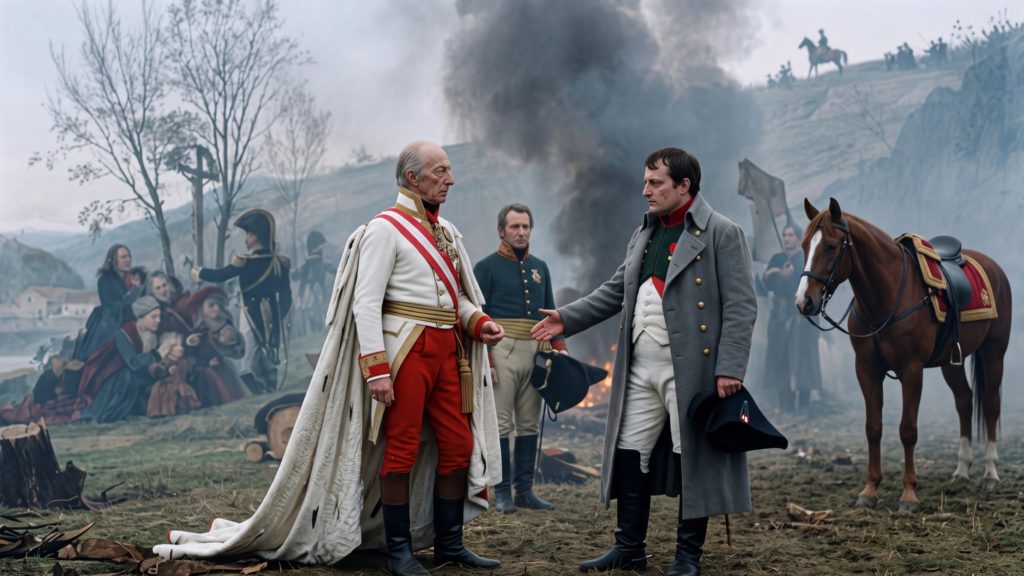
On 6 August 1806, Francis II issued a formal declaration resigning the imperial dignity. He stated that, in the altered state of affairs, he could no longer fulfil the obligations of his imperial 'capitulation', considered the bonds attaching him to the German body dissolved, released its states from their allegiance to him, and retired to rule only his own hereditary domains as Emperor of Austria[1, p. 119]. The crown once worn, in title, by Charlemagne, Otto and Charles V simply ceased to exist[1, p. 119].
There was no war, siege or vote - the Empire ended by declaration, on paper, in a single week. Its Imperial Diet at Regensburg dissolved with it, and the office of Holy Roman Emperor, held continuously in one form or another for over a thousand years, was never revived[1, p. 119]. Contemporaries noted that France, in a great measure, had simply inherited the influence and dignity the old Empire once carried in central Europe[4].
Quick Facts
The essentials
Quick Facts
Napoleon and the Confederation of the Rhine
Leadership
Emperor Napoleon I, recognised as Protector of the Confederation[2]
Forces
Napoleon's French Empire; sixteen German states, including the newly-created kingdoms of Bavaria and Wurttemberg and the grand-duchies of Baden, Berg and Hesse-Darmstadt, organised under Napoleon as 'Protector'[2]
Objective
Detach the German princes from Habsburg authority and bind them instead to France
The Holy Roman Empire and its head, Austria
Leadership
Francis II, Holy Roman Emperor and, from 1804, Emperor of Austria[3, p. 273]
Forces
Emperor Francis II; the remaining Imperial Diet at Regensburg and the smaller states still nominally loyal to the Empire[1, p. 119]
Objective
Preserve what remained of the Empire's authority, or failing that, extricate Austria from a title it could no longer defend
The Bigger Picture
The direct diplomatic aftershock of Austria's defeat at Austerlitz and the Treaty of Pressburg, and of Napoleon's reorganisation of western Germany into his own sphere of influence[2].
How It Came To This
Austria's defeat left her stripped of roughly a sixth of her revenue and three million subjects under the Treaty of Pressburg, and cut off from Italy and Switzerland[2]. Seven months later, on 12 July 1806, Napoleon organised sixteen German states into the Confederation of the Rhine under his own protection, and on 1 August its members formally proclaimed their secession from the Empire at Regensburg[2]. Francis II, no longer able to enforce the obligations of his imperial office, had already anticipated the loss by taking the separate hereditary title of Emperor of Austria back in 1804[3, p. 273].
What Actually Happened
What makes 1806 unusual is how anticlimactic it was: no battle decided it, and no assembly voted it away. The Empire had been a legal and religious idea as much as a state for centuries, resting on the theory that the German king's crown continued an authority handed down from Charlemagne[1, p. 119]. Napoleon did not need to attack that idea directly - he only had to make it materially unworkable, by detaching its most powerful members into a rival confederation under his own protection and pledged to his own army[2]. Once France's envoy at Regensburg told the old Imperial Diet that Paris no longer recognised the Empire's existence at all, Francis II's position became legally impossible rather than merely difficult: he held a title whose most powerful vassals had already left and whose chief rival refused to acknowledge it[1, p. 119]. His declaration was less a defeat than bookkeeping - tidying up a title that Napoleon's diplomacy, not his armies, had already emptied out.
Why It Still Matters
Ended thirteen centuries of the Holy Roman Empire as an institution and completed Napoleon's reorganisation of western Germany into his own client states; left German nationalism to find new forms after 1815; and set a precedent - a great power dissolved by declaration rather than conquest - for the Habsburgs' own empire in 1918[2].

Quick Facts
Roger would like you to know...
Francis II ended the Holy Roman Empire without a single battle. His deed of 6 August 1806 was purely a piece of paper - a declaration that the imperial title he could no longer enforce was simply 'dissolved'[1, p. 119].
Keith checked the sources...
Francis actually saw this coming two years early. In 1804, anticipating that his German title might not survive, he pre-emptively crowned himself 'Hereditary Emperor of Austria' - a fallback crown that didn't depend on anyone else's allegiance[3, p. 273].
One for the Ageonauts...
The empire that ended in 1806 had, by one historian's count, lasted 'one thousand and six years' since Pope Leo III crowned Charlemagne - meaning Napoleon's diplomacy took down an institution older than most European royal houses combined[1, p. 119].
History gets strange here...
The final blow wasn't a battle - it was a message. On 1 August 1806, the French envoy at Regensburg simply informed the old Imperial Diet that Napoleon no longer recognised the Empire's existence at all[1, p. 119].
Keith would like to clarify...
'Dissolving' the Empire didn't just remove Francis's title - it wiped out the political existence of dozens of smaller states. Free Imperial Cities like Augsburg and Nurnberg, which had survived for centuries, were absorbed into their larger neighbours in a process called 'mediatisation'[2].
Meanwhile, in history...
By 1808 the Confederation of the Rhine that had helped force Francis's hand had grown to thirty-nine states covering around 20 million people, all bound to provide troops for Napoleon's wars[2].
Roger has entered the historical rabbit hole...
Francis II's declaration was careful with its wording throughout - it kept using the phrase 'German Empire' rather than the grander, more sacred 'Holy Roman Empire' it was quietly retiring[1, p. 119].
A small fact with a very large consequence...
One historian compared Francis II to Odoacer - the chieftain whose deposing of the last Western Roman Emperor in 476 had ended classical Rome. Thirteen centuries apart, both men quietly closed the books on 'Rome' as a political title[1, p. 119].
Keith has spotted the problem...
Losing the imperial title cost Austria far less than losing the war that caused it. The real damage was done at Pressburg, which stripped Austria of about a sixth of her revenue and three million subjects before Francis ever put pen to the abdication[2].
The familiar story leaves this out...
The Confederation that replaced the old Empire in western Germany wasn't really independent. Napoleon held its foreign policy, its decisions on war and peace, and command of its pledged 60,000-strong army entirely in his own hands[2].

We proclaim, accordingly, that we consider the ties which have hitherto united us to the body politic of the German Empire as hereby dissolved... and herewith laying down the imperial crown.
Francis II, Holy Roman Emperor, Act of Abdication
Issued at Vienna on 6 August 1806, this was Francis's own formal instrument ending his reign as Holy Roman Emperor, made to keep Napoleon from ever claiming the imperial title himself.
Timeline
How it unfolded
1803
Imperial Recess Remakes Germany
The Reichsdeputationshauptschluss, or Imperial Recess, secularised the clerical states and mediatised the Free Imperial Cities, redistributing one-sixth of the soil of Germany and suppressing 112 states.[2]
11 August 1804
Francis II Takes the Title Emperor of Austria
Alarmed by Napoleon's dealings with Germany and to protect his older title, Francis II assumed the title of Hereditary Emperor of Austria.[2] He announced the new title on 11 August 1804, in response to Napoleon crowning himself emperor of the French.[5]
26 December 1805
Treaty of Pressburg Releases Bavaria and Württemberg
The Treaty of Pressburg is printed in Anderson's documents under this date.[6, p. 138] Under it Bavaria, Baden and Wurttemberg were released from allegiance to the moribund Holy Roman Empire.[2]
12 July 1806
Confederation of the Rhine Founded
The Treaty of the Confederation of the Rhine was signed by the participating princes and by Napoleon, who assumed a protectorate over the new political body, and the princes renounced their association with the Holy Roman Emperor and declared their sovereignty.[7, p. 1] Francis II himself later cited the agreement signed at Paris on 12 July, by which several important estates were severed from the Empire, as making his imperial office impossible to continue.[8]
1 August 1806
Princes Announce Secession at Ratisbon
According to Mignet, the Confederation princes told the Diet of Ratisbon that they were separating from the Germanic body.[9]
6 August 1806
Francis II Abdicates as Holy Roman Emperor
In a proclamation given at Vienna, Francis II declared the bond uniting him to the body politic of the German Empire severed and his office as its Supreme Head lapsed through the union of the confederate Estates of the Rhine.[8] The Holy Roman Empire of the German Nation ended on this date, and Francis kept the title Emperor of Austria that he had held since 1804.[10, p. 1]
8 June 1815
German Confederation Created
The Federal Act of 1815 made Germany a perpetual confederation of independent and sovereign states, the Germanic Confederation, with a Federative Diet sitting at Frankfort under the presidency of Austria.[2] The Congress of Vienna's act establishing it is dated 8 June 1815.[11]
Dig Deeper
Copy any prompt below into your favourite AI chat to keep exploring.
Explain how Austria's defeat at Austerlitz and the formation of the Confederation of the Rhine left Francis II no real choice but to dissolve the Holy Roman Empire in 1806.
Debate whether the Holy Roman Empire's end in 1806 was really Napoleon's doing, or an institution that had already been hollow long before he arrived.
Convince me that ending a thousand-year-old empire with one signed declaration is the most understated exit in history.

Further Reading
Where to read more
The Confederation of the Rhine - History of Western Civilization II (Lumen Learning)
A free, concise course overview of how the Confederation of the Rhine was formed and directly caused the Empire's end.
Why look at this: Lays out exactly which German princes seceded to form Napoleon's Confederation - the move that made Francis II's old title unworkable.
https://courses.lumenlearning.com/suny-hccc-worldhistory2/chapter/the-confederation-of-the-rhine/The Confederation of the Rhine and the Dissolution of the Holy Roman Empire (1 August 1806) - George Mason University
A free translated primary-source declaration from Napoleon's own envoy at the German Diet, with scholarly context.
Why look at this: Gives the actual words used to end the thousand-year Empire: the French envoy's own argument that the old Diet 'has no longer a will of its own'.
https://revolution.chnm.org/d/516/The Holy Roman Empire - James Bryce (1871)
The free, classic academic study of the Empire's entire history, freely digitised on the Internet Archive.
Why look at this: Bryce's study is the same source behind this page's account of Francis II's declaration and its 'thousand and six years' framing of the Empire's end.
https://archive.org/details/holyromanempire00brycuoftRelated
Keep exploring

Places

Events

Can be seen in
Where this shows up

References
Sources
Sources
- BookThe Holy Roman Empire by James Bryce. Page 119. ↑
- BookA short history of Europe from the dissolution of the Holy Roman empire to the outbreak of the… by Charles Sanford Terry ↑
- BookA short history of Europe, from the fall of the Eastern empire to the dissolution of the Holy… by Charles Sanford Terry. Page 273. ↑
- BookLife of Napoleon Bonaparte, Volume III. by Walter Scott ↑
- Websiteen.wikipedia.org: Francis II, Holy Roman Emperor ↑
- BookThe Constitutions and Other Select Documents Illustrative of the History of France 1789-1907 by Frank Maloy Anderson. Page 138. ↑
- WebsiteThe Founding of the Confederation of the Rhine (Rheinbund) on July 12 1806 - German History Docs. Page 1. ↑
- DocumentAbdication of Francis II, Holy Roman Emperor ↑
- BookThe French revolution from 1789 to 1815 by M. Mignet and James Westfall Thompson ↑
- WebsiteCentral Europe at the Height of Napoleonic Power (1812) - German History Docs. Page 1. ↑
- Websiteen.wikipedia.org: German Confederation ↑