
Construction of the White House
The president's new house took eight years to build — and less than one to burn: British troops set fire to it in August 1814, a decade after President Adams first moved in.[1, p. 56]
What Happened
The story
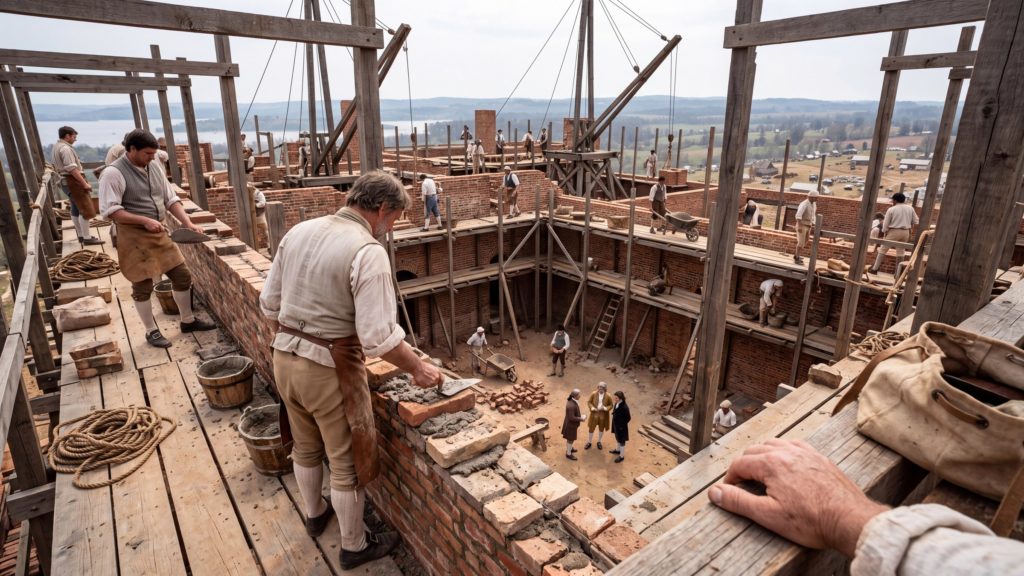
Following James Hoban's winning design in an open 1792 competition[2], construction began on a residence for the president in the new federal city, its cornerstone laid that same year[3, p. 1].
Workmen built the house from light grey sandstone quarried at Aquia Creek in Virginia[4], under Hoban's continued direction as architect[5].
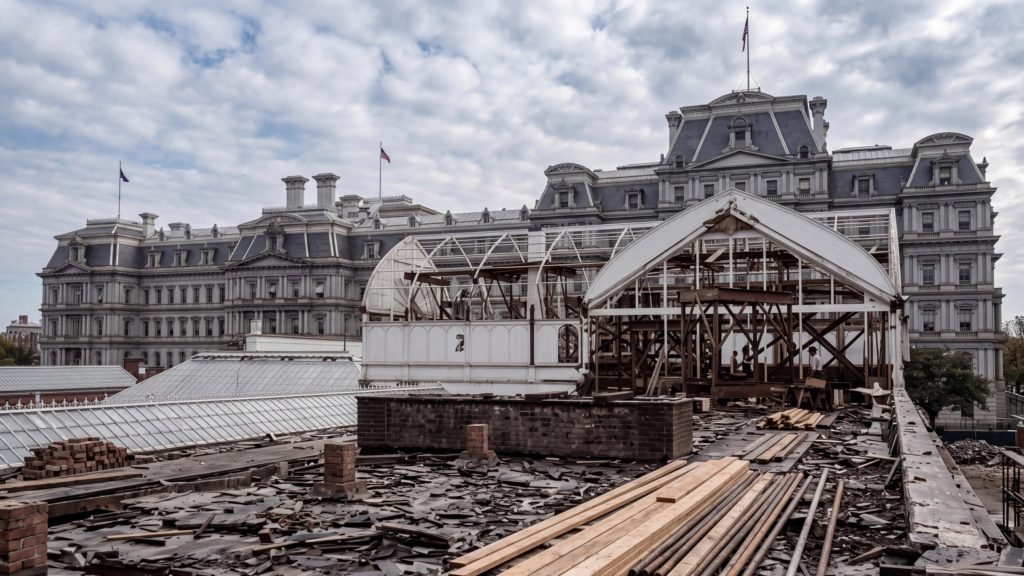
By 1800 the house was ready enough for occupation, and President John Adams and his wife Abigail moved in that year as its first residents[6, p. 2].
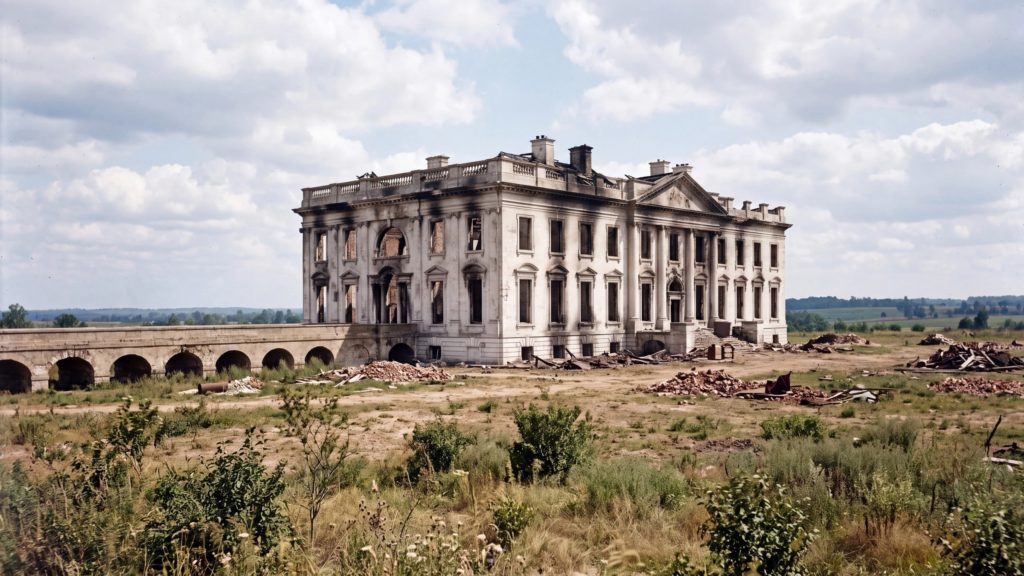
The building served as the presidential residence for over a decade before British troops burned it during their occupation of Washington in August 1814[1, p. 56].
Quick Facts
The essentials
Quick Facts
The Bigger Picture
Part of the broader creation of the new federal city under the 1790 Residence Act, alongside the Capitol.[7, p. 6]
How It Came To This
Following an open 1792 design competition for a presidential residence in the new federal city[8], construction was needed before the government's planned move to the new capital.
What Actually Happened
James Hoban's design won the 1792 competition[2], and the cornerstone was laid that year[3, p. 1]. Workmen built the house from light grey sandstone quarried at Aquia Creek, Virginia[4], under Hoban's continued direction[5]. By 1800 the house was ready enough for occupation, and John and Abigail Adams moved in that year as its first residents[6, p. 2].
Why It Still Matters
The building served as the presidential residence for over a decade before British troops burned it during their occupation of Washington in August 1814[1, p. 56]; rebuilt afterward, it has remained the presidential residence ever since.
Quick Facts
Roger has moved in early…
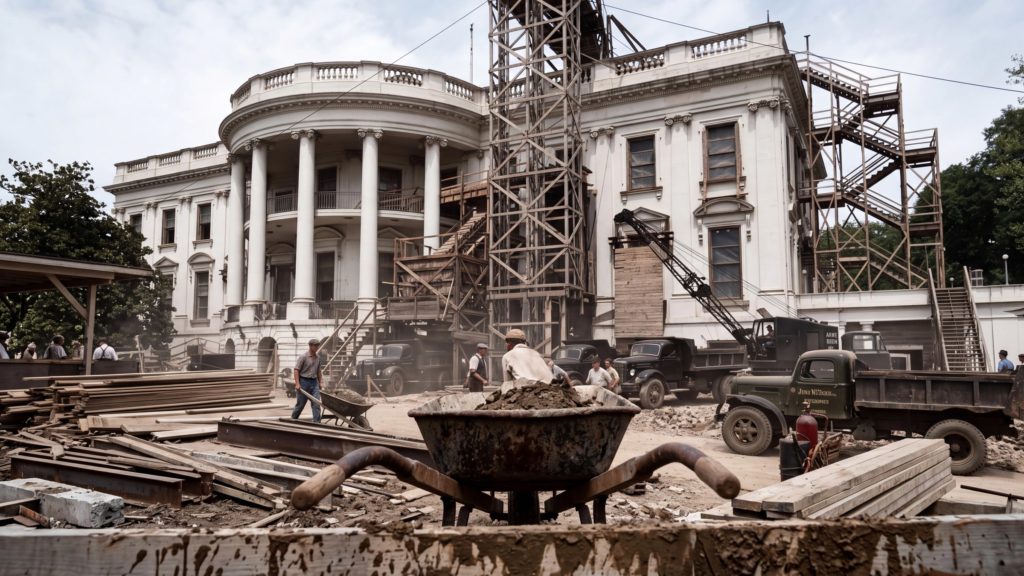
John Adams became the first president to live in the President's House in November 1800 — while it was still very much a building site[6, p. 2], with plaster wet and rooms unfinished.
Keith checked Abigail's letter…
Abigail Adams described her new home bluntly: ‘made habitable, but there is not a single apartment finished’[9], a review that would sink most modern property listings.
One for the Ageonauts…
The President's House was whitewashed with lime-based paint as early as 1798, simply to protect its porous sandstone from the weather[6, p. 3] — years before the popular myth that white paint was added to hide scorch marks from the 1814 burning.
Keith has spotted the architect…
Jefferson didn't build his famous colonnades himself — he had them designed and built by architect Benjamin Henry Latrobe, extending to service wings on both sides of the house[10, p. 27].
Roger has found the cornerstone…
The President's House cornerstone was laid on 13 October 1792, using pale sandstone quarried at Aquia Creek in Virginia[4], the same stone that gave the building its eventual colour.
Meanwhile, the design competition…
James Hoban, an Irish-born architect, won the competition to design the President's House[11], and then stayed on to oversee its construction through the 1790s and its rebuilding after 1814.
Roger insists this matters…
Every American president since John Adams has lived in the White House, except during the rebuilding forced by the British burning it down in August 1814[1, p. 56] — a single, spectacular interruption in an otherwise unbroken run.
History has added a footnote…
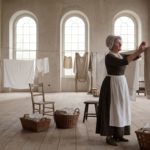
The White House's enormous, empty East Room became Abigail Adams's practical solution to a problem no design competition had considered: somewhere to dry the presidential laundry[6, p. 2].
Keith would like to clarify…
The building wasn't always called the White House. For much of its early history it was more often known as the President's House or Executive Mansion[6, p. 7], the whitewashed nickname only later becoming its official name.
Meanwhile, upstairs…
Thomas Jefferson chose not to enlarge the mansion itself when he added his famous colonnades — expansion, he judged, would look a little too much like a palace for a republic[10, p. 27].
The house is made habitable, but there is not a single apartment finished.[9]
Abigail Adams
Written shortly after Abigail Adams moved into the still-unfinished President's House with her husband John Adams in November 1800, the first First Lady to live there[9].
Timeline
How it unfolded
16 July 1790
Residence Act Authorises a New Capital
Congress approved the Residence Act, which placed the permanent seat of government on the Potomac River and so created the need for a presidential residence in a new city.[12] The act established a permanent national capital to be built on the Potomac, with President Washington choosing the specific site.[6, p. 1]
c. 26 August 1791
L'Enfant Reserves the President's Palace Site
Washington chose the spot for the President's House, and L'Enfant set it aside in his plan for what he called a palace, five times the size of the house that would later be built.[6, p. 1] L'Enfant submitted his plan to the President about 26 August 1791.[13, p. 2]
March 1792
Design Competition for the President's House
After L'Enfant's dismissal, Jefferson organised a design contest with a prize of five hundred dollars or a medal of that value for the best design of the President's House.[6, p. 1] An advertisement of March 1792 offering such a premium is described in a nineteenth-century account.[14]
16 July 1792
James Hoban Wins the Competition
Washington met the federal city commissioners to judge the competition and the Irish-born architect James Hoban was declared the winner.[15][6, p. 1] Hoban came to Washington in July 1792 and on the 18th was employed at a salary of three hundred guineas a year.[5]
13 October 1792
Cornerstone of the President's House
Construction began with the laying of the cornerstone, and workmen used light gray Aquia Creek sandstone from Virginia for the exterior walls.[4][15]
1 November 1800
John Adams Moves Into the President's House
John Adams became the first president to move into the building, which Washington had chosen and approved but never lived in.[16] The house was ready for occupancy but unfinished: many rooms were unplastered, the grand staircase was missing, and Abigail Adams hung laundry in the East Room.[6, p. 2]
24 August 1814
British Burn the Executive Mansion
During the War of 1812 enemy forces moved through Washington and set fire to the Executive Mansion, destroying the interior and furnishings while some exterior walls remained standing.[6, p. 2]
Autumn 1817
Monroe Moves Into the Rebuilt House
Madison had Hoban rebuild the house on the same site to the original design, rather than moving the capital elsewhere, and James Monroe moved into it in the fall of 1817.[6, p. 3] Hoban finished the reconstruction in slightly less than three years, in contrast with the nearly ten years the original had taken.[6, p. 3]
1830
Porticoes Complete the White House's Look
Hoban supervised the south portico, finished in 1824, and the north portico, built in 1829-1830 once Congress appropriated funds, giving the building its iconic appearance.[6, p. 4]
Dig Deeper
Copy any prompt below into your favourite AI chat to keep exploring.
Explain what condition the White House was actually in when John Adams first moved in.
What does an unfinished White House say about how new countries have to fake confidence before they've earned it?
Roleplay John Adams trying to convince Abigail this half-built house is actually fine.
Further Reading
Where to read more
Building the White House — White House Historical Association
The White House Historical Association's overview of the President's House's construction, from James Hoban's winning design through the Adams family's move-in in 1800.
Why look at this: A concise account of how the building actually got built — the design competition, the Aquia Creek sandstone, and the still-unfinished house Adams moved into.
https://www.whitehousehistory.org/building-the-white-houseEnslaved Labor Used to Build the White House and the Capitol Building — White House Historical Association
A fuller account of the enslaved and free laborers — quarrying stone, making bricks, and building the structure — who did much of the physical work of construction from 1792 to 1800.
Why look at this: Fills in a part of the story the design-and-architecture version leaves out: who actually built the house, and under what conditions, alongside Hoban's European craftsmen.
https://www.whitehousehistory.org/enslaved-labor-used-to-build-the-white-house-and-the-capitol-buildingThe White House (‘President's House’), Washington, D.C.: East front elevation, B.H. Latrobe, 1807 — Library of Congress
Benjamin Henry Latrobe's own digitized 1807 architectural elevation drawing of the President's House, from the period when he was designing Jefferson's colonnades.
Why look at this: Shows Latrobe's own hand at exactly the moment he was adding the colonnades and wings Jefferson had asked for, rather than a later artist's reconstruction.
https://www.loc.gov/resource/cph.3a06650/Related
Keep exploring



Can be seen in
Where this shows up

References
Sources
Sources
- BookThe Jeffersonians, 1801-1829. Page 56. ↑
- BookHistoric buildings of America : as seen and described by famous writers ↑
- WebsiteWashington D.C.: The Growth of a Capital City (NPS newspaper). Page 1. ↑
- BookSigners of the Declaration: Historic Places Commemorating the Signing of the Declaration of Independence by Robert G. Ferris ↑
- BookThe national Capitol : its architecture, art and history by George Cochrane Hazelton ↑
- WebsiteClassroom Resource Packet: Designing the White House 1792-1830. Pages 1, 2, 3, 4, 7. ↑
- WebsiteFederal Interest Report and Findings (Draft, September 2013) - National Capital Planning Commission. Page 6. ↑
- BookPresiding Ladies of the White House by Lila G. A. Woolfall ↑
- BookAbigail Adams and Her Times by Laura Elizabeth Howe Richards ↑
- WebsiteChapter IV: The Work of Benjamin Henry Latrobe, Architect (H. Doc. 108-240, U.S. Government Publishing Office). Page 27. ↑
- DocumentCatholic Encyclopedia (1913)/Washington, D.C. ↑
- BookAlexander Hamilton by Henry Jones Ford ↑
- WebsiteOriginal Plan of Washington, D.C. (George Mason University Digital History). Page 2. ↑
- BookReminiscences of Newport ...Extra Illustrated. Edition B. by George Champlin Mason ↑
- Websiteen.wikipedia.org: White House ↑
- Websitegeorgewbush-whitehouse.archives.gov: Text / 1101 ↑