
John Quincy Adams
Sixth President of the United States, diplomat, Secretary of State and Massachusetts congressman
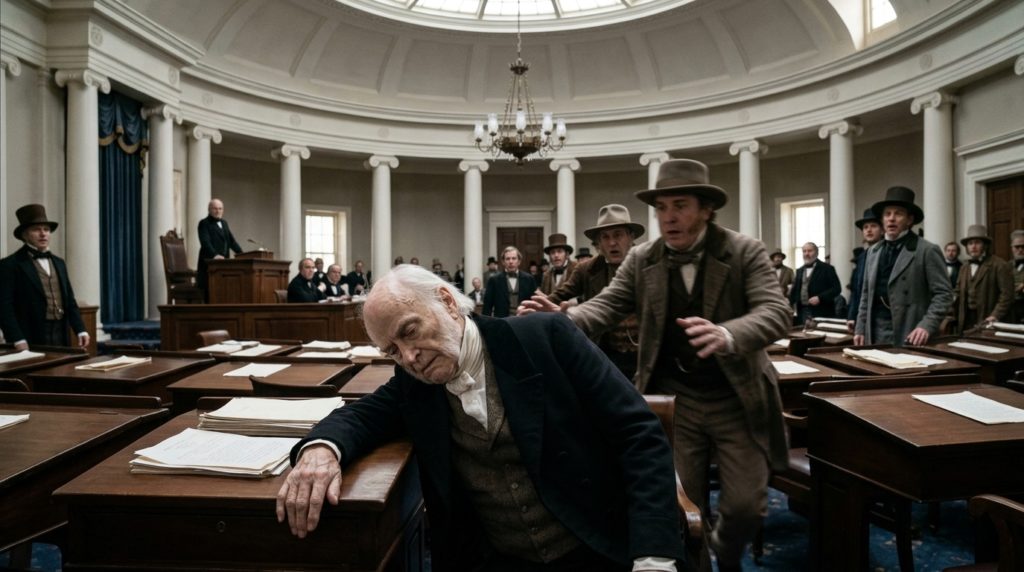
A diplomat's son who sailed to Europe with his father as a boy[1], won the presidency in a House of Representatives vote in 1825[2], then returned to Congress and collapsed in his seat there in 1848[1].
Bio
Who they were
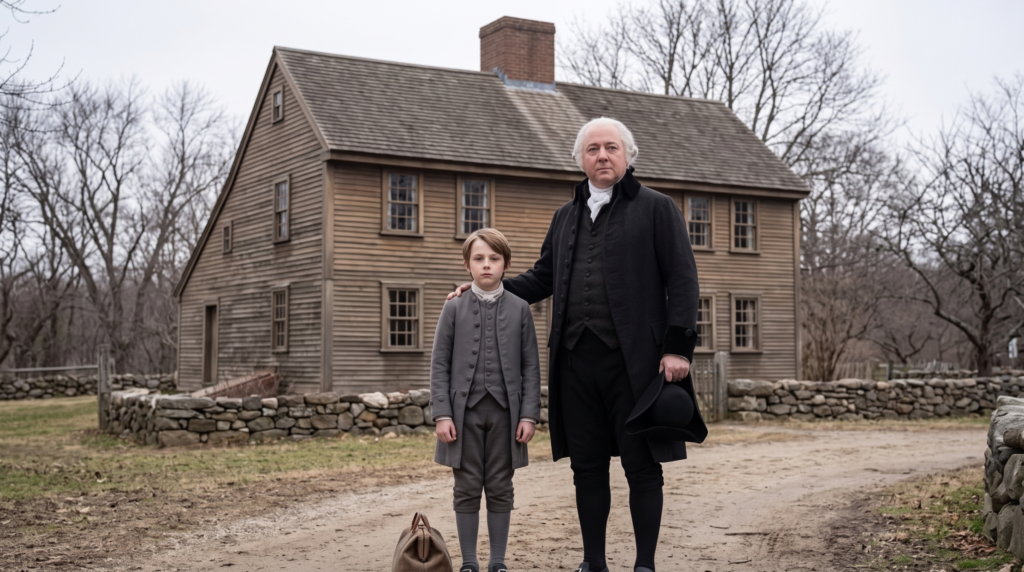
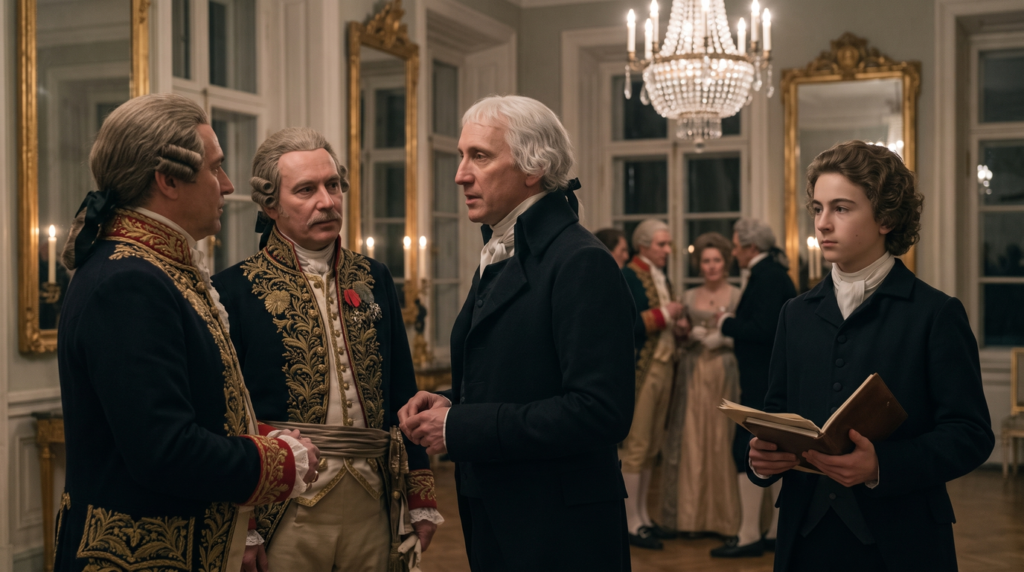
John Quincy Adams was born on 11 July 1767 in the North Parish of Braintree, Massachusetts, a district later made into the town of Quincy[1]. His parents were John and Abigail Adams[2]. He was named after his great-grandfather on his mother's side, John Quincy[1]. At seven, he climbed a hill with his mother to listen to the battle of Bunker Hill and watch Charlestown burn[1]. At nine, he became a post-rider, a courier carrying the latest news between Boston and the family farm[1]. In 1778 he sailed to France with his father on a diplomatic journey[1]. In 1781, at thirteen, he went to St Petersburg as private secretary and interpreter to Francis Dana, on a mission to the court of Catherine II[2].
Adams came home to study at Harvard College, graduating in 1787[1]. He read law at Newburyport and was admitted to the bar on 15 July 1790[1]. In 1791 he anonymously published a series of papers, signed Publicola, refuting Thomas Paine's Rights of Man[1]. In 1794 President Washington appointed him Minister to the Dutch States-General, when he was only twenty-seven[2]. He met Louisa Catherine Johnson, the daughter of the American consul in London[1], and married her there on 26 July 1797[1]. That year he became Minister to Prussia[2]. In 1803 the Massachusetts legislature elected him United States Senator[2].
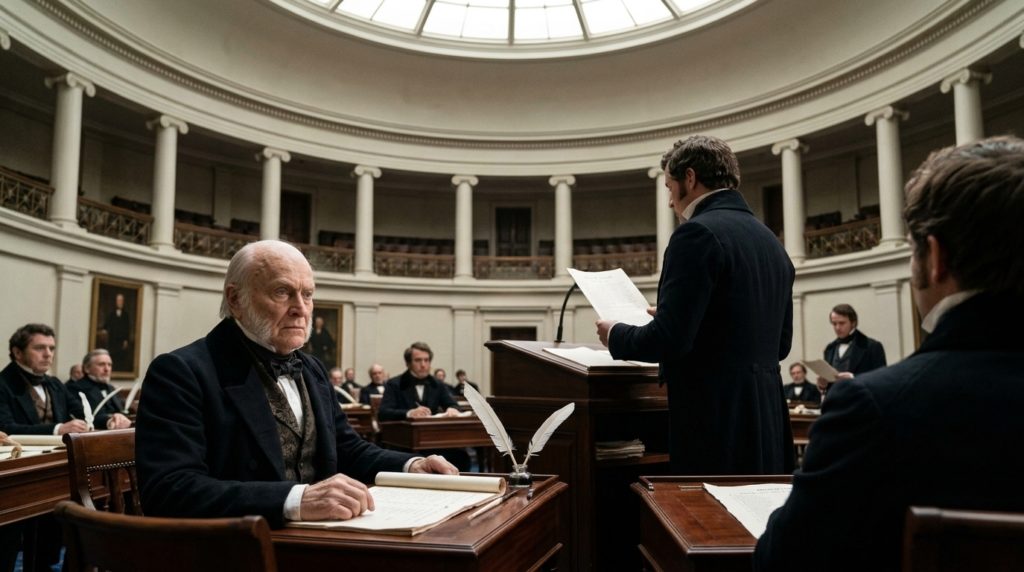
As Senator, Adams played an independent role, backing the Louisiana Purchase, which most Federalists condemned, and Jefferson's embargo[2]. In 1808 the Federalist-dominated Massachusetts legislature chose his successor early, and he resigned[2]. In 1809 President Madison sent him to Russia as Minister[2]. In 1813 he was named one of five American commissioners to negotiate peace with Britain at Ghent[2], and the treaty was signed on 24 December 1814[1]. President Monroe made him Secretary of State in 1817[2]. In 1819 he signed the treaty transferring Florida to the United States[2], and in 1823 Monroe's message to Congress, the Monroe Doctrine, used words drafted by Adams[2]. In 1825 the House of Representatives elected him President on the first ballot, after no candidate had won an electoral majority[2]. Andrew Jackson defeated him in 1828[2].
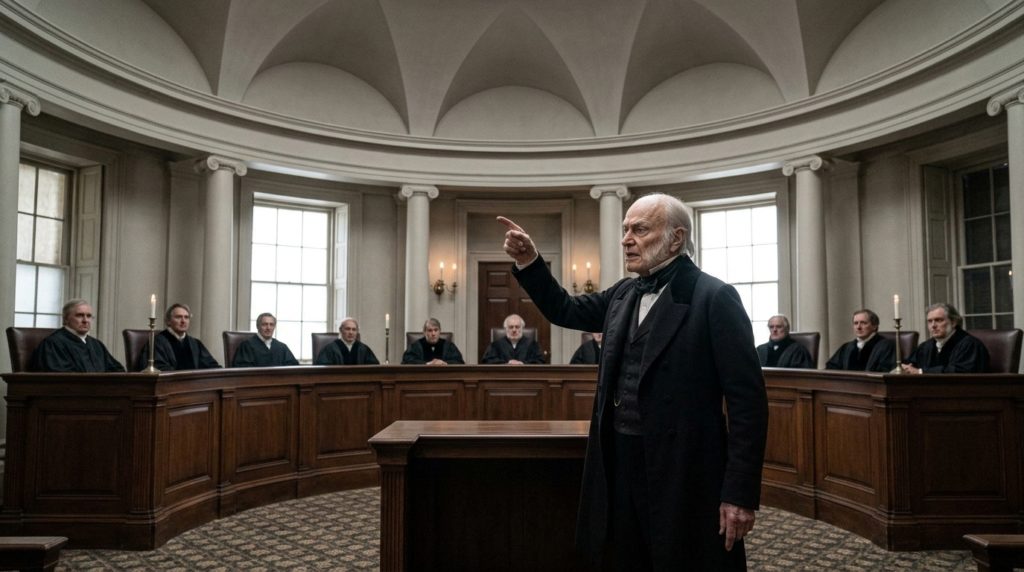
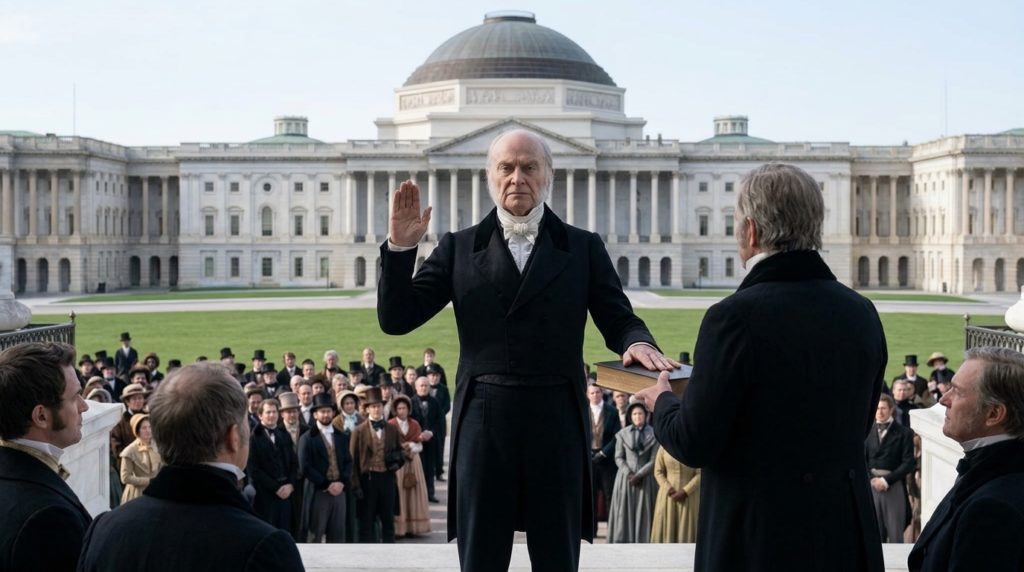
Adams declined to accompany Jackson to his inauguration on 4 March 1829[2]. In 1830 he was elected to the House of Representatives[2], where he served about sixteen years[1]. He fought the gag rule, which blocked anti-slavery petitions from being debated[2], and in 1841 he won freedom for the Amistad captives before the Supreme Court[2]. On 3 December 1844 the House voted 108 to 80 to drop the gag rule[1]. He collapsed in his seat on 21 February 1848[1] and died on 23 February[2]. The House adjourned while he lay dying[3]. He was buried in the Adams family crypt in Quincy[4].
Nevins, who edited a selection of Adams's diary, credited him, more than any other American, with saving the Smithson bequest and putting the Smithsonian on a sound footing[2][2]. In November 1843 Adams laid the cornerstone of an observatory at Cincinnati, called the first astronomical observatory built in America[2]. The hill there was named Mt. Adams in his honour[2]. In 1842 he argued that in wartime the president and army commander could order the emancipation of enslaved people, a speech Nevins says foreshadowed Lincoln's Emancipation Proclamation[2].
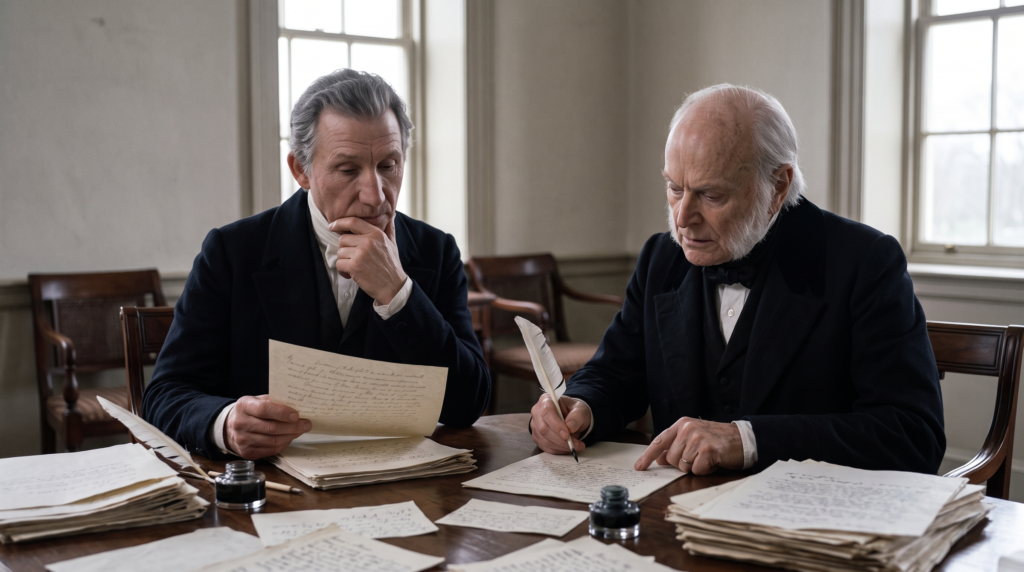
Adams kept a plain routine even as president, rising at four or five, building his own fire and reading his Bible before the day's work[2]. He began his diary on a voyage in November 1779[1] and kept it up almost to the end, the last entry being dated 4 January 1848[1]. His biographer Morse found no instance of humour in its twelve volumes[1].
Legacy & Reputation
What’s the verdict?
John T. Morse, in his 1882 biography, wrote that no man of pure life and just purposes had fewer friends or more enemies than Adams[1], yet he thought later generations were beginning to honour him as one of the greatest American statesmen[1]. Allan Nevins, editing the diary in 1928, called him one of the best-equipped men ever to enter the presidency but judged his administration a failure, because his stiff, unyielding temper could not cope with factions[2].
Myth-buster
Think you know this one?
The Monroe Doctrine sounds like the work of President James Monroe alone. In fact the message used words drafted by his Secretary of State, Adams[2], who preferred a purely American policy to the joint declaration that Britain’s George Canning proposed[2][2]; Nevins describes the authorship as divided between the two men[2].
Quick Facts
The essentials
Quick Facts
Roger would like you to know…
When John Adams became president in 1797, he hesitated to keep his son in the diplomatic service, fearing charges of favouritism[6]. He asked Washington[6], who called the young man the most valuable public character America had abroad[3], and the son reluctantly accepted the appointment[5].
Keith checked the reading list…
Adams tried Paradise Lost ten times before he got through it, and was nearly thirty when he finally reached the end[1]. He also tried smoking and Milton at the same time, hoping to find what his father enjoyed in both, and found the tobacco easier going[1].
This sounds invented, but…
In 1838 a petition from Rocky Mount, Virginia, asked the House to expel Adams. He presented it himself, with a resolution that a committee investigate it[1]. His enemies, seeing that he would have the best of the sport, laid the matter on the table[1].
Meanwhile, in the Potomac…
In his first months as president, the boat in which Adams crossed the Potomac for a bath sank in mid-stream. He swam back wearing his shirt and hat, and later gave the hat to his servant, Antoine[2].
Roger has been presented at court…
The editor of Adams's diary notes that Adams had an audience with George III, and that the king wanted to know whether all the Adamses came from Massachusetts[2].
File under: family business…
John Quincy Adams was sixteen months into his presidency when his father, John Adams, died at Quincy on 4 July 1826[2][2]. Mid-term elections that year gave the opposition a large majority in both houses of Congress[2].
Keith can confirm this one…
In 1811 President Madison appointed Adams to the Supreme Court, and the Senate confirmed him. He declined the seat[2]. At the time he was serving as Minister to Russia[2].
A small fact with a very large consequence…
In the 1824 election Jackson won 99 electoral votes to Adams's 84, and nobody had a majority[2]. The House then chose Adams on the first ballot, with thirteen states voting for him[2].
One for the Ageonauts…
In 1833, as a member of Harvard's Board of Overseers, Adams opposed giving President Jackson an honorary doctorate of laws. He stayed away from the ceremony, which he thought would honour a "barbarian"[2].
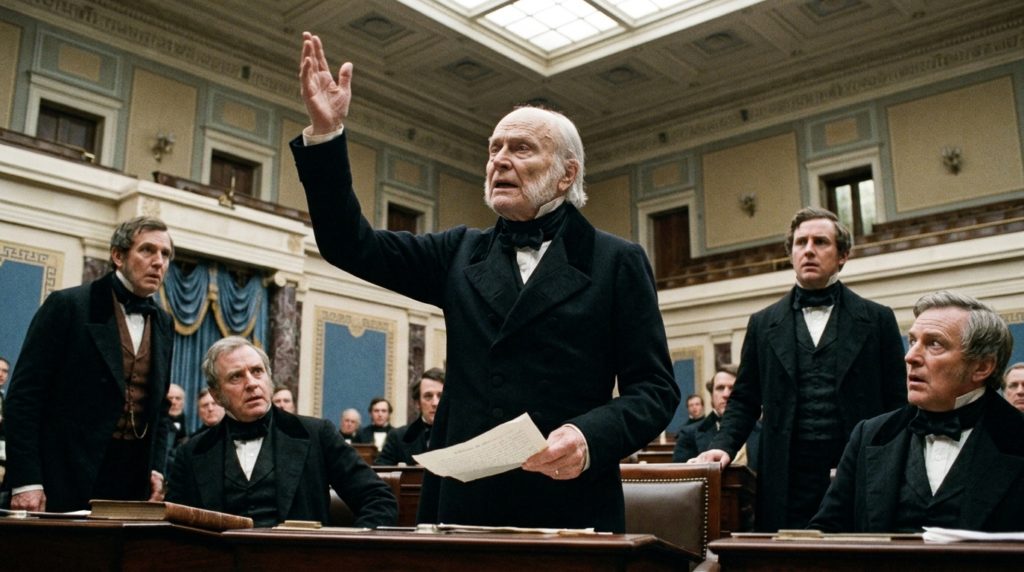
This is the last of earth! I am content!
John Quincy Adams
Adams's last words, spoken in the Speaker's room of the Capitol after he collapsed in the House on 21 February 1848, as recorded by his biographer John T. Morse[1][1].
Timeline
How it unfolded
11 July 1767
Birth of John Quincy Adams
John Quincy Adams, son of John and Abigail Adams, was born in the North Parish of Braintree, Massachusetts, later incorporated as the town of Quincy.[7] The Messages and Papers of the Presidents gives the same date.[8]
24 December 1814
Signing of the Treaty of Ghent
Appointed in January 1814 to head the commission negotiating an Anglo-American peace, Adams signed the Treaty of Ghent with Great Britain, ending the War of 1812.[9, p. 9] According to Morse's biography, it was signed by all eight negotiators on that day.[1]
5 March 1817
Adams Named Secretary of State
President Monroe appointed Adams secretary of state, and he took up the post in September 1817 after returning from his ministry in London.[9, p. 10]
22 February 1819
Adams-Onis Transcontinental Treaty
Adams signed the Transcontinental Treaty with Spain, by which the United States acquired Florida and extended its boundary to the Pacific.[9, p. 10]
9 February 1825
Adams Chosen President by the House
After running second to Andrew Jackson in the 1824 election with no candidate holding a majority, Adams was chosen president by the House of Representatives and inaugurated as sixth president on 4 March 1825.[9, p. 10] Morse's biography reports the House vote as thirteen states for Adams, seven for Jackson and four for Crawford.[10]
November 1828
Defeat by Andrew Jackson
Adams lost his bid for re-election to Andrew Jackson, ending his single term as president.[9, p. 11]
1 November 1830
Elected to the House of Representatives
Rather than retire, the former president was elected to the House of Representatives from Massachusetts' Plymouth district and was re-elected until his death.[9, p. 11]
February-March 1841
Defense of the Amistad Captives
Adams successfully defended the African captives of the Amistad before the US Supreme Court, one of the best-known acts of his congressional career.[9, p. 11]
Dig Deeper
Copy any prompt below into your favourite AI chat to keep exploring.
Explain how John Quincy Adams, as Secretary of State, shaped the Monroe Doctrine and why he preferred a purely American policy to the joint declaration Britain's George Canning proposed.
Debate whether John Quincy Adams's most lasting work was the Monroe Doctrine, his presidency, or his long fight in Congress against the House gag rule on slavery petitions.
Roleplay John Quincy Adams persuading President Monroe that America should issue its own statement instead of signing a joint declaration with Britain's George Canning.
Further Reading
Where to read more
John Quincy Adams - National Park Service
A short biography from the US National Park Service, which cares for the Adams family homes at Quincy. It follows his diplomatic posts, his single term as sixth president and his long second career in the House of Representatives.
Why look at this: A fast way to see the whole arc: a diplomat under five presidents, then a former president who went back to Congress in 1831, argued the Amistad case in 1841 and collapsed on the House floor in February 1848.
https://www.nps.gov/people/john-quincy-adams.htmJohn Quincy Adams: Campaigns and Elections - Miller Center, University of Virginia
A long essay by Margaret A. Hogan, formerly of the Adams Family Papers at the Massachusetts Historical Society, on the elections of 1824 and 1828.
Why look at this: Explains how the 1824 contest, with no electoral majority, went to the House in February 1825, where Henry Clay was eliminated and Adams won on a single-vote margin, and why Jackson's 'corrupt bargain' charge dogged him until his defeat in 1828.
https://millercenter.org/president/jqadams/campaigns-and-electionsThe John Quincy Adams Digital Diary - entry for 3 December 1844 (diary 44), Massachusetts Historical Society / Primary Source Cooperative
A free online transcription of Adams's own diary entry for 3 December 1844, from the 15,000-page diary he kept from 1779 to 1848 and which the Adams Papers at the Massachusetts Historical Society have edited.
Why look at this: Records the day the House voted 108 to 80 to rescind the gag rule on anti-slavery petitions, after a motion to table Adams's resolution failed 81 to 104, with his own cry of thanks to God at the result.
https://www.primarysourcecoop.org/publications/jqa/document/jqadiaries-v44-1844-12-p528--entry3?navmode=chronologicalRelated
Keep exploring



Places

Can be seen in
Where this shows up

References
Sources
Sources
- BookJohn Quincy Adams by John Torrey Morse ↑
- BookThe Diary Of John Quincy Adams 1794-1845 by Charles Scribner’s Son’s New York ↑
- BookA eulogy on the life and character of John Quincy Adams, delivered at the request of the legislature… by Edward Everett and others ↑
- Websitenps.gov: Nearbyattractions ↑
- BookMemoir of the life of John Quincy Adams by Josiah Quincy ↑
- BookLife and public services of John Quincy Adams, sixth president of the United States by William Henry Seward ↑
- BookMemoir of the Life of John Quincy Adams. by Josiah Quincy ↑
- BookA Compilation of the Messages and Papers of the Presidents. Volume 2, part 2: John Quincy Adams ↑
- WebsiteAdams Family Foreign Policy: Introduction and Timeline. Pages 9, 10, 11. ↑
- BookJohn Quincy Adams: American Statesmen Series by John T. Morse ↑
- BookLittle Journeys to the Homes of the Great - Volume 03 by Elbert Hubbard ↑
- BookThe national Capitol : its architecture, art and history by George Cochrane Hazelton ↑