
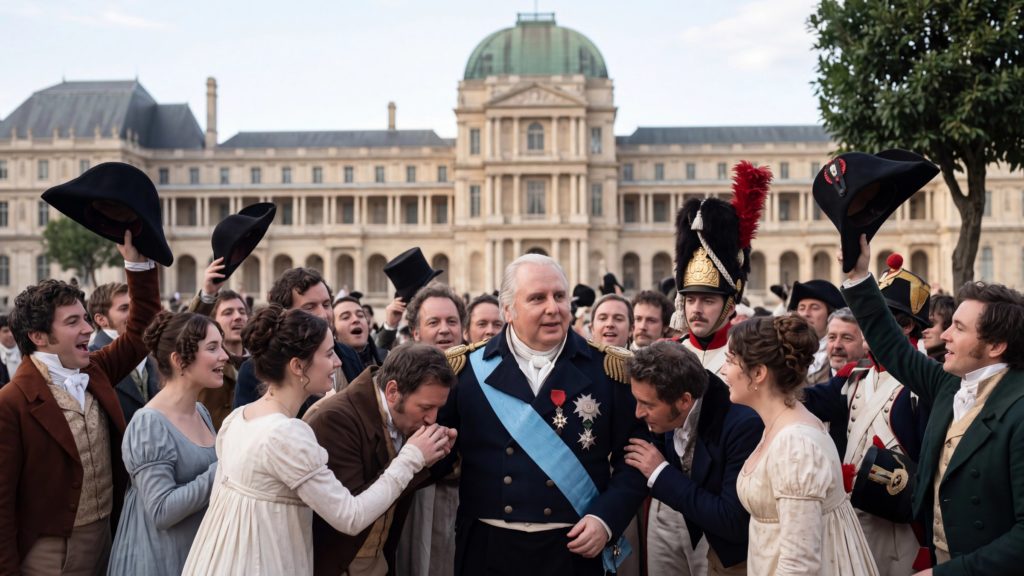
AI reconstruction based on Antoine-Jean Gros's "The Departure of Louis XVIII from the Tuileries Palace" (1817), from inside the crowd of officers, angled towards the king at the centre and the man kneeling at his feet.
Waterloo was barely over before Louis XVIII was back on the same throne he had already lost once - carried home this time behind more than a million Allied soldiers[1, p. 32].
What Happened
The story
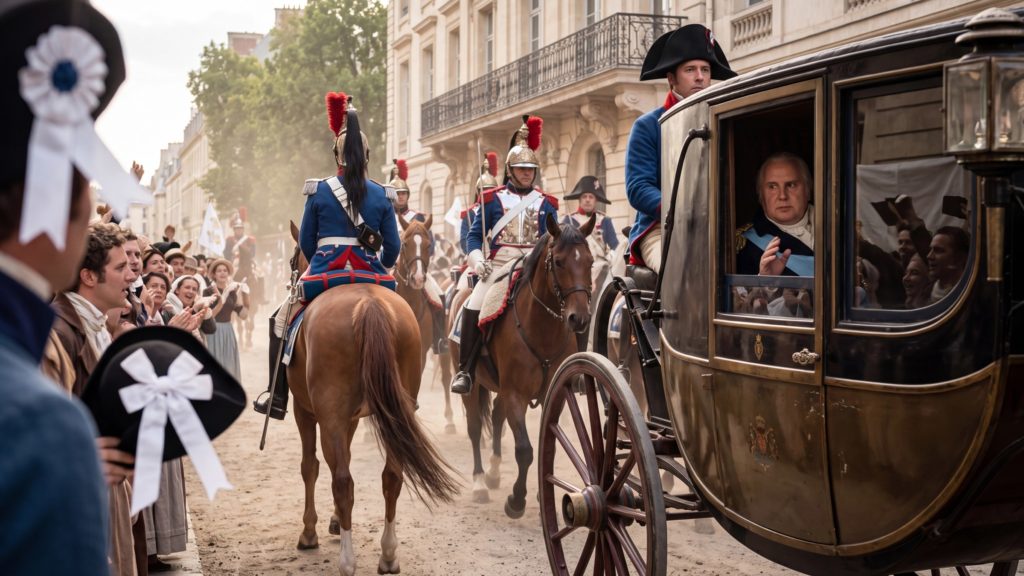
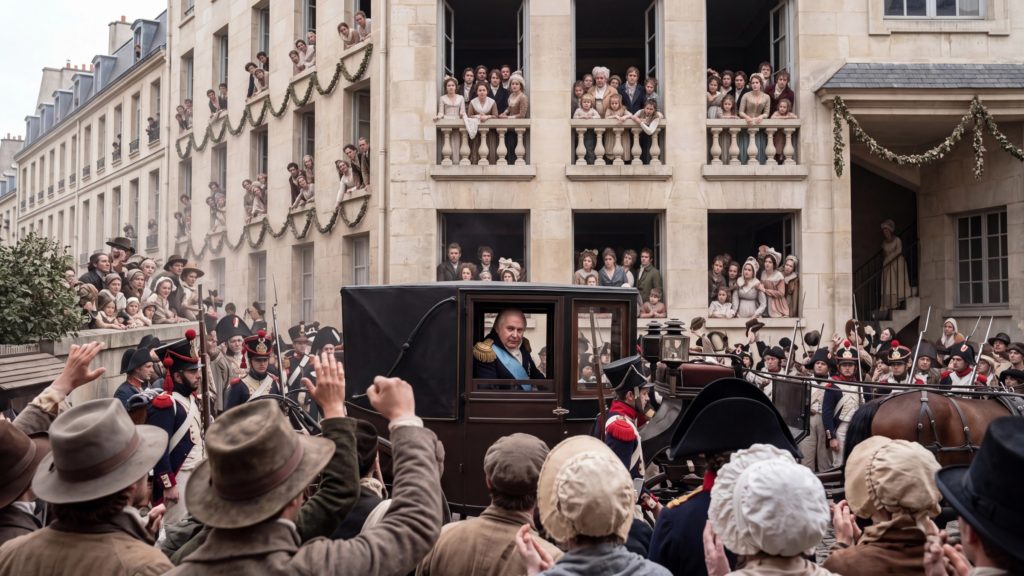
After Waterloo and Napoleon's second abdication, Allied armies advanced on Paris; by late July 1815 well over a million Allied troops had entered France[1, p. 32]. The Allies occupied Paris on 7 July, and the very next day Louis XVIII returned to the capital he had fled during the Hundred Days[2][3]. Unlike his first restoration in 1814, which had followed the Allies' occupation of an exhausted country, this second return arrived under something much closer to military escort.
Louis XVIII reassembled a government drawing on men from the old imperial administration, with Talleyrand as chief minister and Joseph Fouche, Napoleon's own former police chief, running the police once again[4, p. 292]. New elections that August returned a legislature so overwhelmingly royalist it was nicknamed the 'Chambre introuvable'[2][5]. In the south, meanwhile, royalist crowds took revenge on Bonapartists and Protestants in a wave of violence remembered as the White Terror; Marshal Brune was murdered by a mob at Avignon[6].
The government moved to punish the most conspicuous defectors of the Hundred Days. Marshal Ney, who had promised Louis XVIII he would "bring Buonaparte back in an iron cage" and instead rejoined Napoleon at Auxerre within days[7, p. 108][8], was tried, convicted, and shot in the Luxembourg Gardens on 7 December 1815[9, p. 403]. Press freedom, promised under the 1814 Charter, was curtailed again by fresh censorship[7, p. 108]. On 20 November 1815 the Second Treaty of Paris settled France's punishment among the powers.
An army of occupation and a heavy war indemnity followed, the formal cost of having gone to war under Napoleon a second time[10]. Talleyrand, who owed his own restored office to the Allies' bayonets rather than to the king's unforced favour, later summed up the whole affair with characteristic bitterness: "we returned with the baggage of the allies"[11]. France was formally at peace, but visibly a defeated country under foreign occupation.
Quick Facts
The essentials
Quick Facts
The Bigger Picture
Part of the final settlement of the Napoleonic Wars after Waterloo, when Allied armies occupied France and a convention among the four allied powers helped decide not only France's new borders but Napoleon's own fate[7, p. 108].
How It Came To This
Napoleon's final defeat at Waterloo and his second abdication; the advance of well over a million Allied troops into France by late July 1815[1, p. 32]; and the Allied powers' insistence that only Louis XVIII's return to Paris could settle the country[2].
What Actually Happened
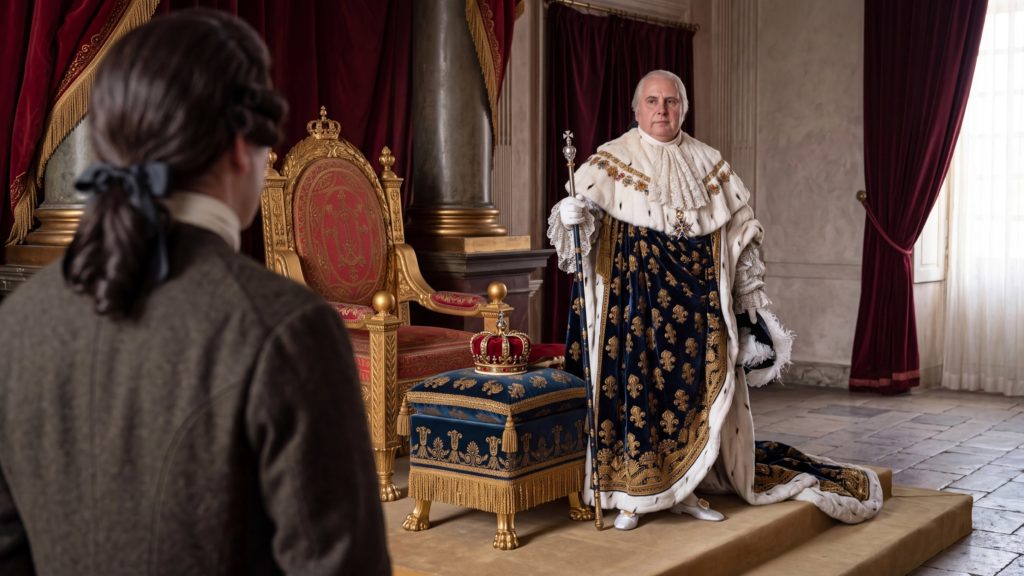
The Second Restoration was harsher than the first, and contemporaries knew it. As one historian of the period summed up the shift, "the first restoration had been merciful, the second would be terrible"[12]. Where 1814 had at least the appearance of a welcome, 1815 arrived under the visible weight of foreign bayonets, a fact ultra-royalists conveniently minimised and Bonapartists never let anyone forget. Louis XVIII governed through ministers - Talleyrand and the former imperial police chief Fouche chief among them - whose loyalty to the crown long predated their loyalty to Napoleon, but whose presence in office scandalised returning emigres who wanted a clean break from two decades of revolution and empire[13]. That tension between pragmatic continuity at the top and vengeful reaction at the grassroots defined the months that followed: an elected assembly more royalist than the king himself, a wave of local score-settling the government did not fully control, and formal justice reserved for the most conspicuous defectors, chief among them Marshal Ney. The restoration that resulted was legally secure but politically fragile from its very first weeks.
Why It Still Matters
The Second Restoration entrenched a constitutional monarchy dependent on foreign goodwill and produced the ultra-royalist backlash of the 'Chambre introuvable'[2], leaving behind a lasting "hatred of the reigning dynasty"[5] that culminated in the elder Bourbon line's fall in the Revolution of July 1830[14, p. 169].
Quick Facts
Roger would like you to know...
By late July 1815, more than one and a quarter million Allied troops had marched into France[1, p. 32] - Louis XVIII's second homecoming came with considerably more armed company than his first.
Keith checked the sources...
The legislature elected that August was so overwhelmingly royalist it earned its own nickname - the 'Chambre introuvable', roughly 'the chamber you could search the whole country and never find the like of again'[2].
One for the Ageonauts...
Louis XVIII's new government leaned on two men who had served Napoleon right through the Hundred Days: Talleyrand as chief minister, and Joseph Fouche running the police once again[4, p. 292].
History gets strange here...
Not every reprisal waited for a courtroom. Marshal Brune was murdered by a royalist mob at Avignon during the wave of violence remembered as the White Terror[6].
Roger has entered the historical rabbit hole...
Marshal Ney had promised Louis XVIII he would "bring Buonaparte back in an iron cage"[7, p. 108] - then joined Napoleon at Auxerre within days instead[8]. It cost him his life at the Second Restoration's hands.
Keith would like to clarify...
Ney's iron-cage promise did not age well. Once the Bourbons were back for good, he was tried, convicted of treason, and shot in the Luxembourg Gardens on 7 December 1815[9, p. 403].
The familiar story leaves this out...
The Charter of 1814 had promised a free press. Under the Second Restoration that freedom was quietly curtailed again by fresh censorship[7, p. 108].
Roger said it. Keith checked it...
Talleyrand himself admitted how this restoration had actually happened, later writing with some bitterness that "we returned with the baggage of the allies"[11] - hardly the image of a joyously welcomed king.
Meanwhile, in history...
While Paris settled back under its restored king, the powers were busy settling France's bill. The Second Treaty of Paris, concluded on 20 November 1815, imposed considerably harsher terms than the treaty signed the year before[15, p. 17].
A small fact with a very large consequence...
One historian's blunt verdict - "the first restoration had been merciful, the second would be terrible"[12] - captures why the Bourbons never fully shook off the memory of reprisal, right up to their final fall in 1830.
Acting in this way, we returned with the baggage of the allies.
Charles Maurice de Talleyrand, recalling the Second Restoration[11]
Talleyrand's own bitter verdict on a restoration that owed its return to foreign armies rather than to any popular mandate.
Timeline
How it unfolded
22 June 1815
Napoleon's second abdication
Napoleon signed his second abdication at about noon on 22 June, resigning his crown in favour of his son.[5]
8 July 1815
Louis XVIII re-enters Paris
With Paris again in Allied hands, Louis XVIII re-entered the capital, ending the Hundred Days; his enemies said he returned in the baggage-train of the Allied armies.[2][16]
2 August 1815
White Terror in the south: Marshal Brune killed at Avignon
As the royalist reaction known as the White Terror raged in Provence and the south, a mob at Avignon killed Marshal Brune, and bands in Nimes and Marseilles attacked suspected Bonapartists.[8][7, p. 108][17, p. 51]
7 October 1815
Opening of the Chambre introuvable
The twice-adjourned session opened with a Chamber of Deputies that was almost entirely ultra-Royalist, the session known as the Chambre introuvable.[5][17, p. 51]
20 November 1815
Second Treaty of Paris
France accepted the Second Treaty of Paris, which placed it under Allied military occupation of up to 150,000 men for no more than five years.[2][18, p. 135]
7 December 1815
Execution of Marshal Ney
Marshal Ney, who had been arrested in August and sentenced on 6 December, was shot in the Luxembourg Gardens, an execution that marked the vengeful side of the second Restoration.[18, p. 135][9, p. 403]
5 September 1816
Dissolution of the Chambre introuvable
Louis XVIII signed the Ordinance of 5 September dissolving the ultra-Royalist Chamber and reducing the number of Deputies to what the Charter prescribed, a move that ultra-Royalists received with fury.[17, p. 51]
16 September 1824
Death of Louis XVIII and accession of Charles X
Louis XVIII died and his brother, the Comte d'Artois, took the crown as Charles X.[16][19]
25 July 1830
Charles X issues the July Ordinances
Charles X tried to push through an extension of the sovereign's powers under the Charter of 1814 by ordinance, and the publication of the Ordinances was met with vigorous opposition.[20, p. 399][21, p. 92]
9 August 1830
Louis Philippe declared King of the French
Louis Philippe was declared King of the French, and a month later the Chamber voted to maintain the 1816 law against the Bonaparte family.[22]
Dig Deeper
Copy any prompt below into your favourite AI chat to keep exploring.
Explain how Louis XVIII came to reoccupy the Tuileries for a second time within a single year, backed on 8 July 1815 by over a million Allied troops.
Debate whether a king who returns behind foreign bayonets, as Louis XVIII did on 8 July 1815, can ever really call it a homecoming rather than an occupation.
Pitch me the Second Bourbon Restoration like a sequel nobody asked for - same king, same throne, same address on the Tuileries, twice in twelve months.
Further Reading
Where to read more
Louis XVIII - Encyclopedia.com
A free, concise biographical overview covering the July 1815 return, the White Terror, and the 'Chambre introuvable'.
Why look at this: Covers the same chain this page follows - the 8 July return, the ultra-royalist backlash, and its eventual dissolution - in one compact reference entry.
https://www.encyclopedia.com/people/history/french-history-biographies/louis-xviiiEpisode 8: The Unexpected Chamber - The Siecle
A free, thoroughly researched long-form narrative of the August 1815 elections and the ultra-royalist Chamber they produced.
Why look at this: Goes deep on exactly how a chamber meant to be manageable turned overwhelmingly ultra-royalist instead, and on the clash between Louis's caution and the Ultras' demand for reprisal that this page's account only sketches.
http://thesiecle.com/episode8/Memoirs to Illustrate the History of My Time, Volume 1 - Francois Guizot
The freely digitised English translation of Guizot's own memoirs, held in this library.
Why look at this: Guizot served in the restored government himself in 1815 - this is a minister's own first-hand account of the tension between the crown's pragmatic ministers and the emigres who wanted a clean break from the Napoleonic past.
https://www.gutenberg.org/ebooks/28169Related
Keep exploring





Places





Can be seen in
Where this shows up

References
Sources
Sources
- WebsiteDwight D. Eisenhower - biographical pamphlet (ERIC / U.S. Department of Education). Page 32. ↑
- BookA short history of Europe from the dissolution of the Holy Roman empire to the outbreak of the… by Charles Sanford Terry ↑
- BookCorrespondence on the French Revolution, 1789-1817 by William Augustus Miles and Charles Popham Miles ↑
- BookHistory of the war in France and Belgium, in 1815 by William Siborne. Page 292. ↑
- BookThe Bourbon restoration by John Richard Hall ↑
- BookThe Memoris Of Joseph Fouche ( Vol - Ii ) ↑
- BookHistory of Europe from the Fall of Napoleon in 1815 to the Accession of Louis Napoleon in 1852… by Archibald Alison. Page 108. ↑
- BookThe Life of Napoleon Bonaparte. Vol. 4 (of 4) by William Milligan Sloane ↑
- BookWith Napoleon in Russia: The Memoirs of General de Caulaincourt Duke of Vicenza by Armand-Augustin-Louis de Caulaincourt. Page 403. ↑
- BookVictor Hugo by Duclaux Madame ↑
- BookTalleyrand by Charlotte Julia von Leyden Blennerhassett and Frederick Clarke ↑
- BookThe French revolution from 1789 to 1815 by M. Mignet and James Westfall Thompson ↑
- BookMemoirs to Illustrate the History of My Time Volume 1 by Francois Guizot ↑
- BookParis in December, 1851; or, The coup d'tat of Napoleon III by Eugène Ténot, Sherman W. Adams and A. H Brandon. Page 169. ↑
- BookThe boy's Wellington by Harold Felix Baker Wheeler and Thomas Maybank. Page 17. ↑
- BookA dictionary of Napoleon and his times by Hubert N.B Richardson ↑
- BookLouis XVIII by Mary Frances Sandars. Page 51. ↑
- BookMemoirs of Napoleon Bonaparte — Complete by Louis Antoine Fauvelet de Bourrienne. Page 135. ↑
- BookThe history of Napoleon III, emperor of the French. Including a brief narrative of all the most important… by John S. C. Abbott ↑
- BookSelect Documents Illustrating Mediaeval and Modern History (includes Abdication of Francis the Second document) by Emil Reich. Page 399. ↑
- BookThe rise of Louis Napoleon by F. A. Simpson. Page 92. ↑
- BookLouis Napoleon and the genesis of the Second Empire; being a life of the emperor Napoleon III to… by Frank Halliday Cheetham ↑