
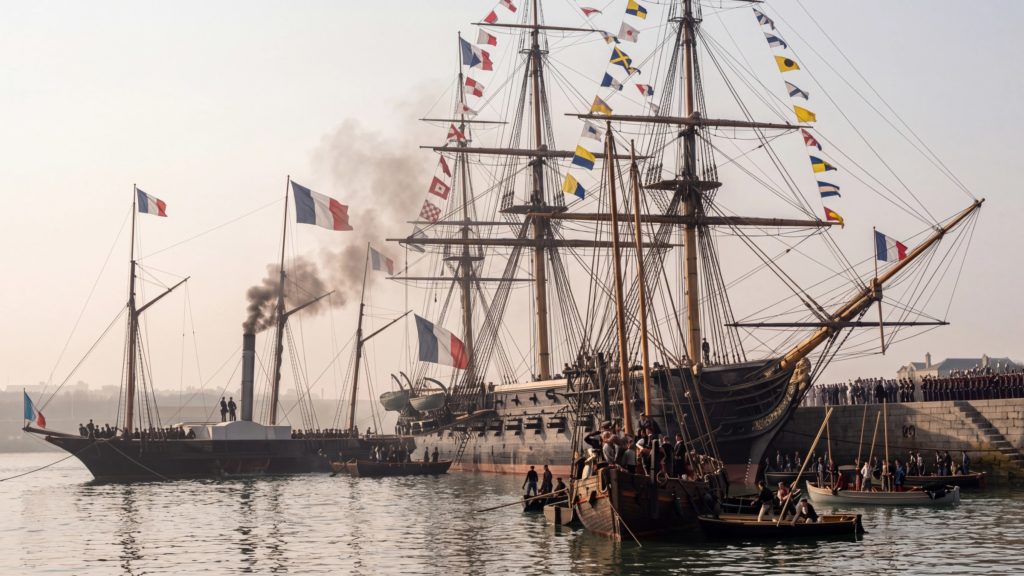
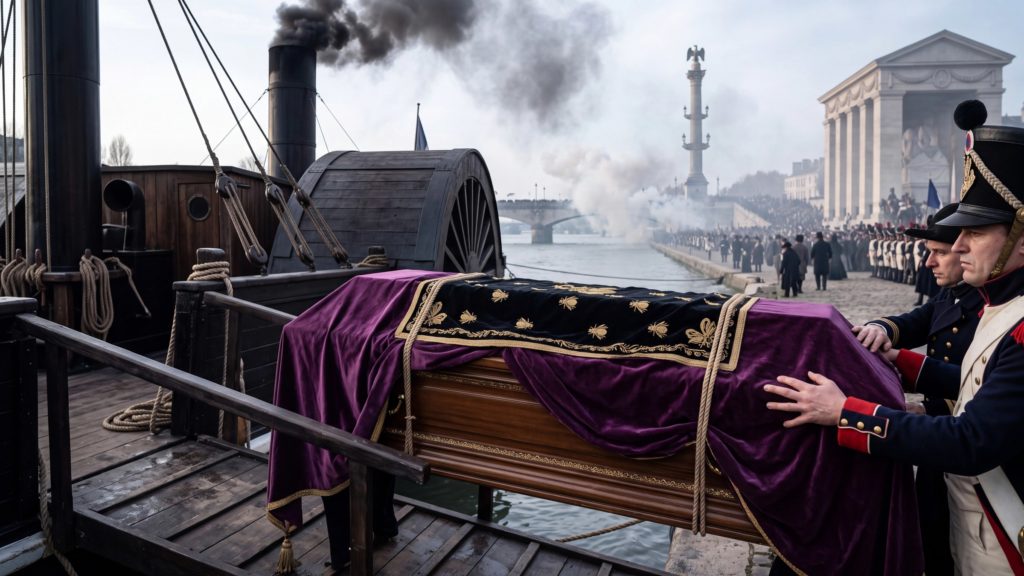
AI reconstruction based on Eugene Isabey's "Transbordement des cendres de Napoleon Ier a bord de la Belle Poule, 15 octobre 1840" (1842), keeping the reference's vantage on the coffin within the ship's rigging, with every figure removed so the coffin stands alone.
Nineteen years after his death, France sent a warship and a prince to fetch Napoleon home - and a hushed Paris crowd turned out in the cold to watch the coffin go by[1].
What Happened
The story
Nineteen years after Napoleon's death and burial on Saint Helena, the French government asked Britain to release his remains, and England formally acceded to the request[2]. King Louis-Philippe sent his own son, the Prince de Joinville, to fetch them, in command of the frigate 'Belle Poule'[1]. Before the ship's departure the Bishop of Frejus blessed the expedition[1]. Joinville sailed to Saint Helena, oversaw the exhumation, and had the coffin formally handed over to the French commissioners for the voyage home[3].
The 'Belle Poule' reached the French coast at Cherbourg on the 30th of the month[1], and the coffin travelled on toward the capital. On 15 December 1840 it was drawn through Paris in a huge funeral procession before packed crowds[4]; windows and the roofs of the houses along the route were crowded with spectators[2], and Victor Hugo, watching, set down his own notes on the spot that day[5, p. 1838]. As the funeral car itself passed, one eyewitness recorded, the enormous crowd fell hushed, and only a few voices cried 'Vive l'Empereur!'[1].
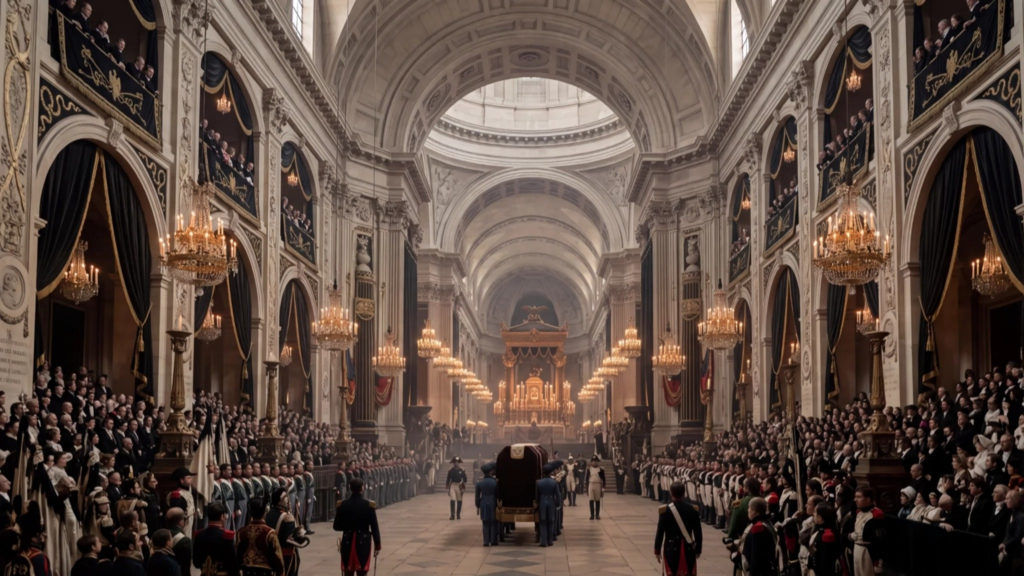
The procession ended at the Invalides, where the coffin was carried in beneath the building's immense gilded dome[1]. There a funeral service was held and the coffin was placed to lie in state[1, p. 578], the culmination of a journey that had begun with the coffin's formal handover by British officials on Saint Helena two months before[3]. Nineteen years after his death and burial in a plain grave on the island[6, p. 300], Napoleon's remains had at last been brought home to Paris.
In the days that followed, the coffin remained on display within the Invalides[1], and Paris kept talking of little else. The frigate that had carried the remains home, the 'Belle Poule', became a small piece of Bonapartist memory almost overnight, remembered ever after alongside the ceremony it had made possible[7] - and alongside the wry, distant commentary of foreign visitors like Thackeray, who had come to watch a legend's homecoming and left unsure quite what they had seen[1].
Quick Facts
The essentials
Quick Facts
The Bigger Picture
Part of the July Monarchy's use of Napoleonic memory: King Louis-Philippe's government asked Britain to release the remains from Saint Helena, and England formally acceded to the request[2].
How It Came To This
The French government's request that Britain release Napoleon's remains from Saint Helena, to which England formally acceded[2]; and the king's choice of his own son, the Prince de Joinville, to sail south in command of the frigate 'Belle Poule' and bring the remains home in person[1].
What Actually Happened
The retour des cendres was less a spontaneous outpouring of grief than a piece of calculated state theatre. Louis-Philippe's July Monarchy, a regime that owed its throne to revolution rather than unbroken hereditary right, used the return of France's most famous soldier to borrow some of his glamour for its own legitimacy, sending the king's own son to fetch the remains personally[1] rather than leaving the errand to a minor official. The choice of negotiating partner was itself pointed: it was England, Napoleon's old enemy and jailer, that first had to formally accede to the French request before the remains could leave Saint Helena at all[2]. Foreign witnesses watched with a certain wry distance - the English writer William Makepeace Thackeray, who saw the funeral car pass through Paris, described a crowd that fell hushed rather than roaring old war cries[1] - while French witnesses such as Victor Hugo recorded the day as a genuine, unresolved reckoning with the empire's memory[5, p. 1838]. The ceremony's real audience was less the dead emperor than the living regime that staged it.
Why It Still Matters
The retour des cendres cemented Napoleon's image as a national hero above party politics, gave the July Monarchy a moment of borrowed grandeur, and fixed the Invalides as his permanent tomb[1] - even as the Bonapartist sentiment it revived helped pave the way for his nephew's later return to power.
Quick Facts
Roger would like you to know...
The king didn't send a diplomat to fetch Napoleon home - he sent his own son. The Prince de Joinville personally commanded the frigate that sailed all the way to Saint Helena and back[1].
Keith checked the sources...
Napoleon's body could not simply be dug up and shipped home. England first had to formally accede to the French government's own request to release it[2].
One for the Ageonauts...
Before the 'Belle Poule' even set sail for Saint Helena, the Bishop of Frejus blessed the ship and its mission[1].
History gets strange here...
Handing the coffin over on Saint Helena was its own small piece of bureaucracy - British authorities passed it to French commissioners by a formally recorded process before it could ever leave the island[3].
Roger has entered the historical rabbit hole...
Victor Hugo was in the crowd that day. He wrote up his own eyewitness notes on the funeral 'taken on the spot' as it actually happened, rather than relying on second-hand reports[5, p. 1838].
Keith would like to clarify...
The popular image of a delirious, roaring crowd doesn't quite match one eyewitness's account: as the funeral car itself went past, the enormous crowd reportedly fell hushed, with only a few voices calling out 'Vive l'Empereur!'[1].
The familiar story leaves this out...
The ceremony's final stop, the Invalides, delivered its own visual climax - contemporaries described the coffin passing in beneath the building's immense gilded dome as the moment the day had been building toward[1].
Roger said it. Keith checked it...
The 'Belle Poule's homecoming had its own staged arrival - the frigate carrying the coffin reached the French port of Cherbourg on the 30th of the month, well ahead of the grand ceremony still to come in Paris[1].
Meanwhile, in history...
The frigate that carried Napoleon's remains home, the 'Belle Poule', became a small piece of Bonapartist memory in its own right, remembered alongside the ceremony it made possible[7].
A small fact with a very large consequence...
This one ceremony fixed the Invalides, not a distant Atlantic island, as Napoleon's resting place in the popular imagination - a designation that still draws visitors to the site today[1].
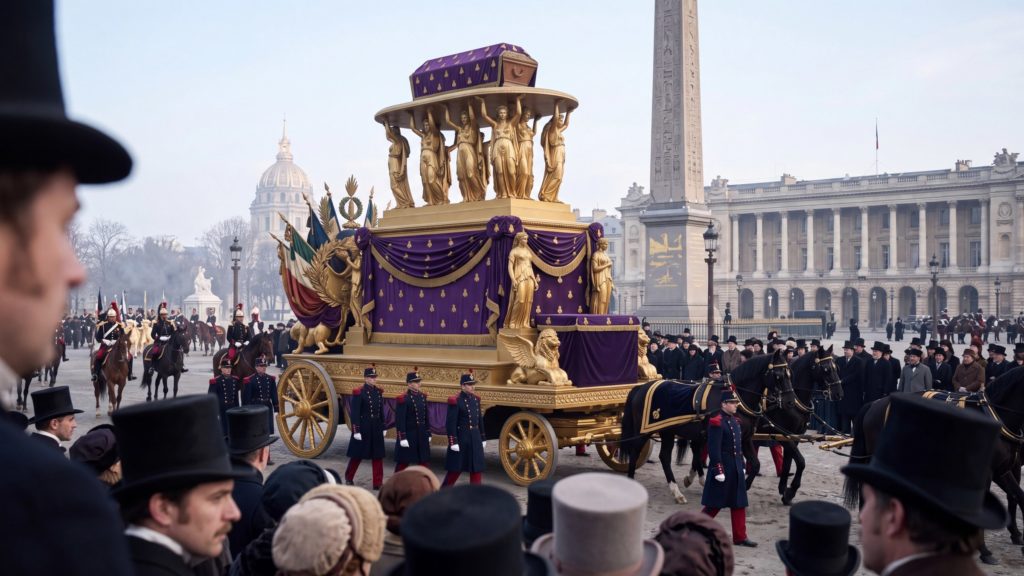
Hush! the enormous crowd thrills as it passes, and only some few voices cry Vive l'Empereur!
William Makepeace Thackeray, 'The Second Funeral of Napoleon' (1841)[1]
Thackeray's own eyewitness description of the funeral car passing through the streets of Paris on 15 December 1840.
Timeline
How it unfolded
15 April 1821
Napoleon's will asks for his ashes to lie beside the Seine
At Longwood Napoleon made his last will, in which he wished his ashes to repose on the banks of the Seine among the French people.[8, p. 15][2]
9 August 1830
Louis-Philippe becomes King of the French
After the July Revolution Louis Philippe was declared King of the French, and in September the Chamber voted to keep the 1816 law against the Bonaparte family.[4]
12 May 1840
Government announces the return of Napoleon's remains
The Minister of the Interior, Rémusat, asked the Chamber of Deputies to vote a million francs to bring Napoleon's remains home from Saint Helena, announcing that the king had ordered the Prince de Joinville to fetch them; Tarbell credits the idea to Monsieur Thiers.[9][10, p. 240][11, p. 240]
7 July 1840
The Belle Poule sails from Toulon
The frigate Belle Poule, commanded by the Prince de Joinville and accompanied by the Favorite, left Toulon for Saint Helena, with several old companions of Napoleon in the prince's suite.[1][10, p. 240]
15 October 1840
Exhumation of Napoleon on Saint Helena
The Belle Poule reached Saint Helena on 8 October, and the disinterment, with the English conducting the work, was begun at midnight on 15 October.[10, p. 240][11, p. 240][6, p. 300]
30 November 1840
The Belle Poule reaches Cherbourg
The Belle Poule arrived at Cherbourg forty-three days after leaving Saint Helena, and the town honoured the return of the remains with every pomp.[10, p. 240][11, p. 240]
15 December 1840
Funeral procession and entry into Les Invalides
Napoleon's coffin was brought to Les Invalides, where Louis Philippe received it from the Prince de Joinville, and nearly a million people are said to have seen the entry of the remains.[5, p. 1847][10, p. 240][11, p. 240]
2 April 1861
Final burial beneath the dome of Les Invalides
Napoleon was finally buried in the purpose-built crypt designed by Visconti at Les Invalides, nearly forty years after his death and over twenty after the Retour des Cendres; Tarbell notes that his body lay there until the mausoleum was finished.[12][10, p. 240]
Dig Deeper
Copy any prompt below into your favourite AI chat to keep exploring.
why a king brought his predecessor's body home to prop up his own throne
opening a grave on Saint Helena twenty-five years to the day
the ashes that were never ashes and the porphyry that isn't porphyry
Further Reading
Where to read more
The 'Retour des Cendres': Napoleon's Body Is Returned to Paris - napoleon.org
A free, concise overview of the 1840 return, from the request to Britain through to the arrival at the Invalides.
Why look at this: Confirms the same chain of events this page draws on - the Prince de Joinville's mission, the 'Belle Poule', and the final ceremony at the Invalides.
https://www.napoleon.org/en/history-of-the-two-empires/close-up/close-up-on-the-retour-des-cendres-napoleons-body-is-returned-to-paris/Napoleon's Funeral in Paris in 1840 - Shannon Selin
A free, extensively detailed account of the 15 December 1840 procession and ceremony, drawn from contemporary British newspaper reports.
Why look at this: Quotes Thackeray's own satirical account of the funeral at length, the same eyewitness source behind this page's central quote and its description of the hushed crowd.
https://shannonselin.com/2018/12/napoleons-funeral-paris-1840/Memoirs (Vieux Souvenirs) of the Prince de Joinville
The freely digitised English translation of Joinville's own memoir, held in this library.
Why look at this: Joinville personally commanded the expedition that recovered Napoleon's remains from Saint Helena - this is his own first-hand account of that mission, not a later retelling of it.
https://www.gutenberg.org/ebooks/5716Related
Keep exploring





Events

Can be seen in
Where this shows up

References
Sources
Sources
- BookThe Second Funeral of Napoleon by William Makepeace Thackeray. Page 578. ↑
- BookThe history of Napoleon III, emperor of the French. Including a brief narrative of all the most important… by John S. C. Abbott ↑
- BookUnpublished correspondence of Napoleon I : preserved in the War Archives by Emperor of the French Napoleon I and others ↑
- BookLouis Napoleon and the genesis of the Second Empire; being a life of the emperor Napoleon III to… by Frank Halliday Cheetham ↑
- BookThings seen = Choses vues ; Essays by Victor Hugo by Victor Hugo. Pages 1838, 1847. ↑
- BookNapoleon and Waterloo, the emperor's campaign with the Armée du Nord, 1815; a strategical and tactical study by Archibald Frank Becke. Page 300. ↑
- BookNapoleon the Third; the romance of an emperor by Walter Geer ↑
- BookMemoirs Of Napoleon Bonaparte - Iii And Iv by Louis Antoine Fauvelet De Bourrienne. Page 15. ↑
- BookIntimate memoirs of Napoleon III, personal reminiscences of the man and the emperor by baron d' Ambès and others ↑
- BookA Life of Napoleon Bonaparte, with a Sketch of Josephine, Empress of the French. by Ida M. Tarbell. Page 240. ↑
- BookA life of Napoleon Bonaparte; with a sketch of Josephine, empress of the French by Ida M. Tarbell. Page 240. ↑
- Websitenapoleon.org: Final burial of the mortal remains of emperor napoleon i eglise des invalides ↑