
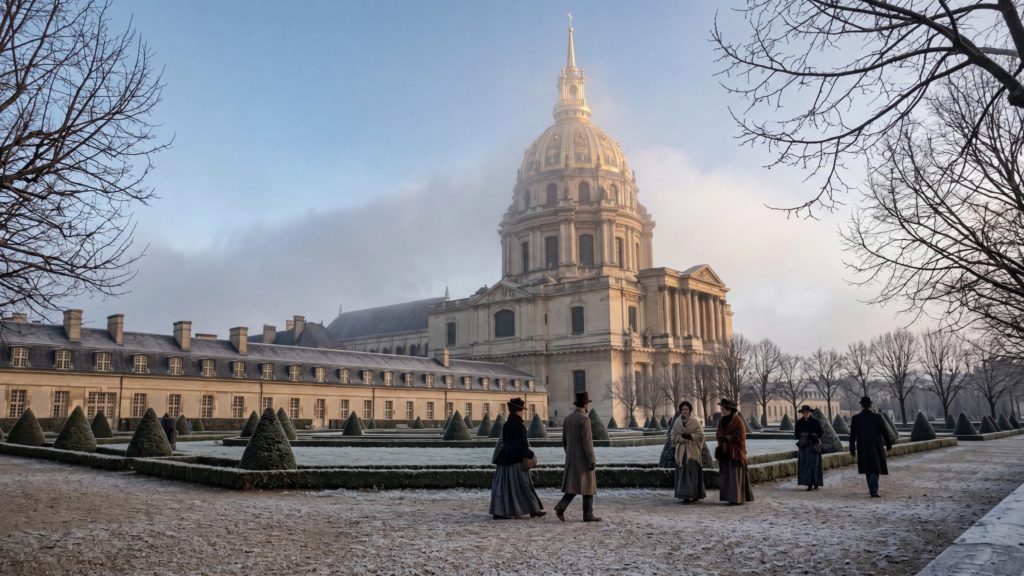
The gilded Dome des Invalides catches the sun above a misty Paris; its most recent regilding, in 1989, used some 12.65 kg of gold leaf.
Les Invalides is the grand Parisian home Louis XIV built for his old soldiers — the same complex where, generations later, Napoleon Bonaparte was laid to rest beneath a golden dome.[1]
About the Place
Why it matters
Les Invalides was founded by King Louis XIV in the 1670s to give France's old and wounded soldiers a permanent home and hospital, rather than leaving them to beg or rely on monasteries once they could no longer serve. The vast complex, with its parade ground and soldiers' quarters, was built under royal architects, and its landmark domed church was added to crown the site a little later, making the whole complex both a working home for veterans and a monument to royal military patronage.[1][2]
In its early decades, Les Invalides operated as a self-contained soldiers' community: veterans lived, ate and were cared for on site under military discipline, while others held place among detached veteran companies or received pensions elsewhere. A 1791 report to France's National Assembly on the institution's finances distinguished between invalides "retirés à l'hôtel" (housed at the Hôtel) and those pensioned in the provinces, and it explicitly addressed provision for the widows and children of Invalides residents.[3]
On the morning of 14 July 1789, a crowd advancing on royal authority in Paris broke into Les Invalides and seized muskets stored there, arming themselves before marching on to the Bastille in search of gunpowder that same day. It is one of the few moments Les Invalides — built as a veterans' home, not a fortress — became a flashpoint of revolutionary Paris, and it happened barely two years before the Assembly's own 1791 review of how the Hôtel's veterans and their families were provided for.[4][3]
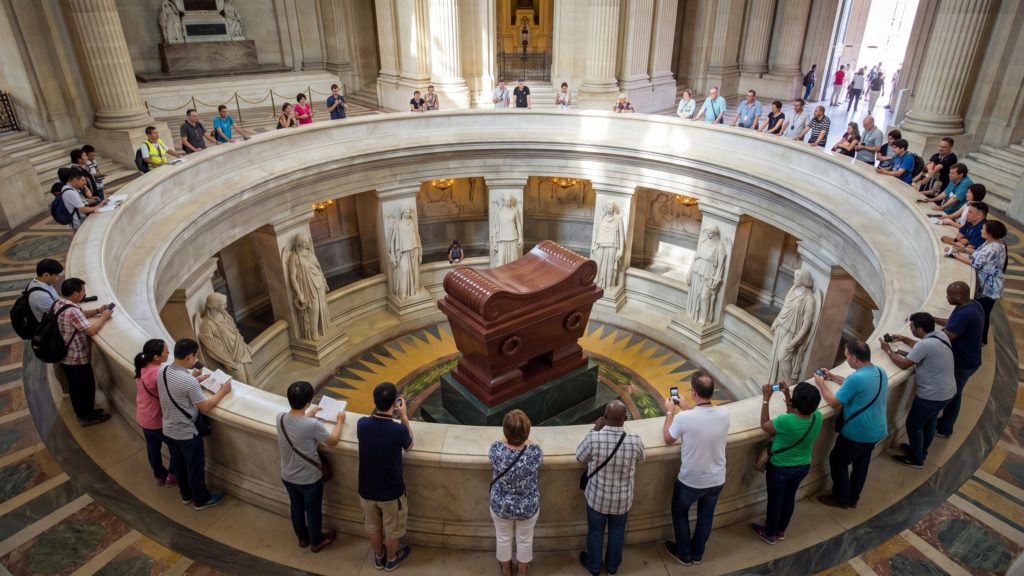
Napoleon Bonaparte's remains were brought to Les Invalides and interred beneath its golden dome, cementing the site as a place of French military remembrance far beyond its original veterans'-home purpose. The complex today houses the Musée de l'Armée, France's national military history museum, continuing — in an evolved form — Louis XIV's original mission to honour and care for France's soldiers.[1][5]
Legacy & Reputation
What’s the verdict?
Les Invalides is remembered chiefly as Napoleon’s resting place, but its older identity as one of the first purpose-built state institutions for military veterans is arguably the more historically significant legacy: it set a template later governments copied for organised veteran care, reflected in the 1791 Assembly’s own detailed reckoning of pensions, widows’ and children’s provision, and veteran companies tied to the Hôtel.[3]
Myth-buster
Think you know this one?
A common assumption is that Les Invalides has always been essentially a museum and war memorial. In fact, it began — and for a long time operated — as a working home and hospital for actual serving and retired soldiers, with its own internal system of pensions, veteran companies and provision for soldiers’ widows and children, as set out in a 1791 report to the National Assembly.[3]
Quick Facts
The essentials
Quick Facts
Keith would like to clarify
Keith would like to clarify: a "hôtel" in this sense isn't a hotel at all. In French, hôtel long meant a grand public or private building — here, a purpose-built home for old soldiers, not anywhere you could book a room.[1]
Roger has a theory
Roger had a theory that Les Invalides was always just a fancy war memorial. Keith checked the sources: an 1791 report to France's revolutionary National Assembly shows it was a working home, with real veterans housed "à l'hôtel" and pensions, widows and children all formally provided for.[3]
One for the Ageonauts
One for the Ageonauts: Les Invalides first opened its doors to veterans in 1674, and at its height housed and fed more than 4,000 resident soldiers within its own walls — effectively a small self-contained town in the middle of Paris.[6]
Keith checked the sources
Keith checked the sources: the Hôtel didn't just house veterans in Paris. Its 1791 accounting also covered detached veteran companies stationed elsewhere, and set out formal support for the widows and children of Invalides residents — a surprisingly organised welfare system for its time.[3]
History gets strange here
History gets strange here: on the morning of 14 July 1789, before the Bastille was ever stormed, a Paris crowd broke into Les Invalides and helped themselves to the muskets stored there — arming the very uprising that would topple the old order that had built the place.[4]
Roger would like you to know
Roger would like you to know that Les Invalides' golden dome — designed to crown a royal soldiers' hospital, not a tomb — has ended up sheltering an emperor. It remains one of the most recognisable landmarks on the Paris skyline.[2]
Keith has a note on that
Keith has a note on that: the detailed 1791 Assembly report on the Hôtel's soldes, pensions and veteran companies wasn't just bookkeeping — it shows revolutionary France trying to turn a royal charity into a rational state system, a forerunner of how modern governments handle veterans' affairs.[3]
Geography check
Geography check: not every soldier on the Hôtel's books actually lived there. The 1791 report distinguishes veterans housed "à l'hôtel" in Paris from those in departmental companies scattered around France, all paid from the same central fund.[3]
Worth a rabbit hole
Worth a rabbit hole: the Age Team's research library holds real 1791-92 French Revolutionary Assembly paperwork on how invalided soldiers were pensioned and housed, including the Hôtel des Invalides' own accounts — genuine period documents, not a modern retelling.[3]
Roger's favourite bit of theatre
Roger's favourite bit of theatre: popular retellings say Napoleon's tomb was deliberately sunk into an open crypt so that every visitor peering down at the sarcophagus ends up bowing their head to the emperor, whether they mean to or not.
I desire that my ashes may repose on the banks of the Seine, in the midst of the French people whom I have loved so much.
Napoleon Bonaparte
Opening clause of his will, dictated at Longwood House on Saint Helena, 15 April 1821. The wish was granted nineteen years later with the Retour des Cendres.
Timeline
How it unfolded
1670
Louis XIV founds the Hotel des Invalides
In 1670 Louis XIV founded the Hotel des Invalides in Paris as a soldiers' hospital, on the left bank of the Seine near the Champ de Mars.[7] According to Geer, it was built between 1670 and 1674 in the Faubourg Saint-Germain in the regular style introduced by Mansart.[8]
1706
Dome church completed
The church-and-chapel complex was designed by Jules Hardouin-Mansart in 1676, and the Dome chapel was completed in 1706, rising 107 metres and becoming the tallest dome in Paris.[9]
14 July 1789
Invalides raided for arms
At seven o'clock on 14 July 1789 a mob rushed to the Invalides to demand the arms that had been tacitly promised the previous day.[8] According to Wheeler, 28,000 muskets were stacked there, and the governor Sombreuil refused to hand them over without orders.[10, p. 408]
15 December 1840
Napoleon's funeral procession reaches the Invalides
On 15 December 1840 the funeral procession for Napoleon ran from Courbevoie by the Arc de Triomphe and the Champs-Elysées to the Esplanade des Invalides.[11, p. 240] According to Tarbell, his body lay there until the mausoleum designed by Visconti was finished.[11, p. 240]
2 April 1861
Napoleon laid in his sarcophagus
On 2 April 1861 Napoleon's remains were transferred from the chapel of Saint-Jérôme into the sarcophagus beneath the Dome.[12] Louis Visconti had been selected as project architect in 1842.[12]
1905
Musée de l'Armée formed
In 1905 the Artillery Museum, which had been housed in the Invalides since 1872, was merged with another military museum to form the present Musée de l'Armée.[9]
14 July 2024
New Invalides museum spaces open
On 14 July 2024 the Musée de l'Armée opened the first phase of its MINERVE project, new spaces telling the history of the Hotel des Invalides, including the renovated Vauban refectory and immersive films on key dates.[13]
Dig Deeper
Copy any prompt below into your favourite AI chat to keep exploring.
Explain how the Hôtel des Invalides' pension and housing system for veterans, widows and children actually worked in practice under the 1791 Assembly reforms.
Debate whether Les Invalides' 1791 system of housing veterans and pensioning their widows and children was a genuine welfare innovation, or just royal charity repackaged by revolutionaries.
Roleplay as a skeptical 1791 Assembly auditor grilling Les Invalides on exactly how it justifies every soldier's pension, widow's allowance and child's upkeep on the books.
Further Reading
Where to read more
Hôtel des Invalides — Britannica
Britannica's reference entry on Les Invalides, covering its founding by Louis XIV, its architecture, and Napoleon's tomb.
Why look at this: Best five-minute overview before diving in — confirms the headline facts (Louis XIV's founding, the golden dome, Napoleon's burial) in one reliable summary.
https://www.britannica.com/place/Hotel-des-InvalidesLes Invalides: The Military Museum and Tomb of Napoleon — napoleon.org (Fondation Napoléon)
An in-depth article from the Fondation Napoléon tracing Les Invalides from Louis XIV's foundation through to the 1840 Retour des Cendres and today's Musée de l'Armée.
Why look at this: Goes well beyond the potted version — walks through exactly how and why Napoleon's remains ended up under the Dome decades after his death, the part the episode itself never reaches.
https://www.napoleon.org/en/magazine/places/les-invalides-the-military-museum-and-tomb-of-napoleon/The Hôtel National des Invalides — Musée de l'Armée (official site)
The official Musée de l'Armée page describing the Hôtel National des Invalides as "a city within the city," founded by Louis XIV and opened to veterans in 1674.
Why look at this: Straight from the institution itself — good for checking the precise founding language and the scale of the original veterans' community (over 4,000 residents) against secondary retellings.
https://www.musee-armee.fr/en/your-visit/museum-spaces/the-hotel-national-des-invalides.htmlRelated
Keep exploring
People





Can be seen in
Where this shows up

References
Sources
Sources
- BookA Visit to the Invalides by Jules Félix Vacquier ↑
- BookA World History of Architecture by Marian Moffett, Michael W. Fazio and Lawrence Wodehouse ↑
- BookRapport fait a l'Assemblée nationale, au nom du Comité militaire, relatif aux invalides retirés à l'hôtel, aux invalides… by Jean-Girard Lacuée and others ↑
- BookLa Bastille by Fernand Bournon ↑
- BookSuzy's City Promenades by Annie Coburn Vincens Bernard Poisson and Suzy ↑
- Websitemusee-armee.fr: The hotel national des invalides ↑
- BookThe French revolution from 1789 to 1815 by M. Mignet and James Westfall Thompson ↑
- BookThe French revolution : a historical sketch by Walter Geer ↑
- Websiteen.wikipedia.org: Les Invalides ↑
- BookThe French revolution from the age of Louis 14 to the coming of Napoleon by Harold Felix Baker Wheeler. Page 408. ↑
- BookA Life of Napoleon Bonaparte, with a Sketch of Josephine, Empress of the French. by Ida M. Tarbell. Page 240. ↑
- Websiteen.wikipedia.org: Tomb of Napoleon ↑
- Websitemusee-armee.fr: Le projet minerve le musee de demain ↑