
The Arc de Triomphe at the head of the Champs-Elysees, decreed by Napoleon in February 1806 and finished thirty years later under a restored monarchy.
The Arc de Triomphe is the great stone triumphal gateway at the head of Paris's Champs-Élysées, raised among Napoleon's monuments to his own armies[1].
About the Place
Why it matters
The library gathered for this entry has no dedicated construction history for the arch, so the exact commissioning decree, date, and architect cannot be confirmed here and are deliberately left out rather than assumed. What period accounts do show is that the arch belonged to Napoleon's wider programme of Paris public works: an 1852 history groups "the triumphal arch of the Barrière de l'Étoile" alongside his granaries, the Madeleine and the Canal de l'Ourcq[1], and a contemporaries' memoir lists it simply as "Triumphal Arch de l'Étoile" among the great Napoleonic-era Paris projects[2, p. 15].
Napoleon did not live to see the arch completed. After his fall he was held at St Helena, "from July, 1817, until May, 1821," when he died there[3, p. 274]. The library used for this entry has no dedicated account of the arch's own building progress during these years, so its exact physical state at the time of his death is left unstated here rather than guessed at.
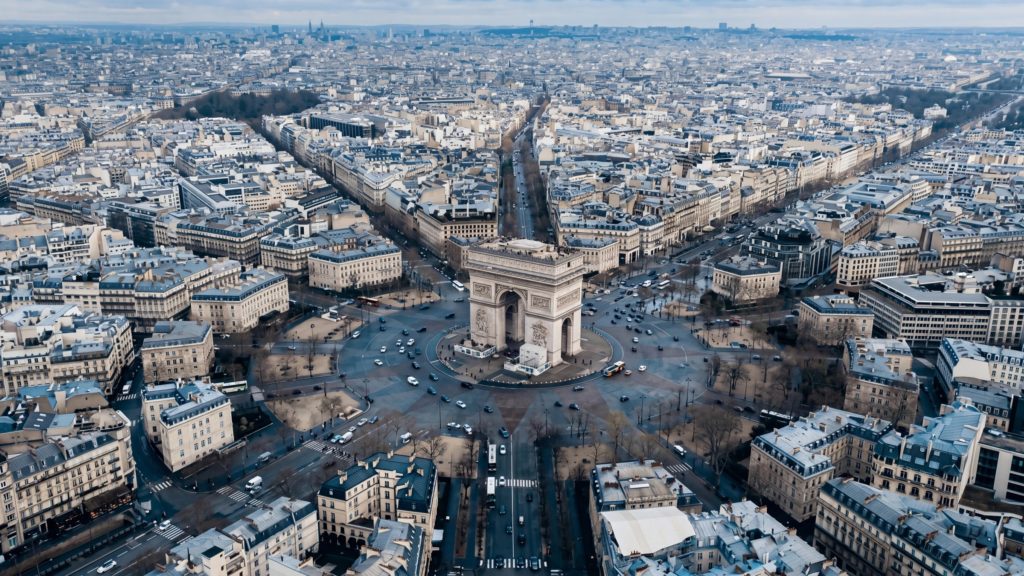
The arch's defining scene in the library gathered here is 15 December 1840, "intensely cold," when Napoleon's funeral cortège crossed roughly three miles from Courbevoie, through Neuilly, to the arch[4, p. 240]. A temporary "apotheosis of Napoleon" had been mounted on top of it for the day, and the flags captured at Austerlitz were draped over his coffin as it passed beneath, before the procession continued on to the Hôtel des Invalides[4, p. 240].
The library assembled for this entry is built from Napoleonic-era biographies and memoirs and does not extend past 1840 into the arch's later, twentieth-century history. Any claim about its role after that date would go beyond what these sources actually support, so it is left unstated here rather than asserted without a citation — see Further Reading and the Fun Facts below for web-sourced later history instead.
Legacy & Reputation
What’s the verdict?
Within the library gathered here, the arch’s reputation rests on the role it was given in 1840: the state chose it, ahead of any other Paris monument, as the point where Napoleon’s remains were ceremonially received back into France, draped in flags from his own Austerlitz campaign[4, p. 240]. That choice reads as an act of official rehabilitation — treating the arch as the nation’s proper gateway for honouring its army, whatever verdict history later reached on the man himself.
Myth-buster
Think you know this one?
The show’s own line has Napoleon building the arch to spite people who called him short — played for laughs, not offered as history. The library’s evidence points the other way: the arch is grouped among Napoleon’s public works honouring his armies, not his ego[1], and when his remains came home in 1840 it was flags captured at Austerlitz, not a joke about his height, that were draped over the coffin as it passed beneath[4, p. 240].
Quick Facts
The essentials
Quick Facts
Keith checked the sources…
Keith checked the sources: the arch began as an imperial decree of 18 February 1806, ordered after Austerlitz specifically to honour the Grande Armée, not any single victory[6]. The foundation stone went in that August, eight metres underground.
Roger would like you to know…
Roger would like you to know the first stone was laid on 15 August 1806 — Napoleon's own birthday[6]. Nothing says "happy birthday to me" quite like commissioning fifty metres of triumphal masonry in your own honour.
History gets strange here:
History gets strange here: the arch took roughly thirty years to finish, stalling completely after Napoleon's fall before resuming under a later king, and passing through several architects after Chalgrin's death in 1811 before it was finally finished[7].
Roger has a theory…
Roger has a theory that Napoleon simply refused to wait: for his 1810 wedding procession with Marie-Louise, the still-unfinished arch was faked with a full-size wooden-and-canvas mock-up so the wedding party could pass under it anyway[8].
Keith would like to clarify…
Keith would like to clarify: the arch was decreed to honour the army after Austerlitz, not to answer jokes about Napoleon's height[6]. When his remains came home in 1840, it was flags from Austerlitz draped over the coffin, not a punchline, that marked the moment[4, p. 240].
One for the Ageonauts:
One for the Ageonauts: on 15 December 1840, an "intensely cold" day, Napoleon's coffin crossed three miles from Courbevoie to the arch, passing beneath a temporary "apotheosis of Napoleon" mounted on top before continuing to the Hôtel des Invalides[4, p. 240].
Roger can't resist pointing out…
Roger can't resist pointing out that the grand 1836 opening was almost a non-event: King Louis-Philippe, wary of assassins, kept the ceremony to around eleven people at dawn, then let 700 gas lamps do the showing-off that evening[9].
Keith notes for the record…
Keith notes for the record that Napoleon never saw any of this: he was held on St Helena from 1817 and died there in May 1821[3, p. 274], fifteen years before Louis-Philippe finally opened the arch he had ordered built.
The Age Team's research turned up…
The Age Team's research turned up a later chapter the show doesn't mention: an unidentified French soldier from the First World War was placed beneath the arch on 11 November 1920 and formally buried there on 28 January 1921, with the eternal flame first lit in 1923[10].
Worth digging into further:
Worth digging into further: the arch was first meant for the Place de la Bastille, but Napoleon's own architects talked him into the western site instead, specifically so the finished monument would be visible from his imperial residence[6].
You will return to your homes only under triumphal arches.
Napoleon Bonaparte
From his proclamation to the Grande Armee at Austerlitz, 3 December 1805. The arch was decreed ten weeks later; most of the soldiers he was addressing never saw it finished.
Timeline
How it unfolded
18 February 1806
Napoleon Orders the Arc de Triomphe
Napoleon ordered the building of the Arc de Triomphe de l'Etoile by imperial decree of 18 February 1806, in honour of the French armies.[11][12][13]
15 August 1806
Foundation Stone Laid
The first stone was laid on 15 August 1806, the birthday of the head of state, but the foundations delayed the monument's rise because the limestone layers of the ground offered no solidity.[11][11][12]
29 July 1836
Completion and Inauguration under Louis-Philippe
Work resumed with energy under Louis-Philippe, and according to Duchesne the architect Blouet was called on 31 July 1832 to finish the monument.[11] The arch was solemnly inaugurated on 29 July 1836, thirty years after the foundation stone.[11, p. 121][12][13]
15 December 1840
Napoleon's Funeral Cortege Passes under the Arch
On 15 December 1840 the funeral procession bringing Napoleon's remains back from Saint Helena ran from Courbevoie by way of Neuilly to the Arc de Triomphe, then down the Champs Elysees toward the Invalides.[4, p. 240][4, p. 240][12] Duchesne describes the cortege halting beneath the arch to a spontaneous cry of Vive l'Empereur.[11, p. 121]
6 February 1896
Classified as a Historic Monument
The Arc de Triomphe was classified as a monument historique on 6 February 1896.[12][13]
11 November 1920
Tomb of the Unknown Soldier Placed beneath the Arch
The coffin of the Unknown Soldier made a solemn entrance under the Arc de Triomphe on Armistice Day, 11 November 1920, and was buried there on 28 January 1921.[14][14] The flame of remembrance was lit for the first time on 11 November 1923 by Andre Maginot.[14]
Dig Deeper
Copy any prompt below into your favourite AI chat to keep exploring.
Walk me through how Napoleon's 1806 decree honouring the Grande Armée turned into a 50-metre arch that outlived his own reign by decades.
Does measuring a leader's legacy in stone and metres, rather than in the years he actually held power, tell us something true about him — or just something flattering?
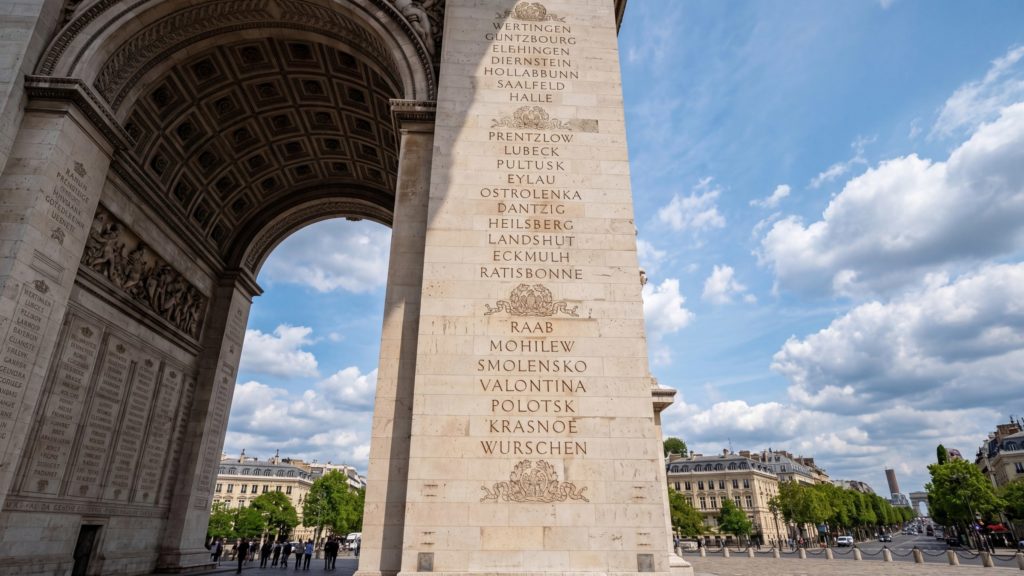
Roleplay as Roger giving over-the-top tour-guide commentary at the base of the 50-metre arch, treating every carved victory in its "roll call" like his own personal trophy cabinet.
Further Reading
Where to read more
History of the Arc de Triomphe
The monument's own official history page, run by the Centre des monuments nationaux, covering the 1806 decree, the succession of architects, and the long road to the 1836 opening.
Why look at this: Gives the real Austerlitz-and-army decree behind the arch — the direct fact-check for the show's height-joke gag.
https://www.paris-arc-de-triomphe.fr/en/discover/history-of-the-arc-de-triompheArc de Triomphe de l'Étoile, Paris
An in-depth magazine article from the Fondation Napoléon (napoleon.org) covering the architects' rivalry, the 1810 wooden mock-up used for Napoleon's wedding procession, and the arch's consecration by his funeral cortège in December 1840.
Why look at this: Expands on the exact scene the episode closes on — Napoleon's remains passing beneath the arch in December 1840.
https://www.napoleon.org/en/magazine/places/arc-de-triomphe-de-letoile-paris-2/Notice historique sur l'Arc de Triomphe de l'Étoile
A dedicated historical account of the arch by Jules D. Thierry, published in 1840 — the same year Napoleon's remains passed beneath it — digitised and freely downloadable on the Internet Archive.
Why look at this: A genuine period-primary account of the monument for readers who want to go past the summary pages, from the very year the episode's closing scene takes place.
https://archive.org/details/noticehistoriqu00thiegoogRelated
Keep exploring






Can be seen in
Where this shows up

References
Sources
Sources
- BookThe Napoleon dynasty: or, The history of the Bonaparte family. An entirely new work by C. Edwards Lester and Edwin Williams ↑
- BookMemoirs Of Napoleon Bonaparte - Iii And Iv by Louis Antoine Fauvelet De Bourrienne. Page 15. ↑
- BookHistory of the Captivity of Napoleon at St Helena Vol. 1 by William Forsyth. Page 274. ↑
- BookA Life of Napoleon Bonaparte, with a Sketch of Josephine, Empress of the French. by Ida M. Tarbell. Page 240. ↑
- Websitevisitparisregion.com: Arc de triomphe ↑
- Websiteparis-arc-de-triomphe.fr: Genesis and first stone ↑
- Websitenapoleon.org: Arc de triomphe de letoile paris 2 ↑
- Websiteparis-arc-de-triomphe.fr: History of the arc de triomphe ↑
- Websitebritannica.com: July 29 A Monument Built for Glory Opened Quietly ↑
- Websiteparis-arc-de-triomphe.fr: The unknown soldier ↑
- BookLa Place de l'Étoile et l'Arc de Triomphe; la construction de l'Arc de Triomphe et ses ornements; les… by Henri Gaston Duchesne. Page 121. ↑
- Websitefr.wikipedia.org: Arc de triomphe de l'Étoile ↑
- Websitelaflammesouslarcdetriomphe.org: La construction ↑
- Websiteen.wikipedia.org: Tomb of the Unknown Soldier (France) ↑
- Websiteen.wikipedia.org: Arc de Triomphe ↑
- Websiteen.wikipedia.org: L'Arc de Triomphe, Wrapped ↑