
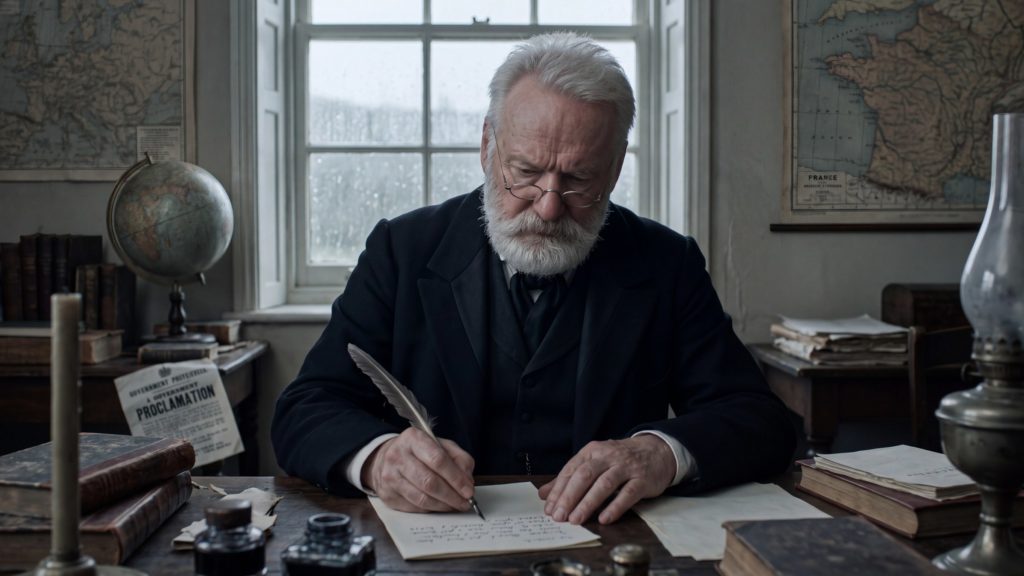
In exile on Guernsey, Hugo beside the manuscript of a great work; he wrote Les Miserables there during nineteen years away from France.
Poet, Novelist & Playwright
The French poet who refused an official amnesty and could only bury his own wife at the Belgian border, rather than set foot back in Napoleon III's France[1].
Bio
Who they were
Victor Marie Hugo was born on 26 February 1802 in Besançon, France, the second son of Joseph Léopold Sigisbert Hugo, an officer who had risen from the ranks of the Republican army, and Sophie Trébuchet, the devout, royalist daughter of a Nantes shipowner[1]. Though a sickly child, he was carried along with his brothers in his father's baggage train through southern France and into Spain, as the elder Hugo — by then a general — served as governor of three provinces and Lord High Steward at the court of Joseph Bonaparte, Napoleon's brother and the installed King of Spain[1].
Back in Paris, Hugo was educated first by priests and then briefly by General Lahorie, a supporter of a failed plot against Napoleon[1]. He proved a startling literary prodigy: he won prizes at the Toulouse Floral Games two years running, and in 1817 the French Academy gave an honourable mention to his "Odes on the Advantages of Study," doubting its author was really only fifteen[1]. His early poetry impressed Louis XVIII enough to earn Hugo a royal pension[1]. By his twenties he had married his childhood sweetheart, Adèle Foucher, in October 1822[1].
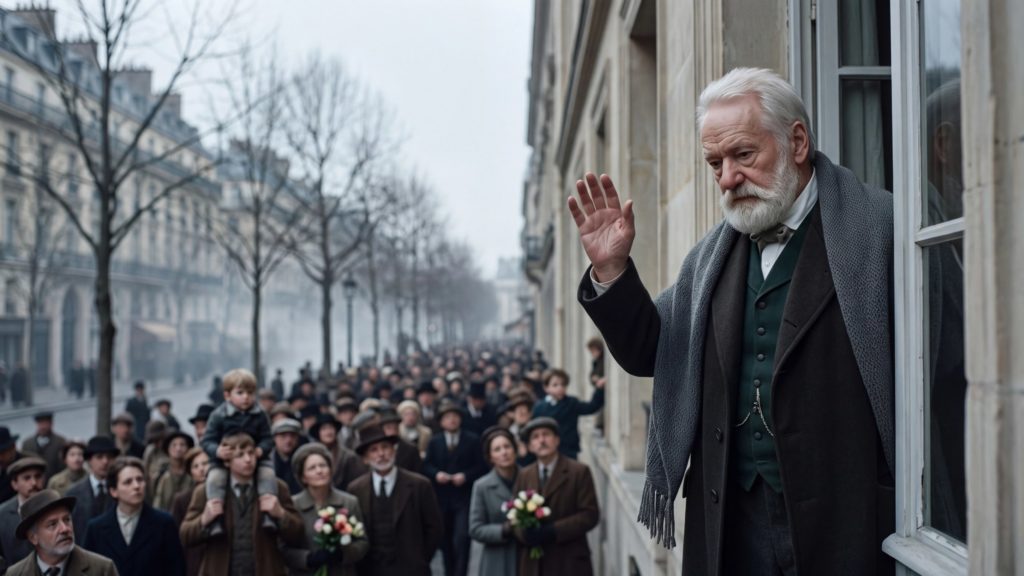
Hugo became the figurehead of French Romanticism: his 1830 play Hernani provoked open clashes between traditionalists and his supporters after censors briefly suppressed it[1], and his 1831 novel Notre-Dame de Paris was translated worldwide and adapted into countless plays and operas[1]. Personal tragedy struck in 1843 when his daughter Léopoldine drowned in the Seine alongside her husband, who refused to let go and save himself[1]. After Napoleon III's coup, Hugo fled into exile, attacked the new regime in print, nicknamed the emperor "Napoleon the Little," and in 1862 published Les Misérables, explaining in its preface that such a book would stay necessary "so long as ignorance and poverty exist on earth"[2].
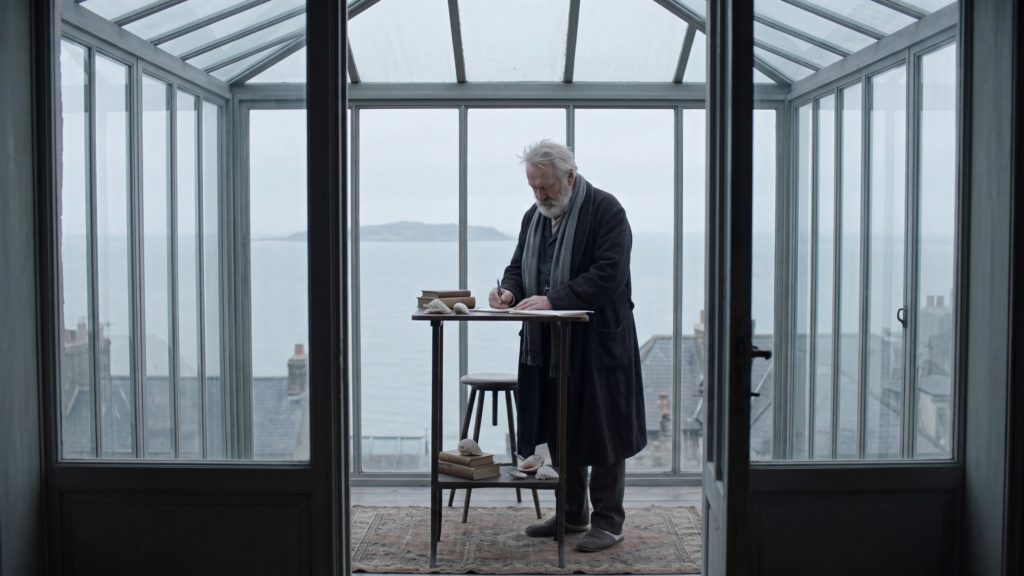
Hugo died in Paris in May 1885[1]. France gave him a funeral on a scale usually reserved for heads of state: his coffin, deliberately that of a pauper by his own request, was carried in a vast public procession from the Arc de Triomphe to the Panthéon, joined by virtually everyone prominent in French art and letters[1]. By then he had long been a life senator and a national institution, remembered as much for his defiance of the Second Empire as for his writing[1].
Hugo's novels, especially Notre-Dame de Paris and Les Misérables, turned Romantic fiction into a tool for social protest, forcing readers to confront poverty, criminal justice and the treatment of women and children[2]. His years of political exile, and his refusal of amnesty even to bury his wife on French soil, cemented his image as a conscience of the nation rather than merely a popular author[1]. That combination — bestselling storyteller and outspoken political dissident — has kept his work central to French culture and made Les Misérables one of the most widely adapted stories in the world.
Even in his sixties Hugo could not stay out of a fight: after fleeing to Brussels once the Paris Commune fell, he sheltered and helped its defeated fighters so openly that a mob attacked his house, and the Belgian government banished him from the country rather than risk it happening again[1].
Legacy & Reputation
What’s the verdict?
Critics in his own lifetime were divided: the poet Heine mocked Hugo’s fondness for grotesque, deformed characters such as Quasimodo as a kind of self-portrait, given Hugo’s own slightly uneven shoulders[1]. Later opinion has largely set that mockery aside, treating him instead as the central figure of French Romanticism and, through Les Misérables, one of literature’s most influential campaigners against poverty and injustice — though some modern critics still find his prose overblown and his moralising heavy-handed.
Myth-buster
Think you know this one?
Myth: Les Misérables was written mainly as an adventure story. Correction: Hugo stated in his own preface that he intended it as a direct protest against poverty and ignorance, writing that such books “cannot fail to be of use” so long as those problems exist[2].
Quick Facts
The essentials

Quick Facts
Keith checked the paperwork…
Victor Hugo was born on 26 February 1802 in Besançon, in eastern France[1]. He would go on to outlive an empire and several political systems entirely, but the birth certificate itself is refreshingly uncomplicated.
A small fact with a very large consequence…
In 1843, Hugo's eldest daughter Léopoldine drowned in the Seine along with her husband, Charles Vacquerie, in a boating accident[3]. Hugo learned of it from a newspaper while travelling, and the grief followed him into some of his most personal later writing.
Roger has renamed the novel…
Hugo's 1831 novel is properly titled Notre-Dame de Paris, after the cathedral itself, not its bell-ringer. English publishers retitled it "The Hunchback of Notre Dame"[4] to sell it, and the misleading title has outlasted the original ever since.
Keith has found the pamphlet…
During his years of exile after opposing Napoleon III's coup, Hugo wrote Les Châtiments, a collection of furious satirical verse aimed squarely at the new emperor[5]. It was banned in France for years, which only made everyone more curious to read it.
Roger said it. Keith checked it…
Hugo was elected a senator of France in 1876 and died in Paris on 22 May 1885[6]. By then he had gone from banned political exile to national institution, which is quite a swing for one literary career.
Roger has found an angry crowd…
During the upheaval of 1848, a mob confronted Hugo over his role as a peer of France, one man reportedly levelling a rifle and shouting "Down with the peer of France!"[7]. Revolutionary Paris, it turns out, was not always a receptive audience for aristocratic titles.
Keith has traced the family tree…
Hugo's father served as a general in Napoleon's army[1], which meant the future author of some of the century's most searching writing about war and empire grew up literally following an imperial household from posting to posting across Europe.
History gets strange here…
Hugo's will asked to be carried to the cemetery in a pauper's hearse and left fifty thousand francs to the poor[8]. The government gave him a vast state funeral attended by roughly two million people anyway, but did at least honour the hearse request.
This sounds invented, but…
Popular retellings say Hugo wrote naked to stop himself wandering off outside. The real story, from his wife Adèle, is nearly as strange: he locked away his formal clothes and wrapped himself in a huge grey shawl instead, leaving the house simply not an option.
One for the Ageonauts…
In 1848, Hugo supported Louis-Napoleon Bonaparte's election to the presidency of the new Republic[9], a decision he came to regret so thoroughly that within a few years he was writing whole books attacking the same man as emperor.

So long as there shall exist, by virtue of law and custom, decrees of damnation pronounced by society ... so long as ignorance and poverty exist on earth, books of the nature of Les Misérables cannot fail to be of use.
Victor Hugo
From his preface to Les Misérables, dated "Hauteville House, 1862" — written from his home in exile on Guernsey[2].
Timeline
How it unfolded
26 February 1802
Birth of Victor Hugo
Victor Marie Hugo, second son of an officer risen from the ranks in the Republican army, was born on 26 February 1802 at Besancon.[1]
25 February 1830
Hernani Premiere
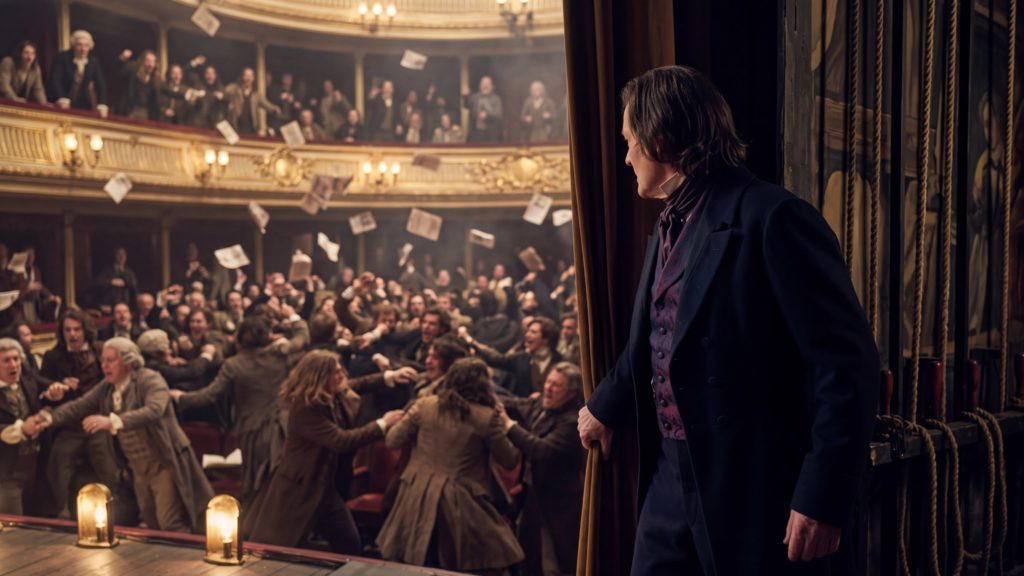
Hernani was first performed on 25 February 1830 amid the uproar of opposition.[10, p. 171] Carrington's preface says the battle of Romanticism was fought out and won on the stage.[3]
16 March 1831
Publication of Notre-Dame de Paris
Notre-Dame de Paris was published on 16 March 1831 and was quickly translated into other languages across Europe.[11][12]
December 1851
Hugo Flees After Louis-Napoleon's Coup
After Louis-Napoleon's coup d'etat of 2 December 1851 Hugo helped organise opposition and fled to Brussels, later living in Jersey and then at Hauteville House in Guernsey until 1870.[6]
March 1862
Publication of Les Miserables
Les Miserables appeared in 1862, one of three long-heralded novels of Hugo's exile, and was first published in Belgium at the end of March 1862 while he lived in Guernsey.[1][13]
5 September 1870
Hugo Returns to Paris
Hugo returned to Paris on 5 September 1870 after Napoleon III's defeat and downfall, and remained in the city throughout the siege.[6] The fall of the Empire restored him to France, where he lived in Paris with his son Charles and his grandchildren during the siege.[3]
Dig Deeper
Copy any prompt below into your favourite AI chat to keep exploring.
Explain why Victor Hugo refused an official amnesty and could only bury his own wife at the Belgian border instead of returning to France.
What does it mean that Victor Hugo valued his opposition to Napoleon III more than the ability to bury his own family on French soil?
Convince me refusing to come home, even for your own wife's funeral, is the most stubborn political statement in French history.
Further Reading
Where to read more
Victor Hugo
Britannica's reference biography covering Hugo's birth in 1802, his major novels and plays, and his death and state funeral in 1885.
Why look at this: Explains why a novelist was given a national funeral and burial in the Panthéon — by 1885 Hugo was regarded as the moral conscience of the Third Republic as much as its most famous writer.
https://www.britannica.com/biography/Victor-HugoVictor Hugo's Life — biographical timeline (Maisons Victor Hugo)
A detailed, date-by-date biographical timeline maintained by the official Hugo house-museums in Paris and Guernsey, organized around his life before, during, and after his 19-year political exile.
Why look at this: Ties to his 1851 stand against Louis-Napoléon Bonaparte's coup d'état — he publicly opposed it, fled arrest, and later refused Napoleon III's 1859 amnesty offer on principle, choosing to stay in exile rather than compromise.
https://www.maisonsvictorhugo.paris.fr/en/paris/museum/find-out-more-about-victor-hugo/des-questions-sur-la-vie-de-victor-hugoFonds Victor Hugo — Les Misérables, Tome premier (autograph manuscript, Gallica / BnF)
The digitized handwritten manuscript of the first volume of Les Misérables, part of the Fonds Victor Hugo that Hugo bequeathed to the French national library.
Why look at this: Hugo began writing Les Misérables in 1845, set it aside for over a decade, and finished it in exile on Guernsey in 1862 — these are the actual handwritten pages, left to the French state in his will so the public could read them for free.
https://gallica.bnf.fr/ark:/12148/btv1b6000941q/f13.imageRelated
Keep exploring

Places



Can be seen in
Where this shows up

References
Sources
Sources
- BookPoems by Victor Hugo ↑
- BookLes Misérables by Victor Hugo ↑
- BookTranslations from the poems of Victor Hugo by Victor Hugo, Henry Carrington and Evelyn Lilian Hazeldine Carrington Martinengo-Cesaresco ↑
- DocumentThe Pall Mall Magazine/Victor Hugo ↑
- BookVictor Hugo; a memoir and a study by James Cappon ↑
- BookThe poetry of Victor Hugo by Victor Hugo, Pelham Edgar and John Squair ↑
- BookThe memoirs of Victor Hugo by Victor Hugo, Paul Meurice and John William Harding ↑
- Websiteh-france.net: Victor hugos funeral as historical fiction ↑
- BookVictor Hugo by Duclaux Madame ↑
- BookVictor Hugo and his time. Illustrated by Émile Bayard, Clerget [and others] and [with] drawings by Victor Hugo… by Alfred Barbou. Page 171. ↑
- Websiteen.wikipedia.org: The Hunchback of Notre Dame ↑
- Websiteen.wikipedia.org: Victor Hugo ↑
- Websiteen.wikipedia.org: Les Misérables ↑