
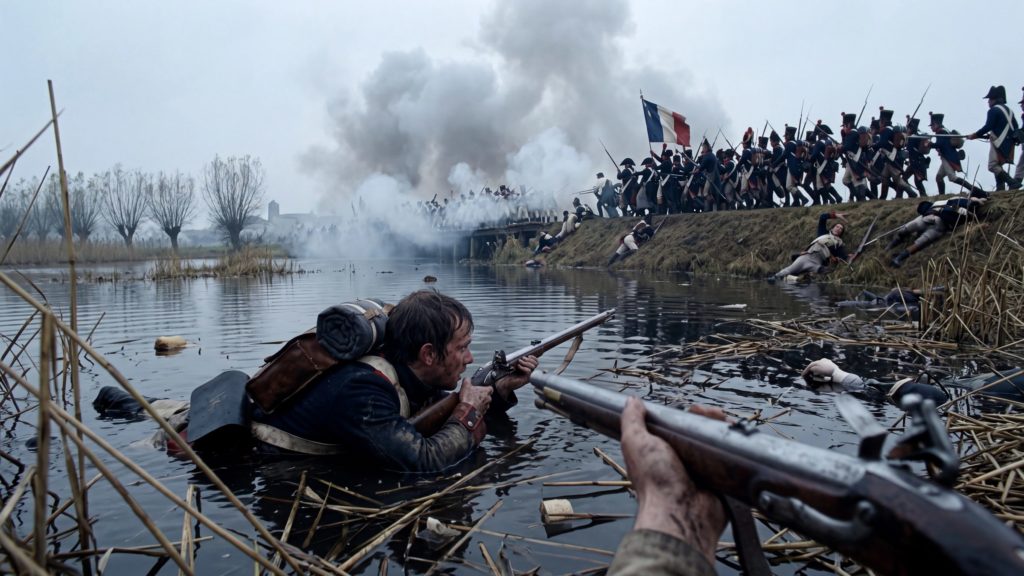
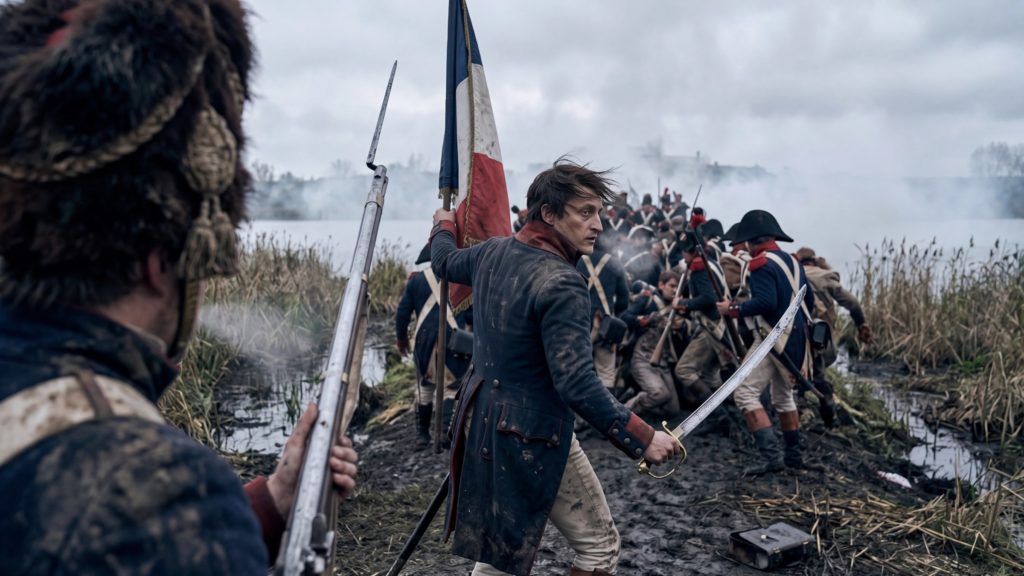
AI reconstruction based on Antoine-Jean Gros's "Bonaparte au pont d'Arcole, 17 novembre 1796" (1796), from the perspective of a grenadier of the Army of Italy pressing forward one pace behind the general on the causeway at the bridge.
In spring 1796 the Directory sent an untested twenty-six-year-old general[1] to what was meant to be a secondary front in Italy[2] - and he turned it into the campaign that made his name.
What Happened
The story
In February 1796 the Directory's grand strategy for the war put the main effort on the Rhine, where Moreau and Jourdan were to march on Vienna, while the Army of Italy merely held the Apennines and pushed into Lombardy[2]. That army's outgoing commander, General Scherer, resigned and asked the Directory to replace him with 'a general Bonaparte' possessing more resources and ability than himself[2]. Napoleon, newly married to Josephine on 9 March 1796, left his bride only two days later to take up the command[3].
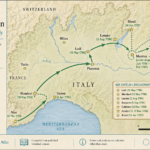
Napoleon opened the campaign by defeating Beaulieu's Austrians at Montenotte on 12 April 1796, then drove Piedmont out of the war within weeks[3]. At Lodi on 10 May his grenadiers stormed a 250-yard wooden bridge under Austrian artillery fire, an assault later credited with a huge moral effect on both armies[4]. Six months later at Arcola his own attack collapsed into confusion: pushed off the causeway, Napoleon was nearly engulfed in the marsh and had to be dragged out by his staff, saved from capture by pursuing Croats only at the last moment[2].
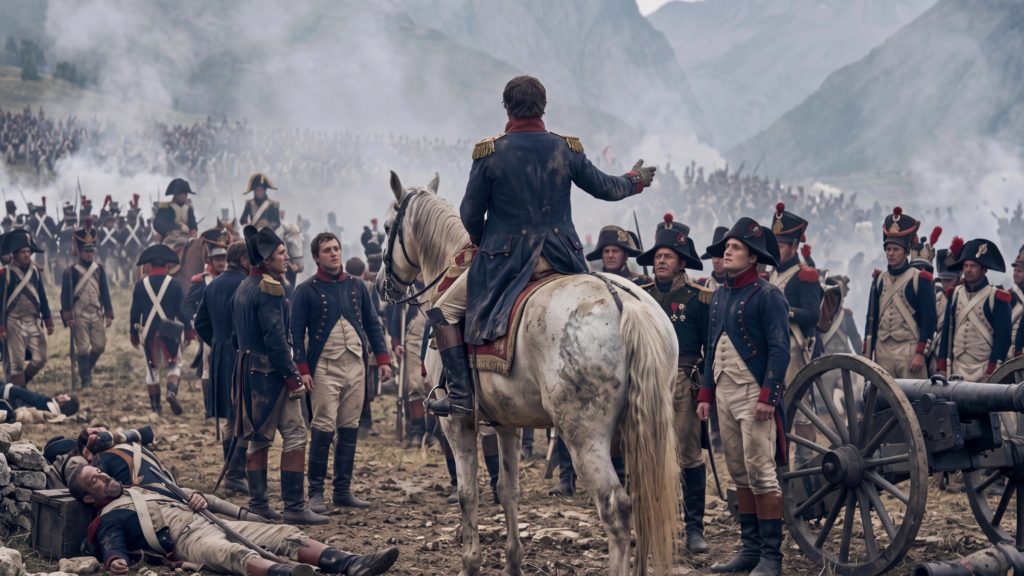
Napoleon entered Milan on 16 May 1796, about a month after Montenotte, laying siege to its citadel while organising a new government in Lombardy[4]. The decisive prize was Mantua, where Marshal Wurmser's besieged garrison was reduced to eating cats and dogs before surrendering on 3 February 1797 with only 16,000 men left of an original 80,000[2]. Wurmser himself, whom Napoleon praised for his 'courage and constancy', was allowed to leave freely with his staff[2].
With Mantua gone, Napoleon pushed towards Austria itself, forcing Vienna to negotiate[5]. The resulting Treaty of Campo Formio, signed in October 1797, saw Austria cede Belgium to France and recognise the new Cisalpine Republic, while France handed over conquered Venice, Istria and Dalmatia to Austria but kept the Ionian Islands[5]. An army meant as a sideshow to the Rhine campaign had instead ended the war.
Quick Facts
The essentials
Quick Facts
France (the Army of Italy)
Leadership
General Napoleon Bonaparte, appointed commander-in-chief by the Directory in February 1796[4]
Forces
The French Army of Italy under Napoleon Bonaparte, with generals Massena, Augereau, Berthier and Lannes[4]
Objective
Conquer Lombardy and knock Piedmont and Austria out of the war, per the Directory's strategic plan[2]
Austria and the Kingdom of Piedmont-Sardinia
Leadership
Austrian commanders Beaulieu, then Wurmser, then Alvinzy; Colli commanding for Victor Amadeus of Piedmont[2]
Forces
Austrian troops under Beaulieu, then Wurmser and Alvinzy in succession; Piedmontese troops under Colli[2]
Objective
Defend Austrian-held Lombardy and Piedmont against the French invasion
The Bigger Picture
Part of the War of the First Coalition, in which Austria, Piedmont-Sardinia and other powers were allied against Revolutionary France[6, p. 273]; the Directory's main effort was aimed at the Rhine, with the Army of Italy meant only to hold the Apennines and push into Lombardy[2].
How It Came To This
The Army of Italy's outgoing commander, General Scherer, resigned in February 1796 and begged the Directory to send 'a general Bonaparte' with more ability than himself[2]; the Directory's own war plan called for Moreau and Jourdan to drive on Vienna from the Rhine while Italy's army merely conquered Lombardy[2]; and Napoleon, fresh from suppressing the Vendemiaire rising in Paris, was available and newly connected to the Directory through Barras[2].
What Actually Happened
The campaign worked because Napoleon kept the Coalition's separate armies from ever fighting him together. Beaulieu commanded the Austrians and Colli commanded the Piedmontese, and each alone was beatable; the opening battles were fought precisely to preserve that separation, knocking Piedmont out of the war within weeks so only Austria remained[2]. The campaign's odd shape - a string of battles against successive Austrian relief armies rather than one climactic battle - follows from the same logic: Wurmser's own field army was consumed trying to rescue his besieged garrison at Mantua[2]. Politically, the campaign also slipped out of the Directory's control. Napoleon negotiated terms and organised conquered Lombardy's government largely on his own authority, and the settlement at Campo Formio redrew Italy's map before Paris had fully signed off[5]. An army the Directory had planned as a secondary front to the main Rhine offensive under Moreau and Jourdan[2] ended up being the one that actually forced Austria to the table, leaving Napoleon with a loyal officer corps and a public reputation owed to no one in Paris.
Why It Still Matters
The campaign made Napoleon the Republic's most celebrated general and delivered the Cisalpine Republic as a client state, plus the standing that produced the Treaty of Campo Formio[5]. It set a pattern - an ambitious general operating almost independently of Paris - that he would repeat for the rest of his career.
Quick Facts
Roger would like you to know...
Napoleon married Josephine on 9 March 1796 - and left her just two days later to take up command of the Army of Italy[3]. The honeymoon, such as it was, happened entirely by letter.
Keith has spotted the problem...
That heroic painting of Napoleon waving a flag on the bridge at Arcola? By most accounts he was actually pushed off the causeway into the marsh and had to be hauled out by his own staff, narrowly avoiding capture[2].
One for the Ageonauts...
The bridge at Lodi that Napoleon's grenadiers stormed under fire was 250 yards of wood, defended by twelve battalions and fourteen guns - and its capture was remembered less for its size than for the 'moral effect' it had on both armies[4].
A small fact with a very large consequence...
A single campaign, one report to the Directory boasted, saw an army of only 30,000 Frenchmen - commanded by a general 'scarce twenty-six years old' - destroy three Austrian armies and take more than fifty captured standards[1].
Roger has entered the historical rabbit hole...
Napoleon wrote fond, almost sporting letters to Josephine about his Austrian opponent: 'I am much pleased with Beaulieu. He manoeuvres very well... I shall beat him, I hope, out of his boots'[3].
Keith checked the sources...
Mantua's siege was brutal on both sides: 18,000 Austrians and 6,000 townspeople died before Wurmser's starving garrison, reduced to eating cats and dogs, finally surrendered in February 1797[2].
History gets strange here...
As Napoleon shipped Italy's art treasures back to Paris, Josephine kept quietly accepting jewels and pictures sent to her personally - against his direct disapproval - and simply learned not to mention it[3, p. 240].
Meanwhile, in history...
The Treaty of Campo Formio redrew the map of Italy at a stroke: Austria got Venice, Istria and Dalmatia, while France kept the Ionian Islands and forced Austrian recognition of the new Cisalpine Republic[5].
Keith would like to clarify...
Napoleon wasn't the Directory's own discovery - the general he replaced, Scherer, resigned by name-checking him, asking Paris to send 'a general Bonaparte' because he felt incapable of the command himself[2].
The familiar story leaves this out...
Italy wasn't supposed to be the main event. The Directory's real war plan sent Moreau and Jourdan's much larger armies against Vienna via the Rhine - the Army of Italy was only meant to hold a secondary front[2].
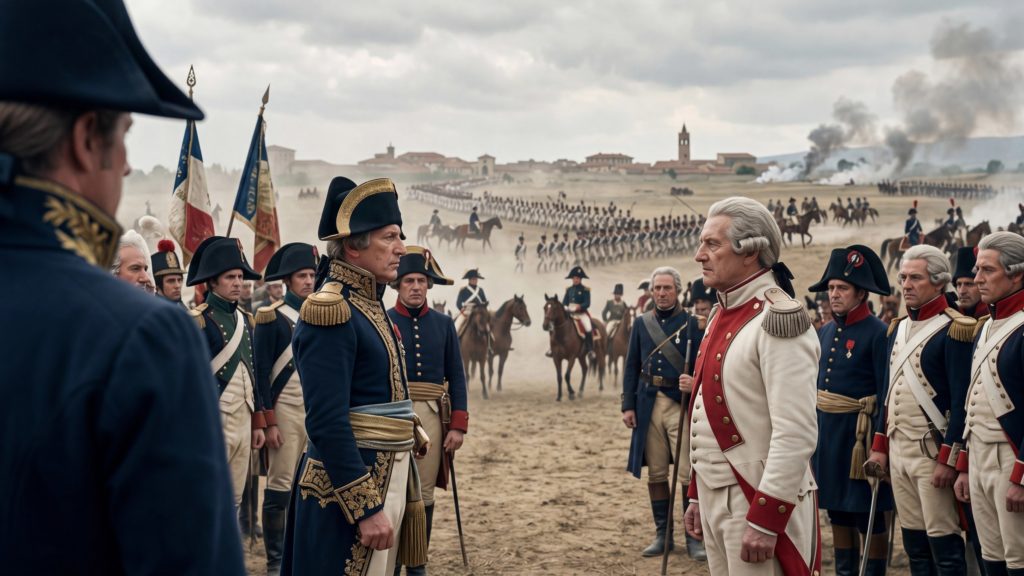
I am much pleased with Beaulieu. He manoeuvres very well. I shall beat him, I hope, out of his boots.
Napoleon Bonaparte, in a letter to Josephine at the opening of the campaign, spring 1796[3]
Written as the two armies manoeuvred against each other just before the Battle of Montenotte, Napoleon's first engagement of the campaign.
Timeline
How it unfolded
2 March 1796
Bonaparte Named to Command the Army of Italy
Geer says Bonaparte was named general-in-chief of the Army of Italy on 2 March 1796.[7] The Directory's plan for 1796, as Burton gives it, had Moreau and Jourdan drive back the Archduke Charles in Germany[2] while the Army of Italy conquered Lombardy.[2]
26 March 1796
Bonaparte Reaches Nice
On 26 March 1796 Bonaparte arrived at Nice to take command of an army that Burton describes as scattered in detachments and almost immobilised for want of supplies.[2] Geer likewise has him taking up his command at Nice on 26 March.[7]
12 April 1796
Battle of Montenotte
On the morning of 12 April 1796 Argenteau was attacked near Montenotte by Laharpe, defeated, and pursued towards Acqui.[4] Sargent describes Bonaparte opening the battle with the divisions of La Harpe and Massena against the Austrian centre under Argenteau.[8]
28 April 1796
Armistice of Cherasco
On 28 April 1796 an armistice signed at Cherasco took Piedmont out of the coalition: she agreed to disband her army, give up three of her strongest fortresses, and cede Nice and Savoie to France.[7] Geer's chronology also dates the truce with Sardinia to 28 April.[7]
10 May 1796
Battle of Lodi
On 10 May 1796 the French reached Lodi and found the wooden bridge over the Adda, 250 yards long, still standing and defended by a rear guard left by Beaulieu.[4] Geer notes that the importance of the action has been much exaggerated, but says the French carried the bridge by storm and took two thousand prisoners.[7]
15-17 November 1796
Battle of Arcole
A narrow causeway led from Ronco to Arcole and ended in a little wooden bridge over the Alpon, which the French at first could not carry.[7] The battle began on 15 November 1796 and continued for two more days, and on the last day Bonaparte crossed the river and took Arcole in reverse.[7][4]
14 January 1797
Battle of Rivoli
Bonaparte reached Rivoli just before daybreak on 14 January 1797 with only Joubert's division in hand, yet the Austrians were so separated that he was able to beat them in detail.[7] Geer calls it the worst defeat and most complete rout the Imperial arms had yet sustained.[7] Fiebeger places Alvinczi's attack on Joubert on the morning of 14 January.[4]
2 February 1797
Mantua Surrenders
The victories of Rivoli and La Favorita destroyed the last hopes of Wurmser, and on 2 February 1797 the starving garrison of Mantua surrendered.[7]
18 April 1797
Preliminaries of Leoben
After Bonaparte took Leoben on 7 April 1797 and came within one hundred miles of Vienna, Austria agreed to treat for peace.[7] By the preliminaries signed on 18 April France was to have Belgium and the line of the Rhine, while Austria obtained the mainland of Venice together with Istria and Dalmatia.[7]
17 October 1797
Peace of Campo-Formio
Geer's chronology dates the Peace of Campo-Formio to 17 October 1797.[7] Austria ceded Belgium and the left bank of the Rhine to the French Republic and acquired Istria, Dalmatia, the city of Venice and the mainland of Venetia as far west as Lake Garda, the Adige and the lower part of the river Po.[7]
Dig Deeper
Copy any prompt below into your favourite AI chat to keep exploring.
Explain how Napoleon's rapid movement between Montenotte, Lodi and Arcola in 1796 kept the separated Austrian and Piedmontese armies from ever combining against him.
What does the gap between the chaotic reality at Arcola - Napoleon pulled from a marsh by his own staff - and the heroic flag-waving paintings of it teach us about how legends get made?
Pitch me the storming of the Lodi bridge like a movie trailer - the 250-yard wooden bridge, the artillery duel, and the grenadiers who charged across it anyway.
Further Reading
Where to read more
Napoleon's Italian Campaign - World History Encyclopedia
A concise, free encyclopaedia overview of the 1796-97 campaign that made Napoleon's reputation.
Why look at this: Covers how Napoleon's soldiers nicknamed him 'the Little Corporal' after Lodi, and how the siege of Mantua survived four separate Austrian relief attempts before finally falling.
https://www.worldhistory.org/Napoleon's_Italian_Campaign/The Military Operations of the First Italian Campaign (1796-1797) - Napoléon & Empire
A fuller, battle-by-battle account of the campaign's operations, from Montenotte through to Rivoli.
Why look at this: Goes into more tactical depth on the fighting at Lodi and Arcole than a general encyclopaedia entry can, covering the ground behind this page's account of both battles.
https://www.napoleon-empire.org/en/battles/first-campaign-italy-military-operations.phpNapoleon's Campaigns in Italy, 1796-1797 and 1800, by R. G. Burton
The 1912 military-history study, freely digitised on the Internet Archive, used throughout this page for the Lodi and Arcola fighting.
Why look at this: Gives the full blow-by-blow of the storming of the Lodi bridge and the chaos at Arcola that this page draws on, including the moment Napoleon himself was nearly lost in the marsh.
https://archive.org/details/napoleonscampaig00burtRelated
Keep exploring




Can be seen in
Where this shows up

References
Sources
Sources
- BookLife of Napoleon Bonaparte, Volume II. by Walter Scott ↑
- BookNapoleon's Campaigns in Italy 1796-1797 and 1800 by R.G. Burton ↑
- BookA life of Napoleon Bonaparte; with a sketch of Josephine, empress of the French by Ida M. Tarbell. Page 240. ↑
- BookThe Campaigns of Napoleon Bonaparte of 1796-1797 by G.J. Fiebeger ↑
- BookThe French revolution from 1789 to 1815 by M. Mignet and James Westfall Thompson ↑
- BookA short history of Europe, from the fall of the Eastern empire to the dissolution of the Holy… by Charles Sanford Terry. Page 273. ↑
- BookThe French revolution : a historical sketch by Walter Geer ↑
- BookNapoleon Bonaparte's first campaign, with comments by Herbert Howland Sargent ↑