
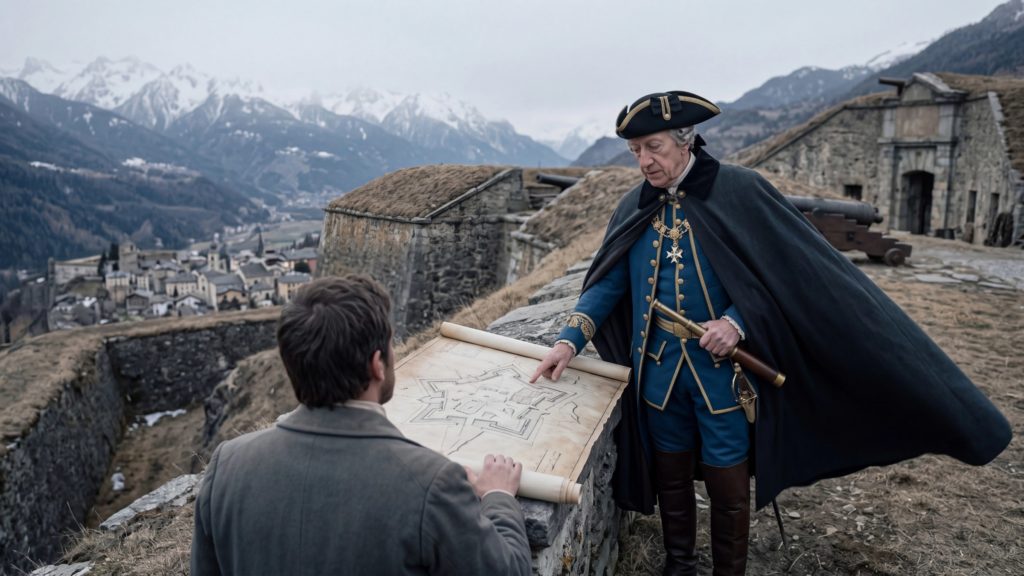
Victor Amadeus III over a map of Piedmont; three of his daughters had married French Bourbon princes, tying Turin closely to the old regime in Paris.
King of Sardinia (Piedmont-Savoy), r. 1773-1796
The King of Sardinia whose small Alpine kingdom held the line against Revolutionary France for years — until a young General Bonaparte broke through in 1796 and forced him to give up Savoy and Nice.[1]
Bio
Who they were
Son of Charles Emmanuel III, Victor Amadeus succeeded in 1773 and spent heavily on the army and on fortifying his Alpine frontier, while reversing several of his father's administrative reforms. He inherited a kingdom straddling both sides of the Alps, mainland Savoy and Piedmont plus the island of Sardinia, a geographically awkward arrangement that made defence difficult. Three of his daughters married French Bourbon princes, among them the future Louis XVIII and Charles X, tying his court closely to the old regime in Paris. He inherited a kingdom straddling both sides of the Alps, mainland Savoy and Piedmont plus the island of Sardinia, a geographically awkward arrangement that made defending against a French invasion particularly difficult. Three of his daughters married French Bourbon princes, tying his court closely to the old regime in Paris even as revolutionary France threatened his own kingdom's survival.
Victor Amadeus III became King of Sardinia — ruler of the Alpine state of Piedmont-Savoy plus the island of Sardinia — reigning from 1773 to 1796[2].

Victor Amadeus III's reign is defined almost entirely by its final year, when Revolutionary France went to war with his kingdom. In spring 1796, French forces under the young General Bonaparte broke through Piedmont's defences in a rapid campaign, taking Millesimo, Dego, Mondovì, and Cherasco[3]. With his army broken, Victor Amadeus was forced to make peace, followed by an armistice[3]. Under the resulting treaty he yielded up Savoy and Nice and renounced further resistance[1]; one account of the settlement states plainly that "the surrender was absolute"[4].

Victor Amadeus III's reign ended in 1796, the same year as his kingdom's defeat and forced peace with France[2].
Piedmont-Sardinia's defeat in 1796 was one of the opening blows of Napoleon Bonaparte's Italian campaign — the run of victories that first made his reputation[3]. For the kingdom itself, the treaty cost it Savoy and Nice, a real territorial loss to the small Alpine state.

The vast fortress complex he built at Fenestrelle in the Alps, sometimes called the Great Wall of Italy for its scale, remains one of the largest fortified structures in Europe, an enormous investment that proved almost entirely irrelevant once Bonaparte simply out-manoeuvred rather than directly assaulted his army in 1796. The vast fortress complex he built at Fenestrelle, sometimes called the Great Wall of Italy for its scale, proved almost entirely irrelevant once Bonaparte simply outmanoeuvred rather than assaulted his army.
Legacy & Reputation
What’s the verdict?
The one characterisation of Victor Amadeus III found in the sources here is unflattering: an early-twentieth-century Catholic Encyclopedia summary describes him simply as “a weak man”[2].
Myth-buster
Think you know this one?
Because of his title, Victor Amadeus III is easily imagined as an island king, but his realm was the Alpine state of Piedmont-Savoy on the mainland plus the island of Sardinia[2].
Quick Facts
The essentials
Quick Facts

Meanwhile, in history…
Victor Amadeus III ruled a kingdom that took its name from an island he rarely, if ever, needed to visit. The 'Kingdom of Sardinia' actually centred on mainland Piedmont, with the island itself forming just one part of a title that was more paperwork than geography.[5]
Keith found the footnote…
The 'King of Sardinia' title itself only existed because Victor Amadeus III's grandfather had swapped Sicily for the island with Austria back in 1720. By the time our king inherited the crown, the trade was ancient history — but the slightly odd name stuck.[6, p. 273]
Roger would like you to know…
History has not been especially kind to Victor Amadeus III. One period reference dismisses him as 'a weak man of little importance' — which feels a touch harsh for a king whose entire later reign was swallowed by the opening storms of the French Revolution.[2]
Roger said it. Keith checked it…
In 1771, Victor Amadeus III's daughter Marie-Joséphine of Savoy married the future Louis XVIII of France. It made the Savoy family part of the French royal household years before either son-in-law or father-in-law had any idea how violently that world was about to change.[7]
Keith remains unconvinced…
When French troops invaded in 1792, Victor Amadeus III's own territories of Savoy and Nice were formally annexed to France. A kingdom drawn together over centuries by careful Savoyard marriages and treaties lost two of its oldest pieces almost overnight.[8]
Roger insists this matters…
The Kingdom of Sardinia that Victor Amadeus III inherited wasn't just Piedmont and an island — it also took in the Duchies of Savoy, Montferrat and several smaller territories. Ruling it meant juggling a patchwork of provinces that didn't always even share a common border.[5]
Keith can confirm this one…
Victor Amadeus III came to the Sardinian throne in 1773, succeeding his father Charles Emmanuel III, and reigned until 1796. For twenty-three years, in other words, he ruled — right up until the kingdom he'd inherited started coming apart under revolutionary pressure.[2]
Roger says, "Hear me out…"
The title 'King of Sardinia' that Victor Amadeus III held would stay in Savoy hands for generations after him, eventually becoming the throne from which a much later Savoy king, Victor Emmanuel II, helped unify Italy in the following century. Same family, same title, a completely different story.[9]
Somewhere in the archives…
Victor Amadeus III's son and successor, Charles Emmanuel IV, didn't last long on the throne either. He inherited the crown in 1796, retreated to the island of Sardinia as French control tightened on the mainland, and abdicated altogether in 1802. The dynasty's mainland grip had simply run out.[5]
File under: surprisingly true…
By the time the fighting stopped, French annexations hadn't just swallowed Victor Amadeus III's Savoy and Nice — Belgium had gone the same way. His small Alpine kingdom's losses turned out to be one small piece of a much bigger continental land-grab.[10, p. 3]

incapable and extravagant, and he chose equally incapable ministers
Encyclopaedia Britannica
Britannica's summary judgment on the king whose years spent fortifying the Alpine frontier still weren't enough to stop his Piedmontese army collapsing within a fortnight of Bonaparte's opening 1796 campaign.
Timeline
How it unfolded
26 June 1726
Birth of Victor Amadeus III
The future king of Sardinia was born in Turin on 26 June 1726.[11][4]
20 February 1773
Accession as King of Sardinia
Victor Amadeus III came to the throne of Sardinia on the death of his father, Charles Emmanuel III, beginning a reign that lasted until 1796.[11][5]
28 April 1796
Armistice of Cherasco
Napoleon's victories over the Piedmontese forced Victor Amadeus to conclude the armistice of Cherasco.[12]
Dig Deeper
Copy any prompt below into your favourite AI chat to keep exploring.
Explain how a young General Bonaparte's rapid 1796 campaign forced Victor Amadeus III to give up Savoy and Nice.
What does Victor Amadeus III's defeat teach us about how quickly an old, established power can be undone by a single fast campaign?
Roleplay Victor Amadeus III's generals trying to explain to him how a 26-year-old general broke through their defenses so fast.

Further Reading
Where to read more
Victor Amadeus III — Britannica
A concise Britannica biography of Victor Amadeus III, King of Sardinia from 1773 to 1796, covering his reforms and his defeat by Bonaparte.
Why look at this: Explains why an experienced, reform-minded king ended his reign forced into Bonaparte's 1796 armistice at Cherasco — and died within months, having lost Savoy and Nice to France.
https://www.britannica.com/biography/Victor-Amadeus-IIIVittorio Amedeo III di Savoia — Dizionario Biografico degli Italiani, Treccani
A comprehensive Italian scholarly biographical-dictionary entry (Treccani, vol. 99) covering his accession, administrative and military reforms, and his kingdom's collapse against Revolutionary France.
Why look at this: Details the specific administrative commissions he set up to try to salvage state finances after the April 1796 Cherasco armistice confirmed his army's defeat — the last real act of his reign before his death that October.
https://www.treccani.it/enciclopedia/vittorio-amedeo-iii-di-savoia_(Dizionario-Biografico)/Éloge de Victor-Amédée III, duc de Savoie, roi de Sardaigne... (Joseph de Maistre, 1775) — Gallica, Bibliothèque nationale de France
A digitized 1775 formal eulogy/panegyric written for Victor Amadeus III shortly after his accession, by the young Joseph de Maistre — decades before de Maistre became a leading counter-revolutionary philosopher.
Why look at this: A genuine primary document showing how the new king was publicly presented to his Savoyard subjects at the very start of his reign, authored by a writer who would later become one of the Revolution's fiercest intellectual opponents.
https://gallica.bnf.fr/ark:/12148/bpt6k134091gRelated
Keep exploring
People



Can be seen in
Where this shows up

References
Sources
Sources
- BookNapoleon and the end of the French revolution by Charles F. Warwick ↑
- DocumentCatholic Encyclopedia (1913)/Piedmont ↑
- BookThe Boys' Nelson by Harold Wheeler ↑
- BookLife of Napoleon Bonaparte, Volume II. by Walter Scott ↑
- DocumentCatholic Encyclopedia (1913)/Sardinia ↑
- BookA short history of Europe, from the fall of the Eastern empire to the dissolution of the Holy… by Charles Sanford Terry. Page 273. ↑
- BookA dictionary of Napoleon and his times by Hubert N.B Richardson ↑
- BookThe Campaigns of Napoleon Bonaparte of 1796-1797 by G.J. Fiebeger ↑
- DocumentCatholic Encyclopedia (1913)/Savoy ↑
- BookThe principal speeches of the statesmen and orators of the French Revolution, 1789-1795 by Henry Morse Stephens. Page 3. ↑
- Websitenapoleon-empire.org: Victor amedee III ↑
- DocumentCatholic Encyclopedia (1913)/Napoleon I (Bonaparte) ↑
- Websiteen.wikipedia.org: Victor Amadeus III of Sardinia ↑