
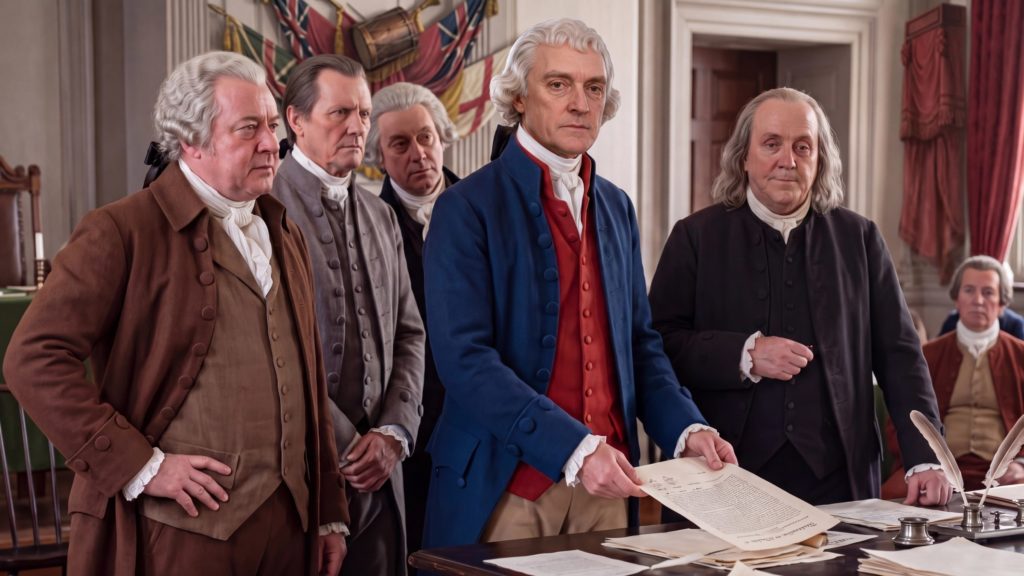
Drafting and adoption of the Declaration of Independence
A committee of five picked one man to find the words for a revolution: Thomas Jefferson, its youngest member, was given the actual writing.[1, p. 10]
What Happened
The story
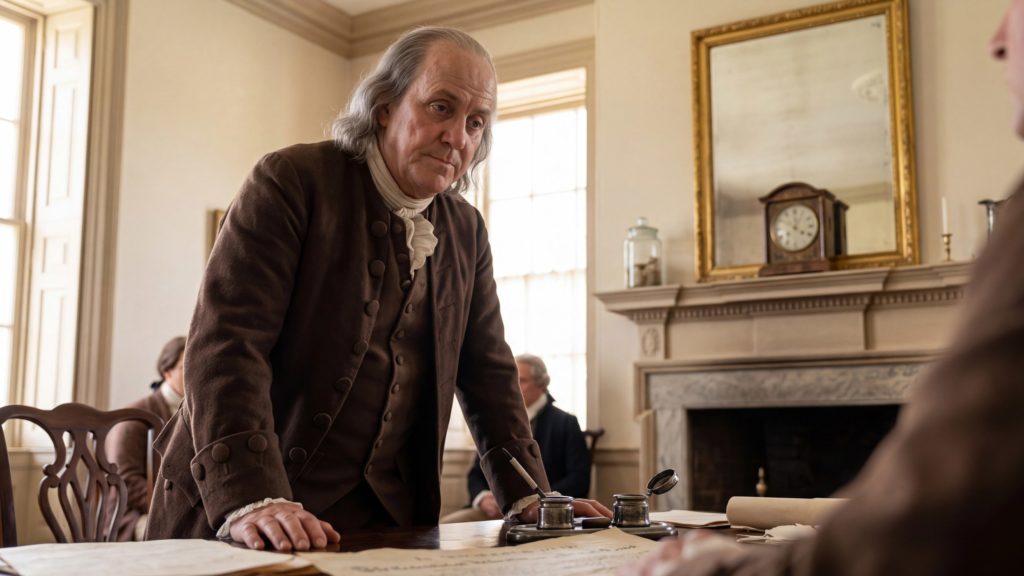
After Congress voted for independence on 2 July 1776, it turned to the Committee of Five's task of explaining that decision to the world. The committee, which included Benjamin Franklin and John Adams, had already left the actual writing to its youngest member, Thomas Jefferson[1, p. 10].
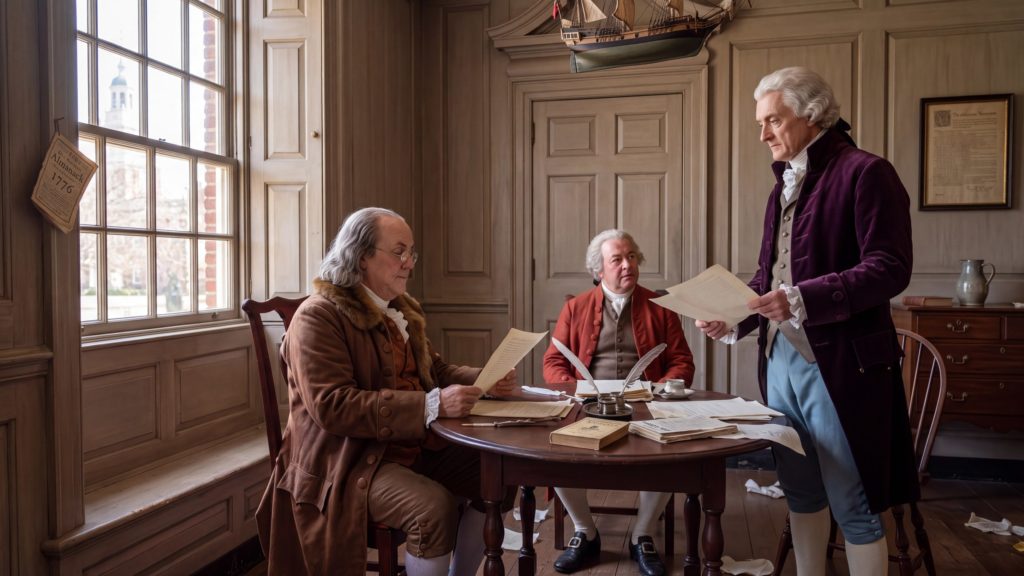
Jefferson produced what he later called his “Rough Draft”[2], then submitted it to Franklin and Adams, who made their own amendments before it went back to the full committee[2].
Congress spent two days debating and trimming the committee's draft before formally adopting the Declaration of Independence on 4 July 1776[3].
The adopted Declaration was quickly printed and circulated to the states and the army, publicly announcing the reasons for the colonies' new claim to independent nationhood[3].
Quick Facts
The essentials
Quick Facts
The Bigger Picture
Drafted in the same Congress session that had just voted for independence on 2 July 1776, amid the ongoing Revolutionary War against Britain.[4, p. 2]
How It Came To This
Congress's vote for independence on 2 July 1776 created an immediate need for a public document explaining and justifying that decision to the world.[4, p. 2]
What Actually Happened
The Committee of Five assigned the actual writing to its youngest member, Thomas Jefferson[1, p. 10]. Jefferson produced what he called his Rough Draft[2] before submitting it to Benjamin Franklin and John Adams, who made their own amendments[2]. Congress then reviewed and trimmed the committee's text over two days before formally adopting the Declaration of Independence on 4 July 1776[3].
Why It Still Matters
The adopted text became the founding statement of the United States, announcing the colonies' claim to a “separate and equal station” among nations[3].
Quick Facts
Keith has spotted the quotation problem…
In Jefferson's rough draft, the Declaration's most famous line originally read differently. Where the final text calls these truths “self-evident”, Jefferson had first written “sacred and undeniable” before the phrase was crossed out and rewritten[2, p. 170].
Keith checked the sources…
Jefferson's rough draft included a long passage blaming the British king for the Atlantic slave trade, condemning it as “cruel war against human nature itself”[2, p. 170]. Congress cut the entire passage before the Declaration's final adoption.
History gets strange here…
Jefferson himself later summed up what he'd been trying to do. Looking back on the Declaration, he described it simply as “an expression of the American mind”[5, p. 375], rather than a work of original philosophy.
This sounds invented, but…
The elegant handwriting on the Declaration's famous parchment copy isn't Jefferson's at all. It belongs to Timothy Matlack, the Congressional clerk given the job of engrossing the approved text[6].
Roger has entered the historical rabbit hole…
Jefferson's own manuscript still carries the fingerprints of his editors. Notes in the margins of his rough draft mark specific passages where Benjamin Franklin made changes[2, p. 170] as he and John Adams reviewed the text line by line.
Roger would like you to know…
The document wasn't actually titled “The Declaration of Independence” when Jefferson wrote it. His rough draft opens simply: “A Declaration by the Representatives of the United States of America, in General Congress assembled”[2, p. 170].
Keith would like to clarify…
Even a single word could get the committee treatment. A note beside one correction on Jefferson's draft records that the fix from “neglected utterly” to “utterly neglected” is in John Adams's own handwriting[2, p. 170].
One for the Ageonauts…
Jefferson wasn't writing on a blank page. Many of his phrases echo George Mason's Virginia Declaration of Rights, drafted only weeks earlier and already circulating among the delegates[7, p. 1].
Roger says, “Hear me out…”
John Adams later explained, with characteristic bluntness, why he'd pushed the writing job onto Jefferson: “I am obnoxious, suspected, and unpopular. You are very much otherwise,” he reportedly told him[8, p. 99].
Down the rabbit hole we go…
The Declaration's actual legal effect had already happened two days earlier. Congress voted for independence on 2 July 1776; adopting the Declaration on 4 July only supplied the public explanation[7, p. 1].
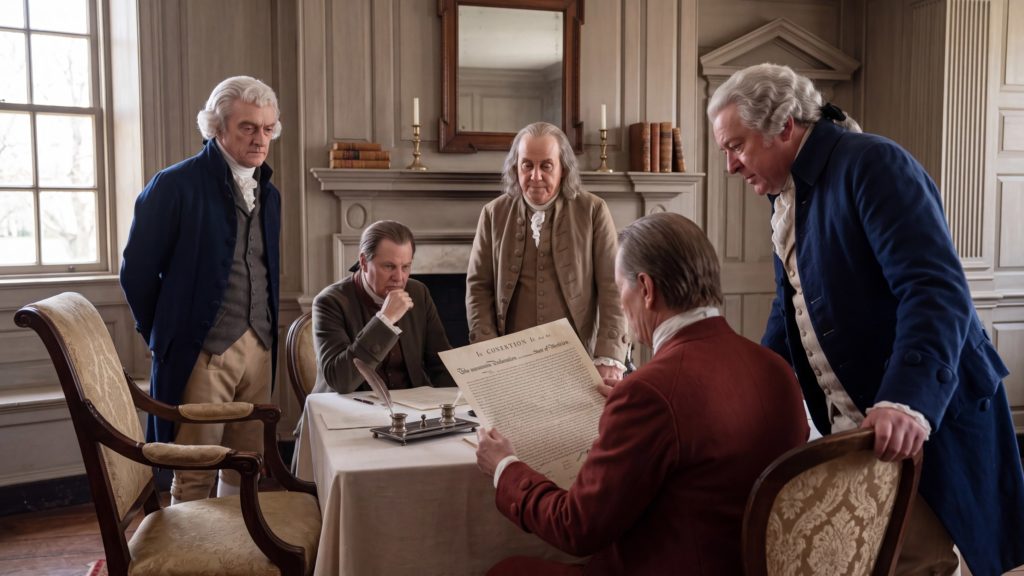
We hold these truths to be self-evident, that all men are created equal, that they are endowed by their Creator with certain unalienable rights[9, p. 242]
Second Continental Congress (draft principally by Thomas Jefferson)
The opening of the Declaration's second paragraph, the philosophical core of the document Jefferson drafted for the Committee of Five and Congress adopted, with amendments, on 4 July 1776.[3]
Timeline
How it unfolded
June 1776
Jefferson Writes the Draft
Jefferson drew up the draft himself, and by his own 1823 account to Madison he showed it separately to Franklin and Adams for corrections, which were two or three only and merely verbal, before reporting it to the committee.[2] Donaldson places his lodgings, where Jefferson said he lived while writing it, at the Graff House at Seventh and Market streets.[10, p. 53]
11 June 1776
Committee of Five Appointed
Congress named Thomas Jefferson, John Adams, Benjamin Franklin, Roger Sherman and Robert R. Livingston to prepare a declaration, and, according to the later account in Rayner's life of Jefferson, the committee unanimously asked Jefferson to write the draught alone.[1, p. 10][11][12]
28 June 1776
Draft Laid Before Congress
The committee brought in its draft, which was read and ordered to lie on the table.[5, p. 375][13]
2 July 1776
Congress Edits the Draft
By Jefferson's account the debates on the draft took up the greater parts of 2, 3 and 4 July, and Congress struck out the passages censuring the people of England and the clause condemning the slave trade, the latter out of regard for South Carolina and Georgia.[14, p. 87]
4 July 1776
Declaration Adopted and Ordered Printed
Benjamin Harrison reported that the committee of the whole had agreed to a Declaration, which Congress then agreed to and ordered authenticated and printed, with the drafting committee to superintend the press.[5, p. 375] Copies were sent out signed only by John Hancock as president and Charles Thomson as secretary.[13]
8 July 1776
First Public Reading in Philadelphia
The Declaration was read to the public for the first time in Independence Square outside the Pennsylvania State House, followed by celebrations.[15, p. 2][13]
19 July 1776
Engrossing Ordered
Congress voted that the Declaration be engrossed on parchment under the title 'The unanimous Declaration of the thirteen united States of America' and signed by every member, and the clerk Timothy Matlack produced the parchment copy.[16][13]
2 August 1776
Members Sign the Engrossed Declaration
The engrossed parchment copy was signed at the table by the members present, and absent members signed later; Congress withheld the names of the signers for more than six months.[16, p. 170][17]
Dig Deeper
Copy any prompt below into your favourite AI chat to keep exploring.
Explain what ideas Thomas Jefferson drew on when he wrote the Declaration of Independence, and how the Committee of Five actually worked.
What does it mean that the document explaining American independence was written by one man in seventeen days, then edited by an entire Congress, before it became a nation's founding legacy?
Pitch Jefferson's seventeen-day writing sprint on the Declaration of Independence like a deadline story from a modern newsroom.
Further Reading
Where to read more
Writing of Declaration of Independence — HISTORY
HISTORY.com's overview article on how Jefferson, the Committee of Five and Congress produced the Declaration between 11 June and 4 July 1776.
Why look at this: A quick, reliable account of who wrote what and when — good for checking the basic sequence before reading Jefferson's actual draft.
https://www.history.com/articles/writing-of-declaration-of-independenceThe Declaration of Independence: A History — National Archives
The National Archives' fuller history of the Declaration, from the Committee of Five's appointment through Congress's editing and the engrossing and signing of the parchment copy.
Why look at this: Covers the parts of the story that get skipped in short summaries — how much Congress actually cut from Jefferson's draft, and why the famous parchment wasn't signed on 4 July at all.
https://www.archives.gov/founding-docs/declaration-historyJefferson's ‘original Rough draught’ of the Declaration of Independence — Founders Online, National Archives
The transcribed manuscript of Jefferson's own working draft, annotated to show every change made by Franklin, Adams and Congress.
Why look at this: Lets you see, line by line, exactly which words are Jefferson's, which are Franklin's or Adams's edits, and which whole passages — including the anti-slave-trade clause — Congress cut.
https://founders.archives.gov/documents/Jefferson/01-01-02-0176-0004Related
Keep exploring





Can be seen in
Where this shows up

References
Sources
Sources
- BookLetters and addresses of Thomas Jefferson by Thomas Jefferson, William B Parker and Jonas Viles. Page 10. ↑
- BookThe Declaration of independence; a study in the history of political ideas by Carl Lotus Becker. Page 170. ↑
- DocumentUnited States Declaration of Independence ↑
- WebsiteThe Lee Resolution (America 250 Alabama). Page 2. ↑
- BookThomas Jefferson, the Apostle of Americanism by Gilbert Chinard. Page 375. ↑
- DocumentUnited States Declaration of Independence (engrossed copy) ↑
- WebsiteThe Declaration of Independence, 4 July 1776, annotated (National Humanities Center). Page 1. ↑
- BookThe life of Thomas Jefferson by Henry Stephens Randall. Page 99. ↑
- BookThe Declaration of Independence, its history .. by John H. Hazelton. Page 242. ↑
- BookThe house in which Thomas Jefferson wrote the Declaration of Independence by Thomas Donaldson. Page 53. ↑
- BookThomas Jefferson The Apostle Of Americanism by Gilbert Chinard ↑
- BookLife of Thomas Jefferson, with selections from the most valuable portions of his voluminous and unrivalled private correspondence.… by B. L Rayner ↑
- BookSigners of the Declaration: Historic Places Commemorating the Signing of the Declaration of Independence by Robert G. Ferris ↑
- BookThe Writings of Thomas Jefferson, Vol. 1 (of 9): Being His Autobiography, Correspondence, Reports, Messages, Addresses, and Other… by Thomas Jefferson. Page 87. ↑
- WebsiteFoundation Document Overview - Independence National Historical Park. Page 2. ↑
- BookThe Declaration of Independence : a study in the history of political ideas by Carl Lotus Becker. Page 170. ↑
- BookThe American Revolution, 1776-1783 by Claude Halstead Van Tyne ↑