
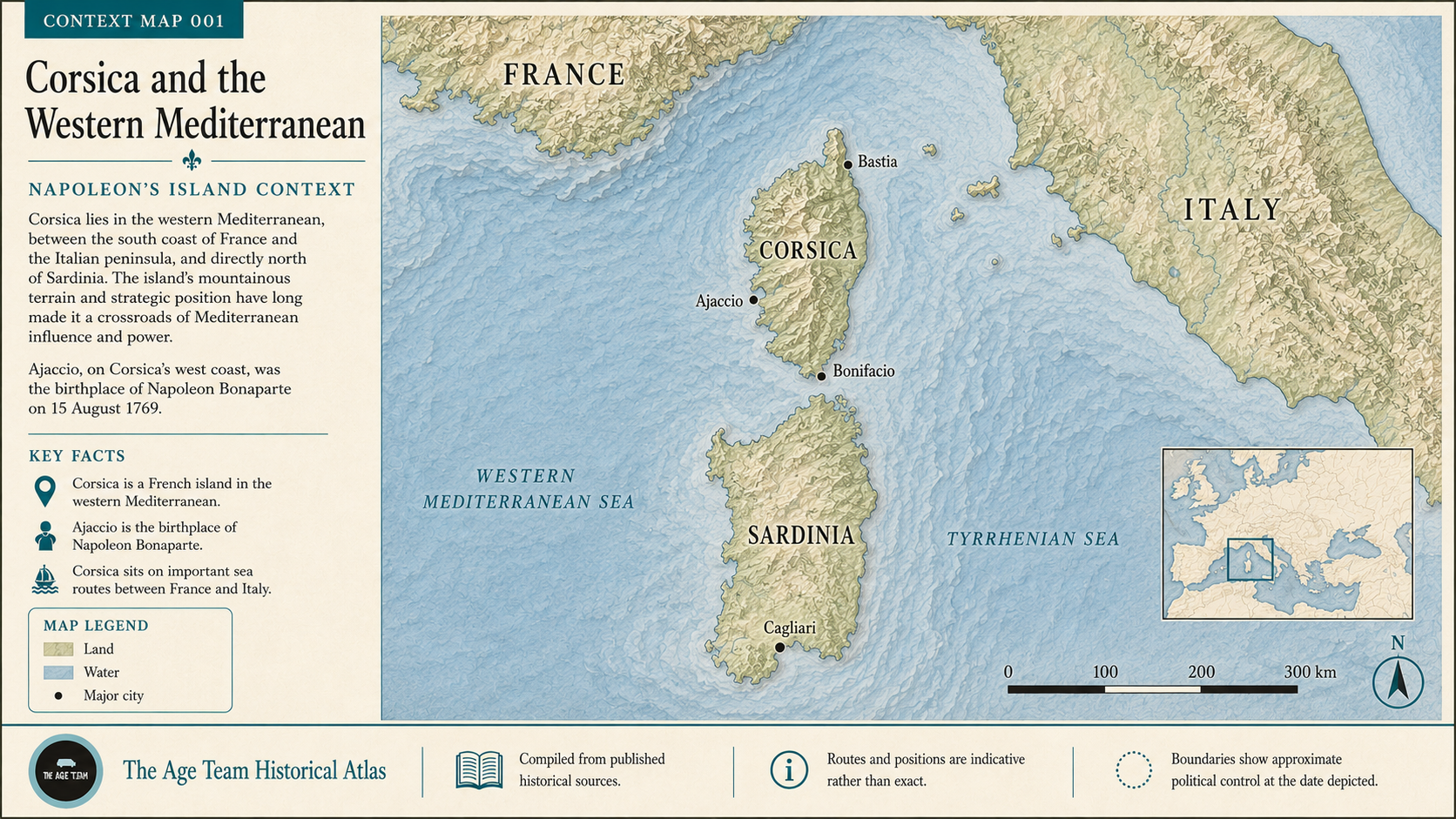
About This Map
What it shows
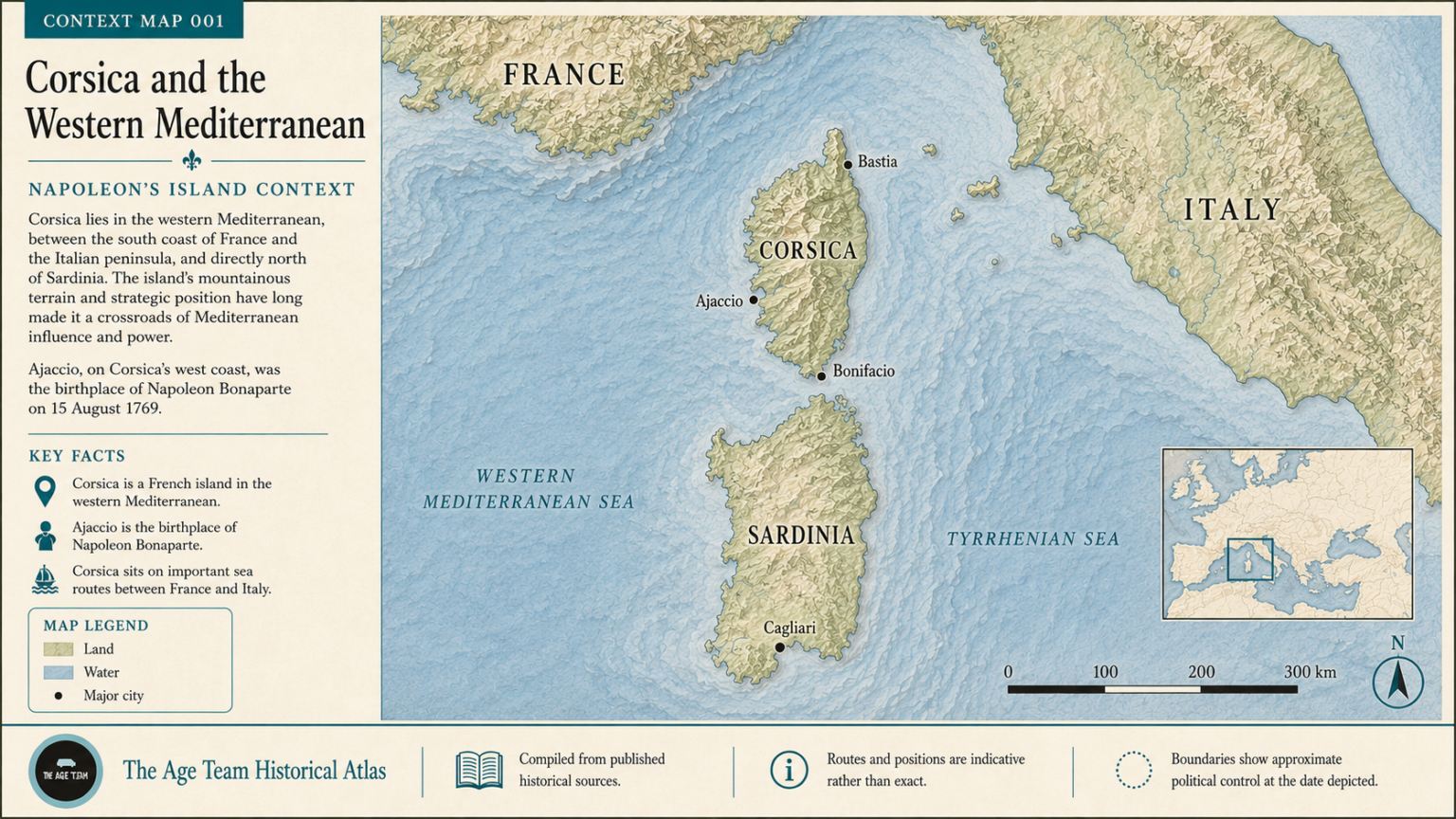
This map sets the stage for Napoleon's origin story by placing Corsica in the western Mediterranean, wedged between southern France and the Italian mainland with Sardinia just to its south. For most of the early modern period the island was ruled from Genoa, its written language and culture drawing on Italy even as Corsicans fought a decades-long war for independence under Pasquale Paoli. In 1768, exhausted by that rebellion, Genoa signed the island's administration over to France — and barely fifteen months later, on 15 August 1769, Napoleone di Buonaparte was born in Ajaccio as a brand-new subject of the very power his own family had recently been fighting. The map's job is to hold that "not quite France, not quite Italy" outsider status in view before the episode follows Napoleon's rise, since it shaped how both the French establishment and Napoleon himself saw him for the rest of his career.
Quick Facts
The essentials
Quick Facts
I was born when the homeland was dying. Thirty thousand French soldiers were regurgitated onto our shores, drowning the throne of liberty in a sea of blood.
Napoleon Bonaparte, in a letter to Pasquale Paoli
Written 12 June 1789, when the 20-year-old Napoleon (then a junior French artillery officer) was still an ardent Corsican nationalist appealing to his exiled boyhood hero Paoli to endorse a history of Corsica he had written; it frames Corsica's 1768 absorption into France as violence done to his homeland in the very year of his birth, which is the emotional core this map exists to set up.
Timeline
How it unfolded
1755
Paoli takes command of the Corsicans
Under the command of Pasquale Paoli from 1755, the Corsicans fought so successfully against the Genoese that Genoa lost the whole island except Bastia.[1, p. 28]
15 May 1768
Treaty of Versailles transfers Corsica to France
The treaty signed at Versailles on 15 May 1768 had France pay Genoa for its rights over the island.[2] Paoli appealed to the great powers against the transfer, but in vain, and the campaign of subjugation opened at once.[3]
8-9 May 1769
Battle of Ponte Nuovo
The French decided to end the costly war quickly, and the decisive battle of Ponte Nuovo was fought in May 1769, after which Paoli escaped to Leghorn.[2] Baedeker's handbook adds that Corsica lost its independence to France in consequence of the battle.[1, p. 28]
15 August 1769
Birth of Napoleon at Ajaccio
Napoleon Bonaparte was born on 15 August 1769 at Ajaccio in Corsica, in the very year the island passed to France.[4]
1779
Napoleon leaves Corsica for school in France
In 1779, aged nine, Napoleon left home and travelled with his father to Brienne to enter the military school there.[5] He had been placed at the college of Autun at the beginning of that year.[2]
June 1793
Bonaparte family leaves Corsica for France
Early in June 1793 an artillery captain arrived in Marseilles from Corsica, where his ambitions had met a check.[6] The house of Napoleon's mother and family had been burnt by Paoli's partisans, an event that brought all the Bonapartes permanently to France.[7, p. 15]
1794
British conquest of Corsica
In 1794 an English force under Hood conquered Corsica, which had been brought to Paoli's aid; after the English abandoned their conquest, Corsica has belonged to France ever since.[1, p. 28]
Dig Deeper
Copy any prompt below into your favourite AI chat to keep exploring.
Corsica 1768 Genoa France treaty Napoleon Ajaccio birthplace
an island that changed hands the year before it made an emperor
meet the toddler born on brand new french real estate
Further Reading
Where to read more
Corsica — Encyclopaedia Britannica
Britannica's overview article on Corsica, covering its geography, its Genoese and French periods, and its status as Napoleon's birthplace.
Why look at this: Gives the quick, reliable dateline for the 1768 Genoa-to-France handover and confirms Ajaccio's status as Napoleon's birthplace in a five-minute read.
https://www.britannica.com/place/CorsicaGranite Island: A Portrait of Corsica, by Dorothy Carrington
A widely respected, deeply researched cultural and historical portrait of Corsica by a historian who lived on the island for decades, covering the Genoese period, the Paoli revolution, and the French annexation in depth.
Why look at this: Goes far beyond a caption's worth of context to explain Corsican identity under Genoa-then-France in real depth — the direct source for the episode's "not quite France, not quite Italy" theme.
https://books.google.com/books/about/Granite_Island.html?id=T15aBgAAQBAJAn Account of Corsica, the Journal of a Tour to that Island, and Memoirs of Pascal Paoli — James Boswell (1768)
Boswell's own primary-source travelogue and political account of Corsica, written after his 1765 visit and meeting with Pasquale Paoli, published the same year Genoa agreed to cede the island to France.
Why look at this: A genuine 18th-century primary source — lets viewers read the Corsica-Paoli story exactly as contemporary Europe received it, in the same year as the treaty this map depicts. (Note: our local library copy of this text is an empty Wikisource scrape; the full text is confirmed live at the Wikisource URL given.)
https://en.wikisource.org/wiki/An_Account_of_CorsicaRelated
Keep exploring

Can be seen in
Where this shows up
References
Sources
Sources
- BookSouth-eastern France Including Corsica: Handbook for Travellers by Karl Baedeker (Firm Karl Baedeker. Page 28. ↑
- BookA dictionary of Napoleon and his times by Hubert N.B Richardson ↑
- BookThe Life of Napoleon Bonaparte. Vol. 1 (of 4) by William Milligan Sloane ↑
- BookThe French revolution from 1789 to 1815 by M. Mignet and James Westfall Thompson ↑
- BookNapoleon and the end of the French revolution by Charles F. Warwick ↑
- BookNapoleon and his coronation by Frédéric Masson and Frederic Cobb ↑
- BookMemoirs Of Napoleon Bonaparte - Iii And Iv by Louis Antoine Fauvelet De Bourrienne. Page 15. ↑