
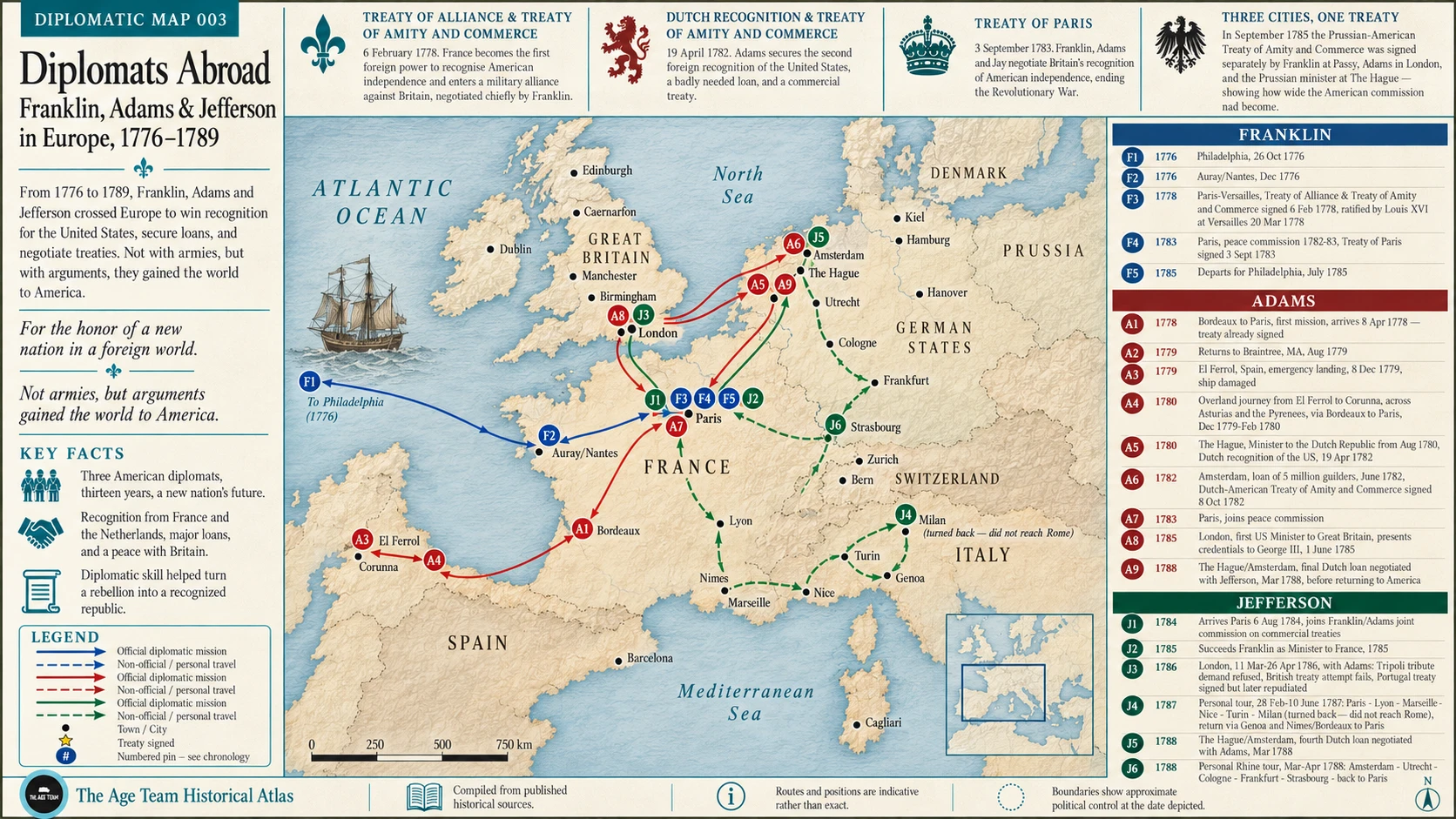
Diplomats Abroad: Franklin, Adams & Jefferson in Europe, 1776-1789
About This Map
What it shows
Franklin, John Adams and John Jay brought the war to a close with Britain's Treaty of Paris, signed at Paris on 3 September 1783.[1]
Quick Facts
The essentials
Quick Facts
It having pleased the Divine Providence to dispose the hearts of the Most Serene and Most Potent Prince, George the Third... and of the United States of America, to forget all past misunderstandings and differences that have unhappily interrupted the good correspondence and friendship which they mutually wish to restore.[1]
Opening lines of the Definitive Treaty of Paris, signed by David Hartley for Britain and John Adams, Benjamin Franklin and John Jay for the United States
The treaty's own opening language, agreed and signed at Paris on 3 September 1783 by the same three American commissioners this map follows across Europe — the formal words that closed the mission the map depicts.[1]
Timeline
How it unfolded
26 September 1776
Franklin Elected Commissioner to France
Congress elected Benjamin Franklin one of three commissioners to France on 26 September 1776[2, p. 6]; Thomas Jefferson was also chosen but declined because of his wife's ill health, and Arthur Lee took his place[3, p. 347]. Franklin arrived in Paris in December 1776 and found Silas Deane and Arthur Lee already there[4].
17 October 1777
Burgoyne Surrenders at Saratoga
General Burgoyne surrendered his entire army at Saratoga on 17 October 1777[5]. According to Sargent's edition of Franklin's works, the news from Saratoga decided the French cabinet in its course[4].
6 February 1778
Franco-American Treaties Signed
The treaties between France and the United States were signed on 6 February 1778, a compact of friendship and commercial reciprocity together with an eventual treaty of alliance[6, p. 38]. The commissioners were presented to the king as representatives of an independent state on 20 March 1778[7].
8 April 1778
John Adams Arrives in Paris
John Adams reached Paris on 8 April 1778[4] as a joint commissioner with Franklin and Arthur Lee, took up residence with Franklin at Passy, and had his first audience with Louis XVI on 8 May[8, p. 6]. In February 1779 he learned that the joint commission had been superseded by Franklin's appointment as sole minister to France[8, p. 6].
19 April 1782
Dutch Republic Recognises American Independence
The States General of the Netherlands recognised American independence on 19 April 1782, and Adams presented his credentials as minister plenipotentiary to the stadholder three days later[8, p. 7]. He signed a contract for a loan of five million guilders with Amsterdam bankers on 11 June and a treaty of amity and commerce with the Netherlands on 8 October 1782[8, p. 7].
3 September 1783
Treaty of Paris Signed
The definitive peace treaty between the United States and Great Britain was signed in Paris on 3 September 1783, formally ending the war[9]. Adams signed it, having joined Franklin and John Jay in signing the preliminary articles on 30 November 1782[8, p. 7].
6 August 1784
Jefferson Arrives in Paris
Thomas Jefferson arrived in Paris on 6 August 1784 and stayed in France until the autumn of 1789[10, p. 375]; Congress had named him with Adams and Franklin that spring to negotiate commercial treaties with European and North African nations[8, p. 7]. In March 1785 Congress voted that he should succeed Franklin as minister at the French court[11].
1 June 1785
Adams Presented to George III
Named the first United States minister to Great Britain on 24 February 1785[8, p. 7], Adams was presented to George III on 1 June 1785[12, p. 8]. His daughter's journal records that Lord Carmarthen introduced him to the king at the palace and that he made a speech when presenting his letter[13].
26 September 1789
Jefferson Leaves Paris
Jefferson left Paris for America on 26 September 1789, ending the stay in France that had begun in August 1784[14][10, p. 375]. He intended only a brief visit home and a return to Europe, a plan he never carried out, as he was appointed Washington's Secretary of State[15].
Dig Deeper
Copy any prompt below into your favourite AI chat to keep exploring.
Explain why the Prussian-American Treaty of Amity and Commerce of September 1785 had to be signed three separate times - by Franklin at Passy, Adams in London and the Prussian minister at The Hague - rather than at one ceremony, and what that says about how far the American diplomatic mission in Europe had spread by then.
Argue whether the three separate signings of the September 1785 Prussian treaty - in France, Britain and the Dutch Republic - make it one treaty or three, and what that tension reveals about how a nation with no capital of its own actually did diplomacy.
Pitch me the September 1785 Prussian treaty like it's the world's most awkward group project: three American diplomats, three different cities, one signature each, and nobody ever in the same room.
Further Reading
Where to read more
French Alliance — Office of the Historian, U.S. Department of State
Free, no login. Walks through the French side of the table this map opens on - why Vergennes waited for news of the American victory at Saratoga before Franklin could turn the cautious 1776 Model Treaty into the full military alliance signed 6 February 1778.
Why look at this: Covers the same diplomatic track this map traces — why Vergennes waited for news of Saratoga before Franklin could turn the cautious 1776 Model Treaty into a real alliance.
https://history.state.gov/milestones/1776-1783/french-allianceBenjamin Franklin — Episode 2: "An American" (1775–1790) — Ken Burns (PBS, 2022)
Two-hour episode of the Ken Burns documentary devoted to Franklin's eight years in Paris, including his friction with the more impatient John Adams working the same courts.
Why look at this: Devotes two hours to exactly the Paris years this map covers, including the friction between Franklin's patient diplomacy and Adams's more impatient version of the same job.
https://www.pbs.org/kenburns/benjamin-franklin/benjamin-franklin-episode-2-an-americanThe Diplomacy of the American Revolution — Samuel Flagg Bemis (D. Appleton-Century, 1935)
Free full scan at the Internet Archive, no login. The foundational scholarly account of the whole thirteen-year mission this map traces - the book that first pieced together Franklin, Adams and Jefferson's separate negotiating tracks into one diplomatic story.
Why look at this: The scholarly account that first pieced together Franklin, Adams and Jefferson's overlapping European missions into one coherent story, free to read in full.
https://archive.org/details/dli.ernet.214430Related
Keep exploring



Events

Can be seen in
Where this shows up

References
Sources
Sources
- BookDefinitive treaty of peace and friendship between His Britannic Majesty and the United States of America : signed… by etc. United States Great Britain. Treaties and etc. Great Britain United States. Treaties ↑
- BookThe autobiography of Benjamin Franklin; by Benjamin Franklin and Albert Henry Smyth. Page 6. ↑
- BookThe True Benjamin Franklin by Sydney George Fisher. Page 347. ↑
- BookThe select works of Benjamin Franklin; including his autobiography by Benjamin Franklin and Epes Sargent ↑
- BookAmerican Leaders and Heroes: A preliminary text-book in United States History by Wilbur F. Gordy ↑
- BookThe French war and the revolution by William Milligan Sloane. Page 38. ↑
- BookThe diplomatic correspondence of the American Revolution, being the letters of Benjamin Franklin, Silas Deane, John Adams, John… by Jared Sparks ↑
- WebsiteAdams Family Foreign Policy: Introduction and Timeline. Pages 6, 7. ↑
- DocumentTreaty of Paris (1783) ↑
- BookThomas Jefferson, the Apostle of Americanism by Gilbert Chinard. Page 375. ↑
- BookBenjamin Franklin by John T. Morse ↑
- WebsiteAdams Family Foreign Policy: Letters and Diaries from Europe (Complete Unit). Page 8. ↑
- BookColonel William Smith and lady; the romance of Washington's aide and young Abigail Adams by Katharine Metcalf Roof ↑
- BookLife of Thomas Jefferson, with selections from the most valuable portions of his voluminous and unrivalled private correspondence.… by B. L Rayner ↑
- BookWho bought Louisiana? An address on the services of Thomas Jefferson in connection with the Louisiana purchase, delivered… by William M. Thornton ↑