
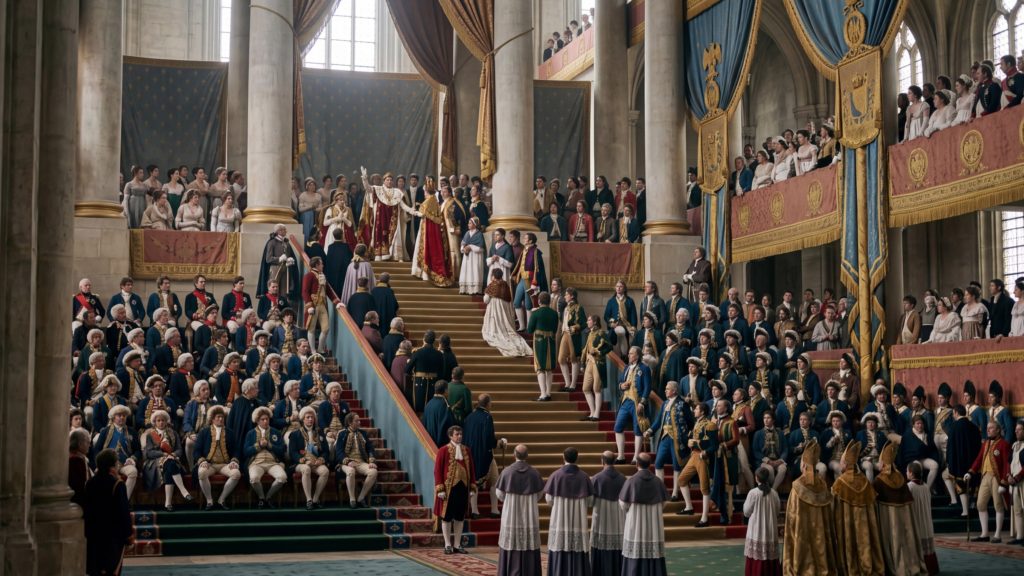
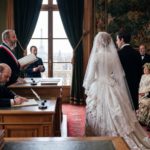
AI reconstruction based on Jacques-Louis David's "The Coronation of the Emperor and the Crowning of the Empress, 2 December 1804" (1807), from the perspective of the female attendant standing immediately behind the kneeling empress, close enough to see the folds of her train.
Pope Pius VII travelled from Rome to consecrate an emperor[1] - then watched Napoleon take the crown and put it on his own head[1].
What Happened
The story
By late 1804 a Senate decree and a landslide plebiscite - over 3,000,000 votes in favour against under 3,000 against - had made Napoleon hereditary Emperor of the French[2, p. 273]. To root the new title in something grander than a recent coup, Napoleon had relics and precedents linked to Charlemagne's own imperial coronation researched at Aix[1]. Pope Pius VII was persuaded to travel from Rome to consecrate the ceremony himself[1], arriving in Paris for a stay that would stretch to four months[1].
On 2 December 1804, inside Notre-Dame, the ceremony reached the moment agreed beforehand between Napoleon and the Pope: rather than have Pius crown him directly, Napoleon took the crown from the altar and placed it on his own head[1]. Eyewitness Laure Junot recorded the moment as almost transfiguring, his expression lit with something she could not fully describe[3]. He then crowned Josephine in turn[1].
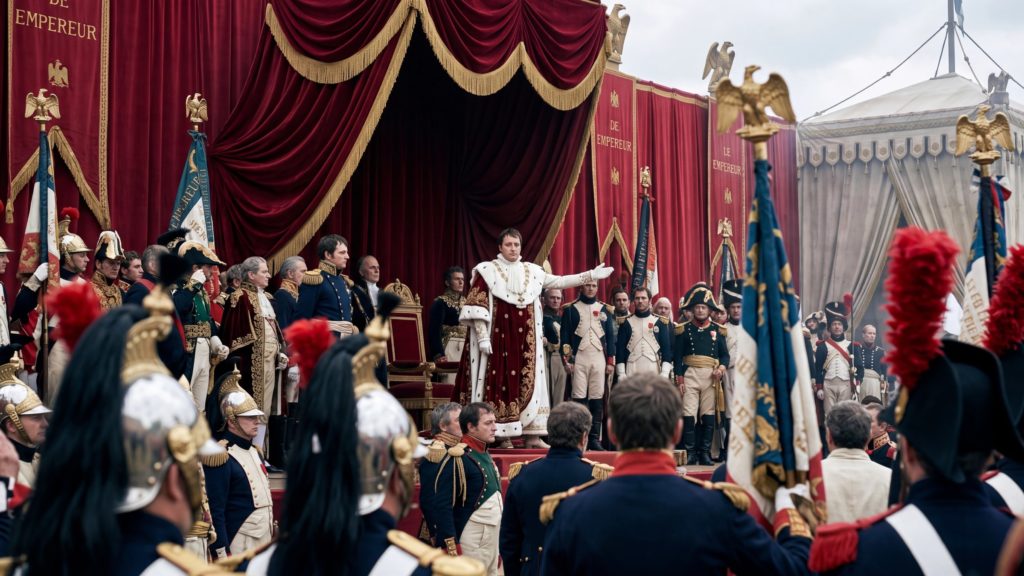
The enthronement that followed briefly went wrong: as Josephine mounted the steps to the throne, the weight of her mantle - no longer supported by her attendant princesses - nearly pulled her back[1]. The wider ceremony, though, closed exactly as intended: a Senate-approved, Pope-consecrated hereditary Emperor of the French now sat on a throne dressed in the borrowed forms of Charlemagne's empire[1].
Pope Pius VII did not leave for months afterward, occupying himself with sightseeing around Paris while negotiations over the promises made to him before the ceremony dragged on[1]. The version of the day that would circulate for generations - a defiant Napoleon seizing the crown against the Pope's wishes - took hold only later, through historians such as Thiers, rather than from those actually present[1].
Quick Facts
The essentials
Quick Facts
The Bigger Picture
Followed the Senate's vote and a popular plebiscite establishing Napoleon as hereditary Emperor of the French, a proposal approved by more than 3,000,000 votes to under 3,000 against[2, p. 273], and came only months after the last Holy Roman Emperor had pre-emptively rebranded himself hereditary Emperor of Austria[2, p. 273].
How It Came To This
The near-unanimous plebiscite legitimising a hereditary French Empire[2, p. 273]; Napoleon's wish to root his new title in something older than his own conquests, hunting through relics linked to Charlemagne's coronation for the occasion[1]; and the need for the Pope's presence to give the new Empire the religious legitimacy a mere Senate vote could not[1].
What Actually Happened
The ceremony was built around a careful compromise the surviving legend usually erases: an arrangement in which the Pope would hand Napoleon the crown, but Napoleon - not the Pope - would place it on his own head, precisely as had been agreed between them beforehand[1]. Historians trace the popular image of an unplanned, defiant seizure of the crown to the historian Thiers, who appears to have originated it[1]. What made the day politically effective was less the crowning gesture itself than the deliberate borrowing of medieval form: a search for regalia linked to Charlemagne[1], a reigning Pope brought from Rome to consecrate the event, and a plebiscite result manufactured to look like near-total consent[2, p. 273]. The coronation was a piece of constructed legitimacy laid over a regime barely five years removed from a coup.
Why It Still Matters
Converted the Consulate into a hereditary Empire, endorsed by Senate decree and an overwhelming plebiscite[2, p. 273], and set Napoleon among Europe's crowned heads - though the deliberately staged self-crowning[1] also fixed the enduring image of a ruler answerable to no one, sacred tradition included.
Quick Facts
Roger would like you to know...
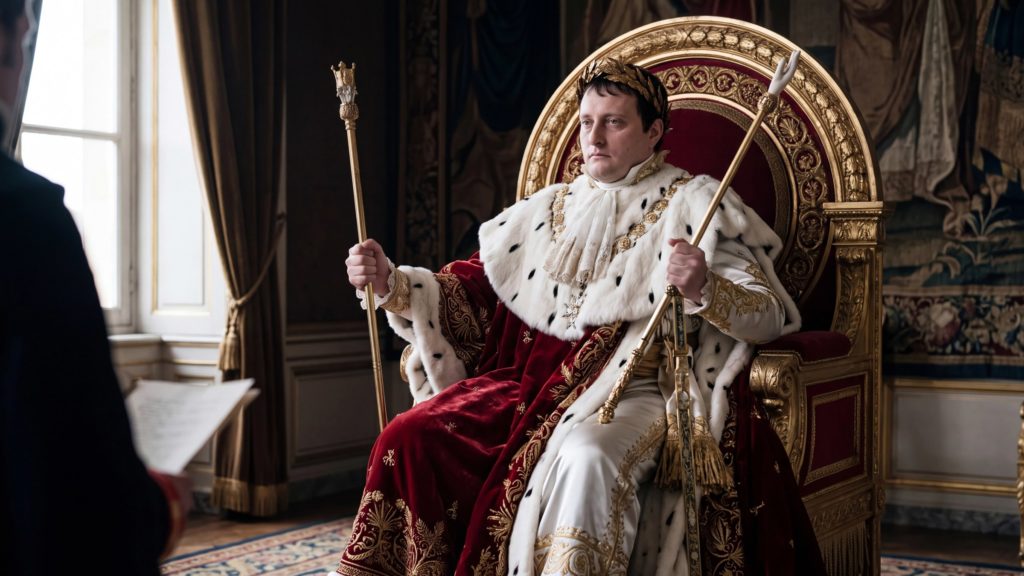
Napoleon crowning himself wasn't a spontaneous snub to the Pope - the moment was agreed between the two men beforehand. The story of him defiantly grabbing the crown seems to trace back to the historian Thiers, not to anyone who was actually there[1].
Keith checked the sources...
The plebiscite that made Napoleon hereditary Emperor was recorded as over 3,000,000 votes in favour against fewer than 3,000 against - a margin so lopsided it says more about the Consulate's control of the process than genuine unanimity[2, p. 273].
One for the Ageonauts...
Napoleon went hunting for regalia linked to Charlemagne's own coronation to legitimise his new title - only to find that most of it, including a fourteen-pound golden crown, was kept at Nuremberg rather than in France[1].
History gets strange here...
Pope Pius VII didn't just attend and leave - he stayed in Paris for four months after the coronation, sightseeing while arguments continued over promises made to him beforehand[1].
Keith would like to clarify...
The coronation nearly had an accident: as Josephine climbed the steps to the throne, her heavy mantle - no longer held up by her attendants - almost dragged her backward[1].
A small fact with a very large consequence...
Just four months before Napoleon's coronation, the last Holy Roman Emperor, Francis II, pre-emptively declared himself hereditary Emperor of Austria - a rebranding that let his dynasty outlast the Holy Roman title itself, which he abandoned two years later[2, p. 273].
Meanwhile, in history...
An eyewitness in the cathedral, Laure Junot, described Napoleon at the instant he crowned himself as looking almost transformed - "lighted up with an expression of which no words can convey an idea"[3].
Roger has entered the historical rabbit hole...
The plan to model the coronation on Charlemagne ran into a practical problem: the Carolingian regalia Napoleon wanted had long since ended up preserved at Nuremberg, not in France at all[1].
Keith has spotted the problem...
The now-famous story of Napoleon snatching the crown "like a purse-snatcher" against the Pope's wishes comes from later historians repeating each other, not from the arrangement the two men had actually settled on before the ceremony[1].
The familiar story leaves this out...
Napoleon crowned Josephine as Empress in the same ceremony, immediately after crowning himself[1] - a second coronation inside the same event that the popular memory of the day often skips over.
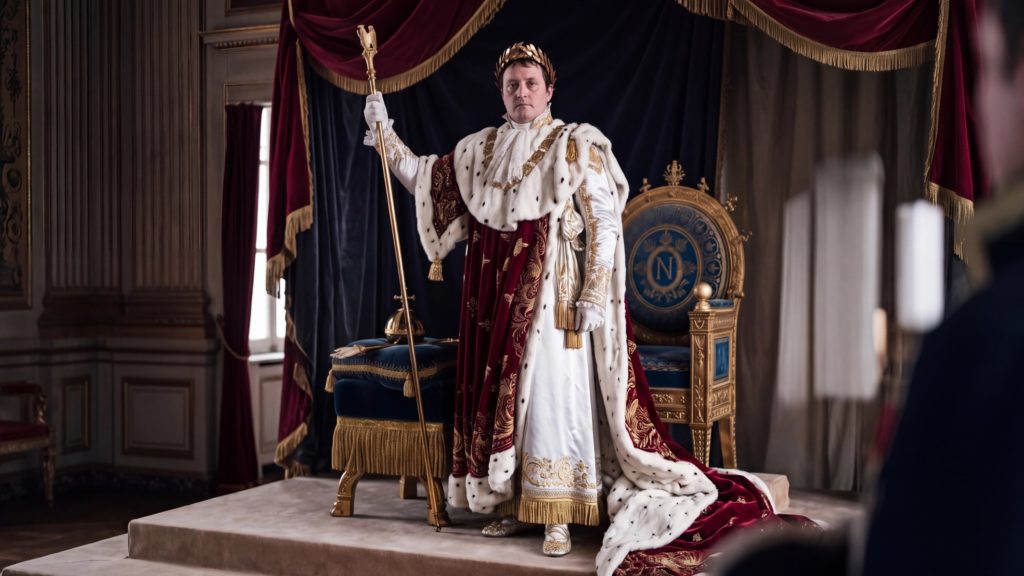
"At that moment he was really handsome, and his countenance was lighted up with an expression of which no words can convey an idea."
Laure Junot, Duchesse d'Abrantes, describing Napoleon at the instant of crowning himself[3]
Junot's wife watched from inside Notre-Dame as Napoleon took the crown from the altar and placed it on his own head.
Timeline
How it unfolded
c. 15 July 1801
Concordat with the Papacy
The Concordat with Rome restored the Roman Catholic religion in France.[4] The Catholic Encyclopedia says that years afterwards, at St. Helena, Napoleon considered it his greatest achievement.[5]
2 August 1802
Napoleon Made Consul for Life
The Senate declared Napoleon Bonaparte Consul for Life, with the power to name his successor.[6] In the plebiscite he received over three and a half million votes, with fewer than nine thousand against.[6]
21 March 1804
Execution of the Duc d'Enghien
Determined to retaliate on the Bourbon princes, Bonaparte ordered the arrest of the Duc d'Enghien.[2, p. 273] He was shot at Vincennes,[4] and Terry says Cadoudal's plot hastened the transformation of the Consulate into a hereditary monarchy.[2, p. 273]
18 May 1804
Napoleon Proclaimed Emperor of the French
The Senate saluted Napoleon as Emperor on 18 May 1804.[7] Terry reports that a popular plebiscite supported the proposal by more than 3,000,000 votes to fewer than 3000.[2, p. 273]
2 November 1804
Pius VII Journeys to Paris
Pope Pius VII left Rome for his long journey to Paris.[6] Napoleon gave him no solemn reception, meeting him in open country during a hunting party and taking him to Fontainebleau in the imperial carriage.[5]
1 December 1804
Religious Marriage of Napoleon and Josephine
Pius VII insisted on a religious blessing of the marriage, otherwise there was to be no coronation.[5] It was secretly performed at the Tuileries, without witnesses, by Fesch, the grand almoner of the imperial household.[5]
2 December 1804
Coronation at Notre-Dame
In the presence of Pope Pius VII, Napoleon crowned himself Emperor of the French.[2, p. 273] According to Geer, as the Pope was about to proceed with the crowning, Napoleon took the crown from his hands and placed it on his own head,[6] and the Catholic Encyclopedia adds that he then crowned the empress.[5]
Dig Deeper
Copy any prompt below into your favourite AI chat to keep exploring.
why Napoleon crowned himself instead of letting the pope do it
a revolutionary general becoming a hereditary emperor
the coins that still said 'Republic' two years after the empire began
Further Reading
Where to read more
The "sacre" or consecration of Napoleon I - napoleon.org
A concise, free overview of the coronation aimed at students, from the Fondation Napoleon's own young-historians resource.
Why look at this: Explains why the ceremony is called the 'Sacre' rather than simply a coronation, and what the religious consecration was meant to achieve politically.
https://www.napoleon.org/en/young-historians/napodoc/the-sacre-of-napoleon-i/Napoleon's Consecration and Coronation - napoleon.org
A fuller, free scholarly article from the Fondation Napoleon on how the ceremony was staged and what it meant.
Why look at this: Goes deeper into the deliberate staging behind the self-crowning moment - the same negotiated arrangement with the Pope described on this page.
https://www.napoleon.org/en/history-of-the-two-empires/articles/napoleons-consecration-and-coronation/Memoirs of Napoleon Bonaparte, by Louis Antoine Fauvelet de Bourrienne (Vols I and II)
Bourrienne's own memoirs, freely digitised on the Internet Archive - one of this event's own richest library sources.
Why look at this: Bourrienne was one of Napoleon's closest aides; his memoirs are the primary-source backbone behind this page's account of the coronation's staging.
https://archive.org/details/MemoirsOfNapoleonBonaparteIAndIiRelated
Keep exploring



Can be seen in
Where this shows up

References
Sources
Sources
- BookNapoleon and his coronation by Frédéric Masson and Frederic Cobb ↑
- BookA short history of Europe, from the fall of the Eastern empire to the dissolution of the Holy… by Charles Sanford Terry. Page 273. ↑
- BookMemoirs Of The Emperor Napoleon Vol - Ii by Madame Junot ↑
- BookMemoirs Of Napoleon Bonaparte - I And Ii by Louis Antoine Fauvelet De Bourrienne ↑
- DocumentCatholic Encyclopedia (1913)/Napoleon I (Bonaparte) ↑
- BookNAPOLEON AND JOSEPHINE THE RISE OF THE EMPIRE by WALTER GEER ↑
- BookThe battle of Waterloo, with those of ligny and Quatre Bras, described by eye-witnesses and by the series… (compiled by John Booth) ↑
- BookA dictionary of Napoleon and his times by Hubert N.B Richardson ↑
- BookA short history of Europe from the dissolution of the Holy Roman empire to the outbreak of the… by Charles Sanford Terry ↑