
AI reconstruction based on Louis-François, Baron Lejeune's "The Battle of the Pyramids" (1808), from the perspective of a soldier in the second rank of a French infantry square near Embabeh, looking out over the kneeling front rank as the Mamluk charge comes in.
In 1798 Napoleon sailed for Egypt with a corps of scientists alongside his soldiers[1] - a campaign that cost France its fleet within days of its greatest victory[2, p. 273].
What Happened
The story
On 19 May 1798 a French fleet of some five hundred vessels sailed from Toulon, carrying Napoleon's army and a corps of scientists and scholars bound for Egypt[1]. The stated aim was to strike at Britain's trade by way of an overland route toward India[3, p. 2]. After landing near Alexandria, Bonaparte pushed south along the Nile, brushing aside Mamluk resistance at Rahmaniya and Chebreiss, before reaching the plain before Cairo at Embabeh, opposite the Pyramids[4].
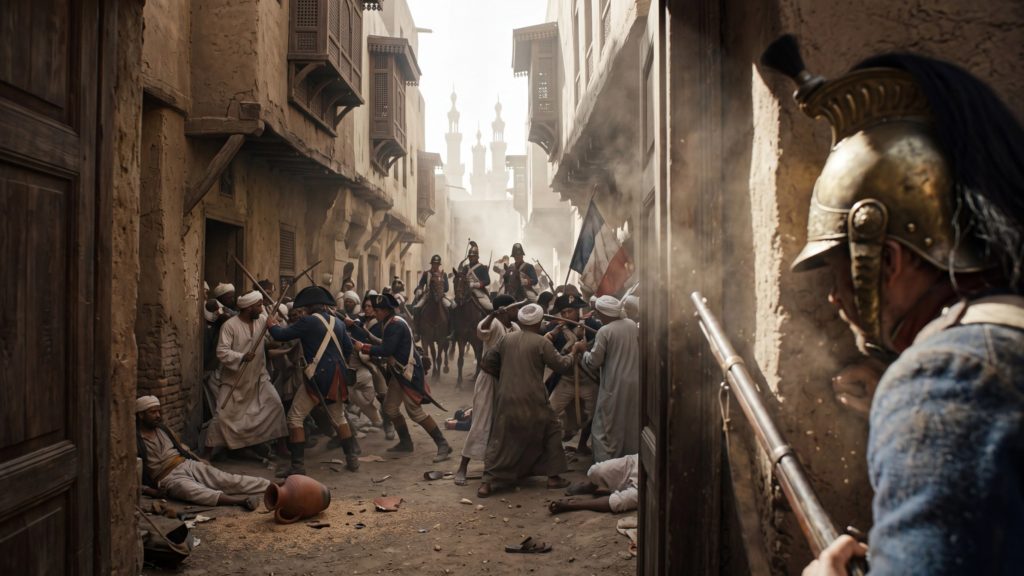
On 21 July 1798, facing the Battle of the Pyramids at Embabeh, Napoleon addressed his troops formed into defensive squares: 'Soldiers, forty centuries look down upon you from the summit of the Pyramids!'[5] Mourad Bey's Mamluk cavalry charged the French squares repeatedly and were shattered by disciplined volley fire; many drowned trying to flee across the Nile, and French soldiers later bent their bayonets into hooks to fish gold-laden bodies from the river[5]. Mourad fled south and Ibrahim east, their infantry scattering.
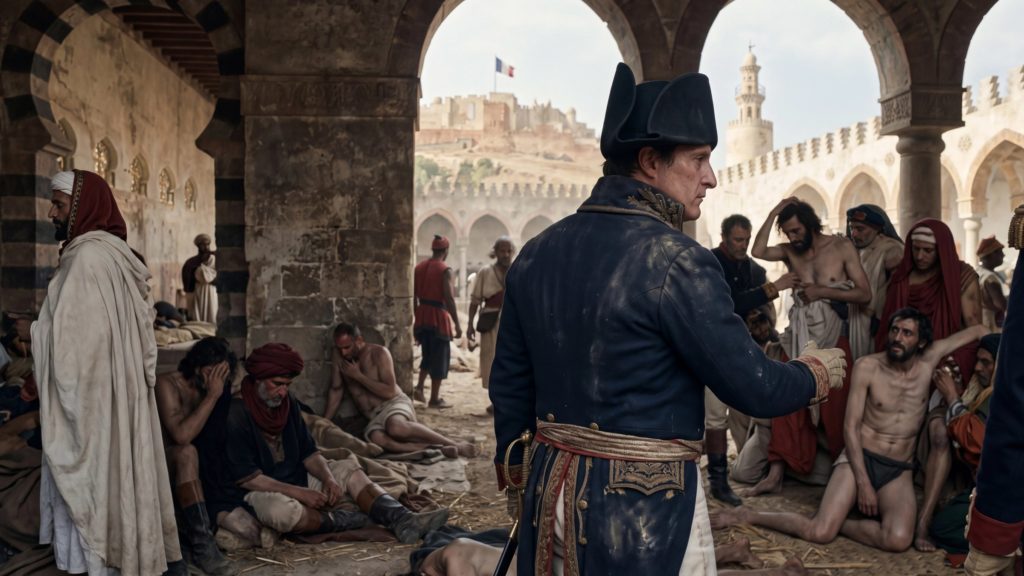
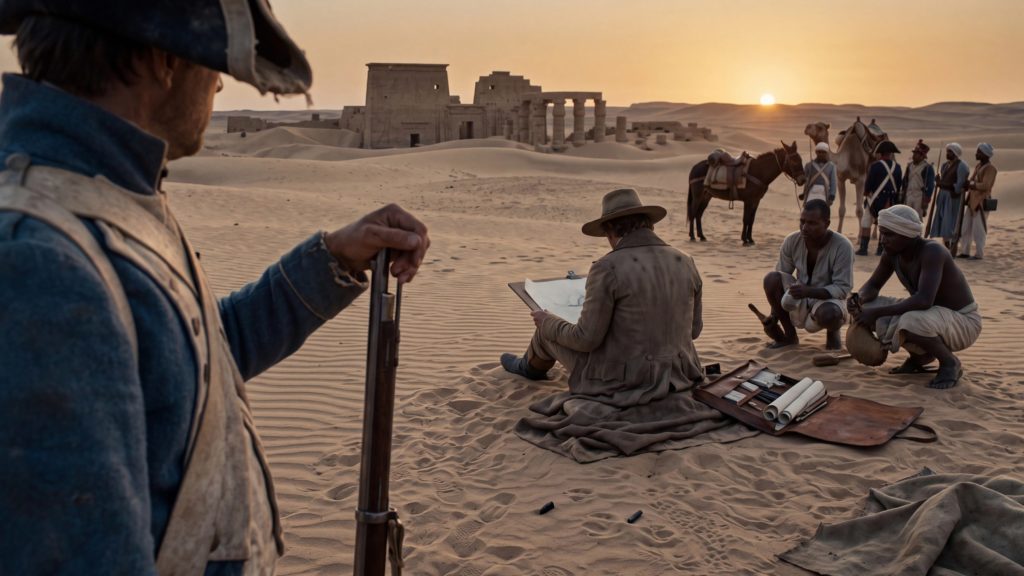
The victory opened Cairo to the French after a campaign of only twenty days from their landing[4]. From his headquarters at Gizeh, Napoleon wrote to the city's sheikhs and notables, promising order in exchange for submission and supplies for his troops[4]. He then founded an institute in Cairo, complete with a library and a chemistry laboratory, and sent the expedition's savants travelling into the interior to survey the country's geography, history and natural science[6].
Within weeks, a French engineer digging fortifications at Fort St Julien near Rosetta uncovered a stone slab inscribed in Greek, hieroglyphic and demotic script - the find later known as the Rosetta Stone, which became the key to reading ancient Egyptian writing[7]. Napoleon's army, meanwhile, was already cut off from France by sea[2, p. 273].
Quick Facts
The essentials
Quick Facts
France (the Army of the Orient)
Leadership
General Napoleon Bonaparte[4]
Forces
The French Army of the Orient under Napoleon Bonaparte, including generals Desaix, Reynier and Dugua, plus a corps of scientists and scholars[6]
Objective
Seize Egypt and open an overland route threatening Britain's trade with India[3, p. 2]
The Bigger Picture
Part of France's ongoing war with Britain; Egypt was targeted as a step toward an overland route that could threaten Britain's trade with India[3, p. 2], at a time when Britain was already fortifying its own approaches to India elsewhere in the region[8].
How It Came To This
The Directory's wish to strike at British power indirectly, by seizing Egypt as a base on the overland route to India[3, p. 2]; and Napoleon's own fresh popularity and ambition after Italy, which made him available for a new, high-profile command.
What Actually Happened
Two things distinguish this invasion from an ordinary campaign of conquest: the deliberate pairing of soldiers with scientists, and the tactical answer Napoleon found to Mamluk cavalry. Bringing a corps of savants, and founding an institute in Cairo the moment the city fell, framed the expedition as a mission of learning as much as an invasion, complete with its own library and chemistry laboratory[6]. Militarily, the Mamluks' horsemen were individually formidable but uncoordinated as a force; the French squares at Embabeh simply held formation under repeated charges, turning the battle into a contest between disciplined volley fire and courage alone, which volley fire won decisively[5]. What the victory could not fix was logistics: an army and a scientific commission moved this far from France depended entirely on the fleet that had carried them remaining afloat in Egyptian waters - a vulnerability exposed within days of the Pyramids victory.
Why It Still Matters
The campaign's lasting legacy was scholarly rather than military: the savants' surveys, from the Rosetta Stone to Egyptian flora and fauna, were published as the Description de l'Egypte and founded modern Egyptology[9]. Militarily, it left Napoleon's army stranded far from France.
Quick Facts
One for the Ageonauts...
The Rosetta Stone was found by a French engineer digging fortifications near Rosetta: a slab three feet seven inches long carrying the same text in Greek, hieroglyphic and demotic script - the key that finally let scholars read ancient Egyptian writing[7].
Keith checked the sources...
After the Battle of the Pyramids, French soldiers bent their bayonets into makeshift hooks to fish for the bodies of drowned Mamluks - who customarily carried their wealth on their persons into battle[5].
Roger would like you to know...
"Forty centuries look down upon you" wasn't just a good line - Napoleon delivered it to troops standing in defensive squares, seconds before thousands of Mamluk horsemen charged them within sight of the Pyramids[5].
A small fact with a very large consequence...
The moment Cairo fell, Napoleon founded an institute there with its own library and chemistry laboratory, and sent his scholars travelling into the interior to survey Egypt's geography and history[6].
History gets strange here...
The scholars' work, later published as the 'Description de l'Egypte', covered everything from the inscription on the Rosetta Stone to the incubation of chickens - and gave the modern study of Egyptology its start[9].
Keith would like to clarify...
Cairo fell just twenty days after the French landed in Egypt - a campaign that reads more like a rout than the grinding siege the scale of the conquest might suggest[4].
Roger has entered the historical rabbit hole...
This wasn't really about Egypt at all: the whole expedition was aimed at Britain, meant to open an overland route that could threaten British trade with India[3, p. 2].
Meanwhile, in history...
After taking Cairo, Napoleon wrote directly to the city's sheikhs and notables: send boats and a deputation, provide bread, meat, straw and barley for his troops, and 'rest assured that no one is more anxious to contribute to your happiness than I'[4].
Keith has spotted the problem...
The Mamluks' famous cavalry charge at the Pyramids didn't break the French lines once - Mourad Bey fled south, his co-ruler Ibrahim fled east, and their infantry, by one account, 'scattered and ran like frightened sheep'[5].
The familiar story leaves this out...
Napoleon brought a corps of scientists and scholars along with his soldiers - so that even while fighting a war, the expedition was already surveying, cataloguing and measuring the country it had just invaded[6].
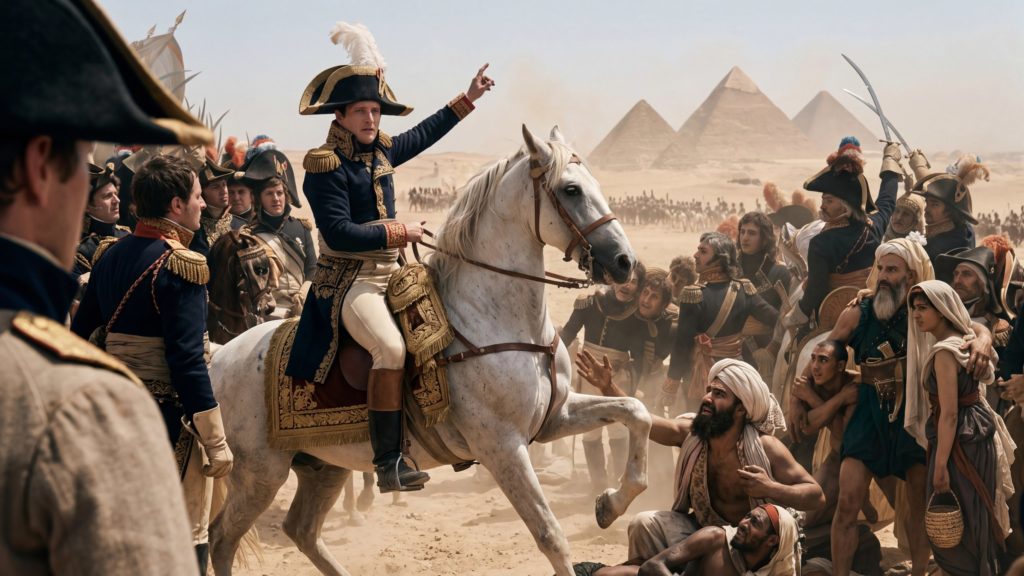
Soldiers, forty centuries look down upon you from the summit of these Pyramids!
Napoleon Bonaparte, addressing his troops before the Battle of the Pyramids, 21 July 1798[5]
Delivered as French infantry formed defensive squares against massed Mamluk cavalry on the plain at Embabeh, in sight of Giza.
Timeline
How it unfolded
March 1798
Directory Approves the Egyptian Expedition
The Directory took the official decision to launch an expedition to Egypt and appointed Bonaparte commander-in-chief.[10] According to the Catholic Encyclopedia, his object was to make the Mediterranean a French lake and to menace England in the direction of India.[11]
19 May 1798
The Armada Sails from Toulon
The Egyptian expedition left Toulon, an occasion Sloane calls thus far the greatest of Bonaparte's life.[5]
2 July 1798
Fall of Alexandria
Sloane says the city of Alexandria yielded to the French after a feeble and ineffectual resistance.[5] The Catholic Encyclopedia dates the taking of Alexandria to 2 July.[11]
21 July 1798
Battle of the Pyramids
According to the Catholic Encyclopedia, the battle of the Pyramids gave Bonaparte the uncontested mastery of Cairo.[11] Sloane judges it little more than a skirmish, with only thirty French soldiers killed.[5]
1 August 1798
Battle of the Nile
In Nelson's victory at Aboukir the French Admiral Brueys was killed and his ship L'Orient blown up.[12] The Catholic Encyclopedia says the naval disaster cut the French troops in Egypt off from Europe.[11]
21 May 1799
Siege of Acre Abandoned
Bonaparte was forced to raise the siege of Acre, begun on 17 March, which was defended by the Turks and a small force of British seamen under Sir Sidney Smith.[13] The Catholic Encyclopedia adds that his army was suffering from plague and he had to make his way back to Egypt.[11]
19 July 1799
Discovery of the Rosetta Stone
According to Budge, a French officer found the trilingual inscription called the Rosetta Stone at Rosetta in 1799.[14, p. 41] Napoleon.org dates the discovery to 19 July 1799.[15]
22 August 1799
Bonaparte Leaves Egypt
Bonaparte embarked at Alexandria on the frigate Muiron, which set sail early the next morning.[16] The Catholic Encyclopedia says he left Kleber in Egypt and returned secretly to France, landing at Frejus on 9 October 1799.[11]
14 June 1800
Assassination of Kleber
Kleber, to whom Bonaparte had left command, was assassinated at Cairo by a Muslim fanatic, and the command fell to General Menou.[17]
2 September 1801
French Garrison Surrenders at Alexandria
After Belliard capitulated at Cairo on 27 June, the garrison at Alexandria laid down its arms on 2 September 1801.[18, p. 1] Mignet adds that the English took the French troops back to France.[17]
Dig Deeper
Copy any prompt below into your favourite AI chat to keep exploring.
Explain why Napoleon brought scientists and scholars along with his soldiers to invade Egypt, and how that decision led directly to finding the Rosetta Stone.
Debate whether Napoleon's Egyptian expedition was a genuine mission of discovery or a conquest with excellent PR, using the Cairo institute and the Rosetta Stone as your evidence.
Convince me that Napoleon's army of scholars, with their own library and chemistry lab set up inside Cairo, was really there to fight a war.
Further Reading
Where to read more
Egyptian Campaign - National Army Museum
A concise, free museum overview of Napoleon's 1798 Egyptian expedition and its eventual failure.
Why look at this: Explains how the campaign that took Cairo within three weeks still ended with French troops expelled from Egypt by 1801 - the flip side of the quick victory this page covers.
https://www.nam.ac.uk/explore/egyptian-campaignNapoleon and the Scientific Expedition to Egypt - Linda Hall Library
A fuller digital exhibition on the scholars Napoleon brought to Egypt and what their work produced.
Why look at this: Follows the roughly 150 scholar-scientists from this page's Cairo institute through to their finished 23-volume 'Description de l'Egypte' - the project this page's Rosetta Stone discovery fed into.
https://www.lindahall.org/experience/digital-exhibitions/napoleon-and-the-scientific-expedition-to-egypt/01-the-napoleonic-invasion-of-egypt/Relation des campagnes du Général Bonaparte en Egypte et en Syrie, by Berthier
Marshal Berthier's own campaign account, freely digitised on the Internet Archive.
Why look at this: Written by Napoleon's chief of staff on the expedition, this is the primary account behind this page's description of the Cairo institute and the savants sent to survey the interior.
https://archive.org/details/relationdescampa00bertuoftRelated
Keep exploring





Places





Can be seen in
Where this shows up

References
Sources
Sources
- BookTalleyrand, a biographical study by Joseph McCabe ↑
- BookA short history of Europe, from the fall of the Eastern empire to the dissolution of the Holy… by Charles Sanford Terry. Page 273. ↑
- WebsiteHeritage Classical Curriculum - Modern Europe - Napoleon. Page 2. ↑
- BookMemoirs Of Napoleon Bonaparte (1851) by Victorian Vault ↑
- BookThe Life of Napoleon Bonaparte. Vol. 2 (of 4) by William Milligan Sloane ↑
- BookRelation des campagnes du Général Bonaparte en Égypte et en Syrie by Louis-Alexandre Berthier ↑
- BookNapoleon and the end of the French revolution by Charles F. Warwick ↑
- BookA short history of Europe from the dissolution of the Holy Roman empire to the outbreak of the… by Charles Sanford Terry ↑
- BookA Life of Napoleon Bonaparte, with a Sketch of Josephine, Empress of the French. by Ida M. Tarbell ↑
- Websiteen.wikipedia.org: French campaign in Egypt and Syria ↑
- DocumentCatholic Encyclopedia (1913)/Napoleon I (Bonaparte) ↑
- BookLife of Napoleon Bonaparte, Volume II. by Walter Scott ↑
- BookA dictionary of Napoleon and his times by Hubert N.B Richardson ↑
- BookThe Nile. Notes for travellers in Egypt by E. A. Wallis Budge. Page 41. ↑
- Websitenapoleon.org: The campaign in egypt ↑
- BookNAPOLEON AND JOSEPHINE THE RISE OF THE EMPIRE by WALTER GEER ↑
- BookThe French revolution from 1789 to 1815 by M. Mignet and James Westfall Thompson ↑
- BookModern Egypt and Thebes : being a description of Egypt, including information required for travellers in that country by John Gardner Wilkinson. Page 1. ↑