

What If Julius Caesar Had a Group Chat
How the Story Unfolds
Start to finish
.In the spring of 44 BC the Roman Republic had a dictator who showed no sign of stepping down. Dictators had served for six months or less, but Caesar was named dictator for a whole year[1], then for ten years[1], and finally for life[1]. Suetonius says he could not shake off the suspicion that he wanted to be king[2]. More than sixty senators joined a plot against him, led by Gaius Cassius, Marcus Brutus and Decimus Brutus[2]. They chose the Ides of March, 15 March 44 BC[3], for a meeting of the Senate in the Hall of Pompey[2]. This What If imagines the plotters organising it all in a group chat that Caesar can still read. The chat is invented. The plot, the setting and the date are real. The page follows the true story: why the Senate turned on Caesar, then the Ides of March itself.
The Story
Start to finish
Why the Senate Turned on Caesar
Rome had been a republic since its last king, Tarquin the Proud, was expelled, traditionally in 509 BC[4]. In a crisis a consul could name a dictator, an emergency ruler limited to six months[5]. Caesar's term was stretched until, by 44 BC, he held the post for life[6][6]. At the Lupercalia festival the consul Mark Antony offered him a crown, and Caesar put it aside[2]. A rumour that he would be named king hurried the plotters on[2]. In Plutarch's account it was Cassius who began recruiting, and he went to Brutus because the others would join only if Brutus led[7]. Brutus was believed to descend from the Junius Brutus who drove out the Tarquins[8], and Romans left notes at his judgement seat asking, 'Brutus, are you asleep?'[8] Caesar had pardoned him after Pharsalus and made him city praetor[1][1], yet Cassius persuaded him to join the plot[1].

The Ides of March
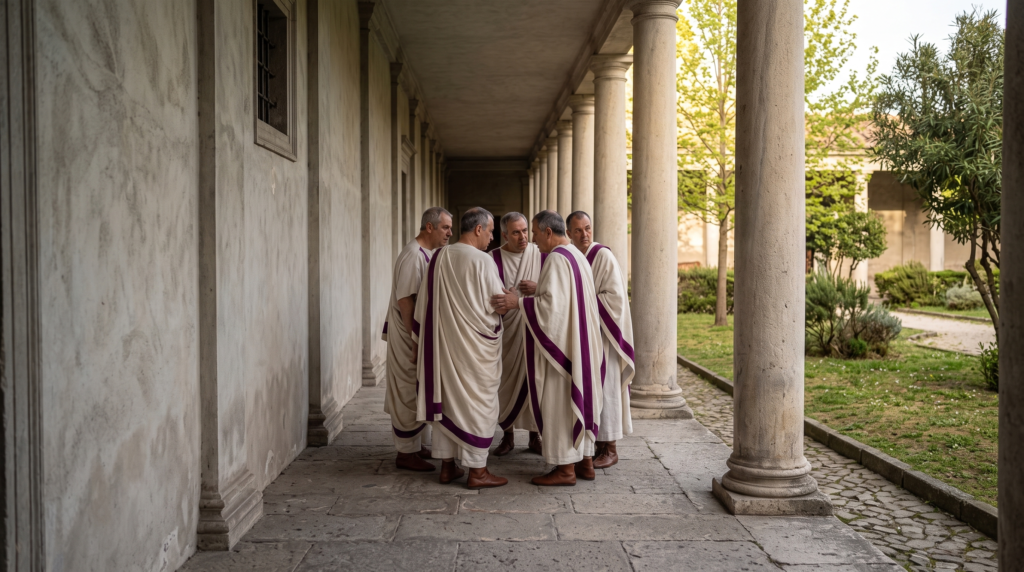
Caesar hesitated about going to the Senate that morning, partly because of poor health and bad omens[2]. Plutarch says his wife Calpurnia begged him to put off the meeting after a frightening dream[9]. The ancient writers cannot agree on the dream: Plutarch has her holding her murdered husband, Suetonius a falling gable, and Appian a husband streaming with blood[9][2][10, p. 87]. In the end Decimus Brutus urged him not to disappoint the full Senate[2]. The plotters had not invited the orator Cicero to join them[11], and they spared Antony, because Brutus argued that only Caesar's death would count as tyrannicide[10, p. 87]. Inside the Curia of Pompey, Tillius Cimber seized Caesar's toga and one of the Cascas struck the first blow[2]. Caesar was stabbed twenty-three times, by the count of Suetonius, Plutarch and Appian[2][12][10, p. 87], and he fell against the base of Pompey's statue[12].

The plotters said they acted to restore the republic of their fathers[10, p. 87]. Britannica notes that the plot instead triggered a civil war, ending in the rise of Caesar's adopted son Octavian, who became the first Roman emperor, Augustus, in 27 BC[3]. Brutus and Cassius were defeated at Philippi in 42 BC[13], and Suetonius says hardly any of the assassins outlived Caesar by three years[2]. Historians have judged the Republic largely by how it ended. Taylor argued that its vital defect was the sovereignty of the people, which let any general with an army win near-absolute power[14]. Opinion on Caesar himself remains divided: Suetonius thought he had abused his power[15], while Mommsen called him the entire and perfect man[16]. Afterwards it was voted that the Ides of March be called the Day of Parricide, and that the Senate never meet on that date[2]. Today a large tuff base at Largo Argentina in Rome is what remains of the Curia of Pompey[17]. The Ides of March was real. Only the group chat was invented.
Historical Context
What was going on
The plotters said they acted to restore the republic of their fathers[10, p. 87]. Britannica notes that the plot instead triggered a civil war, ending in the rise of Caesar's adopted son Octavian, who became the first Roman emperor, Augustus, in 27 BC[3]. Brutus and Cassius were defeated at Philippi in 42 BC[13], and Suetonius says hardly any of the assassins outlived Caesar by three years[2]. Historians have judged the Republic largely by how it ended. Taylor argued that its vital defect was the sovereignty of the people, which let any general with an army win near-absolute power[14]. Opinion on Caesar himself remains divided: Suetonius thought he had abused his power[15], while Mommsen called him the entire and perfect man[16]. Afterwards it was voted that the Ides of March be called the Day of Parricide, and that the Senate never meet on that date[2]. Today a large tuff base at Largo Argentina in Rome is what remains of the Curia of Pompey[17]. The Ides of March was real. Only the group chat was invented.
Quick Facts
The essentials
Quick Facts
Keith has counted the wounds…
Of Caesar's twenty-three wounds, the surgeon Antistius judged only one to be mortal: the second, in the chest[15]. Suetonius adds that three slaves carried the body home on a litter, with one arm hanging over the side[15]. Keith notes that no group chat records that detail.
Roger has a crown to return…
At the Lupercalia festival, Plutarch says, Antony twined a laurel wreath round a diadem, a royal headband, and put it on Caesar's head[7]. Caesar declined it, then pushed it away again, and the people cheered[7]. Roger calls it the most public no thank you in Roman history.
Oh that you had asked me to the banquet! There would have been no leavings.
Cicero
Cicero's remark about the Ides of March, written to Cassius and Trebonius in early February 43 BC, nearly a year after the killing, in the rendering given by the editor Louis Purser[18, p. 26].
Who Is in This One?
The people you'll meet





Timeline
How it unfolded
c. 509 BC
Rome Becomes a Republic
Rome's last king, Tarquin the Proud, was expelled, traditionally in 509 BC[4]. Arnold wrote that Brutus then proposed that two men share supreme power for a single year, and the new governors were called consuls[19, p. 270].
48-44 BC
Caesar's Dictatorship Is Stretched to Life
In a crisis a dictator was limited to six months[5]. Caesar was named dictator for a whole year[1], then for ten years[1], and finally for life[1].
44 BC
Cassius Recruits Brutus
In Plutarch's account it was Cassius who began recruiting, and he went to Brutus because the others would join only if Brutus led[7]. Caesar had pardoned Brutus after Pharsalus and made him city praetor[1][1], yet Cassius persuaded him to join the plot[1].
44 BC
Conspirators Choose the Hall of Pompey
Suetonius says more than sixty men joined the plot, led by Gaius Cassius, Marcus Brutus and Decimus Brutus[2]. When a meeting of the Senate was called for the Ides of March in the Hall of Pompey, they readily chose that time and place[2].
15 February 44 BC
Antony Offers Caesar a Crown
At the Lupercalia on 15 February, Antony, Caesar's fellow consul, offered Caesar a crown or tiara[20][11]. Caesar put it aside, but a rumour that he would be named king hurried the plotters on[2].
15 March 44 BC
The Ides of March
Caesar hesitated over poor health and omens[2], and Plutarch says Calpurnia begged him to put off the meeting after a frightening dream[9], but Decimus Brutus urged him not to disappoint the full Senate[2]. In the Curia of Pompey, Tillius Cimber seized Caesar's toga and one of the Cascas struck the first blow[2]. Caesar was stabbed twenty-three times[2][12][10, p. 87], and he fell against the base of Pompey's statue[12].
17-21 March 44 BC
Amnesty, Funeral and Firebrands
At daylight on 17 March the Senate met in the Temple of Tellus and passed decrees granting amnesty and confirming Caesar's acts, according to Bondurant's chronology[20]. Bondurant dates Caesar's burial and Antony's funeral oration to 20 or 21 March[20], and Suetonius says the crowd ran to the houses of Brutus and Cassius with firebrands immediately after the funeral[2].
October 42 BC
Battle of Philippi
Weigall writes that in October 42 BC Antony defeated Brutus and Cassius at Philippi, where Cassius was killed and Brutus took his own life[21, p. 252]. Suetonius says hardly any of the assassins survived Caesar by more than three years[2].
27 BC
Octavian Becomes Augustus
Caesar's will adopted Gaius Octavius into his family and gave him his name[2]. Britannica says Caesar's death triggered a civil war that led to Octavian becoming the first Roman emperor, Augustus Caesar, in 27 BCE[3].
1926
Curia of Pompey Uncovered at Largo Argentina
According to Turismo Roma, the area of Largo Argentina was discovered unexpectedly in 1926 during the demolition of an old neighbourhood and excavated until 1928[17]. Behind temples B and C, a large tuff base is what remains of the Curia of Pompey[17].
Where Is That?
The maps used in this episode
What Happens in This One?
The moments it covers

Myth-buster
Think you know this one?

Keith, we all know the line. Caesar sees his dear friend Brutus with a dagger, gasps "Et tu, Brute?", and the entire Roman Republic gasps with him. Dying words, perfectly delivered, for the cheap seats. It is practically written in marble, and I will not hear otherwise!
Roger, I admire the delivery, but Suetonius says Caesar gave only a groan at the first wound, though some authors reported words to Brutus[15], and the editions give those words in Greek[15]. Cassius Dio is sceptical of the version in which he speaks, and 'Et tu, Brute?' is first attested in a 1595 play[22, p. 2]. Plutarch has Caesar simply cover his head when he sees Brutus's sword[8].






Where Does It Happen?
The places you'll visit


References
Sources
Sources
- BookDictionary of Greek and Roman biography and mythology by William Smith ↑
- BookSuetonius, Lives of the Caesars (Loeb, Rolfe) by Suetonius ↑
- Websitebritannica.com: Ides of March ↑
- BookHistory of the Roman republic by Jules Michelet and William Hazlitt ↑
- BookThe history of the Roman republic, abridged by C. Bryans and F.J.R. Hendy by Theodor Mommsen, Clement Bryans and Frederick James Robert Hendy ↑
- BookA history and description of Roman political institutions by Frank Frost Abbott ↑
- BookPlutarch, Lives ( LCL 11 Volumes In One; Perrin Trans) by Bernadotte Perrin ↑
- BookPlutarch's Lives, Volume 4 (of 4) by Plutarch ↑
- BookPlutarch's Lives, Volume 3 (of 4) by Plutarch ↑
- BookThe Roman history of Appian of Alexandria; by of Alexandria Appianus and Horace White. Page 87. ↑
- BookCaesar: A Sketch by James Anthony Froude ↑
- BookPlutarch Lives vol 7: Demosthenes, Cicero, Alexander, Caesar (Loeb, Perrin) by Plutarch ↑
- BookNorth's translation of Plutarch's life of Julius Caesar by Plutarch ↑
- BookA constitutional and political history of Rome, from the earliest times to the reign of Domitian by T. M. Taylor ↑
- BookThe Lives of the Twelve Caesars, Volume 01: Julius Caesar by Suetonius ↑
- BookThe History of Rome, Book V by Theodor Mommsen ↑
- Websiteturismoroma.it: Sacred area largo di torre argentina ↑
- BookThe correspondence of M. Tullius Cicero, arranged to its chronological order; with a revision of the text, a… by Marcus Tullius Cicero, Louis Claude Purser and Robert Yelverton Tyrrell. Page 26. ↑
- BookThe history of the Roman Republic, from the earliest records till the time of Sylla by Thomas Arnold and E. Pococke. Page 270. ↑
- BookDecimus Junius Brutus Albinus; a historical study .. by Bernard Camillus Bondurant ↑
- BookThe life and times of Cleopatra, queen of Egypt; a study in the origin of the Roman empire by Arthur E. P. Brome Weigall. Page 252. ↑
- WebsiteFamous Last Words Caesars Prophecy on the Ides of March (Antichthon). Page 2. ↑