
The Assassination of Julius Caesar
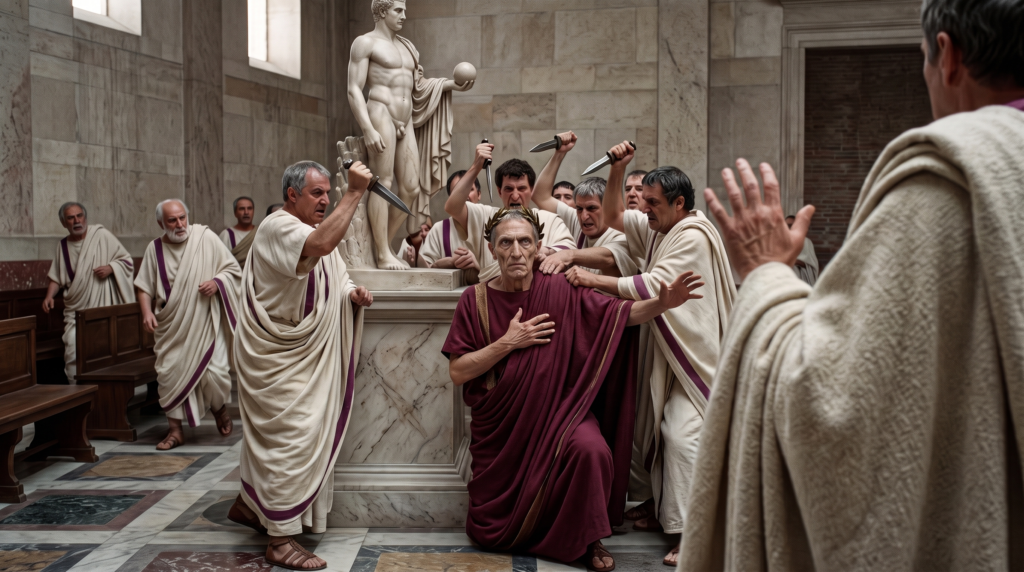
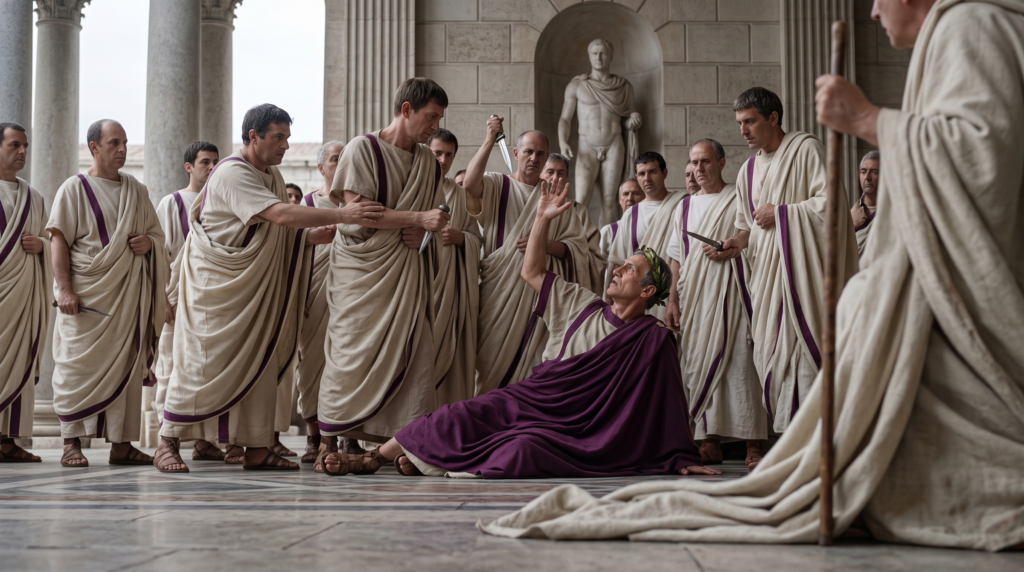
On the Ides of March 44 BC, Julius Caesar went to a Senate meeting in the Hall of Pompey and was stabbed to death by a plot of more than sixty men, several of them his own trusted officers.[1][2, p. 161]
What Happened
The story
By early 44 BC the Romans had made Caesar dictator for life, regarding monarchy as a respite from the civil wars, as Plutarch puts it.[3] Old republicans were plotting his death.[2, p. 161] More than sixty men joined the conspiracy, led by Gaius Cassius and Marcus and Decimus Brutus.[1] They weighed attacking him at the elections, on the Sacred Way or at the theatre entrance.[1] They chose the Senate meeting called for the Ides of March in the Hall of Pompey instead.[1] Plutarch notes that this room, among the porticoes around Pompey's theatre, held a statue of Pompey.[4]
On the morning of 15 March the signs were bad. The soothsayer Spurinna had warned Caesar of danger not later than the Ides of March, and his wife Calpurnia dreamed that her husband was stabbed in her arms.[1] W. W. How writes that Caesar was kept at home by his wife's warnings and entreaties until Decimus Brutus lured him out.[2, p. 161] Suetonius says Caesar then entered the House laughing at Spurinna, because the Ides had come without harm.[1] Spurinna replied that they had come, but not gone.[1] At the door, Trebonius engaged Antony in conversation.[5, p. 87]
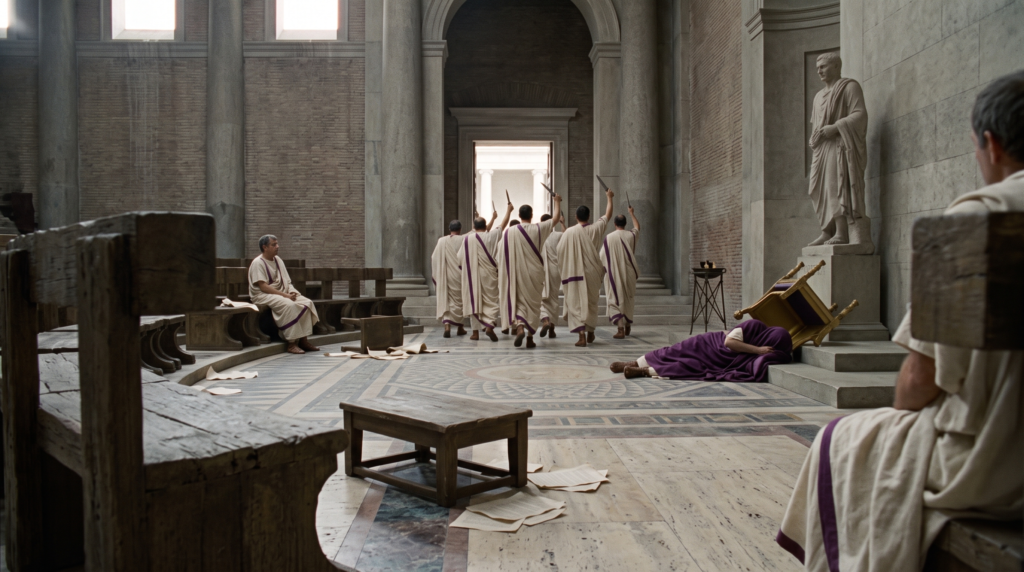
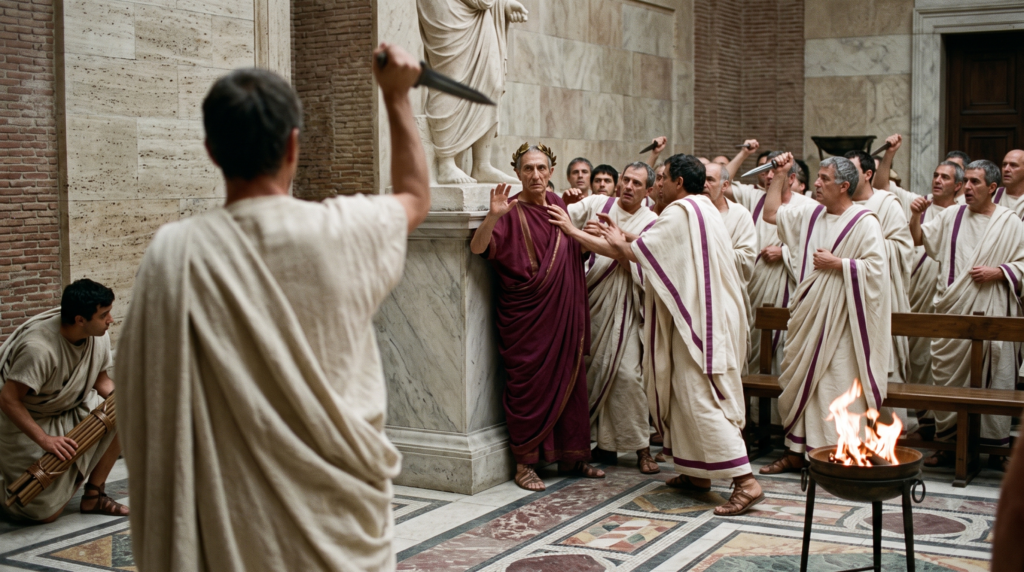
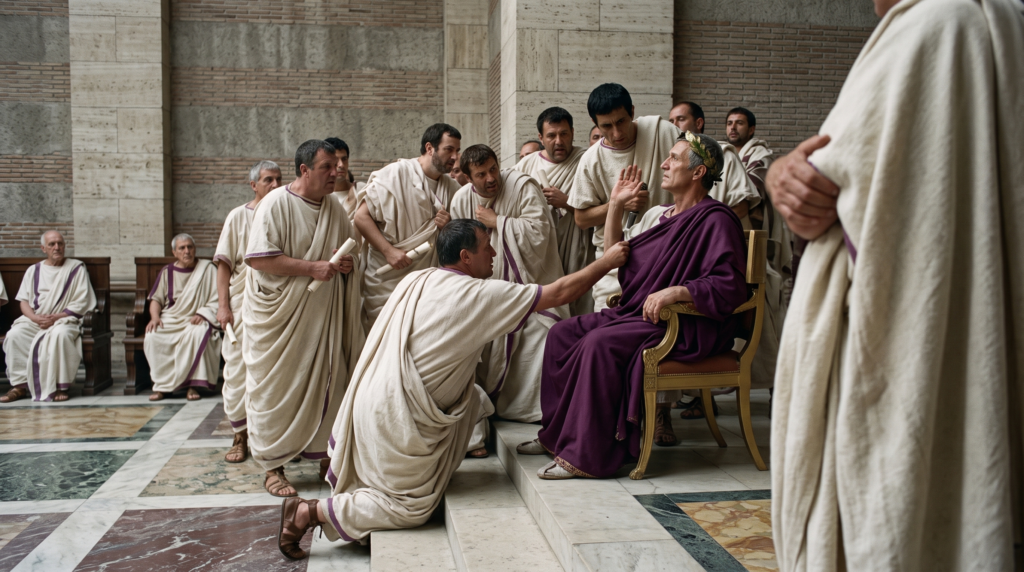
As Caesar took his seat, the conspirators gathered about him as if to pay their respects.[1] Tillius Cimber came forward as though to ask a favour, then caught Caesar's toga by both shoulders.[1] Caesar cried, 'Why, this is violence!' and one of the Cascas stabbed him just below the throat.[1] Beset on every side by drawn daggers, Caesar muffled his head in his robe and drew its lap down to his feet, to fall more decently.[1] Suetonius says he was stabbed with twenty-three wounds and uttered only a groan.[1] Plutarch has him sinking against the pedestal of Pompey's statue.[3]
The conspirators made off, and Caesar lay lifeless for some time. Finally three common slaves put him on a litter and carried him home, with one arm hanging down.[1] The senators had been rooted to the spot by terror. When Brutus raised his bloody dagger and called on Cicero to witness that he had freed Rome, they rushed out.[6, p. 60] Within days the Senate met in the temple of Tellus, where Antony, Plancus and Cicero spoke for amnesty, and it voted immunity for the conspirators.[4] Caesar's will named his sisters' grandson Gaius Octavius as chief heir and adopted him.[1]
Quick Facts
The essentials
Quick Facts
The conspirators
Leadership
Gaius Cassius, Marcus Brutus and Decimus Brutus[1]
Forces
Marcus Brutus; Gaius Cassius; Decimus Brutus; Trebonius; Tillius Cimber; Casca. More than sixty men joined the plot in all.[1][5, p. 87]
Objective
To remove Caesar by killing him and, as the plotters presented it, to recover the freedom of the Republic.[2, p. 161][8]
Julius Caesar and his supporters
Leadership
Julius Caesar, dictator for life[3]
Forces
Julius Caesar, who was killed; Mark Antony, who was kept in conversation at the chamber door.[5, p. 87]
Objective
To keep the supreme power he held and to carry on towards his approaching expedition against Parthia.[2, p. 161]
The Bigger Picture
Dodge writes that the Spanish war was the last in which Caesar was engaged, and that afterwards there was no organised opposition to his rule in any quarter of the world.[9] Plutarch says the Romans, regarding monarchy as a respite from the civil wars, appointed him dictator for life.[3] Even so, Suetonius says Caesar could not shake off the odium of seeming to aspire to be king.[1]
How It Came To This
Many Romans suspected that Caesar wanted to be king. Suetonius says he never shook off that odium, even after telling the crowd, 'I am Caesar and no king'.[1] The plot also fed on personal grievance. A history in The Great Events series says Cassius, who had wanted the city praetorship that Caesar gave to Brutus, resolved on vengeance.[10] The same account says a Senate meeting was set for 15 March at which, as the report went, a proposal was to be made to offer Caesar the crown.[10] Plutarch adds that notes were left for Brutus reading, 'Thou art asleep, Brutus'.[3]
What Actually Happened
The plot worked because it turned a routine against Caesar. Suetonius says the conspirators weighed striking at the elections, on the Sacred Way or at the theatre, and preferred the Senate meeting in the Hall of Pompey for its time and place.[1] Plutarch gives their reasoning: in the Senate they could gather in numbers without arousing suspicion and have the foremost men on hand.[4] Caesar made it easier by dismissing his Spanish bodyguard, which Suetonius says some put down to trust in the senators' oath and others to a wish to stop living in fear.[1] Trebonius kept Antony talking at the door.[5, p. 87] Accounts of the first blow differ in detail. Suetonius and Plutarch have a Casca strike at the throat or neck, while Appian says Casca missed his aim and wounded the breast.[1][3][5, p. 87] Plutarch adds that every conspirator had to take part, so that all would share in the sacrifice.[3] Suetonius records the physician Antistius's opinion that only the second wound, in the breast, was mortal.[1]
Why It Still Matters
Rome voted to wall up the hall where Caesar fell and to call the Ides of March the Day of Parricide.[1] A comet seen at the games held in his honour was taken as his soul rising to heaven.[1] Cicero's editors summarise his view that the Ides of March were a failure unless the killers won further glory.[11, p. 26] In 43 BC, Antony, Octavian and Lepidus formed a triumvirate.[12]
Quick Facts
Keith checked the sources...
'Et tu, Brute?' is not in the ancient sources. Suetonius says Caesar uttered only a groan, though some wrote that he said in Greek, 'You too, my child?' The Latin tag is first attested in a play of 1595, according to a scholarly article in Antichthon.[1][13, p. 2]
Roger has spotted an awkward statue...
Plutarch says Caesar sank against the pedestal of Pompey's statue, which was drenched with his blood, as if Pompey himself were presiding over vengeance on his old enemy. Augustus later moved that statue out of the hall where Caesar was slain.[3][1]
Rome renamed the date...
Rome voted to wall up the hall where Caesar was slain, to call the Ides of March the Day of Parricide, and never to hold a Senate meeting on that date. Suetonius lists all three decisions together, as if the calendar itself had been told off.[1]
The aftermath was unkind to the killers...
Suetonius says hardly any of Caesar's assassins survived him by more than three years or died a natural death. Some perished by shipwreck, some in battle, and some by the same dagger with which they had struck him down.[1]
The will had a twist...
Caesar's will, Suetonius says, named several of his future assassins as guardians of any son born to him, and Decimus Brutus among his second-degree heirs. As far as the paperwork went, the plotters were still very much on the team.[1]
Roger would like you to know...
Rome's graffiti artists got there first. Plutarch says Brutus's praetorial tribune and chair were covered by night with writings, most of them reading 'Thou art asleep, Brutus' or 'Thou art not Brutus'. Peer pressure, Roman style.[3]
The funeral changed the mood...
At Caesar's funeral somebody raised a wax image of him above the bier and turned it round to show the twenty-three wounds. Appian says the crowd then burned the senate-chamber where he was slain and went searching for the murderers.[5, p. 87]
Keith found the footnote...
Antony charged that, after Caesar fell, Brutus held up his bloody dagger and called Cicero's name, congratulating him on regained liberty. In his Second Philippic Cicero did not deny it. He said Brutus was calling him to witness that he had copied Cicero's own deeds.[14][8]
Roger has booked a very specific tour...
You can still visit the area. Rome's tourist board says a large tuff base behind temples B and C in the Largo di Torre Argentina is what remains of the Curia of Pompey, where Caesar was stabbed. The site was found unexpectedly in 1926.[7]
The sky had something to say...
At the first games held in Caesar's honour by his heir, a comet shone for seven successive nights. It was believed to be Caesar's soul taken to heaven, which is why a star is set on the head of his statue.[1]
That which is unexpected.
Julius Caesar, as reported by Plutarch
Caesar's answer on the eve of the Ides of March, at a supper given by Marcus Lepidus, when the talk turned to what sort of death was best.[3] Suetonius records the same preference for a sudden and unexpected death.[1]
Timeline
How it unfolded
January - February 44 BC
Caesar Named Perpetual Dictator
During January and the early days of February 44 BC, Weigall writes, Caesar was nominated perpetual Dictator and Censor of Rome, in effect absolute ruler for life.[15]
44 BC
Antony Offers Caesar the Diadem
At the feast of the Lupercalia Antony offered Caesar a royal diadem.[15] Duckworth says the crowd groaned and applauded loudly when he rejected it.[16]
Before 15 March 44 BC
Conspirators Choose the Senate Meeting
Suetonius says more than sixty men joined the conspiracy, led by Gaius Cassius and Marcus and Decimus Brutus. They preferred a meeting of the Senate on the Ides of March in the Hall of Pompey to other possible places.[1]
15 March 44 BC
Assassination of Julius Caesar
A meeting of the Senate was called for the Ides of March in the Hall of Pompey.[1] Suetonius says Tillius Cimber caught Caesar's toga by both shoulders and one of the Cascas stabbed him just below the throat, though only the second wound, in the breast, was judged mortal by the physician Antistius.[1]
17 March 44 BC
Senate Votes Amnesty in the Temple of Tellus
The Senate met in the Temple of Tellus and passed decrees giving amnesty and confirming Caesar's acts.[17] Cicero's editors add that Caesar's friends then obtained publication of his will, which named Octavius his heir, and a public funeral.[18]
c. October 43 BC
Antony, Octavian and Lepidus Form the Triumvirate
After Antony and Octavian were reconciled in October 43 BC, Weigall writes, they and Lepidus formed a Triumvirate, to run until 31 December 38 BC.[12] A general proscription of enemies followed.[12]
42 BC
Brutus and Cassius Defeated at Philippi
Philippi, a town on the borders of Macedonia and Thrace, was the scene of the defeat of Brutus and Cassius in 42 BC.[1]
October 42 BC
Battle of Philippi
Weigall writes that in October 42 BC Antony defeated Brutus and Cassius at Philippi, where Cassius was killed and Brutus took his own life.[19, p. 252] Suetonius says hardly any of the assassins survived Caesar by more than three years.[1]
Dig Deeper
Copy any prompt below into your favourite AI chat to keep exploring.
Explain why Caesar's position as dictator for life, and the fear that he would become a king, led senators to plot his assassination on the Ides of March in 44 BC.
Debate whether the senators who killed Caesar on the Ides of March saved the Republic or simply cleared the way for the next strongman.
Walk me through Caesar's final morning, from Spurinna's warning and Calpurnia's dream to the Senate meeting in the Hall of Pompey, sticking to what the ancient writers actually record.
Further Reading
Where to read more
Assassination of Julius Caesar - Wikipedia
A free encyclopaedia overview of the killing of Caesar in the Curia of Pompey, within the Theatre of Pompey, on 15 March 44 BC, naming the main conspirators and the consequences.
Why look at this: Answers 'what actually happened' quickly: the senators led by Brutus, Cassius and Decimus Brutus stabbed Caesar about 23 times, and the act led to the Liberators' civil war of 43-42 BC rather than a restored Republic.
https://en.wikipedia.org/wiki/Assassination_of_Julius_CaesarJulius Caesar's Last Words - J.S. Ubhi, Antigone (Classics journal), 15 March 2023
A long-form article that weighs what the ancient sources say about Caesar's final moments, comparing Suetonius, Cassius Dio and Plutarch and the scholarly debate over the reported Greek phrase.
Why look at this: Shows how thin the evidence is for the famous 'you too, child' moment: Suetonius (Caesar 82) gives 23 blows and a groan, and only says 'certain men' reported words to Brutus, while Dio's wording is too close to be independent.
https://antigonejournal.com/2023/03/julius-caesars-last-words/Suetonius - The Life of Julius Caesar (Loeb Classical Library, 1913), LacusCurtius, University of Chicago
The full English text of Suetonius's biography of Caesar, hosted by Bill Thayer's LacusCurtius, with the account of his death near the end of the Life.
Why look at this: Lets the reader go to the ancient narrative that underpins the modern story of the Ides of March, including the 23 wounds and the closing chapters on Caesar's death, and compare it with the later retellings.
https://penelope.uchicago.edu/Thayer/E/Roman/Texts/Suetonius/12Caesars/Julius*.htmlRelated
Keep exploring
Can be seen in
Where this shows up

References
Sources
Sources
- BookSuetonius, Lives of the Caesars (Loeb, Rolfe) by Suetonius ↑
- BookA history of Rome to the death of Caesar by W. W. How. Page 161. ↑
- BookPlutarch Lives vol 7: Demosthenes, Cicero, Alexander, Caesar (Loeb, Perrin) by Plutarch ↑
- BookPlutarch's Lives in eleven volumes. Vol.6: Dion and Brutus. Timoleon and Aemilius Paulus [Loeb 98] by Plutarchus / Plutarch and Bernadotte Perrin ↑
- BookThe Roman history of Appian of Alexandria; by of Alexandria Appianus and Horace White. Page 87. ↑
- BookInternet Archive: historyofrometob00shucuoft. Page 60. ↑
- WebsiteSacred Area of Largo di Torre Argentina (turismoroma.it) ↑
- BookThe Orations of Marcus Tullius Cicero, Volume 4 by Marcus Tullius Cicero ↑
- BookCaesar : a history of the art of war among the Romans down to the end of the… by Theodore Ayrault Dodge ↑
- DocumentThe Great Events by Famous Historians/Volume 2/Assassination of Caesar ↑
- BookThe correspondence of M. Tullius Cicero, arranged to its chronological order; with a revision of the text, a… by Marcus Tullius Cicero, Louis Claude Purser and Robert Yelverton Tyrrell. Page 26. ↑
- BookProject Gutenberg: 54038 ↑
- WebsiteFamous Last Words Caesars Prophecy on the Ides of March (Antichthon). Page 2. ↑
- BookThe decline of the Roman republic by George Long ↑
- BookTHE LIFE AND TIMES OF MARC ANTONY by ARTHUR WEIGALL ↑
- BookInternet Archive: commentaryonfift00cassuoft ↑
- BookDecimus Junius Brutus Albinus; a historical study .. by Bernard Camillus Bondurant ↑
- BookCicero in his letters; edited with notes by Robert Yelverton Tyrrell by Marcus Tullius Cicero and Robert Yelverton Tyrrell ↑
- BookThe life and times of Cleopatra, queen of Egypt; a study in the origin of the Roman empire by Arthur E. P. Brome Weigall. Page 252. ↑
- Websitebritannica.com: Ides of March ↑