

Julius Caesar
Roman general, statesman and dictator
A Roman noble once held for ransom by pirates[1], who went on to conquer Gaul[1], cross the Rubicon into civil war[1] and die stabbed twenty-three times in the senate-house[1].
Bio
Who they were
Gaius Julius Caesar was born in Rome in July 100 BC[2]. The Victorian historian James Anthony Froude gives the day as 12 July[3]. Caesar was the only son of Gaius Julius and Aurelia[3]. His father had been a praetor, a senior Roman magistrate, but never rose higher[3]. His relative Marius was consul, one of Rome's two yearly chief magistrates, that year[3]. The Julii were an old noble family, and Caesar later said they descended from the goddess Venus[1]. The year of his birth is not certain, since Mommsen thought he may have been born two years earlier[4]. Froude judged that his bond with his strict mother Aurelia was affectionate[3].
Caesar's father died when he was in his sixteenth year[1]. Caesar then married Cornelia, daughter of Cinna, a leader of the party of Marius[5]. The dictator Sulla commanded him to put her away, but Caesar refused[5]. He lost his priesthood, his wife's dowry and his own estates, and was forced to leave Rome[1]. Sulla is said to have warned that in this one Caesar they would find many a Marius[1]. Sailing to Rhodes to study, Caesar was captured by pirates and held for nearly forty days until a ransom of fifty talents was paid[1]. He then hunted the pirates down[1]. In 63 BC he was elected Pontifex Maximus, Rome's chief priest[5].
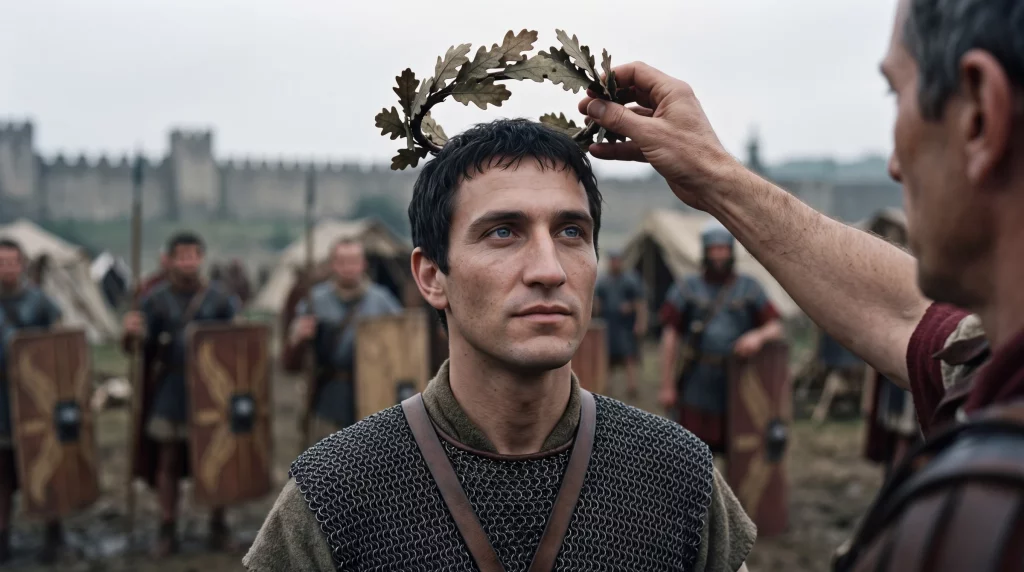
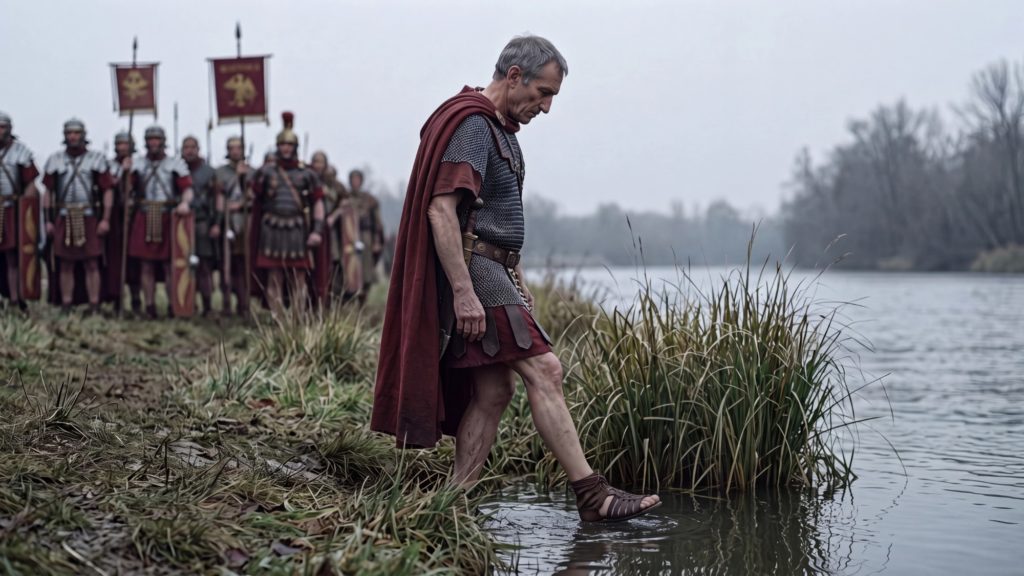
In 59 BC Caesar was elected consul, after making a pact with the generals Pompey and Crassus[2]. The following year he was appointed governor of Roman Gaul[2]. Suetonius says that over nine years he reduced all Gaul to a province, bridged the Rhine and invaded Britain[1]. The Gallic leader Vercingetorix surrendered to him after the siege of Alesia[4]. Meanwhile enemies in the senate wanted a successor named before his command ended[1]. In January 49 BC Caesar reached the Rubicon, the frontier of Italy[6]. According to Suetonius, he told his men that once they crossed that little bridge, nothing was left but to fight it out in arms[1]. They crossed, and civil war began.
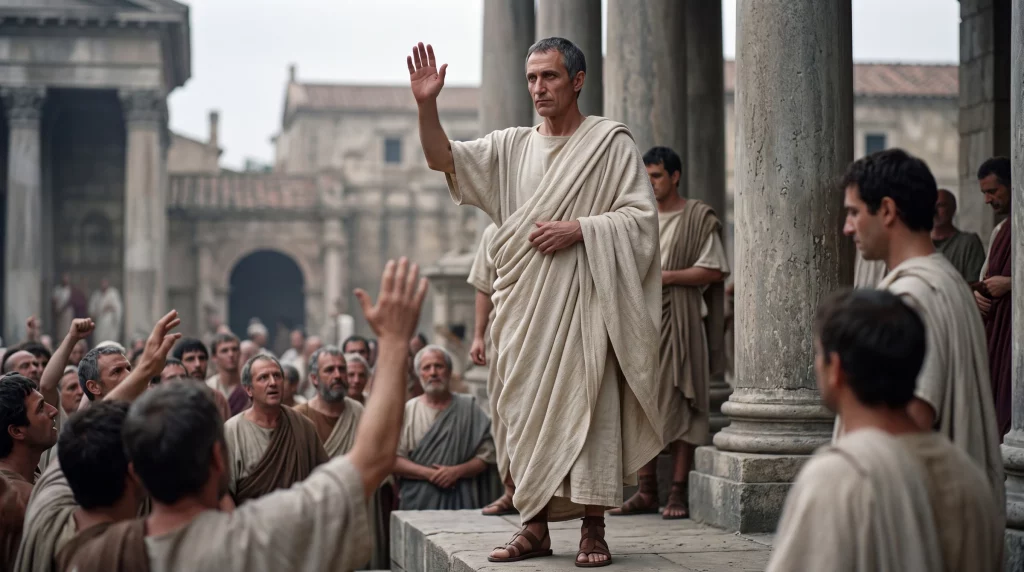
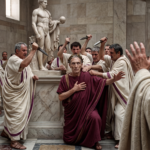
Caesar defeated his rival Pompey at the battle of Pharsalus[1]. Pompey fled to Egypt, where he was assassinated[2]. Caesar went on to win further wars, and Suetonius says he celebrated five triumphs, or victory parades[1]. In 44 BC he took the dictatorship for life[2]. On 15 March 44 BC a group led by Cassius and Brutus assassinated him[2]. He was stabbed twenty-three times in the senate-house built by Pompey[1]. His body was burned in the Forum[1]. His will named Gaius Octavius, a grandson of one of his sisters, as chief heir and adopted him[1].
Caesar's reforms outlived him. The Roman calendar had drifted so far that the harvest festivals no longer fell in summer[1]. Caesar set the year at 365 days, with an extra day every fourth year[1]. This Julian calendar stayed in general use until 1582[1]. After his death Caesar was declared a god by formal decree[1]. A temple to the deified Julius later rose on the spot where the people had burned his body[7]. The civil wars that followed his death ended the Republic. They brought his heir Octavian to power as Augustus, the first emperor[2].
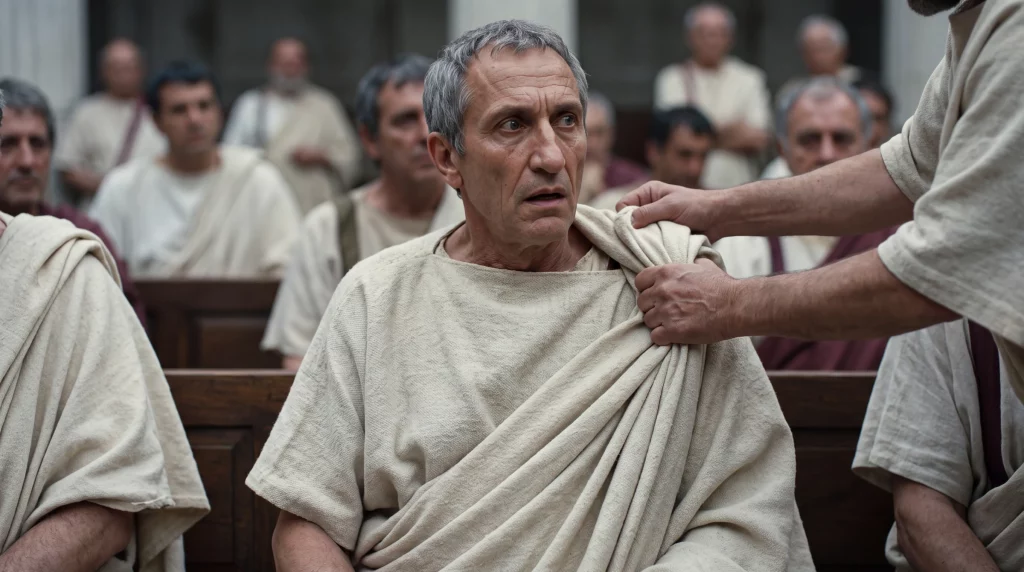
Caesar was touchy about going bald. Suetonius says his enemies often mocked him for it[1]. He used to bring his hair forward from the crown of his head[1]. Of all the honours given to him by the senate and people, none gave him more pleasure than the right to wear a laurel crown at all times[1].
Legacy & Reputation
What’s the verdict?
Writers have judged Caesar very differently. The German historian Theodor Mommsen called him the sole creative genius produced by Rome[4]. Mommsen also wrote that he was a monarch who never played the king[4]. The Roman biographer Suetonius took a harsher line. He wrote that Caesar’s later words and actions led many to think he had abused his power and was justly cut off[1]. The BBC says he paved the way for the imperial system[2].
Myth-buster
Think you know this one?
Quick Facts
The essentials

Quick Facts
Keith found the footnote…
On the morning of the murder, Caesar is said to have joked to the seer Spurinna, "Well, the Ides of March are come." Spurinna replied, "Yes, they are come, but they are not past"[8, p. 7]. Several ancient writers tell the story, so the warning has had an unusually long afterlife.
Keith has spotted the quotation problem…
Suetonius says Caesar uttered only a groan at the first wound, though some authors claim he exclaimed to Marcus Brutus, "Thou, my son!"[1]. In the editions of Suetonius those words are given in Greek, not as Shakespeare's Latin "Et tu, Brute"[1].
This sounds invented, but…
Caesar's Gallic triumph nearly ended in a pratfall. In the Velabrum, the axle-tree of his chariot broke, though he escaped a fall. He then climbed the Capitol by torchlight, with forty elephants carrying torches on his right and left[1].
Caesar has sent a very short message…
In his Pontic triumph, a tablet reading I CAME, I SAW, I CONQUERED was carried before Caesar. Suetonius says it announced not what was done so much as the dispatch with which it was done[1]. Three words, one very satisfied general.
Roger would like you to know…
Fixing the calendar meant one gigantic year. According to George Long, the error was corrected by lengthening 46 BC to 445 days, which made it fifteen months[9]. The reformed calendar then began on 1 January 45 BC. Roger hopes everyone's rent was paid in advance.
Roger has intercepted a secret message…
Suetonius says that when Caesar had anything confidential to tell his friends, he wrote it in cipher by changing the order of the alphabet. To read it, you substitute the fourth letter, D, for A[10]. Some of his letters to Oppius and Balbus, written in a kind of cipher, survived into Aulus Gellius's day[8, p. 7].
History gets strange here…
Popular retellings roll Cleopatra up in a carpet, but Plutarch's account says she stretched herself at full length inside a bed-sack, which her friend Apollodorus the Sicilian tied with a cord and carried indoors to Caesar[11]. Caesar's own account says nothing about Cleopatra[9].
Keith remains unconvinced…
During Caesar's stay at Alexandria, legend pretends that he swam to safety with one hand, holding his Commentaries above the water with the other. Froude thought this absurd: "As if a general would take his MSS. with him into a hot action!"[3]. Keith agrees. The manuscripts stay dry in the legend only.
Roger insists this matters…
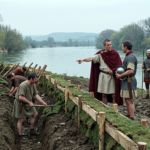
Caesar bridged the Rhine, a river over a quarter of a mile wide, in ten days from the time his men began cutting timber[12]. Plutarch adds that drifting tree trunks kept smashing at the supports, so Caesar planted great timber bulwarks across the stream to catch them[11].
One for the Ageonauts…
Suetonius says that at the first games Augustus held in honour of Julius, a comet appeared. It was taken as a sign that Caesar's soul had been received into heaven, and a star was set on the head of his image[13]. Even the sky, it seems, got a part in the propaganda.
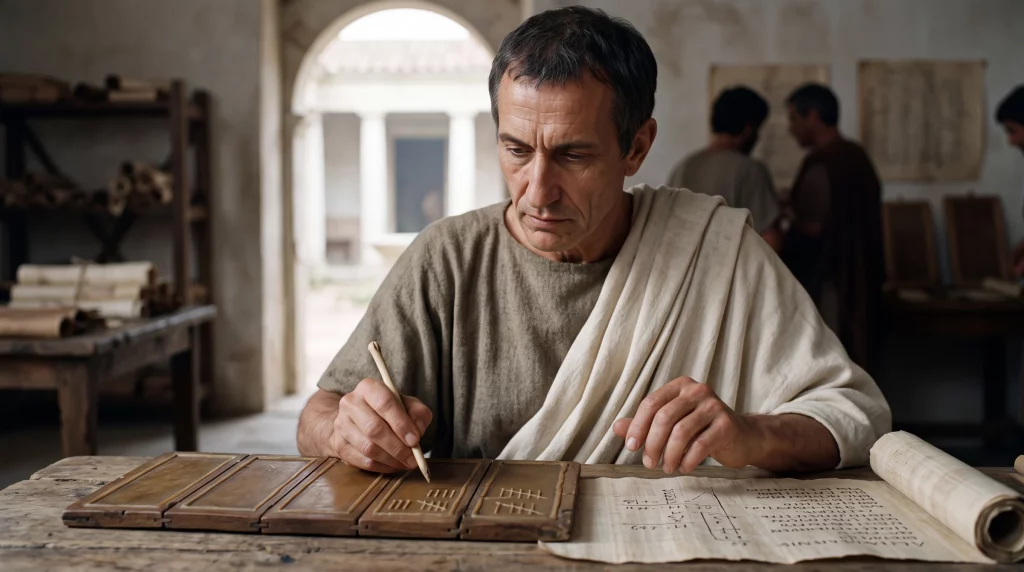
All Gaul is divided into three parts, one of which the Belgae inhabit, the Aquitani another, those who in their own language are called Celts, in ours Gauls, the third.
Julius Caesar
The opening sentence of Caesar's own Commentaries on the Gallic War (De Bello Gallico), in an English translation[14].
Timeline
How it unfolded
12 July 100 BC
Birth of Julius Caesar
James Anthony Froude gives the date of Caesar's birth as 12 July 100 BC. He was Caius Julius Caesar, the only son of Caius Julius and Aurelia and a nephew of the consul Marius.[3]
63 BC
Caesar Elected Pontifex Maximus
Caesar was elected Pontifex Maximus, Rome's chief priest, in 63 BC. The Dictionary of Greek and Roman Biography says he told his mother that morning that he would not return home except in that office.[5]
59 BC
Consulship and the First Triumvirate
Caesar made a pact with Pompey and Crassus, who helped him win the consulship for 59 BC.[2] Backed by them, the Dictionary of Greek and Roman Biography says, he carried all his measures.[8, p. 7]
58 BC - 51 BC
Conquest of Gaul
The year after his consulship Caesar became governor of Roman Gaul and stayed eight years.[2] Mommsen judged that the fall of Alesia decided the fate of the Celtic nation.[4]
January 49 BC
Caesar Crosses the Rubicon
Liddell's history says Caesar, stationed at Ravenna, learned of the Senate's decree of 6 January and at nightfall crossed the Rubicon, the stream dividing his province from Italy. Civil war followed.[15, p. 21]
48 BC
Victory at Pharsalus
Caesar was consul for the second time and defeated Pompey at Pharsalus in Thessaly.[16] Mommsen dates the battle to 9 August, while Dodge gives 29 June.[4][12]
August 48 BC - March 47 BC
Caesar in Alexandria with Cleopatra
Caesar followed Pompey to Egypt and became romantically involved with Queen Cleopatra.[17] Dodge dates his Alexandrian campaign from August 48 to March 47 BC.[12]
January - February 44 BC
Caesar Named Perpetual Dictator
Arthur Weigall writes that new honours came to Caesar in January and early February 44 BC. He was named perpetual Dictator, absolute ruler for life, and given the title Imperator.[18]
15 February 44 BC
Antony Offers the Crown at the Lupercalia
At the Lupercalia festival Antony, in Plutarch's account, ran to the rostra and put a laurel-wreathed diadem on Caesar's head.[11] Caesar refused the crown.[16]
15 March 44 BC
Assassination of Julius Caesar
Cassius, Brutus and other conspirators assassinated Caesar on the Ides of March.[2] The Murray handbook places the attack in Pompey's Curia and says he fell pierced with twenty-three wounds at the foot of Pompey's statue.[19, p. 1]
Dig Deeper
Copy any prompt below into your favourite AI chat to keep exploring.
Explain why crossing the Rubicon with an army in 49 BC counted as a declaration of civil war, and what Caesar's command in Gaul had protected him from.
Debate whether Caesar's choice to cross the Rubicon destroyed the Roman Republic or merely exposed a system that could not hold together an empire.
Roleplay Caesar's very good lawyer defending the 'we were on a break' excuse to the Senate just after his army has crossed the Rubicon.
Further Reading
Where to read more
Julius Caesar - Joshua J. Mark, World History Encyclopedia
A free, referenced encyclopedia article that follows Caesar from his youth and military service through the First Triumvirate, the conquest of Gaul, the civil war and his assassination.
Why look at this: Gives a clear timeline of the key dates in the story, from Alesia in 52 BC and the crossing of the Rubicon in 49 BC to Pharsalus in 48 BC and the Ides of March in 44 BC, so it works well as a first check before the longer sources.
https://www.worldhistory.org/Julius_Caesar/Caesar: Life of a Colossus - Adrian Goldsworthy, Yale University Press
A full-length biography first published by Yale University Press in 2006 (paperback 2008, 608 pages). The publisher's page presents it as covering Caesar as orator, general and dictator, as well as lesser-known episodes such as his capture by pirates.
Why look at this: Takes in the whole arc, from the young Caesar held captive by pirates to the man the publisher describes as a rebel condemned by his own country, so it is the place to go for the detail behind the Rubicon decision and the civil war.
https://yalebooks.yale.edu/book/9780300126891/caesar/Caesar, Commentaries on the Civil War (De Bello Civili), Book 1 - translated by William Duncan (1856), Perseus Digital Library, Tufts University
Caesar's own account of the opening of the civil war, in a nineteenth-century English translation hosted by the Perseus Digital Library. Chapter 7 is the passage in which he addresses his troops after the senate's decree.
Why look at this: Lets you read Caesar's version of the weeks before the war of 49 BC: the tribunes who fled the city to join him at Ravenna, and his speech to his troops about his enemies. It is useful for judging how he presented the crossing himself (the passages read do not name the Rubicon).
https://www.perseus.tufts.edu/hopper/text?doc=Perseus:text:1999.02.0076:book=1:chapter=7Related
Keep exploring
People
Can be seen in
Where this shows up

References
Sources
Sources
- BookThe Lives of the Twelve Caesars, Volume 01: Julius Caesar by Suetonius ↑
- WebsiteBBC - History - Julius Caesar (bbc.co.uk) ↑
- BookCaesar: A Sketch by James Anthony Froude ↑
- BookThe History of Rome (Volumes 1-5) by Theodor Mommsen ↑
- BookDictionary of Greek and Roman biography and mythology by William Smith ↑
- BookThe greatness and decline of Rome by Guglielmo Ferrero, Alfred Eckhard Zimmern and H. J. Chaytor ↑
- WebsiteDivus Iulius, Aedes (digitalaugustanrome.org) ↑
- BookDictionary of Greek and Roman biography and mythology by William Smith. Page 7. ↑
- BookThe decline of the Roman republic by George Long ↑
- WebsiteSuetonius • Life of Julius Caesar (penelope.uchicago.edu) ↑
- BookPlutarch, Lives ( LCL 11 Volumes In One; Perrin Trans) by Bernadotte Perrin ↑
- BookCaesar : a history of the art of war among the Romans down to the end of the… by Theodore Ayrault Dodge ↑
- BookCaesar's conquest of Gaul. An historical narrative (being part I of the larger work on the same subject) by T. Rice Holmes ↑
- Book"De Bello Gallico" and Other Commentaries by Julius Caesar ↑
- BookA history of Rome : from the earliest times to the establishment of the empire. With chapters on… by Henry George Liddell. Page 21. ↑
- BookInternet Archive: gallicwar00caes ↑
- WebsiteBBC - History - Julius Caesar (bbc.com) ↑
- BookTHE LIFE AND TIMES OF MARC ANTONY by ARTHUR WEIGALL ↑
- BookInternet Archive: handbookofromeca00john. Page 1. ↑