
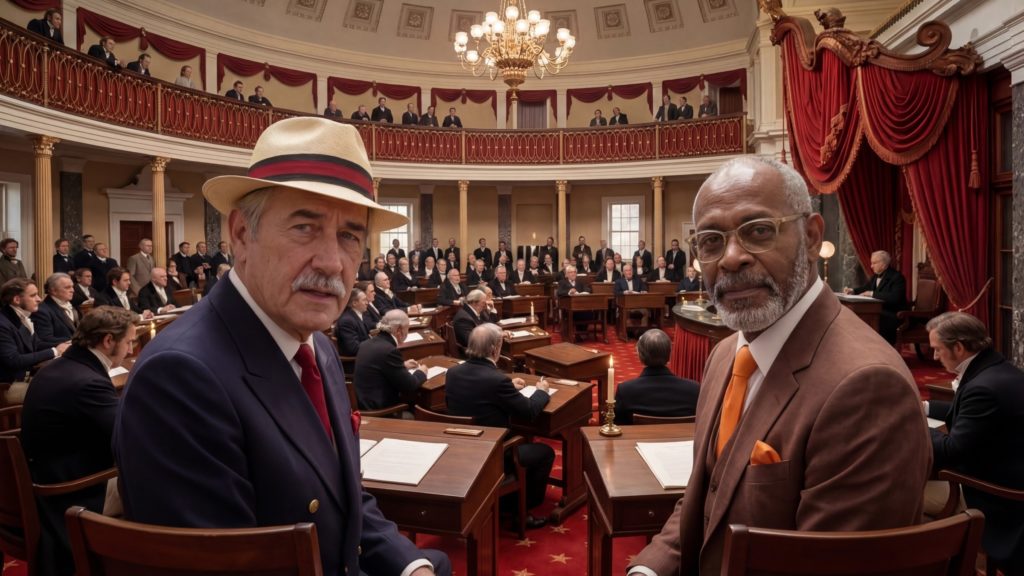
The Senate Chamber, United States Capitol
The Old Senate Chamber that shows up in most dramatic retellings of early American history isn't where the modern Senate meets — it moved next door in 1859.[1, p. 24]
About the Place
Why it matters
The Senate Chamber is the meeting room in the north wing of the United States Capitol where the U.S. Senate conducts its official business, in continuous use since January 1859.[2, p. 109]
The chamber was built as part of a major mid-19th-century expansion of the Capitol; it replaced an earlier, smaller chamber used from 1810 to 1859, now preserved separately as the Old Senate Chamber.[3, p. 2]
Architect Thomas U. Walter oversaw the expansion.[4, p. 10]
The chamber has hosted the Senate through major turning points in U.S. history, including the impeachment trial of Andrew Johnson — recorded as the most famous impeachment trial in the chamber's history — and remains the Senate's working chamber today.[5]
Legacy & Reputation
What’s the verdict?
The Senate Chamber’s reputation rests partly on events that did not happen inside it — the 1856 caning of Charles Sumner by Congressman Preston Brooks took place in the earlier Old Senate Chamber next door, which the Supreme Court later occupied.[3, p. 2][1, p. 24]
Myth-buster
Think you know this one?
Myth: the most notorious clashes of the antebellum Senate, like the 1856 caning of Charles Sumner, happened in the chamber senators use today. In fact, that caning — by Congressman Preston Brooks, on 22 May 1856 — took place in the Old Senate Chamber next door, before the current chamber opened in 1859.[3, p. 2]
Quick Facts
The essentials
Quick Facts
Keith would like to fix a date…
The Senate has met in its current chamber only since 1859. A great many of the confrontations people picture in ‘the Senate Chamber’ actually happened next door, in the room now preserved as the Old Senate Chamber.[1, p. 24]
The caning happened in the other room…
On 22 May 1856, Congressman Preston Brooks struck Senator Charles Sumner over the head with a walking cane on the floor of the Senate — in the chamber the Senate used before 1859, not the one it uses now.[3, p. 2]
Roger has found the furniture receipts…
The original senators' desks, each faced with a red ‘modesty’ curtain, date back to the chamber's own early furnishing, and some are still in use today.[3, p. 1]
Senators sign the drawers…
Since around 1900, senators have followed a tradition of inscribing their names inside their desk drawers — though not every senator has chosen to do it.[6]
One for the Ageonauts…
The Senate's ‘candy desk’ tradition began without ceremony in 1965, when Senator George Murphy of California started keeping hard candy in his desk drawer for passing colleagues.[7]
The snuff is still there…
Snuff-taking really was part of Senate custom: one account describes a senator taking ‘a pinch of snuff from Judge Washington's box’ on the floor.[5]
Keith checked the sources…
Work on the Capitol dome continued through the Civil War. When asked whether building should continue during the war, Lincoln is recorded as replying: ‘If the world sees this Capitol going on they will know that we intend the Union shall go on.’[8]
The court had no house of its own…
After the Senate moved to its current chamber in 1859, the Old Senate Chamber was later used by the Supreme Court, as period photographs in the library's own sources record.[1, p. 24]
Roger insists this matters…
A photograph in the Capitol's own architectural history captures the Senate Chamber's ambient skylight and ‘rich decorative character’ before its 1949 remodeling.[9, p. 18]
History has added a footnote…
The Vice President is constitutionally president of the Senate, and the library's own records describe a Vice President presiding over the chamber on notable occasions.[5]
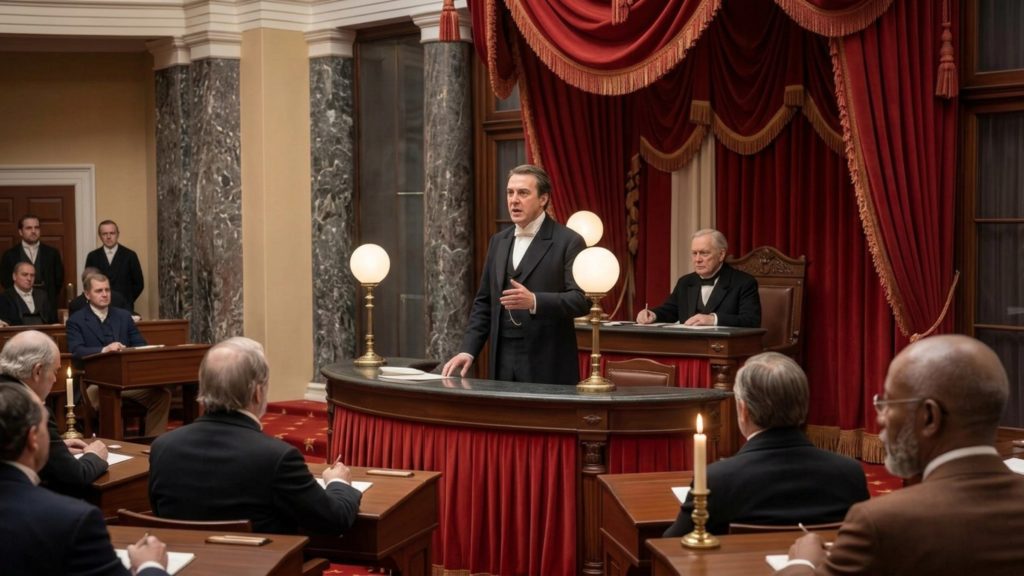
Are not the speeches of the Senator from Kentucky intended for disorganization? are they not intended to destroy our zeal? are they not intended to animate our enemies? Sir, are they not words of brilliant, polished treason, even in the very Capitol of the Republic?[5]
Senator Edward Dickinson Baker of Oregon
Delivered on the floor of this chamber on 1 August 1861, in full colonel's uniform with his sword laid across his desk, in reply to a speech by Senator John C. Breckinridge against the Insurrection and Sedition bill. It was Baker's last speech in Congress — within three months he was killed leading a charge at Ball's Bluff.[5]
Timeline
How it unfolded
November 1800
Senate meets in the first chamber of the north wing
When Congress moved to the new capital in November 1800 only the north wing of the Capitol was complete, and the Senate met in a two-story room on its ground floor, now the site of the Old Supreme Court Chamber.[3, p. 2]
February 1810
Senate moves into Latrobe's second-floor chamber
Architect Benjamin Henry Latrobe redesigned the space and created a new Senate chamber on the second floor, modelled on the amphitheaters of antiquity, which the Senate entered in February 1810.[3, p. 2]
24 August 1814
British burn the Capitol and destroy the chamber
On 24 August 1814 the British marched on Washington and set fire to the Capitol, gutting the interior and destroying the Senate chamber, so Congress met in temporary quarters across the street.[3, p. 2]
December 1819
Rebuilt chamber completed and new desks supplied
Latrobe enlarged his original design and, after his resignation, Charles Bulfinch completed the rebuilt chamber by December 1819.[3, p. 2] That year New York cabinetmaker Thomas Constantine supplied 48 desks for members at $34 each, and the original mahogany desks are now in the present Senate chamber.[3, p. 1]
22 May 1856
Brooks canes Charles Sumner at his desk
On 22 May 1856, Congressman Preston Brooks came to the chamber and repeatedly struck Senator Charles Sumner with a cane after Sumner's speech The Crime Against Kansas, a sign of the sectional tension of the era.[3, p. 2] A separate history describes Sumner as seated and unarmed at his desk.[10]
4 January 1859
Senate moves into its present chamber
The Senate moved into its new chamber in 1859, and Vice President John C. Breckinridge addressed it on 4 January 1859 on the removal from the old chamber to the new.[3, p. 2][11] The Supreme Court then occupied the old room from 1860 to 1935.[3, p. 2]
Dig Deeper
Copy any prompt below into your favourite AI chat to keep exploring.
Explain why the US Senate outgrew its original chamber and moved into a new one in 1859
What does the physical shape of a debating chamber semicircle versus facing benches teach us about how a country actually argues with itself
Convince me that a senator scribbling their name inside a 100-year-old desk drawer is basically Congress's oldest running inside joke
Further Reading
Where to read more
About the Senate Chamber — Historical Overview, U.S. Senate
Article. Free online, no login. Notes the current chamber, built 1851-1859, was saved from a full 1938 reconstruction only by the later addition of air conditioning.
Why look at this: Notes the current chamber, built 1851-1859, was saved from a full demolition-and-rebuild in 1938 only by the later addition of air conditioning — a mundane fix that preserved a historic room.
https://www.senate.gov/about/historic-buildings-spaces/chamber/overview.htmThe Capitol
C-SPAN's 107-minute high-definition documentary special (2006) touring the U.S. Capitol's history, art and architecture, including a dedicated segment on the Senate Chamber itself. Free to watch on c-span.org.
Why look at this: A dedicated segment tours the Senate Chamber itself alongside the rest of the building's history, art and architecture, narrated on-site rather than from an archive.
https://www.c-span.org/program/c-span-specials/the-capitol/165708History of the United States Capitol: A Chronicle of Design, Construction, and Politics — William C. Allen (U.S. Government Printing Office, 2001)
Official congressional history prepared under the Architect of the Capitol. Free PDF via govinfo.gov, no login. The authoritative, footnoted account of how the Senate wing and chamber were designed, built, burned in 1814, and rebuilt.
Why look at this: The Architect of the Capitol's own footnoted, authoritative account of exactly how the Senate wing and chamber were designed, funded and built during the 1850s expansion.
https://www.govinfo.gov/content/pkg/GPO-CDOC-106sdoc29/pdf/GPO-CDOC-106sdoc29-2.pdfRelated
Keep exploring



Can be seen in
Where this shows up
References
Sources
Sources
- WebsiteHistory of the United States Capitol - Chapter (The Old Capitol as Completed) (GPO/House Doc 108-240). Page 24. ↑
- BookCelebration of the one hundredth anniversary of the laying of the corner stone of the Capitol of the… by Duncan S Walker. Page 109. ↑
- WebsiteThe Old Senate Chamber 1810-1859 (US Senate Historical Office). Pages 1, 2. ↑
- BookDocumentary history of the construction and development of the United States Capitol building and grounds .. by United States. Congress. House. Commission on Construction of House Office Building. Page 10. ↑
- BookThe national Capitol : its architecture, art and history by George Cochrane Hazelton ↑
- Websitesenate.gov: Desk occupants ↑
- Websitesenate.gov: Candy desk ↑
- BookConstantino Brumidi, Michelangelo of the United States Capitol by Myrtle Cheney Murdock ↑
- WebsiteHistory of the United States Capitol - Chapter (Edward Clark supervises completion) (GPO/House Doc 108-240). Page 18. ↑
- BookAbraham Lincoln, Volume I by John T. Morse ↑
- BookAddress of Hon. John C. Breckinridge, vice president of the United States : preceding the removal of the… by John C. Breckinridge ↑