
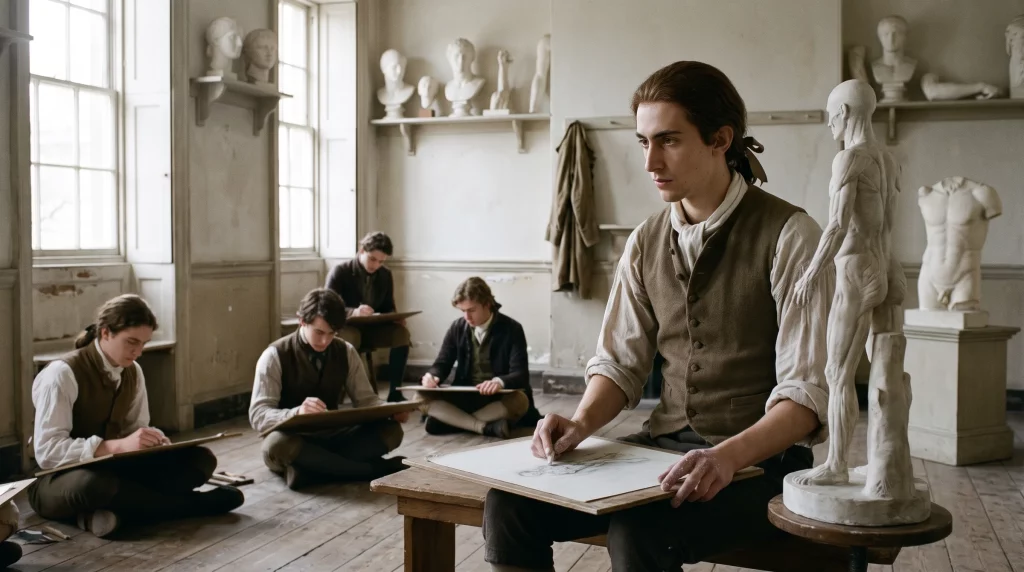
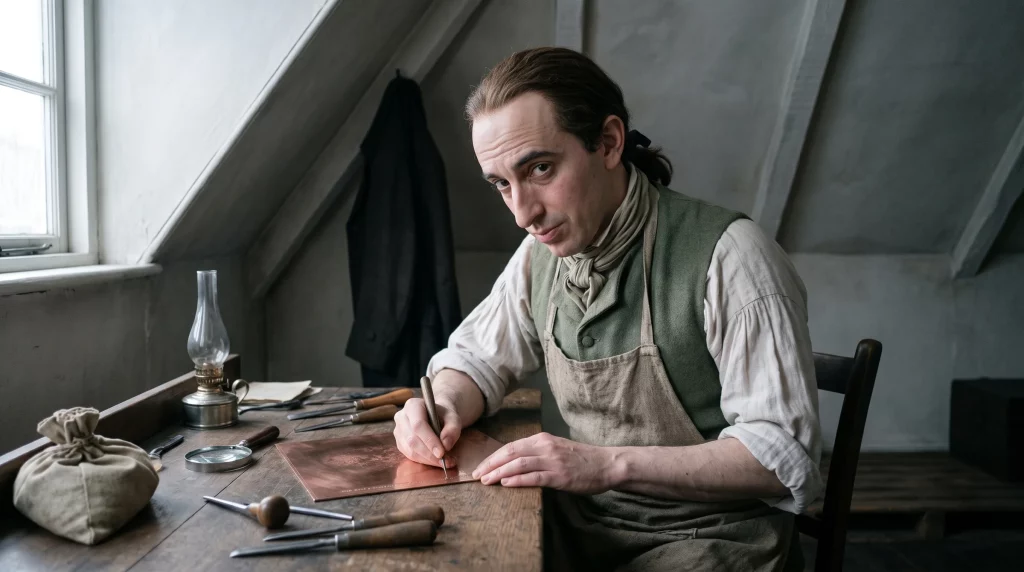
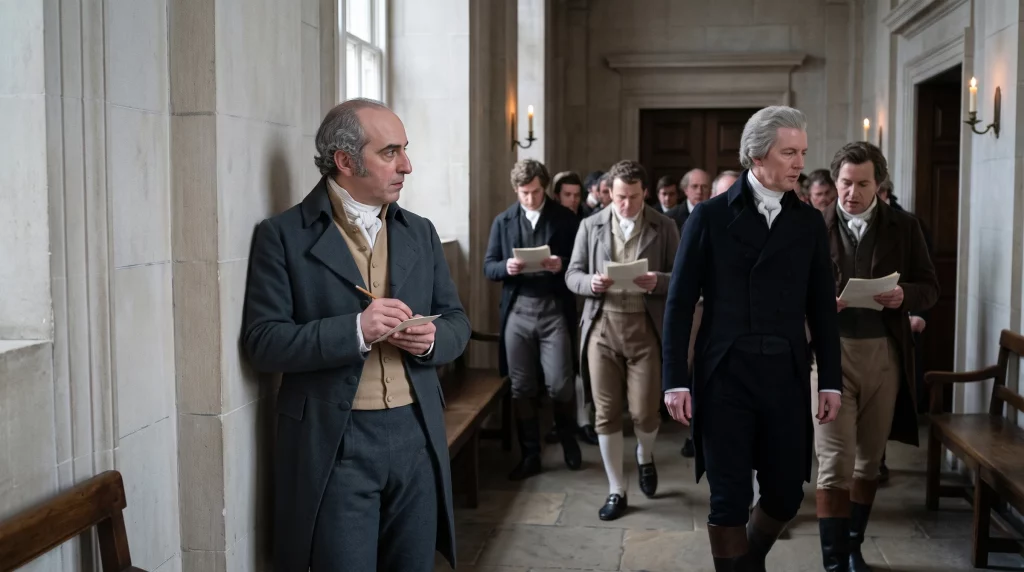
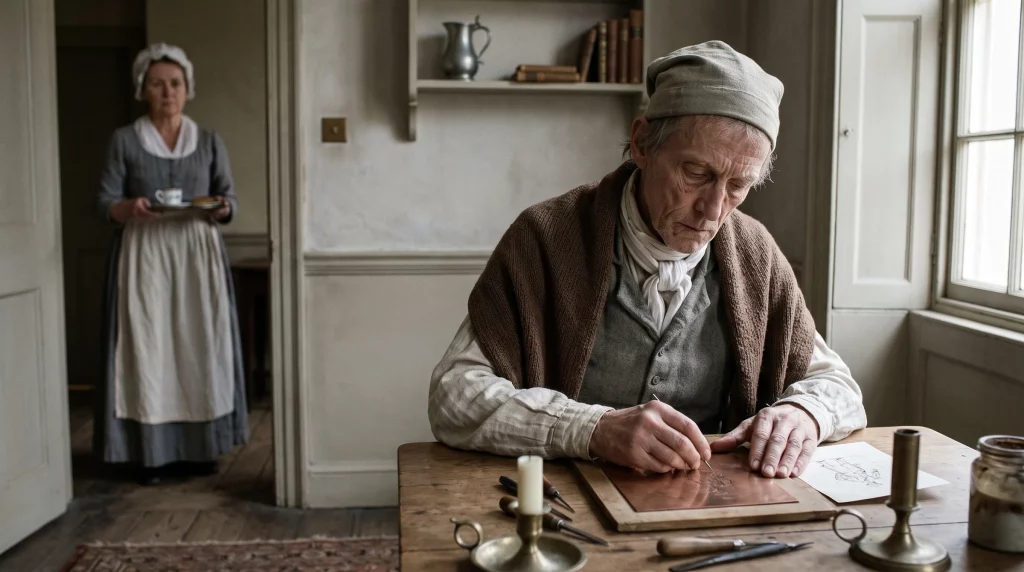
In January 1803 Gillray published German Nonchalence, or the Vexation of Little Boney, showing a raging Napoleon dwarfed by his bodyguards — shown here bent over a copper plate at his table, working the design with an etching needle.
English caricaturist and printmaker
A Chelsea sexton's son[1] whose etchings made fun of George III and Napoleon[2], and who is credited with creating 'Little Boney', the British cartoon version of the French emperor[3].
Bio
Who they were
James Gillray was born in Chelsea, then just outside London, on 13 August 1756[2]. Some Victorian biographers gave the year as 1757[1]. His father, also James, was a Scottish soldier from Lanark who lost an arm in battle at Fontenoy[4]. Back in England the father became a pensioner of Chelsea Hospital, the home for old soldiers, and for forty years served as sexton, or caretaker, of the Moravian burial ground in Chelsea[1]. The Moravians were a strict Protestant sect. From about the age of five, young James was sent to a Moravian boarding school in Bedford[5].
Gillray learned letter engraving, the craft of cutting lettering into plates for printing[2]. Around the age of fourteen he was apprenticed to an engraver named Harry Ashby[5]. By 1775 he appears to have been back in London, working with the Humphrey family of printers and publishers, who stayed his friends and employers for life[6]. In spring 1778 he enrolled at the new Royal Academy schools[7]. His early prints were mostly social rather than political: of 53 made between 1775 and 1781, only 18 were political[6]. In 1784 and 1785 he all but abandoned caricature for serious stipple engraving, shading with fine dots[7]. He returned to satire in 1786[8].
Gillray's best-known Napoleon prints date from 1803 to 1805. In January 1803 he published 'German Nonchalence, or the Vexation of Little Boney'[9][1]. It was loosely based on a diplomatic snub, and shows Napoleon, then First Consul of France, raging at an Austrian envoy and dwarfed by his bodyguards[9]. Broadley wrote in 1911 that this print is where the famous nickname first appears, which he called Gillray's own devising[3]. 'Maniac Ravings, or Little Boney in a Strong Fit' followed on 24 May 1803[1]. On 1 January 1805 came 'The Grand Coronation Procession of Napoleone the 1st'[10]. On 26 February followed 'The Plum-pudding in Danger', in which Napoleon and William Pitt, the British prime minister[11], carve up a pudding shaped like the globe[12].
Gillray's output collapsed in 1810, to just 17 prints, and from 1811 until his death only two works survive[13]. According to his biographer Draper Hill, he lapsed into serious mental illness, with only occasional clear periods[13]. His publisher, Hannah Humphrey, cared for him through the illness[1]. He died in St James's Street on 1 June 1815[3], aged 58[13]. He was buried in the churchyard of St James's, Piccadilly[4], and the burial register entry is dated 6 June[3].
Gillray's hand-coloured prints were sold as broadsheets and circulated widely in Britain and Europe[2]. After his death other publishers copied and reissued them, beginning with John Miller's reduced copies in 1818[11]. In 1827 Thomas McLean announced a series printed from the original plates[11]. Broadley noted in 1911 that the name 'Little Boney' stuck to Napoleon until his death[3], and that the British public still called him that in 1814[3]. A square in Chelsea was later renamed Gillray Square in the artist's memory[3].
Gillray lived above his publisher's shop. According to Broadley, Hannah Humphrey lodged, fed and clothed him, and limited his supply of spirits as far as she could[3]. For more than twenty years before his illness, the two dined together at the same family table every Christmas Day[1]. He also wrote comic verses, including a song about a Bond Street beef-shop, on the back of an unfinished sketch[3].
Legacy & Reputation
What’s the verdict?
The cartoonist Sir David Low called Gillray ‘the father of the political cartoon’[8]. Broadley judged in 1911 that his greatest triumph was possibly the invention of the lasting nickname ‘Little Boney’[3], though he added that Isaac Cruikshank and Thomas Rowlandson shared in the battle against Napoleon[3]. The French critic Champfleury, quoted by Broadley, found in Gillray’s war on Bonaparte superior political views to those of the ordinary caricaturist[3].
Myth-buster
Think you know this one?
Because British cartoons drew ‘Little Boney’ as a pocket-sized tyrant, many people think Napoleon was unusually short. Thiers gave his height as five feet two inches in French measure[14, p. 398], while Walter Scott gave five feet six inches English[15, p. 220], so the two figures use different inches.
Quick Facts
The essentials
Quick Facts
Keith would like to clarify the nickname…
Broadley wrote in 1911 that 'Little Boney' was a nickname of Gillray's own devising, first spotted in the print German Nonchalence[3]. Richardson's 1920 dictionary says he originally coined the phrase[16]. Both wrote a century later, so Keith files this under 'credited to'.
Roger would like you to know where this started…
Gillray's father lost an arm at Fontenoy, then spent forty years as sexton of the Moravian burial ground in Chelsea[1]. Roger would like it noted that the man who mocked emperors was the son of a one-armed veteran gravekeeper.
This sounds invented, but…
In German Nonchalence, the 1803 print where Gillray first drew 'little Boney', the joke is a diplomatic snub, not height. A calm Austrian envoy takes snuff while a raging Napoleon is dwarfed by his bodyguards[9], whose tall hussars have swords half drawn[1].
The globe has been served for dinner…
In The Plum-pudding in Danger, published on 26 February 1805, Pitt and Napoleon carve up a pudding shaped like the globe. Pitt slices off the ocean while Napoleon helps himself to Europe[12]. Wright's book reports it was described as one of Gillray's luckiest hits[1].
Keith found the footnote…
Gillray published The Grand Coronation Procession on 1 January 1805[10]. Ashton quotes its title as dating the ceremony to 2 December 1804, but Wright and Evans's 1851 catalogue prints 19 November[4, p. 42]. Keith sides with 2 December, the date given on james-gillray.org[11].
Meanwhile, in St James's Street…
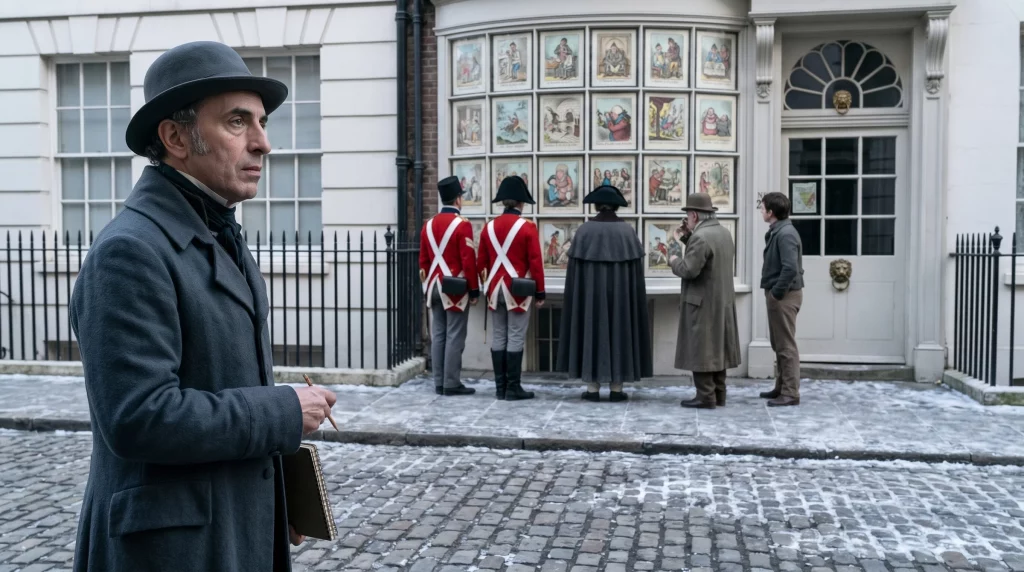
Gillray's print Very Slippy Weather, published on 10 February 1808, shows the bow window of Hannah Humphrey's shop at 27 St James's Street with a caricature in every pane. Broadley spotted the 'Little Boney' Gulliver plate in the very centre[3].
Roger has a theory about the paymaster…
According to the chronology on james-gillray.org, Gillray received a stipend from Pitt's government, arranged through Canning and Sneyd, from November 1797[11]. Roger says that explains everything. The same chronology marks the payments as likely suspended by 1801[11].
File under: surprisingly true…
A Victorian writer quoted by Wright said Gillray's King of Brobdingnag and Gulliver print had a 'wondrous effect' on the opinions of ordinary English people. The writer said John Bull laughed at the pigmy effigy strutting in the hand of good King George[1].
Keith went looking for the grave…
Gillray was buried at St James's, Piccadilly, in June 1815. By 1911 Broadley reported that the flat gravestone had vanished, leaving only the burial register entry[3]. A recreated, rededicated stone now stands in the yard before the church[13].
Roger insists the career change mattered…
In the 1770s and 80s, caricaturist ranked at the bottom of the art world, below history, portrait, landscape and animal painters. Gillray enrolled at the Royal Academy schools in 1778 and tried serious engraving in 1784 and 1785, but it never really took hold[7]. Roger calls that the best failed career change in history.
Fool that I was to cobble thus my shoe!
James Gillray
Words Gillray is said to have written under his last serious engraving, when he gave up that trade for caricature, as reported in a letter quoted by Thomas Wright[1].
Timeline
How it unfolded
13 August 1756
Birth of James Gillray
Gillray was born in Chelsea, according to the james-gillray.org chronology[11], though Wright and Evans's 1851 account gives 1757[4]. His father was sexton of the Moravian burial ground there for forty years[1].
c. 1770
Apprenticed to an engraver
At around fourteen Gillray was apprenticed to an engraver named Harry Ashby[5]. By 1775 he was back in London, linked to the Humphreys, printer-publishers who stayed his friends and employers for life[6].
Spring 1778
Enrols at the Royal Academy schools
Gillray enrolled in the recently founded Royal Academy schools[7]. His early prints were mostly social rather than political: only 18 of 53 made from 1775 to 1781 were political[6].
1786
Return to political caricature
After virtually abandoning caricature in 1784 and 1785[7], Gillray returned as a professional satirist in 1786, the start of the run of works that led Sir David Low to call him the father of the political cartoon[8].
January 1803
German Nonchalence, or the Vexation of Little Boney
Gillray's print, dated January 1803[1], shows a raging Napoleon dwarfed by his bodyguards[9]. Broadley saw here the first trace of the nickname, which he called Gillray's own devising[3].
24 May 1803
Maniac Ravings, or Little Boney in a Strong Fit
Wright dates Gillray's 'Maniac Ravings, or Little Boney in a Strong Fit' to 24 May 1803[1].
1 January 1805
Grand Coronation Procession of Napoleone the 1st
Gillray published the burlesque print on 1 January 1805[10]. Ashton quotes its title as dating the ceremony 2 December 1804, as does the james-gillray.org chronology[11], but Wright and Evans print 19 November[4, p. 42].
26 February 1805
The Plum-pudding in Danger
Gillray's print shows Napoleon and Pitt contending over a globe shaped like a plum pudding, with Pitt cutting off the ocean while Napoleon helps himself to Europe[12]. It has been described as one of his luckiest hits[1].
1810
Final decline
Gillray's output fell to 17 prints in 1810, his lowest since 1786, and only two works survive from 1811 to his death. According to Draper Hill, he lapsed into insanity around the summer of 1810, with only occasional lucid intervals[13].
Dig Deeper
Copy any prompt below into your favourite AI chat to keep exploring.
Explain how James Gillray's cartoons of 'Little Boney' turned Napoleon into a figure of ridicule for British audiences, and why that counted as political propaganda.
Debate whether mocking a leader as 'Little Boney' is harmless satire or wartime propaganda, and what Gillray's cartoons suggest about how cartoons shape public opinion.
Roleplay Napoleon furiously demanding to know who the man with the pencil in London is, and why everyone suddenly keeps calling him Little Boney.
Further Reading
Where to read more
James Gillray - Encyclopaedia Britannica
A short, free encyclopaedia biography of the English caricaturist, covering his training, his publisher Hannah Humphrey, his political and social prints, and his decline after 1807.
Why look at this: Gives the bare outline in minutes, including 'The Plum Pudding in Danger', the celebrated 1805 cartoon of Pitt and Napoleon carving up the globe, and his admission to the Royal Academy as a student in 1778.
https://www.britannica.com/biography/James-GillrayGerman Nonchalence, or the Vexation of Little Boney - James Gillray: Caricaturist (Jim Sherry)
A detailed web commentary on the January 1803 print that is usually linked with the start of 'Little Boney', setting out the incident behind it, the publishing history and the printed sources it draws on.
Why look at this: Explains the joke: Gillray drew Napoleon dwarfed by his bodyguards and furious at an Austrian envoy's snub, so the nickname begins as a jibe at his temper and pride, not simply his height.
https://james-gillray.org/pop/nonchalence.htmlNapoleon in Caricature 1795-1821 - Alexander Meyrick Broadley, John Lane, 1911 (Internet Archive)
A free digitised scan of Broadley's two-volume 1911 study of British and French Napoleonic caricature, with the original plates, publishers' details and long chapters on Gillray and his rivals.
Why look at this: Lets you read the early twentieth-century case for Gillray as the creator of 'Little Boney', including Broadley's account of Hannah Humphrey's St James's Street shop window of 1808 and the lost gravestone of 1815.
https://archive.org/details/bub_gb_CwNoAAAAMAAJRelated
Keep exploring







Can be seen in
Where this shows up

References
Sources
Sources
- BookThe works of James Gillray, the caricaturist :with the history of his life and times /edited by Thomas… by Thomas Wright, Thomas Wright and Joseph Grego ↑
- Websitebritannica.com: James Gillray ↑
- BookNapoleon in caricature 1795-1821 by Alexander Meyrick Broadley and John Holland Rose ↑
- BookHistorical and descriptive account of the caricatures of James Gillray. Comprising a political and humorous history of the… by Thomas Wright, R. H. Evans and James Gillray. Page 42. ↑
- WebsiteJames Gillray: Caricaturist: A Start in Caricature (james-gillray.org) ↑
- WebsiteJames Gillray: Caricaturist: A Start in Caricature (james-gillray.org) ↑
- WebsiteJames Gillray: Caricaturist: At the Crossroads (james-gillray.org) ↑
- WebsiteJames Gillray: Caricaturist: The Political Caricaturist (james-gillray.org) ↑
- WebsiteJames Gillray: German Nonchalence, or the Vexation of Little Boney (james-gillray.org) ↑
- BookEnglish caricature and satire on Napoleon I by John Ashton ↑
- WebsiteJames Gillray: Caricaturist: Chronology (james-gillray.org) ↑
- BookCaricature history of the Georges; or, Annals of the House of Hanover by Thomas Wright ↑
- WebsiteJames Gillray: Caricaturist: Final Years (james-gillray.org) ↑
- BookHistory of the Consulate and the Empire of France under Napoleon by Adolphe Thiers. Page 398. ↑
- BookLife of Napoleon Bonaparte, Volume V. by Walter Scott. Page 220. ↑
- BookA dictionary of Napoleon and his times by Hubert N.B Richardson ↑