
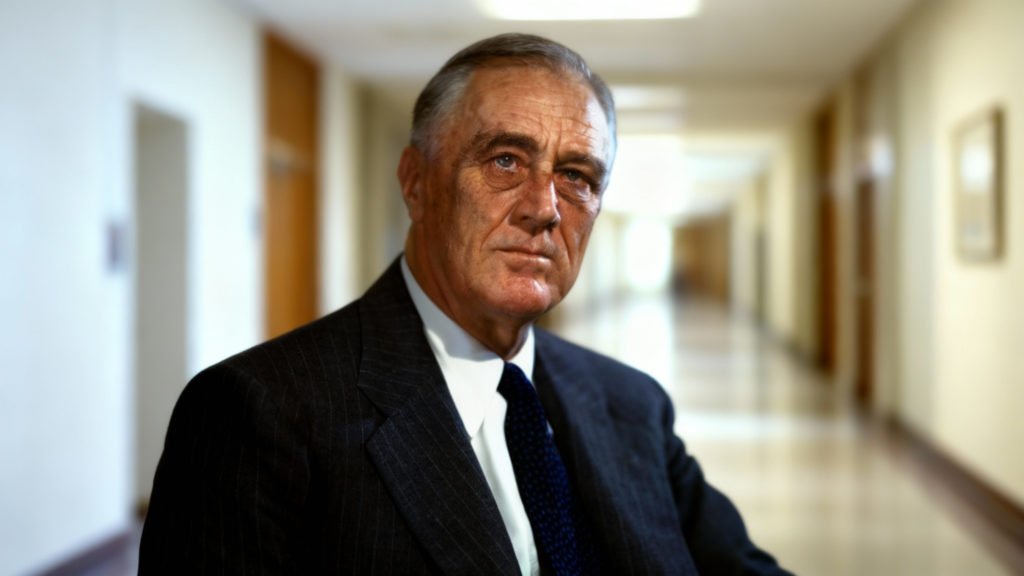
Franklin D. Roosevelt
32nd President of the United States (1933-1945)
A president paralysed from the waist down who turned his own voice into the government's most powerful tool, calming a nation through economic collapse and a world war[1, p. 1].
Bio
Who they were
Franklin Delano Roosevelt was born on 30 January 1882 at Springwood, his family's Hudson River estate in Hyde Park, New York[1, p. 2]. His father, James Roosevelt, was a well-off landowner with interests in coal and trade, and the family lived comfortably at Springwood[1, p. 2]. After finishing at Groton School in 1900, Franklin entered Harvard University[1, p. 3]. He belonged to the same extended family as former president Theodore Roosevelt, the 26th president, while Franklin himself would later become the 32nd[2].
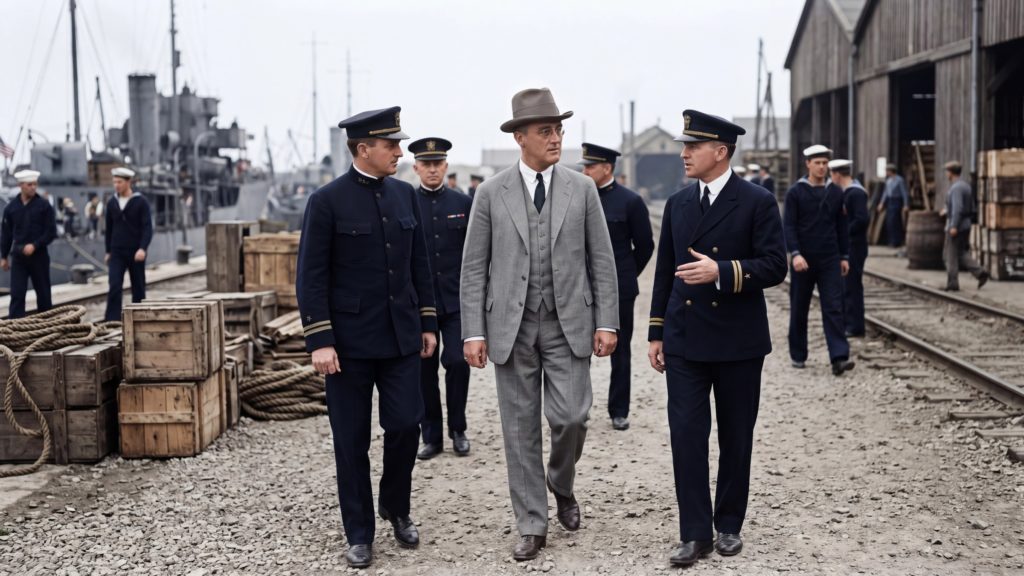
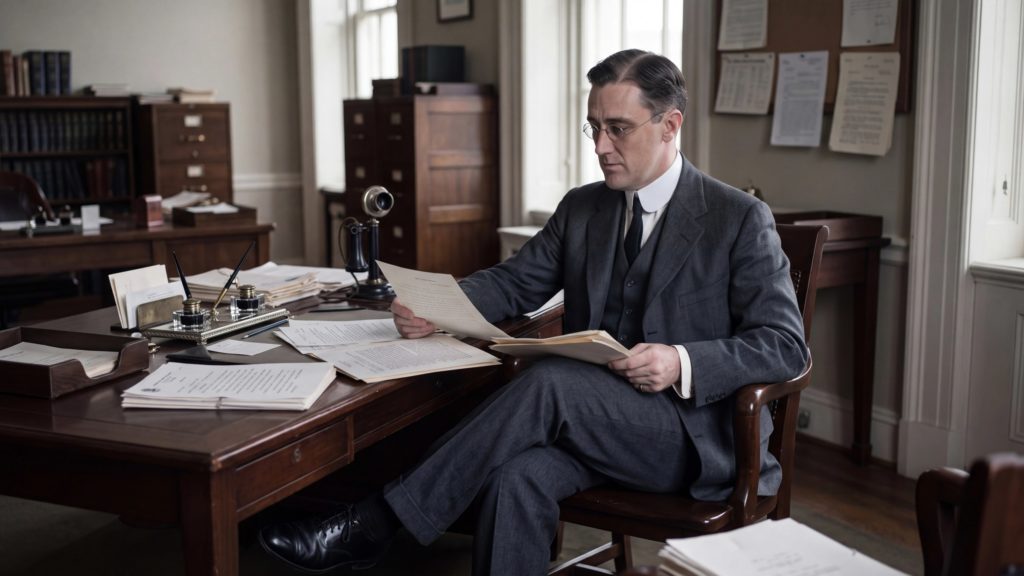
On 17 March 1905, Roosevelt married Eleanor Roosevelt, his own fifth cousin[2][1, p. 3]. In 1910, aged 28, he was elected to the New York State Senate, beginning his political career[1, p. 3]. He went on to serve as Assistant Secretary of the Navy[2]. In 1921, while vacationing at Campobello Island, he was diagnosed with polio and lost the use of his legs[1, p. 2]. He taught himself to walk short distances using heavy leg braces[1, p. 2]. He rebuilt his political career despite this, and was urged to run for Governor of New York by the outgoing governor, Al Smith[1, p. 4].
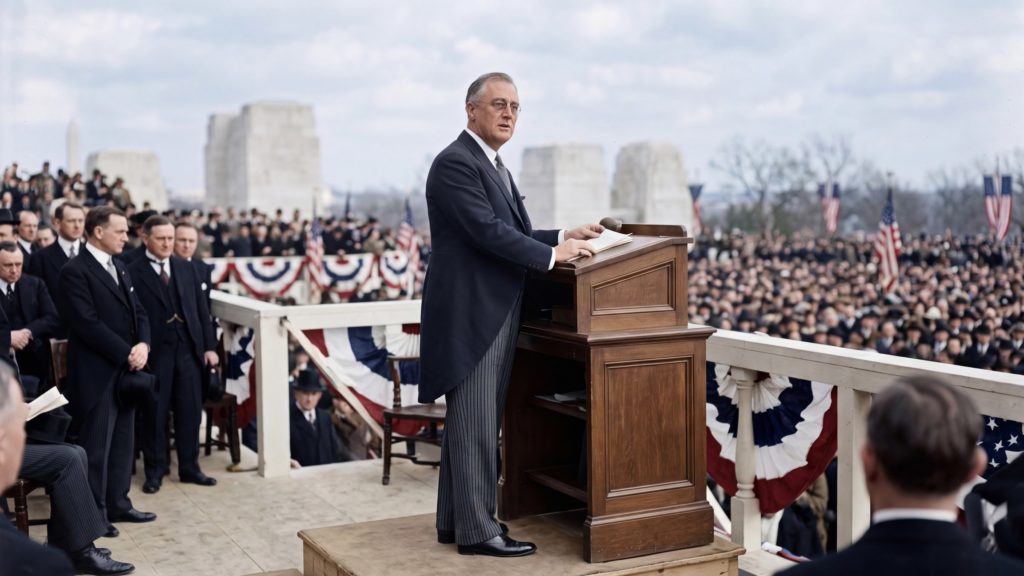
As president from 1933, Roosevelt faced the worst economic crisis in American history, the Great Depression[1, p. 1]. He launched a sweeping programme of relief and reform known as the New Deal[1, p. 1]. To explain his policies directly to ordinary Americans, he began broadcasting radio addresses that became known as his "fireside chats"[3, p. 1]. In his first inaugural address in 1933 he told the country, "the only thing we have to fear is fear itself"[4]. After Japan attacked Pearl Harbor in December 1941, Roosevelt led the United States into the Second World War[5, p. 7]. He was elected president an unprecedented four times[1, p. 1].
Roosevelt won a fourth term in 1944, choosing Missouri senator Harry S. Truman as his running mate[1, p. 5]. On 12 April 1945, at his cottage in Warm Springs, Georgia, he suffered a massive cerebral haemorrhage and died[1, p. 6][5, p. 26]. Within hours, Vice President Truman was sworn in as his successor[1, p. 6]. Roosevelt did not live to see the war end.
Roosevelt's New Deal permanently expanded the federal government's role in American life, including new programmes such as Social Security[6]. His fireside chats set a lasting precedent for presidents speaking directly to the public over the media of the day[3, p. 1]. As wartime commander-in-chief, he helped direct the Allied war effort against Germany, Italy and Japan[5, p. 10]. His unprecedented four terms in office marked the high point of the modern, activist presidency[1, p. 1].
Away from politics, Roosevelt was a lifelong stamp collector; one biographer of the Roosevelt family wrote that "to him the postage stamp is mightier than the brass band"[2]. It was a quiet, solitary hobby for a man who spent his public life surrounded by crowds and advisers, and who lived for over two decades with the physical limits of paralysis[1, p. 2].
Legacy & Reputation
What’s the verdict?
Roosevelt is regarded as one of the most consequential American presidents, credited with reshaping the federal government’s role in economic life through the New Deal and leading the United States through the Second World War[1, p. 1]. His unprecedented four elections to the presidency remain unmatched in American history[1, p. 1]. That same unprecedented length of tenure has kept debate alive ever since about how much power any one president should hold.
Myth-buster
Think you know this one?
It’s sometimes assumed Roosevelt could not walk at all after contracting polio in 1921. In fact, using heavy steel leg braces, he taught himself to walk short distances, even though he relied on a wheelchair for most of his daily life[1, p. 2].
Quick Facts
The essentials
Quick Facts
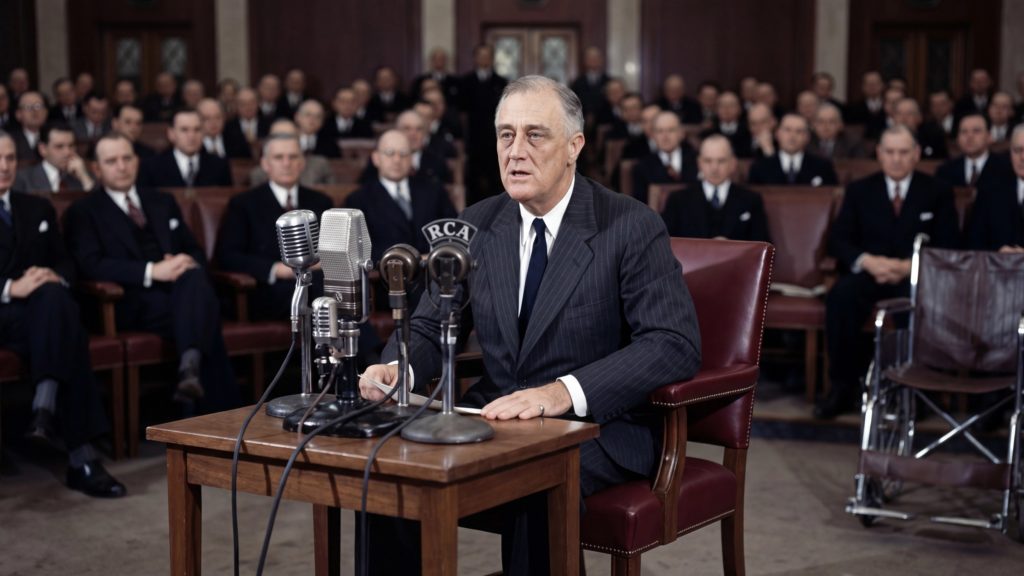
Roger has found Roosevelt's secret indulgence…
Away from the Depression and the war, Roosevelt was a devoted stamp collector. One biographer of the Roosevelt family wrote that "to him the postage stamp is mightier than the brass band"[2] — proof that even presidents need a quiet hobby.
Keith has checked the target list…
In Miami in 1933, a gunman named Giuseppe Zangara fired at president-elect Roosevelt and missed him entirely[8, p. 249]. He instead mortally wounded Chicago's mayor, Anton Cermak, who was standing nearby and later died of his wounds[2].
A record nobody has matched since…
Roosevelt was elected president four separate times[1, p. 1]. No other American president has served more than two terms, before or since — an unprecedented run through depression and world war.
Roger has spotted the Big Three…
In 1943, Roosevelt sat down with Winston Churchill and Joseph Stalin at Teheran, Iran — the wartime leaders known as the 'Big Three' gathering together in one place[5, p. 17].
Keith checked the sources…
After the Supreme Court struck down several of his early New Deal laws, Roosevelt proposed adding extra, friendlier justices to the bench — a scheme remembered ever since as 'court packing'[1, p. 2]. It became one of the most controversial ideas of his presidency.
One for the Ageonauts…
Roosevelt spoke to Americans directly over the radio in broadcasts that became known as his 'fireside chats,' explaining his policies in plain language during the Depression[3, p. 1]. It was an entirely new way for a president to reach the public.
Roger has tuned in to D-Day…
On the night of the D-Day landings, 6 June 1944, Roosevelt did not deliver a speech — he led the nation in a radio prayer, asking for the safety of the troops storming the beaches of Normandy[5, p. 18].
Keith has found the quotation's context…
Roosevelt's 'Four Freedoms' — of speech and expression, to worship as one chooses, from want, and from fear — come from a single address to Congress on 6 January 1941, nearly a year before the United States entered the Second World War[5, p. 5].
The family tree has a twist…
When Franklin Roosevelt married in 1905, he did not have to look far for a bride: Eleanor Roosevelt was his own fifth cousin, and she kept the Roosevelt surname without changing it[1, p. 3][2].
A small fact with a very large consequence…
In one of his fireside chats, Roosevelt argued that America should go "further along lines of social security" than it had before[6]. The New Deal program born from that argument, Social Security, still pays pensions to Americans today.
The only thing we have to fear is fear itself.[4]
Franklin D. Roosevelt
From his first inaugural address, delivered 4 March 1933 as the country reeled from the Great Depression[4].
Timeline
How it unfolded
30 January 1882
Birth of Franklin D. Roosevelt
Franklin Delano Roosevelt was born in Hyde Park, New York, the only child of James Roosevelt and Sara Ann Delano Roosevelt, into a wealthy family.[1, p. 2]
1921
Roosevelt Stricken with Polio
At the age of 39, Roosevelt was diagnosed with polio while vacationing at Campobello Island, New Brunswick, and he never regained the use of his legs.[1, p. 2]
November 1932
Roosevelt Defeats Hoover
Roosevelt defeated the Republican incumbent Herbert Hoover in the presidential election, winning office in the depths of the Great Depression.[1, p. 4]
4 March 1933
Roosevelt's First Inauguration
Roosevelt delivered his first inaugural address on this date and, within his first 100 days in office, called for a "New Deal" for Americans, proposing sweeping economic reforms to address the Great Depression.[9][1, p. 1]
8 December 1941
War Message After Pearl Harbor
The day after Japan's surprise attack on Pearl Harbor, Roosevelt addressed Congress, calling 7 December 1941 "a date which will live in infamy".[5, p. 7]
February 1945
Yalta Conference
Roosevelt met British Prime Minister Winston Churchill and Soviet leader Joseph Stalin at Yalta to discuss post-war reorganization, then returned to the United States and Warm Springs, Georgia.[1, p. 6]
Dig Deeper
Copy any prompt below into your favourite AI chat to keep exploring.
Explain how Franklin D Roosevelt's New Deal programs tried to pull America out of the Great Depression
Debate whether Franklin D Roosevelt's four terms as president reveal a danger in relying on one leader too long or proof that some crises need continuity
Convince me Franklin D Roosevelt hiding his paralysis from most of the public for over a decade is one of the best-kept secrets in presidential history
Further Reading
Where to read more
Franklin D. Roosevelt Biography Overview — Biography.com
A concise, free biography covering Roosevelt's life from Hyde Park and Groton through the New Deal, the Second World War and his death in office in 1945.
Why look at this: A fast way to see how the polio-stricken governor of New York became the only president elected four times, and why his 1933 line about fearing fear itself still gets quoted today.
https://www.biography.com/political-figures/franklin-d-rooseveltFranklin D. Roosevelt — Miller Center, University of Virginia
A full set of scholarly reference essays on Roosevelt's presidency — life before office, campaigns and elections, domestic affairs, foreign affairs, family life and legacy — written by presidential historian William E. Leuchtenburg.
Why look at this: Goes well beyond the headline New Deal story into the mechanics of his four election campaigns and the wartime diplomacy with Churchill and Stalin, with speech audio and transcripts included.
https://millercenter.org/president/fdrooseveltFRANKLIN Digital Archive — FDR Presidential Library & Museum
The Roosevelt Library's own digital repository: free, open access to over 800,000 pages of archival documents and 2,500 historical photographs from Franklin and Eleanor Roosevelt's papers.
Why look at this: Lets a reader search and open the actual White House-era folders themselves — memos, letters and photographs from the New Deal and the war years, not someone else's summary of them.
https://www.fdrlibrary.org/digital-collectionsRelated
Keep exploring


Places
Can be seen in
Where this shows up

References
Sources
Sources
- WebsiteFranklin D. Roosevelt Biography - overview (US Semiquincentennial / Biography.com hosted copy). Pages 1, 2, 3, 4, 5, 6. ↑
- BookAn imperial saga; the Roosevelt family in America by Bellamy Partridge ↑
- WebsitePresident Franklin Roosevelt's Fireside Chats - Radio Inquiry Unit (IEEE REACH). Page 1. ↑
- BookInaugural Address of Franklin Delano Roosevelt: Given in Washington, D.C. March 4th, 1933 by Franklin D. Roosevelt ↑
- WebsiteFDR Commander in Chief: From Fear to Freedom - guide (FDR Presidential Library & Museum). Pages 5, 7, 10, 17, 18, 26, 27. ↑
- BookThe Fireside Chats of Franklin Delano Roosevelt: Radio Addresses to the American People Broadcast Between 1933 and 1944 by Franklin D. Roosevelt ↑
- Websitenps.gov: Burial site of franklin and eleanor roosevelt ↑
- BookReport of the President's Commission on the Assassination of President John F. Kennedy by United States. Warren Commission. Page 249. ↑
- BookUnited States Presidents' Inaugural Speeches: From Washington to George W. Bush by United States. Presidents ↑