
About This Map
What it shows
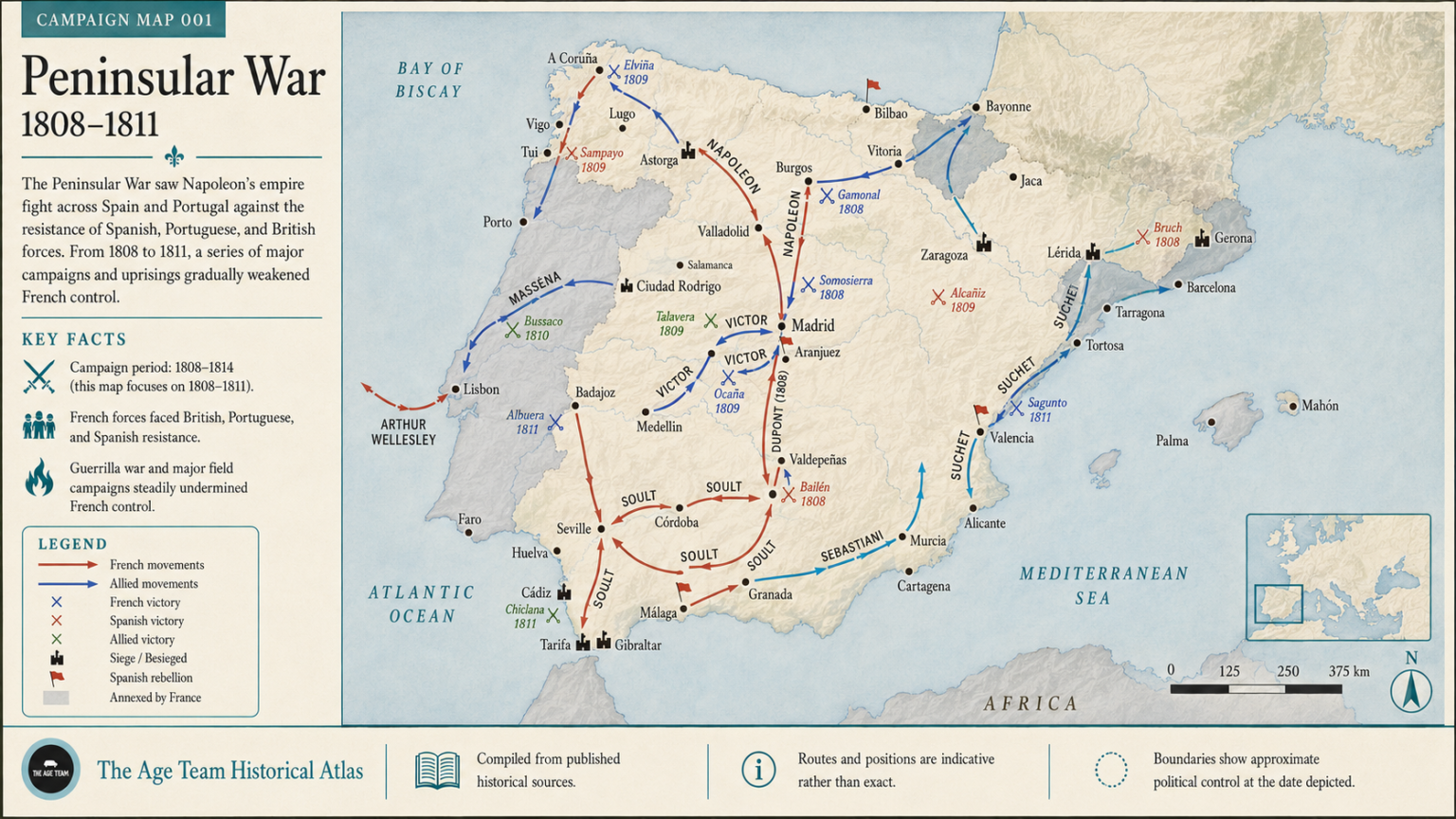
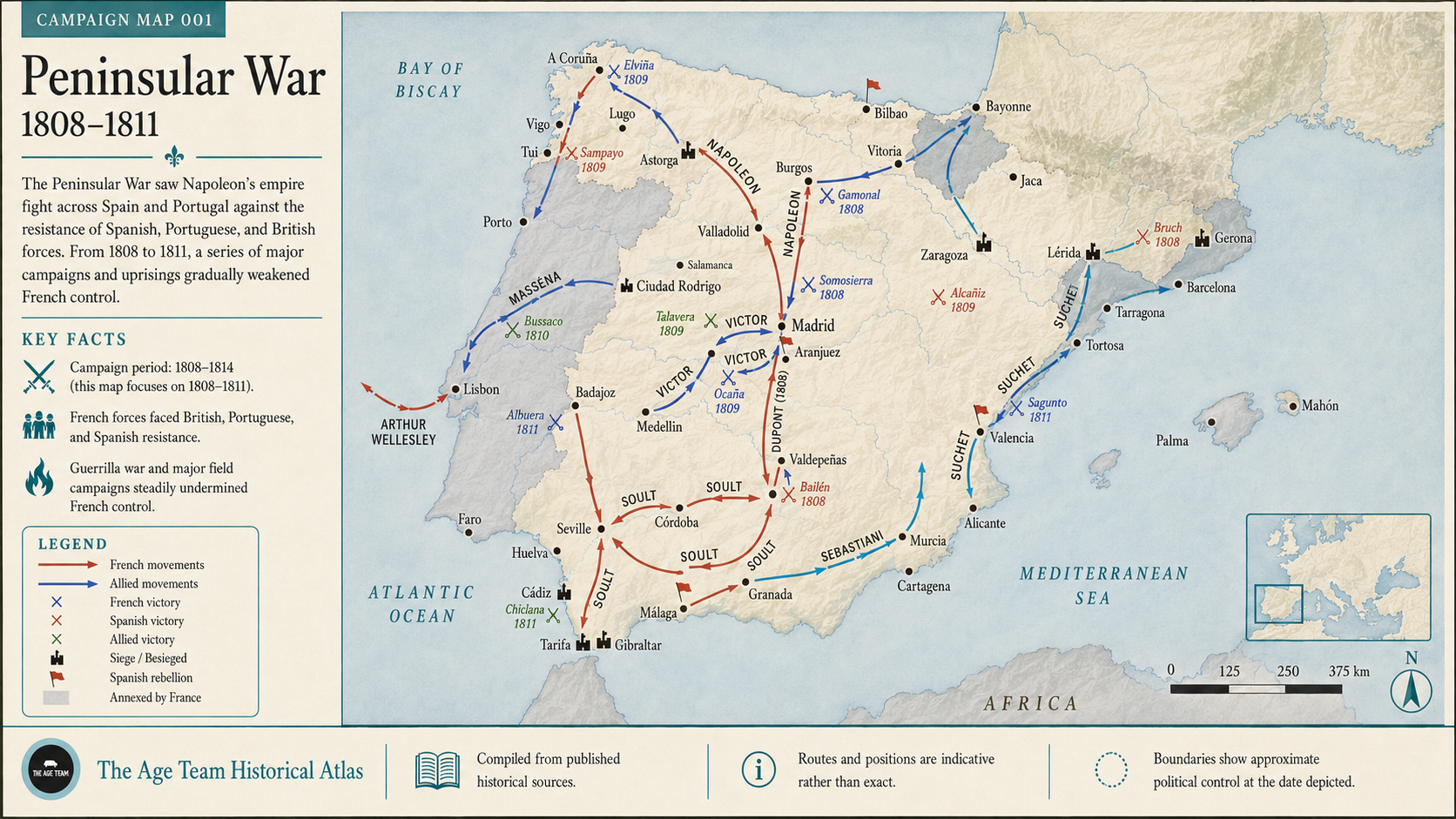
This map traces the Iberian campaign of 1808–1814, the six-year war Napoleon began by installing his brother Joseph on the Spanish throne and never managed to finish. Stretching from Wellington's fortified refuge north of Lisbon to the fortress towns of Ciudad Rodrigo and Badajoz, and out across the guerrilla-contested provinces of Navarre and Old Castile, it shows a conflict fought less as a single front than as dozens of overlapping wars — sieges, pitched battles, and a relentless irregular resistance that tied down French troops far from any battlefield. Popular tradition holds that Napoleon himself later dubbed it his "Spanish ulcer," the wound that bled his empire dry long before Waterloo; his own recorded words on Saint Helena were less pithy but no less damning. This map is the spine for an episode about guerrilla warfare, the brutal calculus of siege warfare, and Wellington's patient, scorched-earth campaigning against an enemy that never fully controlled the ground it occupied.
Quick Facts
The essentials
Quick Facts
"That unfortunate war destroyed me; it divided my forces, multiplied my obligations, undermined my morale. All the circumstances of my disasters are bound up in that fatal knot."
Napoleon Bonaparte
Recorded among Napoleon's retrospective reflections during his exile on Saint Helena, dictated to the Comte de Las Cases for the "Mémorial de Sainte-Hélène" (1815–1821). Flag: this English wording is the best-attested version found in reliable secondary sources, but could not be independently checked word-for-word against the original French text. The popular tag "the Spanish ulcer" itself is widely attributed to Napoleon but its exact origin is unconfirmed — David Gates' 1986 history is literally titled "The Spanish Ulcer," raising the possibility the phrase is a later historian's coinage rather than Napoleon's own words; treat it as a well-established paraphrase of his sentiment, not a verified direct quote.
Timeline
How it unfolded
21 November 1806
Berlin Decree Launches the Continental System
Shand's chronology of the Peninsular War opens with the publication of the Berlin Decree, the first step towards establishing the Continental System.[1]
27 October 1807
Secret Treaty of Fontainebleau
A secret treaty at Fontainebleau agreed the partition of Portugal, and Shand records that a French army had already entered Spain on 18 October for the invasion of Portugal.[1]
2 May 1808
Madrid Rises on the Dos de Mayo
Shand's chronology records an insurrection at Madrid, with the massacre of the French revenged with great cruelty and summary military executions.[1] Ségur, as Shand reports, marvelled that Napoleon failed to foresee that the rising of the 2nd of May was the spark which could only be extinguished beneath the ruins of his crumbling empire.[1, p. 9]
6 June 1808
Joseph Bonaparte Given the Crown of Spain
Napoleon bestowed the Crown on his brother Joseph, a month after Charles, by the Treaty of Bayonne, had surrendered his Crown to Napoleon.[1]
19 July 1808
Battle of Bailen
Spanish forces converged on the French positions along the Guadalquivir and attacked, and a French vanguard met Reding's leading elements at dawn on 19 July.[2] According to Oman, Dupont's troops laid down their arms on 23 July with full formalities.[3, p. 182]
1 August 1808
British Landing in Mondego Bay
The expedition under Sir Arthur Wellesley, which had sailed on 12 July, landed its troops in Mondego Bay, and the army went on to fight at Rolica on 17 August and Vimeiro on 21 August.[1]
4 December 1808
Napoleon Captures Madrid
After the forcing of the Somosierra Pass on 30 November, Napoleon captured Madrid on 4 December.[1] Oman describes the Spanish defensive campaign against Napoleon as ending in the fall of Madrid on that date.[4, p. 396]
12 October 1810
Wellington Enters the Lines of Torres Vedras
Wellington entered the lines of Torres Vedras.[1] Oman writes that the invasion of Portugal was brought to a standstill before the lines and that Masséna, thanks to Wellington's careful starvation of the main French army, was forced to retreat into Leon.[5, p. 7]
21 June 1813
Battle of Vittoria
Napier dates the battle of Vittoria to 21 June 1813 and notes that on 1 July Marshal Soult succeeded Joseph as the emperor's lieutenant, Joseph retiring voluntarily.[6]
10 April 1814
Battle of Toulouse and Soult's Convention
Shand's chronology of the war closes with the battle of Toulouse on 10 April and, on 19 April, Soult's signing of a convention for the suspension of hostilities.[1]
Dig Deeper
Copy any prompt below into your favourite AI chat to keep exploring.
Spanish guerrilla ambushes on French convoys 1812
the war napoleon blamed for breaking his empire
the guerrilla ambush that beat a polish regiment
Further Reading
Where to read more
Peninsular War (Britannica)
A free, concise encyclopedia overview of the 1808–1814 conflict between Napoleonic France and the allied British, Portuguese and Spanish forces across Iberia.
Why look at this: Fills in the strategic throughline behind this map's sieges and campaigns in about ninety seconds — confirms names, dates and the war's overall shape before diving into the deeper tiers below.
https://www.britannica.com/event/Peninsular-WarThe Peninsular War: A New History
Charles Esdaile's acclaimed single-volume modern history (2002 UK / 2003 US, Palgrave Macmillan, ISBN 978-1403962317) of the entire 1808–1814 campaign, drawing on Spanish, Portuguese, French and British sources.
Why look at this: Goes well beyond the battle names to explain the guerrilla war and Spanish politics this map's "Spanish ulcer" framing depends on — the fuller picture behind Mina's ambushes and the fortress sieges.
(none found) — book's existence/author/year/publisher bibliographically confirmed via academic reviews, but no free/live bookseller or publisher URL verified; left blank rather than guessing a retailer link.A History of the Peninsular War, Vol. 1 (1807–1809)
Sir Charles Oman's landmark seven-volume scholarly history (1902–1930) — the primary academic source behind this episode's siege casualty figures and guerrilla detail — now in the public domain.
Why look at this: The exact source behind facts like the Ciudad Rodrigo/Badajoz casualty counts (568 vs 4,670) and Mina's ambush at Puerto de Arlabán — read the whole seven-volume account for free.
https://www.gutenberg.org/ebooks/53264Related
Keep exploring



Events
Can be seen in
Where this shows up

References
Sources
Sources
- BookThe war in the Peninsula, 1808-1814 by Alexander Innes Shand. Page 9. ↑
- Websiteen.wikipedia.org: Battle of Bailén ↑
- BookA history of the Peninsular War, Vol. 1, 1807-1809 : From the treaty of Fontainbleau to the battle… by Charles Oman. Page 182. ↑
- BookA History of the peninsular war by Charles Oman. Page 396. ↑
- BookA history of the Peninsular War, Vol. 3, Sep. 1809-Dec. 1810 : Ocaña, Cadiz, Bussaco, Torres Vedras by Charles Oman. Page 7. ↑
- BookEnglish battles and sieges in the Peninsula by William Francis Patrick Napier ↑