
Curia of Pompey
The hall where the Senate met on 15 March 44 BC, and where Julius Caesar was stabbed, survives today as a tuff base among the ruins of Largo Argentina in Rome.[1]
About the Place
Why it matters
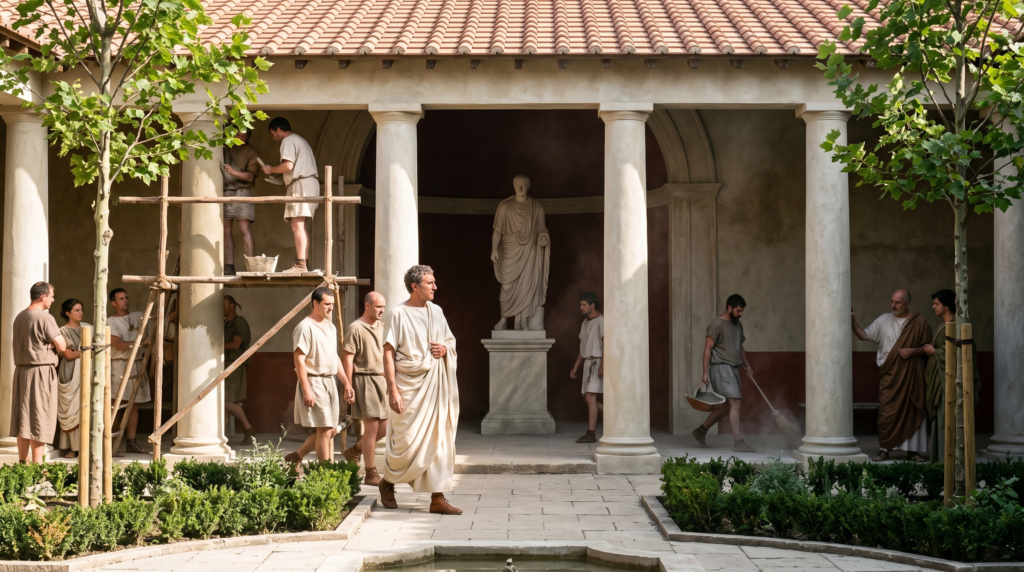
The Curia of Pompey belonged to the buildings raised by Pompey, Caesar's great rival, in the Campus Martius, the plain north of the old city.[2][3] The theatre came first: Platner and Ashby date it to his second consulship in 55 BC and call it the first permanent stone theatre in Rome.[4, p. 353] Beside the porticoes stood the Curia, an exedra, or recess, with one curved side and tiers of seats.[5, p. 1] A colossal statue of Pompey stood at its centre.[5, p. 1]
The hall was used for meetings of the Senate.[5, p. 1] Platner and Ashby describe it as a hall in the Porticus Pompei, probably one of its exedrae, where the senate sometimes met.[4, p. 353] The Curia and its porticoes also held fine Greek paintings, among them a sacrifice of oxen by Pausias.[5, p. 1] Suetonius says that Caesar had statues of Sulla and Pompey set up again after the populace had broken them to pieces.[6] Plutarch places a statue of Pompey in the hall's session-room, raised in his honour by the city.[7]
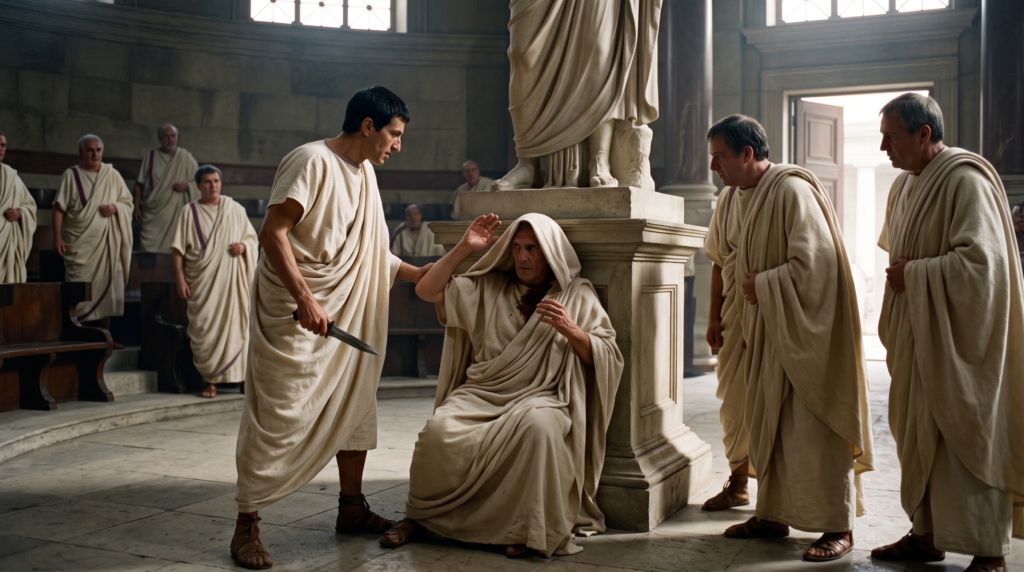
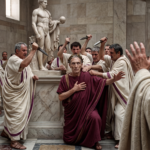
Suetonius reports that more than sixty men joined the plot against Caesar, led by Gaius Cassius and Marcus and Decimus Brutus.[6] When a meeting of the Senate was called for the Ides of March in the Hall of Pompey, they readily chose that time and place.[6] Plutarch adds that they could gather in numbers there without raising suspicion.[7] By one account Caesar pulled his toga over his head and sank against the pedestal of Pompey's statue, which was drenched with his blood.[2]
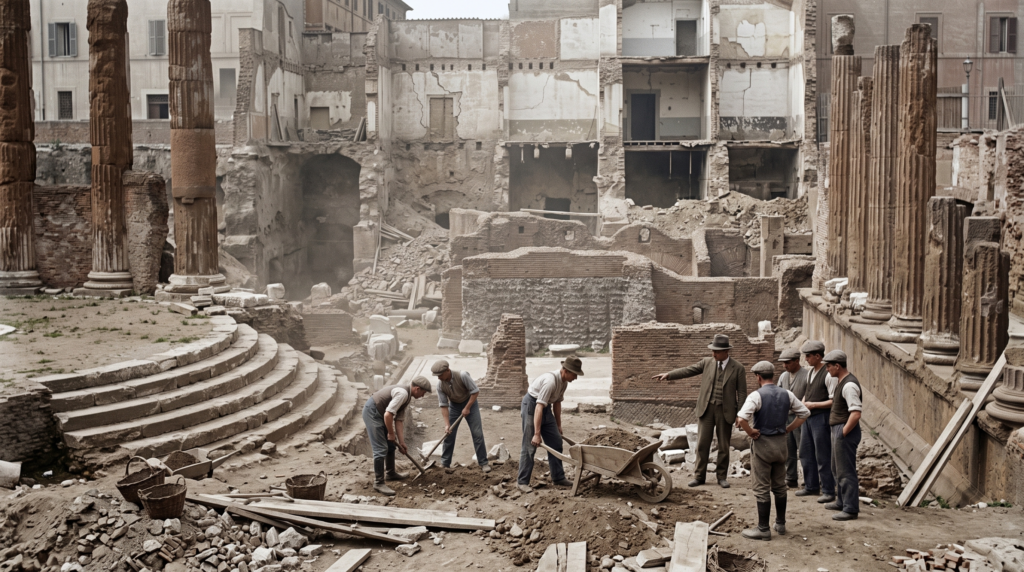
Suetonius records a vote that the hall be walled up, that the Ides of March be called the Day of Parricide, and that the Senate never be called on that day.[6] In 1926 the demolition of an old neighbourhood unexpectedly uncovered the Largo Argentina site.[1] A large tuff base behind temples B and C is what remains of the Curia of Pompey.[1] In 2023 the area reopened to the public, with walkways leading visitors past the temples and the Curia.[8]
Legacy & Reputation
What’s the verdict?
Plutarch’s account dwells on the setting: with Caesar lying at the foot of the statue, one might have thought Pompey himself was presiding over the vengeance on his enemy.[2] Suetonius shows how grimly Rome remembered the place, recording the decree to wall up the hall and brand the Ides of March the Day of Parricide.[6] Turismo Roma calls the Largo Argentina site one of the city’s most important archaeological sites, though it notes that the identification of its temples is not yet completely certain.[1]
Myth-buster
Think you know this one?
It is often assumed that Caesar was killed in the Senate House in the Forum. In fact he died in the Curia of Pompey, in the Campus Martius,[3] while the new Senate House he had begun was unfinished.[4, p. 353]
Quick Facts
The essentials
Quick Facts
Keith has spotted the loophole: the theatre that wasn't a theatre
Pompey is said to have built a temple of Venus Victrix at the top of his theatre's seating, so the rows looked like steps up to it. Platner and Ashby explain the point: to escape censure for building a permanent theatre.[4, p. 353]
Roger would like you to know the Senate's hall doubled as an art gallery
The Curia and its porticoes held fine Greek paintings. Middleton singles out one by Pausias showing a sacrifice of oxen, which he calls technically remarkable for its skilful foreshortening and chiaroscuro. Senators had something to look at while the debate dragged on.[5, p. 1]
History has a sense of timing
Suetonius says Caesar set up the statues of Sulla and Pompey after the populace had broken them to pieces. Plutarch puts a statue of Pompey in the Curia's session-room, and has Caesar falling at its pedestal. Rome rarely wrote better irony.[6][7][2]
This sounds invented, but Suetonius wrote it down
Suetonius reports an omen from the day before the Ides: a little bird carrying a sprig of laurel flew into the Hall of Pompey, chased by others from the nearby grove, and was torn to pieces there. Ancient writers loved a warning, so treat it as a story.[6]
Roger insists this matters: the Senate cancelled a date
After Caesar's death, Suetonius says, it was voted that the Ides of March be called the Day of Parricide and that a meeting of the senate should never be called on that day. Roger finds this the most dramatic calendar change in Roman history.[6]
Keith would like to clarify: nobody agrees how the hall ended
Platner and Ashby say Augustus walled up the curia as a locus sceleratus, an accursed place. Middleton, writing in 1892, says it was burnt in the outburst of grief after Caesar's death. The sources differ, so Keith is declining to pick a winner.[4, p. 353][5, p. 1]
Argentina has nothing to do with Argentina
The square is named after Argentoratum, a Roman military outpost in modern Strasbourg. Johannes Burckardt, master of ceremonies to Alexander VI Borgia, came from that city and called the tower of his palace Argentina. The square, in short, is named after a Strasbourg man's tower.[1]
The cats would like a word about the ruins
Cats have sheltered among the ruins since the 1929 excavation, according to the sanctuary's own history, and the film star Anna Magnani fed them during breaks at the neighbouring Teatro Argentina. The sanctuary was founded in 1993, when about 90 cats lived there.[9]
Keith found a labelling problem: temples A, B, C and D
The four temples beside the Curia are known only by letters because their identification is not yet completely certain, Turismo Roma says. The site itself was found unexpectedly in 1926 during demolition, so the Curia's neighbours are still partly anonymous.[1]
Roger has noticed the contrast with Pompey's house
Pompey's private house stood close by, and Middleton calls it very modest and simple. It contrasted strongly with the magnificence of the group of buildings Pompey erected for public use, including the hall where the Senate met.[5, p. 1]
the pedestal was drenched with his blood, so that one might have thought that Pompey himself was presiding over this vengeance upon his enemy
Plutarch
Plutarch, in Perrin's Loeb translation of his Life of Caesar, describing how Caesar fell beside the statue of Pompey.[2]
Timeline
How it unfolded
55 BC
Pompey's portico built beside his theatre
Platner and Ashby date Pompey's portico to 55 BC, built at the same time as his theatre.[4, p. 353] They describe the Curia as a hall in the portico, probably one of its exedrae, where the senate sometimes met.[4, p. 353]
44 BC
Conspirators choose the Hall of Pompey
Suetonius says more than sixty men joined the conspiracy against Caesar.[6] When a meeting of the Senate was called for the Ides of March in the Hall of Pompey, they readily chose that time and place.[6]
44 BC
The hall condemned after the murder
Suetonius records a vote that the hall in which Caesar was slain be walled up.[6] Later authorities differ on its fate: Platner and Ashby say Augustus walled up the curia, while Middleton says it was burnt.[4, p. 353][5, p. 1]
15 March 44 BC
Assassination of Julius Caesar
On 15 March 44 BC Julius Caesar was stabbed to death in the Curia of Pompey.[1] Plutarch says he sank against the pedestal of Pompey's statue, which was drenched with his blood.[2]
Dig Deeper
Copy any prompt below into your favourite AI chat to keep exploring.
Explain why the Senate was meeting in a hall attached to Pompey's theatre on the Ides of March 44 BC, and how that setting suited the conspirators.
Debate whether it matters that Caesar fell beneath a statue of his old rival Pompey, or whether later writers made too much of that detail.
Tell me 3 other historic meeting places that became infamous for what happened inside them, the way the Curia of Pompey did.
Further Reading
Where to read more
Sacred Area of Largo di Torre Argentina - Turismo Roma
The City of Rome's official tourism page for the archaeological area in Largo di Torre Argentina, covering its four Republican temples, its discovery and the remains of the Curia of Pompey.
Why look at this: Locates the large tuff base behind temples B and C as what survives of the Curia where Caesar was stabbed on 15 March 44 BC, and explains that the site was found unexpectedly in 1926 when an old neighbourhood was demolished.
https://www.turismoroma.it/en/places/sacred-area-largo-di-torre-argentinaYou Can Now Visit the Site Where Julius Caesar Was Stabbed - Christopher Parker, Smithsonian Magazine, 22 June 2023
A Smithsonian Magazine news feature on the 2023 opening of the Largo Argentina area to visitors, with the site's history from Augustus's condemnation of the hall to its rediscovery in the 1920s.
Why look at this: Takes on the Shakespearean assumption that Caesar died in the Forum, with the site's archaeologist Monica Ceci explaining why the real scene, the Curia of Pompey, is hard for visitors to picture, and how Augustus closed it as a cursed place after the murder.
https://www.smithsonianmag.com/smart-news/julius-caesar-murder-rome-180982409/Suetonius, Life of Julius Caesar (Divus Julius), Loeb Classical Library translation (1913) - LacusCurtius, University of Chicago
The complete ancient biography in J. C. Rolfe's English translation, free online. Chapters 80 to 82 cover the conspiracy and the murder, and chapter 88 the aftermath.
Why look at this: The nearest thing to a primary source for the room itself: it names the Hall of Pompey as the chosen place for the Ides of March meeting, records the omen of a bird torn apart there the day before, and ends with the vote to wall up the hall and brand the date the Day of Parricide.
https://penelope.uchicago.edu/Thayer/E/Roman/Texts/Suetonius/12Caesars/Julius*.htmlRelated
Keep exploring
Places
Can be seen in
Where this shows up
References
Sources
Sources
- Websiteturismoroma.it: Sacred area largo di torre argentina ↑
- BookPlutarch Lives vol 7: Demosthenes, Cicero, Alexander, Caesar (Loeb, Perrin) by Plutarch ↑
- BookThe Roman Forum, its history and its monuments by Christian Hülsen ↑
- BookA topographical dictionary of ancient Rome (Platner & Ashby) by Samuel Ball Platner and Thomas Ashby. Page 353. ↑
- BookThe remains of ancient Rome (vol 2) by J. H. Middleton. Page 1. ↑
- BookSuetonius, Lives of the Caesars (Loeb, Rolfe) by Suetonius ↑
- BookPlutarch's Lives in eleven volumes. Vol.6: Dion and Brutus. Timoleon and Aemilius Paulus [Loeb 98] by Plutarchus / Plutarch and Bernadotte Perrin ↑
- Websiteavvenire.it: Roma riapre al pubblico larea sacra di largo argentina 67849 ↑
- Websitegattidiroma.net: Who we are ↑