
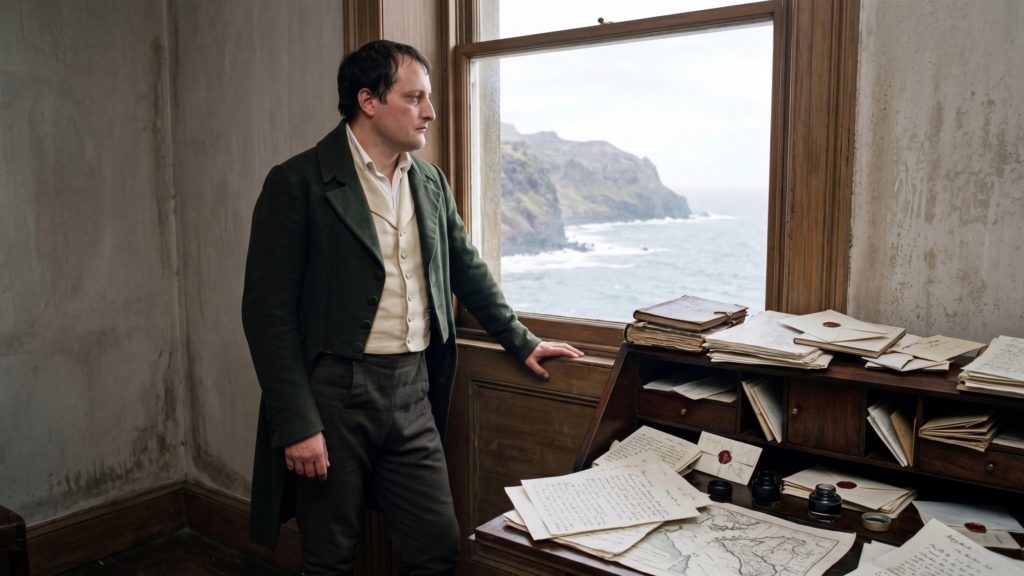
Longwood House on its wind-scoured plateau, the damp converted farm building where Napoleon lived from December 1815 until his death on 5 May 1821.
This remote South Atlantic outpost, owned by the East India Company since the 1650s, became the closed room in which Napoleon Bonaparte's story was finally allowed to end[1, p. 1].
About the Place
Why it matters
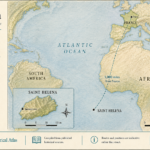
Before Napoleon ever saw it, Saint Helena had already spent over a century and a half as a working piece of empire: a remote volcanic island in the South Atlantic, held by the East India Company from 1651 and formally chartered to the Company on 3 April 1661[1, p. 1]. It functioned mainly as a resupply and garrison post on the sea route between Europe and Asia — small, isolated, and thoroughly unglamorous, with little reason for the wider world to take notice of it, until the summer of 1815.
After his final defeat, the British were determined this exile would hold: an island a few miles offshore clearly hadn't been remote enough for Elba. Saint Helena, deep in the South Atlantic and already run as a Company outpost, was judged secure. He sailed from Start Point aboard HMS Northumberland on 8 August 1815 and reached the island on 15 October 1815, arriving as a closely guarded prisoner rather than a guest[1, p. 64].
Napoleon's first night on the island was spent at a merchant's house in Jamestown, not Longwood[1, p. 1]. From 18 October 1815 he lived in a small pavilion in the garden of the Balcombe family's home, The Briars, until 10 December 1815, when he moved to Longwood House[1, p. 61][1, p. 1]. Sir Hudson Lowe, installed as Governor at the East India Company's request, was his watchful custodian there for the rest of his life[1, p. 85]. A grander "Longwood New House" was later built nearby specifically for him — but he never lived to move in[1, p. 1].
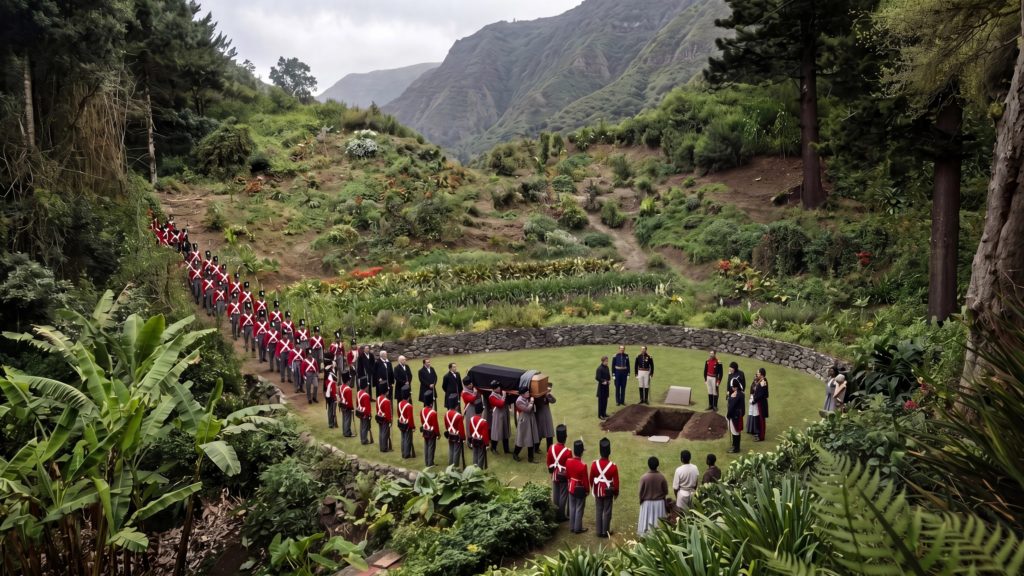
Napoleon died at Longwood on Saturday 5 May 1821, at 5.49pm, aged fifty-one[1, p. 8]. He was buried on the island until 1840, when his body was exhumed — reportedly remarkably well preserved — for return to France[1, p. 64]. Longwood House and the associated exile sites survive on Saint Helena today as historic landmarks on what remains a small, remote South Atlantic community.
Legacy & Reputation
What’s the verdict?
Saint Helena’s whole historical identity rests on six years and one burial: without Napoleon’s captivity it was a minor Company resupply post; because of it, the island’s every landmark — Longwood, The Briars, the Tomb — is catalogued down to who visited on which day[1, p. 85]. That level of documentation itself shaped the legend, turning a defeated Emperor’s final years into one of the best-recorded exiles in history, still argued over by historians two centuries on.
Myth-buster
Think you know this one?
Popular retellings often treat “Napoleon was poisoned” as settled fact. What’s actually documented is murkier: surviving copies of his official post-mortem report show the doctors’ remarks on his liver crossed out and amended before being finalised — real evidence the record itself was edited, not proof of poisoning either way[1, p. 85].
Quick Facts
The essentials
Quick Facts
Roger has a theory about interior decorating.
Roger has a theory that nothing sums up bureaucratic timing like this: a brand-new "Longwood New House" was built specifically for Napoleon, close to the cramped original Longwood House — but he died before it was ever finished enough to move into[1, p. 1].
Keith checked the sailing dates.
Keith checked the sources: Napoleon left England aboard HMS Northumberland from Start Point on 8 August 1815 and reached Saint Helena on 15 October 1815, after a ten-week Atlantic crossing[1, p. 64].
One for the Ageonauts who like their empires bureaucratic.
Saint Helena wasn't chosen at random. The East India Company had run the island since 1651, formally chartered on 3 April 1661 — over 150 years before it became the world's most famous prison cell[1, p. 1].
Roger would like you to know Napoleon didn't even get a proper bed straight away.
Roger would like you to know that Napoleon's first night on the island wasn't spent at Longwood at all — he slept at a merchant's house in Jamestown, then moved into a garden pavilion at the Balcombe family's home, The Briars, while Longwood was made ready[1, p. 1].
Keith would like to clarify how small this island really was.
Keith would like to clarify the scale involved: the 1820 census recorded around 3,534 white residents, 1,156 enslaved people and 481 Chinese labourers on Saint Helena — a tiny, remote garrison community suddenly guarding the most famous man in Europe[1, p. 1].
History gets strange here.
Several surviving copies of the official post-mortem report show the doctors' original remarks about Napoleon's liver crossed out and the wording amended before it was finalised — a genuine, documented edit that historians still argue over[1, p. 85].
Roger is fairly smug about this one.
Roger is fairly smug about this one: Napoleon's companion Las Cases left the island on 30 December 1816 and later published a hugely popular memoir of their conversations at Longwood, helping cement Napoleon's image as a noble, wronged exile for generations to come[1, p. 1].
Keith wants the record straight on who signed off.
Keith wants the record straight: the post-mortem was carried out by Napoleon's own physician, Francesco Antommarchi, with Bertrand and several British doctors present — a mixed French-and-British affair, not a closed-door British procedure as sometimes assumed[1, p. 85].
A date worth pinning to the timeline.
Napoleon died at Longwood on Saturday 5 May 1821, at 5.49pm, aged fifty-one — and his body remained on the island until it was exhumed in 1840, for return to France[1, p. 8][1, p. 64].
This one's a rabbit hole, and we mean that kindly.
Sir Hudson Lowe was installed specifically as Governor to oversee Napoleon's captivity, appointed at the East India Company's request — his strained relationship with the household at Longwood is worth falling into on its own[1, p. 85].
I die before my time, murdered by the English oligarchy and its hired assassin.
Napoleon Bonaparte
From his will, dictated at Longwood House on Saint Helena on 15 April 1821, three weeks before his death.
Timeline
How it unfolded
21 May 1502
Portuguese Discovery of the Island
The uninhabited island was found on 21 May 1502 by the Portuguese navigator João da Nova on his voyage home from India, and takes its name from the feast day of Helena, the mother of Constantine.[2][1, p. 1][3] The Portuguese stocked it with livestock and fruit trees, built a chapel and a few houses and left their sick there, but formed no permanent settlement.[2]
1659
East India Company Settles the Island
According to Britannica the Dutch occupation of the island was temporary and ceased in 1651.[2] The East India Company, which had been granted a charter in 1657, decided to fortify and settle the island with planters, and its first governor, Captain John Dutton, arrived in 1659.[3] After the Dutch were expelled in 1673, a new charter declared the Company the true and absolute lords and proprietors of the island.[2]
15 October 1815
Napoleon Held Prisoner on the Island
The British government chose the island as Napoleon's place of detention, and he arrived aboard the Northumberland on 15 October 1815.[4] He landed on the evening of 17 October, stayed at The Briars until 10 December and then moved to Longwood, where he died on 5 May 1821.[1, p. 8][1, p. 8] During his captivity the island was strongly garrisoned by regular troops under a governor nominated by the Crown.[2]
April 1834
Island Passes to the Crown
After Napoleon's death the East India Company resumed control, and under an act of 1833 the island was vested in the Crown in April 1834.[2][1, p. 1] Slavery was wound up in the same decade, since according to Britannica all slaves were set at liberty between 1826 and 1836, and a formal abolition ordinance for the island followed on 27 May 1839.[2][3]
1858
France Buys Longwood House
The French government bought Longwood House, together with the Valley of the Tomb, in 1858 for 7,100 pounds.[5][6]
1900
Boer Prisoners of War Held on the Island
During the Anglo-Boer War some thousands of Boer prisoners were detained on the island, according to Britannica.[2] Wikipedia puts the number at over 6,000 held in 1900 and 1901, among them General Piet Cronjé after the defeat at Paardeberg.[3]
2010
Restoration of Longwood House
Between 2010 and 2014 the Fondation Napoleon, the French foreign ministry and the Domaines Nationaux de Sainte-Hélène ran a large restoration of Longwood House costing nearly 2.2 million euros.[6]
Dig Deeper
Copy any prompt below into your favourite AI chat to keep exploring.
Explain why several surviving copies of Napoleon's 1821 post-mortem report have the original remarks on his liver crossed out and rewritten.
Debate whether a single redacted line in a colonial doctor's report is enough to fuel two centuries of poisoning theories, or whether that's just how legends fill gaps in evidence.
Roleplay as the island doctor in 1821: what real medical and political pressures might lead someone to quietly amend an emperor's autopsy report before it left the island?
Further Reading
Where to read more
Longwood House and Napoleon's Journey to St Helena
A Fondation Napoléon overview of the Northumberland voyage and Napoleon's years at Longwood House.
Why look at this: Fills in the sea voyage and the Longwood years in more depth than one CSV row can — the same 8 August-15 October 1815 crossing and Longwood residence cited above.
https://www.napoleon.org/en/history-of-the-two-empires/close-up/longwood-house-and-napoleons-journey-to-st-helena/The French Domains of St Helena — Preservation and Practical Information
Fondation Napoléon's account of how Longwood House, Napoleon's Tomb and The Briars pavilion have been owned and restored since the 19th and 20th centuries.
Why look at this: Picks up exactly where bio_text_4 leaves off — what happened to these sites after the 1840 exhumation, including a 2010-2014 restoration campaign at Longwood.
https://fondationnapoleon.org/en/activities-and-services/preserving-heritage/operation-st-helena/Memorial de Sainte Helene: Journal of the Private Life and Conversations of the Emperor Napoleon at Saint Helena
Emmanuel de Las Cases' own record of his conversations with Napoleon at Longwood, published after Las Cases left the island.
Why look at this: The primary-source memoir behind the "noble exile" legend — written by the companion whose 30 December 1816 departure is cited in fact_7 above, free full text on Internet Archive.
https://archive.org/details/memorialdesainte00lascRelated
Keep exploring
People
Places





Can be seen in
Where this shows up

References
Sources
Sources
- BookA St. Helena who's who, or a directory of the island during the captivity of Napoleon by Arnold Chaplin. Pages 1, 8, 61, 64, 85. ↑
- Document1911 Encyclopædia Britannica/St Helena ↑
- Websiteen.wikipedia.org: Saint Helena ↑
- BookThe downfall of Napoleon : his escape from Elba, the battle of Waterloo, captivity in St. Helena, and… by Walter Scott ↑
- Websiteen.wikipedia.org: Longwood House ↑
- Websitefondationnapoleon.org: Operation st helena ↑
- Websiteen.wikipedia.org: Saint Helena Airport ↑