
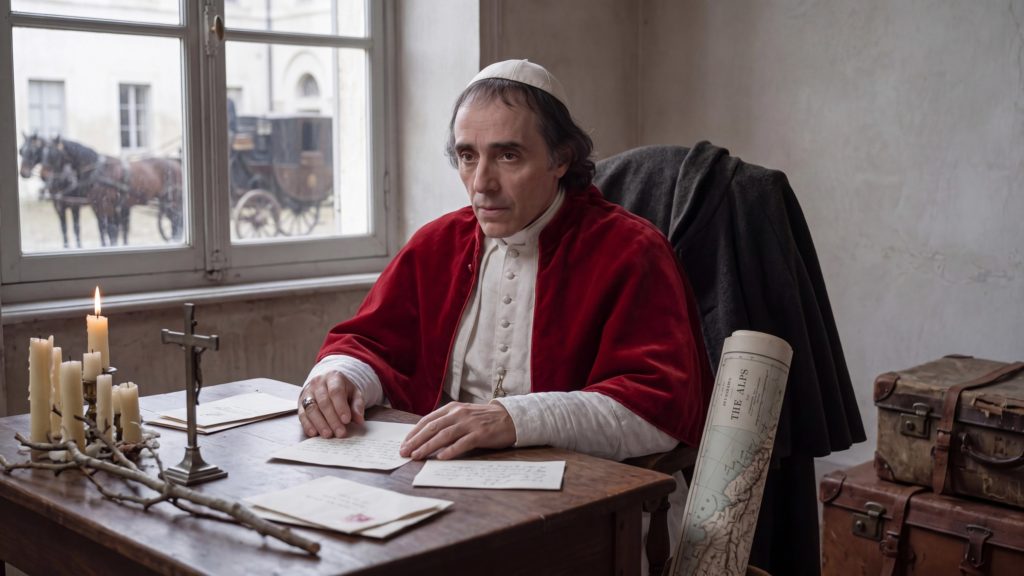
Pius VI signs a document; in 1791 he condemned the Civil Constitution of the Clergy, splitting French Catholics for a decade.
Pope (head of the Roman Catholic Church), r. 1775-1799
The pope who spent his final months a prisoner of Revolutionary France — dragged from Rome and left to die in captivity in a small French town.[1]
Bio
Who they were
Pius VI, born Braschi, came from a noble family of Cesena in the Papal States[2].
As pope, Pius VI became the Catholic Church's central opponent of the French Revolution's attempt to bring the clergy under state control. When the French National Assembly passed the Civil Constitution of the Clergy, requiring priests to swear loyalty to the state, Pius VI condemned it in a formal Brief to the French clergy[1]. That stand set him on a collision course not with mobs or assemblies, but with a French army increasingly willing to march into Italy to settle the dispute by force.
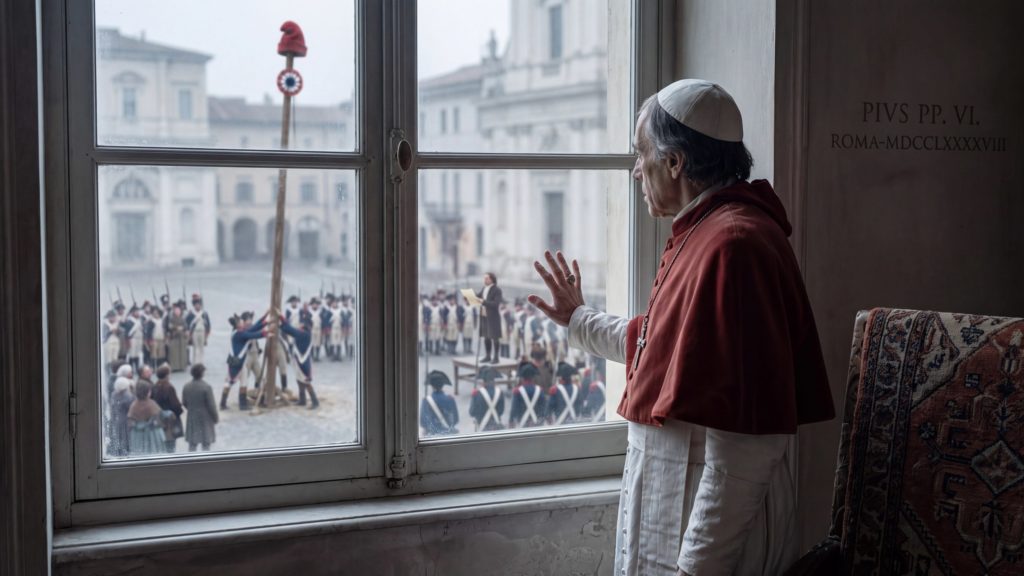
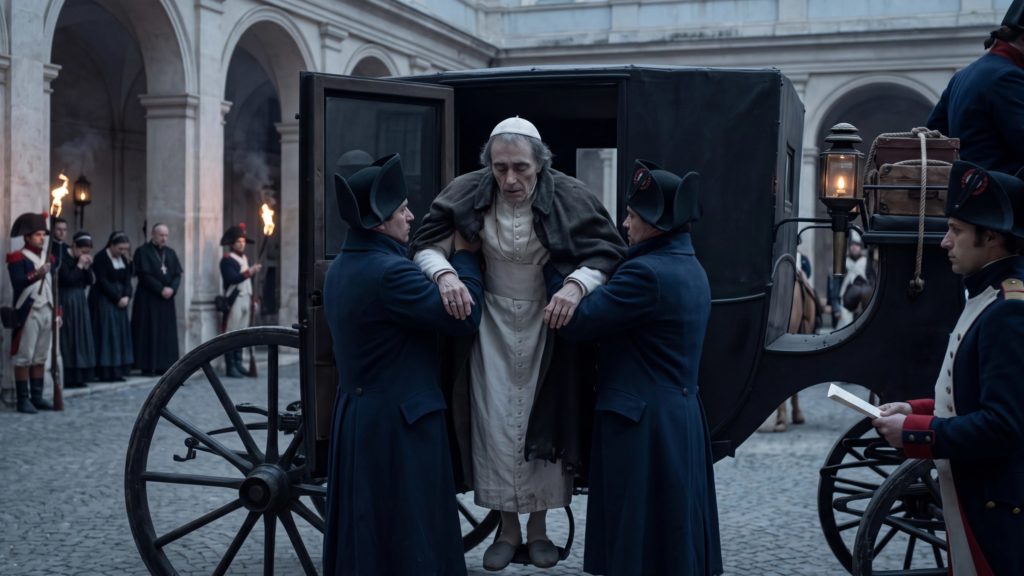
In 1796–97, French forces under General Napoleon Bonaparte invaded the Papal States. The campaign ended with the Treaty of Tolentino, a harsh settlement that stripped Pius VI of territory and treasure[3][4, p. 183]. Peace did not last: in 1798, French troops occupied Rome, proclaimed a Roman Republic, and took the elderly pope prisoner[1]. He was marched out of Italy into captivity in France, eventually held at Valence[5, p. 249] — the head of the Catholic Church, a prisoner of the republic that had already executed its own king.
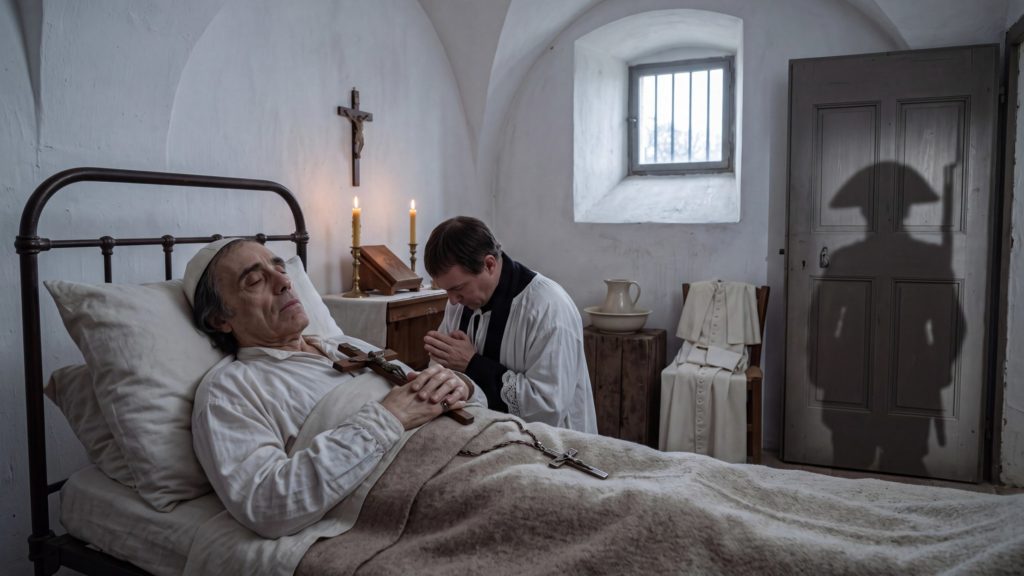
Pius VI never regained his freedom. He died at Valence on 29 August, "in the eighty-first year" of his life[3], not long after being carried into captivity. News of a pope dying as a prisoner of the French Republic shocked Catholic Europe.
The source most consulted here for this period frames Pius VI's final years under one repeated heading — "The Captivity of Pius VI" — treating his seizure and imprisonment as the defining episode of his reign[3]. His downfall, following directly from his refusal to accept French control of the clergy, made him a symbol of the Revolution's willingness to move from reforming the Church to attacking its head directly[1].
Even in captivity, the small formalities of his office continued. One account describes him ceremonially "habited in his white" vestments even as a prisoner far from the Vatican[3] — a quietly stubborn detail suggesting a man determined to remain, visibly, the pope, even with no throne left to sit on.
Legacy & Reputation
What’s the verdict?
Assessments of Pius VI in the sources here centre on his final ordeal rather than his earlier decades as pope. One nineteenth-century history judged that he “was pronounced great by his dignity, great by his…” even in adversity — reading dignified endurance into his downfall rather than personal failure[3].
Myth-buster
Think you know this one?
Pius VI is sometimes remembered simply as a pope who quietly died in exile. In fact his final years followed a direct, years-long confrontation with Revolutionary France — beginning with his public condemnation of the Civil Constitution of the Clergy and ending only when French troops physically seized him from Rome[1][1].
Quick Facts
The essentials
Quick Facts
Keith checked the sources…
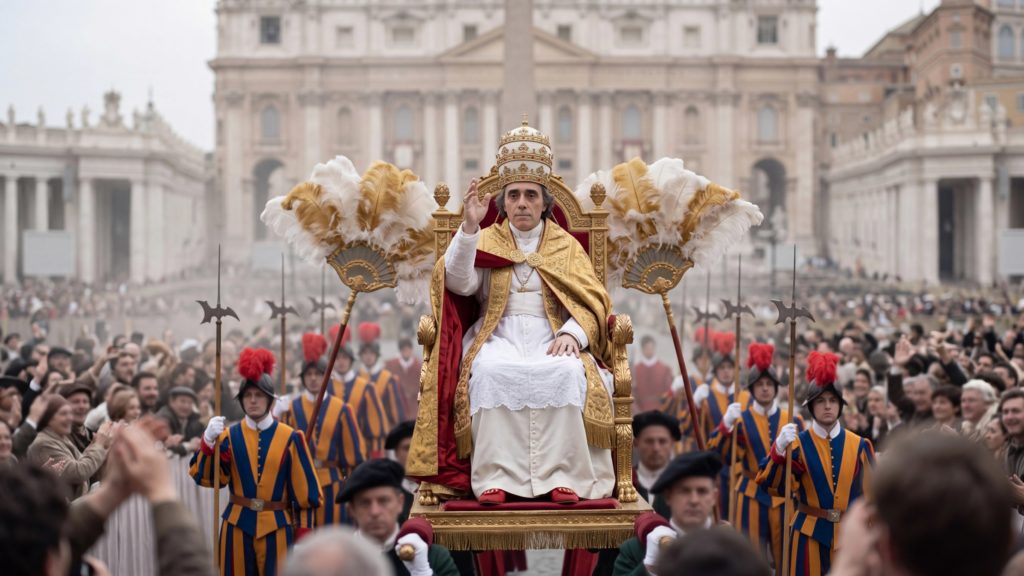
Pius VI was born John Angelo Braschi at Cesena on 27 December 1717 and elected pope on 15 February 1775. Nobody in that conclave could have guessed he would end his reign as a prisoner of a French republic that hadn't even been invented yet.[6]
Roger would like you to know…
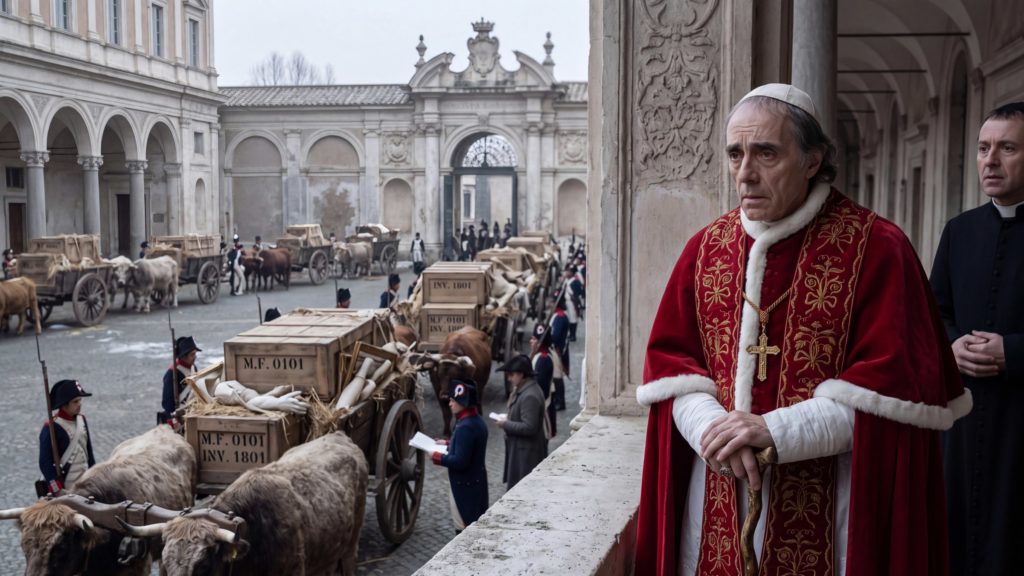
In February 1797 Napoleon forced Pius VI to sign the Treaty of Tolentino, stripping the Papal States of territory, cash and a significant slice of Rome's art collection. It was less a negotiation than an invoice, and the Pope had very little choice but to pay it.[3]
This sounds invented, but…
During his final captivity in France, one lawyer reportedly took to mocking Pius VI by addressing him as the 'Citizen Pope' — a deliberately absurd title for a man stripped of his throne but never, in the Church's own eyes, of his office.[3]
Keith would like to clarify…
Like plenty of popes before him, Pius VI didn't forget his family once he had the job. His nephew was made Duke Braschi, and when Berthier's forces arrived to negotiate the Papacy's fate, it was that same nephew the Pope sent out to meet them.[3]
History gets strange here…
Pius VI never saw Rome again. Removed from Italy by French troops, he died in captivity at Valence on 29 August 1799 — the first pope in centuries to die outside the Church's control, a jolt that briefly left the papacy's own future genuinely uncertain.[5, p. 119]
Roger has entered the historical rabbit hole…
Even in death Pius VI generated paperwork: English Catholics published a full pamphlet describing his 'solemn obsequies,' mourning rites for a pope who had died a captive abroad. It's a reminder his imprisonment shocked Catholic Europe far beyond France's own borders.[2]
Keith has spotted the problem…
The French officially blamed the murder of their attaché Basseville in Rome for justifying their 1798 invasion and the short-lived Roman Republic that followed. Historians are less convinced the killing was really the cause, rather than a convenient excuse for troops already on the march.[6]
Roger insists this matters…
At the height of the conflict, French law banned any papal bull or official document from Rome being published anywhere in France at all. For a pope whose entire authority rested on being heard, silencing him by decree was arguably more effective than any battlefield.[7]
One for the Ageonauts…
When French commissioners read him a fresh list of seventy-six demands stripping away his authority, Pius VI is recorded making only a token protest before accepting them. After more than two decades on the throne of St Peter, it was a strikingly subdued final act of authority.[7]
Down the rabbit hole we go…
Pius VI's death didn't just end a pontificate, it stranded the whole College of Cardinals. Forty-six scattered and impoverished cardinals eventually had to gather in Venice, not Rome, to choose his successor — proof of just how thoroughly the old order had been shaken loose.[7]
This monstrous right nevertheless appears to the Assembly to result from the equality and liberty which are natural to all men.
Pope Pius VI, in the papal bull Quod Aliquantum
Issued on 10 March 1791, this bull was Pius VI's formal condemnation of the French Revolution's Civil Constitution of the Clergy — the same condemnation referenced in his bio, made seven years before he died a prisoner of the French Republic at Valence.
Timeline
How it unfolded
27 December 1717
Birth of Giovanni Angelico Braschi
The future Pope Pius VI, Giovanni Angelico Braschi, was born at Cesena into a noble but impoverished family.[6]
15 February 1775
Election of Pius VI
Braschi was elected pope as Pius VI, after Spain, Portugal and France had at first combined to prevent his election because he was believed to be a friend of the Jesuits.[6]
22 March 1782
Pius VI Visits Joseph II in Vienna
Pius VI travelled to Vienna to resist the ecclesiastical reforms of Emperor Joseph II, but obtained only a promise that the reforms would not violate Catholic dogma or the dignity of the pope.[6]
13 March 1791
Pius VI Rejects the Civil Constitution of the Clergy
After the French Revolution, Pius rejected the Civil Constitution of the Clergy, a stand that led France to annex the small papal territories of Avignon and Venaissin.[6]
19 February 1797
Treaty of Tolentino
Defeated by Napoleon's army, Pius VI was compelled to surrender Avignon, Venaissin, Ferrara, Bologna and the Romagna and to pay an indemnity and give up art treasures and manuscripts.[6][8, p. 408]
20 February 1798
Pius VI Seized and Taken from Rome
After the French took Rome and proclaimed the Roman Republic, the pope refused to submit and was forcibly taken from Rome on the night of 20 February, going first to Siena and then to Florence.[6]
Dig Deeper
Copy any prompt below into your favourite AI chat to keep exploring.
Explain the chain of events that led Pope Pius VI to be taken prisoner by French troops and die in captivity in France.
What does it mean that a pope's final years were decided not by the Church, but by a foreign army's political calendar?
Tell me 3 other historical leaders who ended up prisoners of the very revolution they publicly opposed.
Further Reading
Where to read more
Pius VI — Britannica
A concise Britannica biography of Pope Pius VI's 1775-1799 papacy, from his election through the Napoleonic invasions to his death in French captivity.
Why look at this: Ties directly to the Treaty of Tolentino (February 1797), which Bonaparte forced on him — stripping the Papal States of territory, a huge indemnity, and priceless artworks — the moment that set his final two years in motion.
https://www.britannica.com/biography/Pius-VIPope Pius VI — Catholic Encyclopedia (New Advent)
A detailed 1911 Catholic Encyclopedia entry covering his full pontificate: the Jesuit suppression controversy, conflicts with Joseph II, the French Revolution, and his final forced march across the Alps.
Why look at this: Gives the specific stages of his last journey as a prisoner — Siena, Florence, Parma, Piacenza, Turin, over the Alps to Briançon, Grenoble, and finally Valence, where, seriously ill, he died — a level of itinerary detail the shorter overviews skip.
https://www.newadvent.org/cathen/12131a.htmHistorical and Philosophical Memoirs of Pius the Sixth (Bourgoing, 1799) — Internet Archive
A contemporary two-volume memoir, translated from the French and published the year before the pope's death, covering his private life, his disputes with the powers of Europe, and the collapse of the Papal States.
Why look at this: Written essentially in real time by someone reporting on events as they broke, this is about as close to a primary account of his downfall as exists in English, rather than a later historian's retrospective summary.
https://archive.org/details/HistoricalAndPhilosophicalMemoirsV1Related
Keep exploring




Can be seen in
Where this shows up

References
Sources
Sources
- DocumentCatholic Encyclopedia (1913)/French Revolution ↑
- BookDescription of the solemn obsequies of Pope Pius VI. 1799 ↑
- BookHistory of the pontificate and captivity of Pius the Sixth, together with a glance at the Catholic Church by Graduate of St. Joseph's ↑
- BookHistorical and philosophical memoirs of Pius the sixth and of his pontificate : down to the period of… by Jean-François Bourgoing. Page 183. ↑
- BookReligion and the reign of terror; or, The church during the French revolution by Edmond de Pressensé and John Power Lacroix. Pages 119, 249. ↑
- DocumentCatholic Encyclopedia (1913)/Pope Pius VI ↑
- BookCrises in the History of the Papacy by Joseph McCabe ↑
- BookThe French revolution from the age of Louis 14 to the coming of Napoleon by Harold Felix Baker Wheeler. Page 408. ↑