
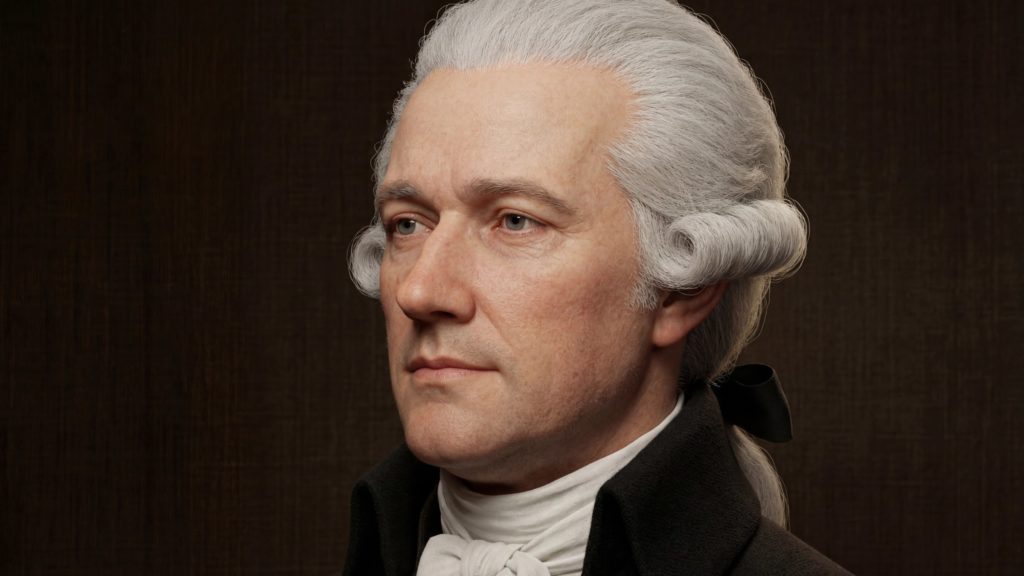
Alexander Hamilton
Founding Father, first U.S. Treasury Secretary, and co-author of the Federalist Papers
The illegitimate, orphaned immigrant from the Caribbean who talked, wrote, and financed his way to the center of a country he wasn't even born in.[1, p. 2][2, p. 472][3]
Bio
Who they were
Alexander Hamilton was born on 11 January 1757 on the Caribbean island of Nevis[2, p. 472]. His parents were never married, and his illegitimate birth was, throughout his life, a source of hardship and self-consciousness[1, p. 2]. As a teenager, he worked as a clerk in a merchant's counting house in the West Indies[4]. A vivid letter he wrote describing a devastating 1772 hurricane showcased his writing talent[5, p. 5], and not long afterward he crossed the Atlantic to pursue a formal education in the American colonies.
In New York, Hamilton enrolled at King's College, now Columbia University[6], just as tensions between Britain and its American colonies were coming to a head. When war broke out, he joined the fight, and in 1777 he was appointed an aide-de-camp to General George Washington[7], serving at the centre of the Continental Army's command for much of the Revolutionary War. The role put the young immigrant clerk in direct, daily contact with the man who would remain his most important political patron for the rest of his career, and gave Hamilton firsthand experience of the young nation's chronic wartime money problems.
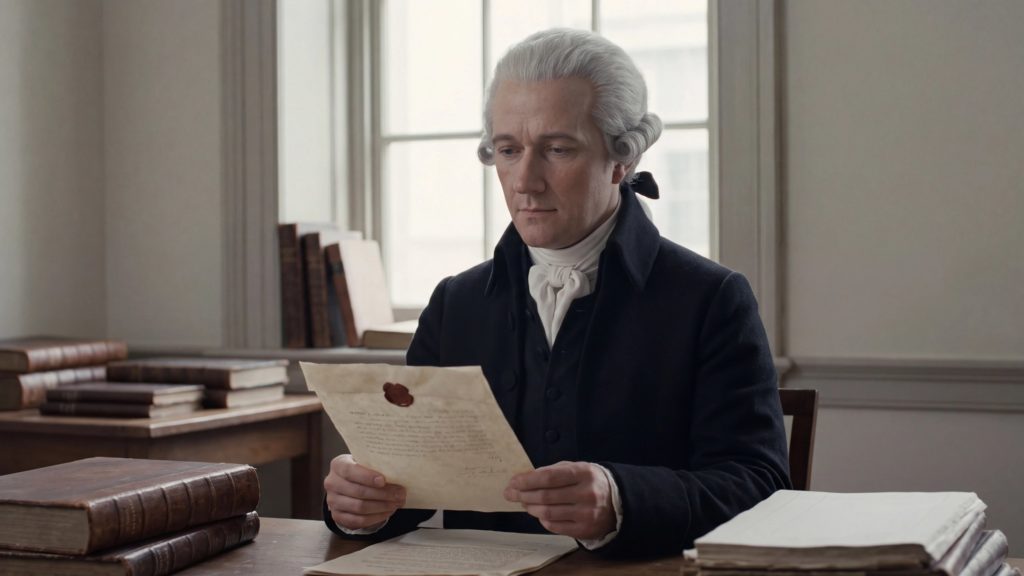
Hamilton's defining contribution came after the war, building the case for a stronger federal union. He co-wrote, with James Madison and John Jay, the Federalist Papers, a series of essays defending the proposed Constitution; Hamilton alone wrote roughly three-quarters of the eighty-five essays[8]. As the nation's first Secretary of the Treasury under President Washington[9, p. 341], he then built the young republic's financial system from scratch, including the establishment of the First Bank of the United States[10, p. 4]. In the deadlocked, contested election of 1800–1801, Hamilton used his influence to get the Federalist Party to back Thomas Jefferson over Aaron Burr, judging Burr the more dangerous of the two[1, p. 3].
Hamilton's long rivalry with Aaron Burr, sharpened by his role in denying Burr the presidency, eventually turned fatal. In 1804, after a chain of personal and political insults, Burr challenged Hamilton to a duel[11, p. 4]. The two met at Weehawken, New Jersey, on 11 July 1804; Hamilton was mortally wounded and died the next day[3]. He was shot at the same dueling ground where his own eldest son, Philip, had been killed in a duel just three years earlier[5, p. 17].
Hamilton's financial system, the funded national debt, tax structure, and the Bank of the United States, gave the young country's economy the credibility it needed to function and to borrow, shaping American public finance for generations. The Federalist Papers he co-wrote, three-quarters of them in his own hand[8], remain one of the most detailed contemporary explanations of what the Constitution's framers intended. Unlike most of his fellow Founding Fathers, Hamilton never became president; his enduring reputation rests instead on the institutions and arguments he built rather than on holding the nation's highest office.
Three years before his own fatal duel, Hamilton had already buried a son at the same dueling ground. Philip Hamilton, his eldest, was killed at Weehawken in 1801, defending his father's honour[5, p. 17], and some accounts suggest the very same set of pistols may have been used in both encounters[11, p. 33].
Legacy & Reputation
What’s the verdict?
Hamilton’s reputation has swung more than almost any other Founding Father’s. An admiring mid-twentieth-century study by Michigan senator Arthur H. Vandenberg was literally titled ‘The Greatest American, Alexander Hamilton,’ crediting him with building the nation’s financial architecture[12]. Earlier and later critics, by contrast, have painted him as an elitist suspicious of popular democracy who trusted commerce and financial expertise over the will of ordinary voters. That tension, founder-as-financial-genius versus founder-as-aristocrat, has never fully resolved.
Myth-buster
Think you know this one?
Myth: because Hamilton appears on U.S. currency alongside various presidents, he is sometimes assumed to have been one himself. In fact, his highest office was Secretary of the Treasury[9, p. 341] — Alexander Hamilton never served as President of the United States.
Quick Facts
The essentials
Quick Facts
Roger has entered the historical rabbit hole…
Historians aren't actually certain what year Hamilton was born. He usually gave 1757, but legal documents from his birthplace suggest 1755 instead[5, p. 4] — meaning America's finance-obsessed founder may have quietly shaved a couple of years off his own age.
Keith checked the sources…
Hamilton, Madison, and Jay didn't publish the Federalist Papers under their own names. All eighty-five essays appeared under one shared pen name, 'Publius'[14], an homage to a legendary defender of the Roman republic.
History gets strange here…
In 1797, facing accusations of financial corruption, Hamilton published a pamphlet that cleared his Treasury record by instead publicly confessing to an affair with a married woman, Maria Reynolds[15]. Arguably America's first great political sex scandal, and entirely self-inflicted.
Keith found the footnote…
Not content with running the Treasury and co-writing the Constitution's defence, Hamilton also founded his own newspaper, the New York Evening Post[16]. It's still publishing today, under a slightly shorter name.
Roger insists this matters…
Of the eighty-five Federalist Papers essays, Hamilton personally wrote roughly three-quarters of them[8]. Madison and Jay contributed real substance too — but Hamilton was, by a wide margin, doing most of the typing.
A small fact with a very large consequence…
Beyond the Treasury and the national bank, Hamilton also helped establish the United States Mint[1, p. 3]. The man who built the country's financial credibility also, quite literally, helped design its money.
Keith would like to clarify…
Hamilton appears on the modern ten-dollar bill, which leads plenty of people to assume he was once president. His actual highest office was Secretary of the Treasury[9, p. 341] — the presidency is one Founding Father milestone he never reached.
Roger says, "Hear me out…"
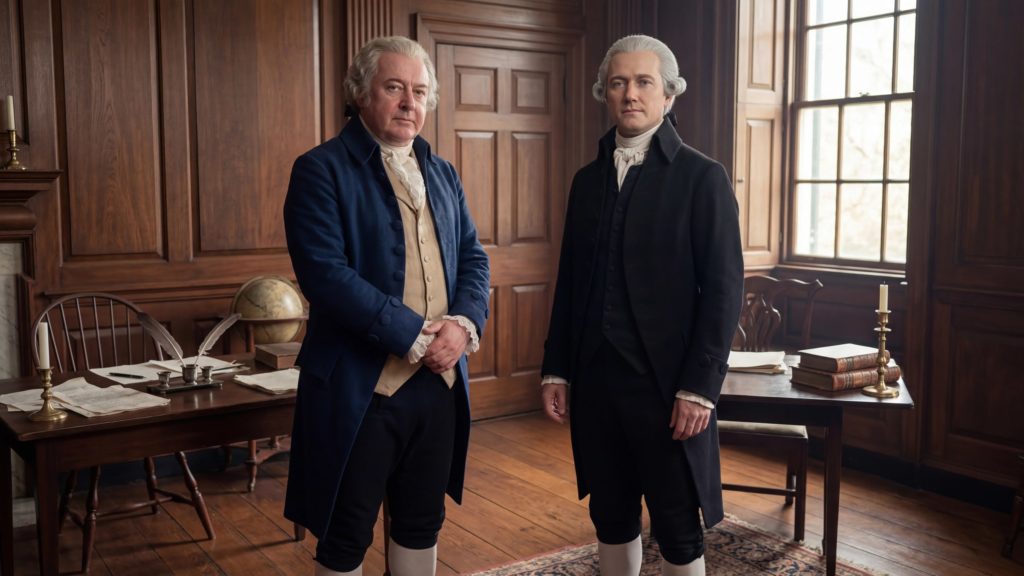
Hamilton was only around twenty years old when George Washington appointed him an aide-de-camp in 1777[7], putting a Caribbean-born immigrant barely out of college at the general's side for most of the Revolutionary War.
One for the Ageonauts…
Three years before Hamilton's own fatal duel, his eldest son Philip was killed in a duel at the very same site, Weehawken, New Jersey[5, p. 17]. Some accounts even suggest the same pair of pistols was used both times[11, p. 33].
File under: surprisingly true…
Hamilton's parents never married, making him illegitimate by the standards of his time[1, p. 2] — a genuinely unusual background for a man who ended up designing the financial system of an entire country.
...whether societies of men are really capable or not of establishing good government from reflection and choice, or whether they are forever destined to depend...on accident and force.
Alexander Hamilton, Federalist No. 1, 1787
The opening lines of Federalist No. 1, the first of the essays Hamilton organised to build public support for ratifying the Constitution[14].
Timeline
How it unfolded
c. 1755-1757
Birth of Alexander Hamilton
Hamilton was born on 11 January on the island of Nevis in the British West Indies, though historians dispute whether the year was 1755 or 1757.[17] Older biographies give 1757, while later researchers favoured 1755 because of legal documents found in his birth country.[2, p. 472][5, p. 4]
6 September 1772
Hamilton's Hurricane Letter
Hamilton's published account of a hurricane in 1772 moved island businessmen to fund his education in North America, setting him on the road to King's College in New York.[18][5, p. 5]
1 March 1777
Hamilton Joins Washington's Staff
Hamilton was appointed aide-de-camp to General Washington on 1 March 1777, beginning his service on the commander in chief's personal staff.[19][2, p. 472]
14 December 1780
Marriage to Elizabeth Schuyler
Hamilton married Elizabeth Schuyler on 14 December 1780.[20][2, p. 496]
14 October 1781
Hamilton at Yorktown
Hamilton took part in the bayonet attack on a British redoubt at Yorktown on the night of 14 October 1781, a few days before Cornwallis surrendered.[21][22]
27 October 1787
Hamilton Writes Federalist No. 1
Hamilton wrote the general introduction to The Federalist, which appeared in the Independent Journal on 27 October 1787.[23]
11 September 1789
Hamilton Becomes Secretary of the Treasury
Washington named Hamilton the first Secretary of the Treasury in September 1789.[24][3]
11 July 1804
Duel with Aaron Burr
Hamilton was mortally wounded in a pistol duel with Aaron Burr at Weehawken, New Jersey, on 11 July 1804.[1, p. 4][2, p. 472]
12 July 1804
Death of Alexander Hamilton
Hamilton died in New York on 12 July 1804 from the wound received in the duel.[25, p. 185][2, p. 496]
Dig Deeper
Copy any prompt below into your favourite AI chat to keep exploring.
Tell me why Hamilton urged Federalists to back Jefferson over Burr in 1800, and how it shaped his rivalry with Burr.
Was Hamilton backing Jefferson over Burr statesmanship, or just the lesser of two evils?
Tell me 3 other times a leader backed a rival to stop someone they feared more, and how each one turned out.

Further Reading
Where to read more
Alexander Hamilton — Britannica
A concise, regularly updated encyclopedia biography covering Hamilton's life from Caribbean birth to Treasury Secretary to his fatal duel with Aaron Burr.
Why look at this: A quick way to check the shape of the 1800–1801 election standoff the episode references, where Hamilton backed Jefferson over Burr, and the Federalist leadership he shared with John Adams.
https://www.britannica.com/biography/Alexander-Hamilton-United-States-statesmanAlexander Hamilton Room — Museum of American Finance
A dedicated exhibit gallery from the Museum of American Finance covering Hamilton's financial system, including his Report on the Public Credit and the founding of the Treasury, the Bank of the United States, and the U.S. Mint.
Why look at this: Goes deep on exactly the institution-building work, stabilising the nation's finances, that made Hamilton the Federalist counterweight the episode sets against Jefferson's Democratic-Republicans.
https://www.moaf.org/exhibits/hamiltonThe Papers of Alexander Hamilton — Founders Online (National Archives)
The complete, searchable digitised edition of Hamilton's letters and writings, including his Federalist Papers essays and Treasury reports, published as part of Founders Online, a joint venture of the National Archives and the University of Virginia Press.
Why look at this: Includes Hamilton's own letters from the days surrounding his 1804 duel with Aaron Burr, the fatal end point of the rivalry the episode traces back to the contested 1800–1801 election.
https://founders.archives.gov/about/HamiltonRelated
Keep exploring



Can be seen in
Where this shows up

References
Sources
Sources
- WebsiteAlexander Hamilton Curriculum (Museum of American Finance). Pages 2, 3, 4. ↑
- BookAlexander Hamilton: Nevis-Weehawken. A Lecture on the Military Career of Alexander Hamilton ... by James Edward Graybill. Pages 472, 496. ↑
- BookBiographical story of the Constitution, a study of the growth of the American Union by Edward Elliott ↑
- BookReminiscences of James A. Hamilton; or, Men and events, at home and abroad, during three quarters of a… by James A. Hamilton ↑
- WebsiteAlexander Hamilton's Rhetorical Abilities (Jennifer Patterson, Western Oregon University, HST 499). Pages 4, 5, 17. ↑
- BookLife of Alexander Hamilton. A history of the Republic of the United States of America, as traced in… by John C. Hamilton ↑
- BookAlexander Hamilton, an essay on American union by Frederick Scott Oliver ↑
- BookParty leaders; sketches of Thomas Jefferson, Alex'r Hamilton, Andrew Jackson, Henry Clay, John Randolph, of Roanoke, including notices… by Joseph G. Baldwin ↑
- BookA list of Treasury reports and circulars issued by Alexander Hamilton, 1789-1795 by Paul Leicester Ford. Page 341. ↑
- WebsiteFRBPHI Chapters: First Bank Lesson (FRASER, Federal Reserve Bank of St. Louis). Page 4. ↑
- WebsiteDueling as Politics (Joanne B. Freeman chapter, hosted by Dickinson College). Pages 4, 33. ↑
- BookThe greatest American, Alexander Hamilton; an historical analysis of his life and works together with a symposium of… by Arthur H. Vandenberg ↑
- BookThe intimate life of Alexander Hamilton; based chiefly upon original family letters and other documents, many of which… by Allan McLane Hamilton ↑
- BookThe Federalist Papers – Hamilton, Madison & Jay on the U.S. Constitution by James Madison Alexander Hamilton ↑
- BookThe history of the United States for 1796; : including a variety of interesting particulars relative to the… by James Thomson Callender ↑
- BookThe conqueror; a dramatized biography of Alexander Hamilton by Gertrude Franklin Horn Atherton ↑
- Websiteconstitutioncenter.org: 10 essential facts about alexander hamilton ↑
- Websiteconstitutioncenter.org: How a hurricane brought an important founding father to america ↑
- BookAlexander Hamilton by Henry Jones Ford ↑
- BookFamous American Statesmen by Sarah Knowles Bolton ↑
- BookYorktown and the Siege of 1781 by Charles E. Hatch ↑
- BookWashington the Soldier by Henry B. Carrington ↑
- BookAlexander Hamilton, John Jay, James Madison - The Federalist Papers by Swapardeshi ↑
- BookWritings of George Washington by George Washington and Lawrence B. Evans ↑
- BookThe rotunda and dome of the U. S. Capitol by S[amuel] D[ouglas] Wyeth. Page 185. ↑