
AI reconstruction based on a contemporary painting of Nelson being brought up on deck after being wounded at the Battle of the Nile, 1 August 1798 (artist and date not confirmed), from the perspective of a sailor standing a few feet away on the crowded deck as he is helped aft, with L'Orient…
On the evening of 1 August 1798, Nelson found the French fleet anchored exactly where it believed it was safe[1] - and attacked from the one direction no one expected[2, p. 89].
What Happened
The story
Nelson's squadron had spent weeks searching the Mediterranean for the French invasion fleet, thwarted at every turn by lack of information[1]. The French, having escorted Napoleon's army to Egypt, lay moored in a line of battle parallel to the shore in Aboukir Bay, trusting that shallow water on their landward side made an attack from that side impossible[1]. On 1 August, Nelson's ships finally sighted them. 'I attacked at sunset,' he later wrote, 'off the mouth of the Nile'[1].
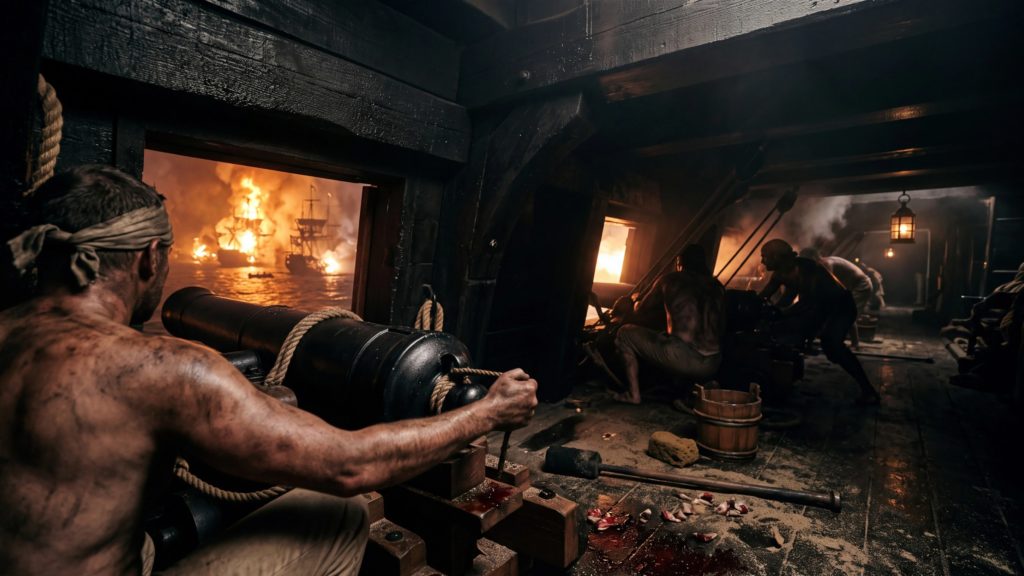
Captain Foley in the Goliath led the British line inside the French ships, anchoring on the landward side the French had judged too shallow to be attacked from[2, p. 89]. Fighting began a little after half-past six, the leading French ship Guerrier's masts falling by sunset, a quarter to seven[2, p. 89]. Around nine o'clock the French flagship L'Orient caught fire, after Vice-Admiral Brueys, already wounded twice, was struck by a shot that nearly cut him in two; he died a quarter of an hour later[3]. Nelson himself was struck in the forehead by flying iron and carried below, briefly convinced the wound was fatal[2, p. 89].
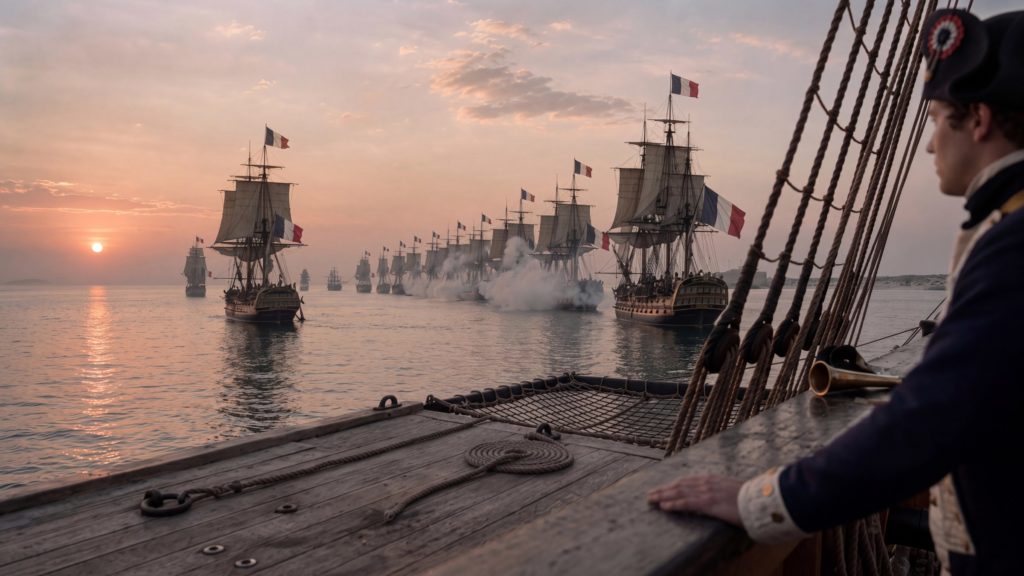
L'Orient exploded that night in what one account called the most terrific incident of the entire battle[3]. By morning, eleven of Brueys's thirteen ships of the line and two of his four frigates had been captured or destroyed; only two ships of the line and two frigates escaped[4]. From his sickbed, Nelson lamented that his wound had cost him an even more total result: 'Had I not been wounded, not a boat would have escaped to tell the tale!'[4]
For the victory Nelson was raised to the peerage as Baron Nelson of the Nile - a title some in London, including his own former admiral Lord Hood, thought fell short of what the scale of the win deserved[2, p. 89]. Ashore, Napoleon's army had watched the fires and explosions through the night, and now found its line of communication with France entirely severed[1].
Quick Facts
The essentials
Quick Facts
Great Britain (the Royal Navy)
Leadership
Rear-Admiral Sir Horatio Nelson[2, p. 89]
Forces
Rear-Admiral Horatio Nelson's Mediterranean squadron, including the captains he called his 'Band of Brothers'[5]
Objective
Find and destroy the French fleet supporting Napoleon's invasion of Egypt[1]
France (the French Mediterranean fleet)
Leadership
Vice-Admiral François-Paul Brueys d'Aigalliers, killed in the action[3]
Forces
Vice-Admiral Brueys's fleet of thirteen ships of the line, anchored to guard Napoleon's line of communication[1]
Objective
Protect the anchorage supporting Napoleon's army ashore in Egypt
The Bigger Picture
The naval side of France's war with Britain and of Napoleon's invasion of Egypt: the French fleet that had escorted his invasion convoy stayed anchored off the coast to guard his army's line of communication with France[1].
How It Came To This
Nelson's squadron had spent weeks searching the Mediterranean for the French invasion fleet, thwarted at every turn by lack of information[1]; the French fleet under Vice-Admiral Brueys, meanwhile, lay moored in a line of battle parallel to the shore in Aboukir Bay, believing the shallow water on its landward side made an attack from that direction impossible[1].
What Actually Happened
The tactical surprise was doubling. Captain Foley gambled that if there was room for the French to swing at anchor, there was room for a British ship to pass inside their line, and found the water deep enough on the landward side where Brueys had assumed his fleet was safe[2, p. 89]. That let Nelson's leading ships anchor on both the shore side and the open-sea side of the same French vessels, so several French ships found themselves fighting two opponents at once while their unengaged consorts further down the line could not manoeuvre to help in the dark[2, p. 89]. Fighting on through the night was itself a departure from standard fleet tactics, which normally broke off action well before dusk. The result was less a victory than what one naval historian called 'a conquest' - earlier fleet battles like the Glorious First of June had ended with a handful of prizes taken from an otherwise intact opposing fleet, whereas here all but four of Brueys's ships were taken or destroyed[4]. The strategic effect mattered even more than the tactical one: with its fleet gone, France no longer controlled the sea lanes to Egypt, and Napoleon's army was cut off from reinforcement.
Why It Still Matters
The Nile ended any hope of French reinforcement or resupply to Egypt, stranding Napoleon's army there[2, p. 89]. It made Nelson a national hero, rewarded with a peerage as Baron Nelson of the Nile, and re-established British naval dominance across the Mediterranean.
Quick Facts
One for the Ageonauts...
Captain Foley's gamble decided the battle before most of the fleet had even fired a shot: he sailed the Goliath inside the anchored French line, into water the French had judged too shallow for anyone to attack from[2, p. 89].
Keith checked the sources...
When Nelson was struck in the forehead by a piece of flying iron, blinded by his own blood, he reportedly cried out 'I am killed! Remember me to my wife!' before Captain Berry caught him as he fell[2, p. 89].
Roger would like you to know...
The French flagship L'Orient's captain, Vice-Admiral Brueys, was already wounded twice in the head and arm when a shot nearly cut him in two; he asked to be left lying on deck and died a quarter of an hour later[3].
A small fact with a very large consequence...
By the time the sun rose, eleven of Brueys's thirteen ships of the line had been captured or destroyed - a French fleet of that size simply ceased to exist in a single night[4].
Keith would like to clarify...
Nelson didn't see the Nile as a total triumph - from his sickbed he complained, 'Had I not been wounded, not a boat would have escaped to tell the tale!', regretting that his injury had let any French ships get away at all[4].
History gets strange here...
Nelson's own nickname for his captains - a 'Band of Brothers' - was his own phrase, written in his post-battle letter praising how each of them knew his duty without needing to be told[6].
Roger has entered the historical rabbit hole...
For arguably his greatest victory, Nelson was only made a Baron, not a Viscount, because technically he wasn't a commander-in-chief - a decision his own old admiral called a reason 'more flimsy' than any he'd ever heard[2, p. 89].
Meanwhile, in history...
Nelson's crews had spent long, weary weeks combing the Mediterranean for the French fleet before finally finding them at anchor - what one account calls 'the glorious first of August'[1].
Keith has spotted the problem...
Nelson himself gave the tidiest possible summary of the whole engagement: 'I attacked at sunset on the 1st of August, off the Mouth of the Nile' - four words shorter than most textbook chapter titles[1].
The familiar story leaves this out...
London's reaction to the win wasn't pure celebration: Lord Hood reported that Pitt himself had expected Nelson to be made a Viscount, only for the honour to be quietly downgraded before it was granted[2, p. 89].
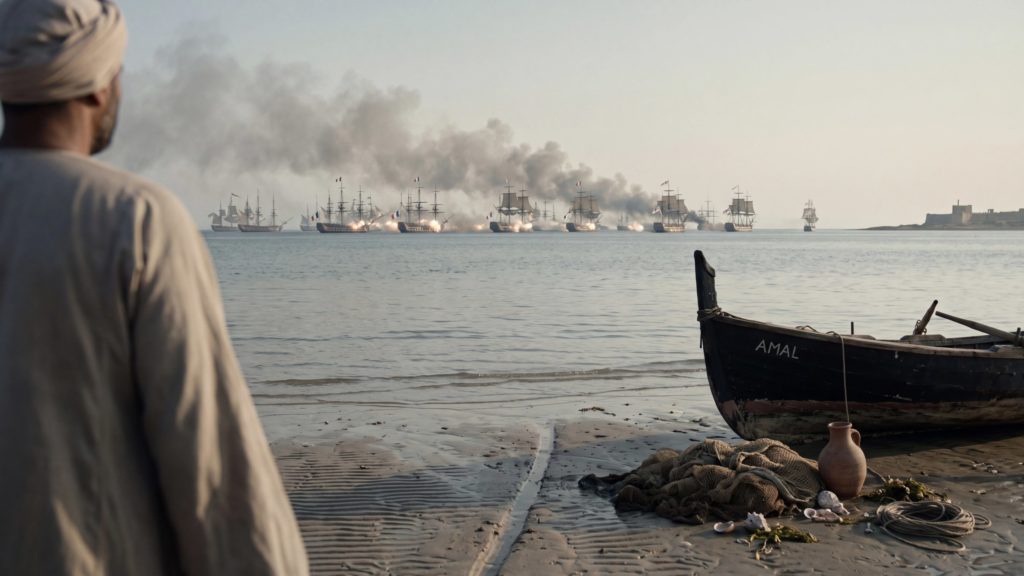
I had the happiness to command a band of brothers. Each knew his duty, and I was sure each would feel for a French ship.
Admiral Horatio Nelson, writing after the Battle of the Nile, August 1798[6]
Nelson praising the captains who, without waiting for further signals, immediately pressed the attack on the anchored French fleet at dusk.
Timeline
How it unfolded
19 May 1798
Bonaparte's Armada Sails from Toulon
The French expedition for Egypt left Toulon.[7] Sloane notes that Nelson's orders were stringent to destroy the enemy's fleet at any hazard.[7]
8 July 1798
Brueys Anchors in Aboukir Bay
Finding it impracticable to take his ships of the line into Alexandria, Admiral Brueys moved the fleet to its anchorage in Aboukir Bay.[8, p. 89] Sloane adds that he did so against Bonaparte's orders, believing the position impregnable.[7]
19 July 1798
Nelson Anchors at Syracuse Without News
After a long fruitless search of the Mediterranean, Nelson anchored his fleet at Syracuse, in his own words as ignorant of the enemy's whereabouts as he had been twenty-seven days earlier.[8, p. 89]
1 August 1798
Nelson Sights the French Fleet
According to Mahan, the lookout of the Zealous discovered the long-sought French fleet at 2.45 in the afternoon, lying in Aboukir Bay fifteen miles east of Alexandria.[8, p. 89]
1 August 1798
British Ships Attack Inside the French Line
The battle began a little after half-past six, with Captain Foley's Goliath and four more British ships anchoring on the inner side of the French line.[8, p. 89] The two leading French vessels were at once crushed.[8, p. 89]
1 August 1798
L'Orient Blows Up
At quarter before ten the French flagship Orient blew up.[8, p. 89] Admiral Brueys was killed in the battle.[9]
2 August 1798
The Morning After at Aboukir
The following morning the leading six French ships had struck their colors.[8, p. 89] Only Villeneuve escaped, with two ships of the line and two frigates.[7] Hearing of the disaster, Bonaparte saw the line of retreat to France cut off.[7]
September 1798
Ottoman Empire Declares War on France
Influenced by Great Britain, Turkey declared war upon France.[10, p. 273] Wheeler writes that the victory paved the way for the Second Coalition against France.[1]
Dig Deeper
Copy any prompt below into your favourite AI chat to keep exploring.
Explain how Nelson's captains turned a late-afternoon attack into an overnight rout that destroyed or captured eleven of Brueys's thirteen ships of the line.
Debate whether Captain Foley's gamble to sail inside the French line, or Nelson's willingness to fight on into the night, mattered more to the scale of the victory at the Nile.
Tell me 3 other ways the Royal Navy could have described turning the French fleet at Aboukir Bay into wreckage in a single night.
Further Reading
Where to read more
The Battle of the Nile - Historic UK
A concise, free overview of Nelson's decisive 1798 victory at Aboukir Bay.
Why look at this: Covers the battle as the moment that established British naval dominance, which this page's account of the destruction of Brueys's fleet leads directly into.
https://www.historic-uk.com/HistoryUK/HistoryofBritain/Battle-Of-The-Nile/Battle of the Nile - British Battles
A fuller, more tactical account of the battle, including ship-by-ship fighting.
Why look at this: Explains that L'Orient's fire actually started from tubs of unused paint and turpentine left on deck during repainting - the mundane cause behind this page's account of the flagship's destruction.
https://www.britishbattles.com/napoleonic-wars/battle-of-the-nile/The Letters and Despatches of Lord Nelson, ed. Laughton
Nelson's own correspondence, freely digitised on the Internet Archive.
Why look at this: Contains, in Nelson's own words, the 'band of brothers' letter this page quotes, written in the immediate aftermath of the battle.
https://archive.org/details/lettersdespatche00nelsialaRelated
Keep exploring






Can be seen in
Where this shows up

References
Sources
Sources
- BookThe Boys' Nelson by Harold Wheeler ↑
- BookThe Life Of Nelson, 2nd edition by Alfred Thayer Mahan. Page 89. ↑
- BookHoratio Nelson and the naval supremacy of England by William Clark Russell ↑
- BookNelson and his captains: sketches of famous seamen by W. H. Fitchett ↑
- BookThe sailors whom Nelson led : their doings described by themselves by Edward Fraser ↑
- BookLetters and despatches of Horatio, viscount Nelson, duke of Bronte, vice admiral of the White squadron by Horatio Nelson Nelson and John Knox Laughton ↑
- BookThe Life of Napoleon Bonaparte. Vol. 2 (of 4) by William Milligan Sloane ↑
- BookThe Life of Nelson, Volume 1 by A. T. Mahan. Page 89. ↑
- BookLife of Napoleon Bonaparte, Volume II. by Walter Scott ↑
- BookA short history of Europe, from the fall of the Eastern empire to the dissolution of the Holy… by Charles Sanford Terry. Page 273. ↑