
About This Map
What it shows
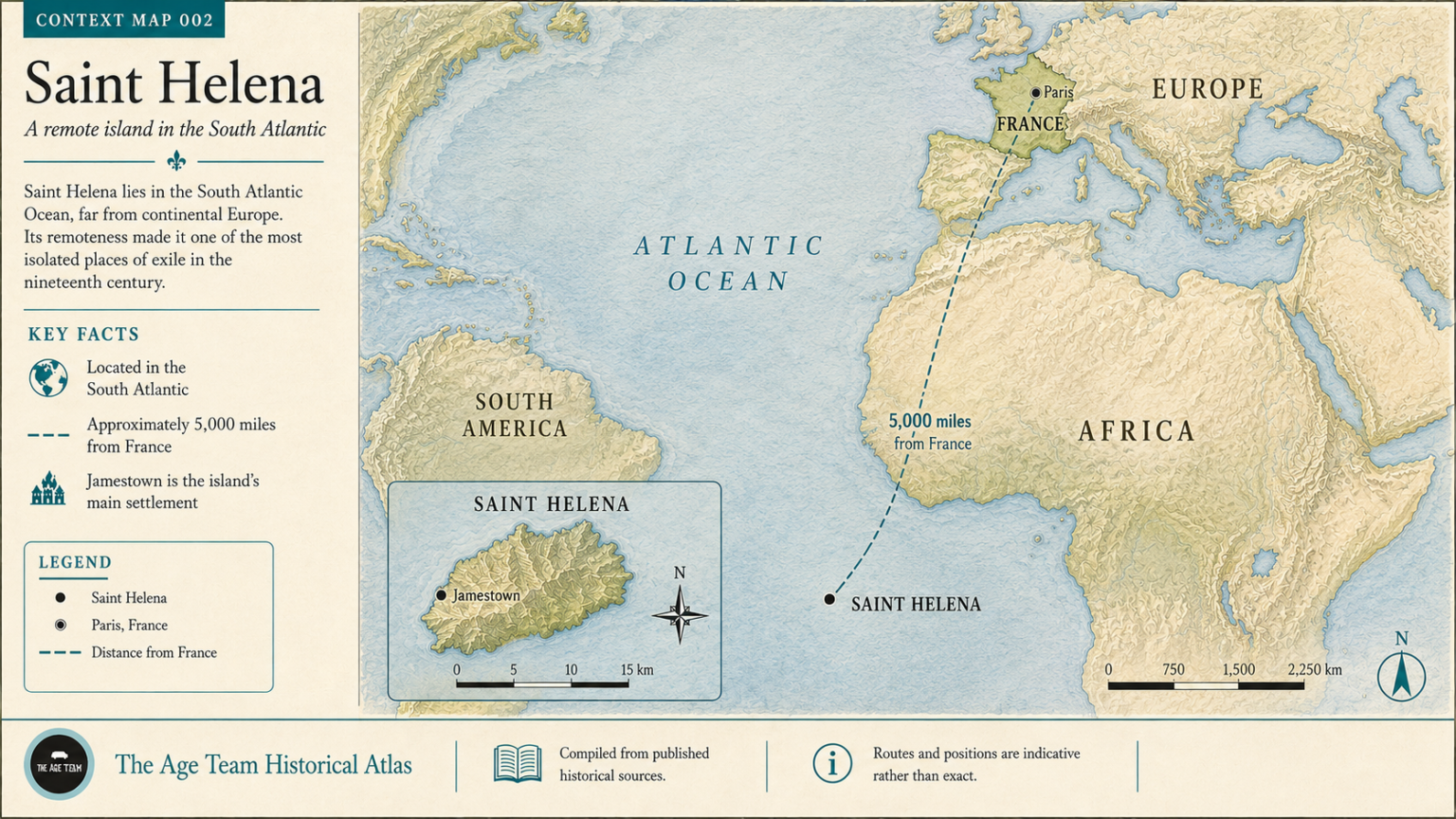
This map shows just how far the British sent their prisoner after Waterloo: not to a nearby fortress or a Mediterranean rock like Elba, but to a speck in the middle of the South Atlantic, nearly 5,000 miles from France and roughly 1,200 miles from the African mainland. Saint Helena had been an East India Company staging post before the Crown took it over specifically to hold Napoleon, and its remoteness — weeks away by sail in any direction — was the entire point. The episode's Saint Helena section uses this map to make the scale of the exile visible: this is the map beat where the show pays off "they didn't just imprison him, they moved the goalposts of the whole map."
Quick Facts
The essentials
Quick Facts
"This rock is wild and barren, no doubt; the climate is monotonous and unwholesome; but the temperature, it must be confessed, is mild and agreeable."
Napoleon Bonaparte, as recorded by Emmanuel de Las Cases
Said to Las Cases while walking in the Longwood garden on 1 February 1816, as Napoleon weighed aloud whether Saint Helena was in fact the least-bad place they could have sent him (compared to a high-latitude or tropical island) — the closest he comes on record to commenting directly on why this exact dot on the map became his prison.
Timeline
How it unfolded
18 June 1815
Defeat at Waterloo
Back at the head of his army in June 1815, Napoleon beat Blucher at Ligny on the 16th but was beaten by Wellington at Waterloo on the 18th, and he finally abdicated on the 22nd.[1]
15 July 1815
Napoleon leaves France
With the coast blockaded by the English squadron and a request to go to America answered with a refusal, Napoleon finally left France on 15 July 1815.[2, p. 135][3, p. 220]
31 July 1815
Exile formally announced at Torbay
On 31 July 1815 Lord Keith and Sir Henry Bunbury formally announced the British government's determination to Napoleon aboard the Bellerophon at Torbay, where newspapers had already reported what was under consideration.[4] Some English newspapers had stated that St. Helena would be the ex-Emperor's place of exile.[2, p. 135]
7 August 1815
Transfer to the Northumberland
On 7 August 1815 Napoleon and the suite he had chosen were moved from the Bellerophon to the Northumberland, which sailed from the Start on 8 August to carry him to St. Helena.[2, p. 135][5, p. 64]
15 October 1815
Arrival at Saint Helena
The Northumberland reached St. Helena on 15 October 1815, and Napoleon landed on the evening of the 17th.[6][5, p. 8] Sloane describes the island as lying four thousand miles from London and 1,140 miles from the coast of Africa.[4]
10 December 1815
Removal to Longwood
Napoleon stayed at the Briars until 10 December 1815, when he removed to Longwood.[5, p. 8] Under the act passed by Parliament, England increased the territorial waters around the island to a ring three times the usual size and policed them with hovering vessels.[4]
5 May 1821
Death of Napoleon at Longwood
Napoleon died on Saturday 5 May 1821.[7, p. 301] He had been lodged at Longwood since being brought to the island in October 1815.[8]
15 October 1840
Exhumation of Napoleon's remains
Napoleon's remains were disinterred on 15 October 1840 and at last returned to France, ending his burial on the island.[9, p. 300]
Dig Deeper
Copy any prompt below into your favourite AI chat to keep exploring.
Longwood House Hudson Lowe Napoleon captivity Saint Helena exile terms
how you turn an entire ocean into a prison wall
the security detail assigned to one already-defeated ex-emperor
Further Reading
Where to read more
Napoleon I: Exile, St. Helena — Encyclopaedia Britannica
Britannica's concise account of the 1815 surrender, the choice of Saint Helena, the move to Longwood, and Napoleon's death there in 1821.
Why look at this: Gives the fast version of exactly what this map depicts — why a mid-Atlantic island over a thousand miles from Africa was chosen specifically because it was nearly impossible to escape from or be rescued to.
https://www.britannica.com/biography/Napoleon-I/Exile-on-St-HelenaThe Emperor's Last Island: A Journey to St Helena, Julia Blackburn (1991)
A hybrid travelogue-history that follows Blackburn's own trip to Saint Helena alongside the accounts of the people who guarded, served, and watched Napoleon there.
Why look at this: Goes well beyond the map's geography into what that isolation actually felt like day to day for everyone on the rock, not just Napoleon — useful ballast for the episode's human-scale beats.
(none found) — legitimate in-print book with no free, login-wall-free full text available online; author's own book page (juliablackburn.com) exists but is promotional rather than a source worth citing here, so left blank rather than pointing to a thin link.Mémorial de Sainte-Hélène (Memorial de Sainte Helene: Journal of the Private Life and Conversations of the Emperor Napoleon at Saint Helena), Emmanuel de Las Cases, 1823
Las Cases' own day-by-day record of his conversations with Napoleon at Longwood, the primary source this whole map's framing (and the in_their_words quote above) is drawn from.
Why look at this: This is the actual document where Napoleon discusses Saint Helena as a place of exile line by line — full primary-source access to the reasoning behind the map, not a summary of it.
https://archive.org/details/memorialdesainte00lascRelated
Keep exploring



Places




Can be seen in
Where this shows up

References
Sources
Sources
- BookNapoleon and the end of the French revolution by Charles F. Warwick ↑
- BookMemoirs of Napoleon Bonaparte — Complete by Louis Antoine Fauvelet de Bourrienne. Page 135. ↑
- BookLife of Napoleon Bonaparte, Volume V. by Walter Scott. Page 220. ↑
- BookThe Life of Napoleon Bonaparte. Vol. 4 (of 4) by William Milligan Sloane ↑
- BookA St. Helena who's who, or a directory of the island during the captivity of Napoleon by Arnold Chaplin. Pages 8, 64. ↑
- BookThe downfall of Napoleon : his escape from Elba, the battle of Waterloo, captivity in St. Helena, and… by Walter Scott ↑
- BookA gift of Napoleon; being a sequel to Letters of Captain Engelbert Lutyens, orderly officer at Longwood, Saint… by Lees Knowles. Page 301. ↑
- Document1911 Encyclopædia Britannica/St Helena ↑
- BookNapoleon and Waterloo, the emperor's campaign with the Armée du Nord, 1815; a strategical and tactical study by Archibald Frank Becke. Page 300. ↑