
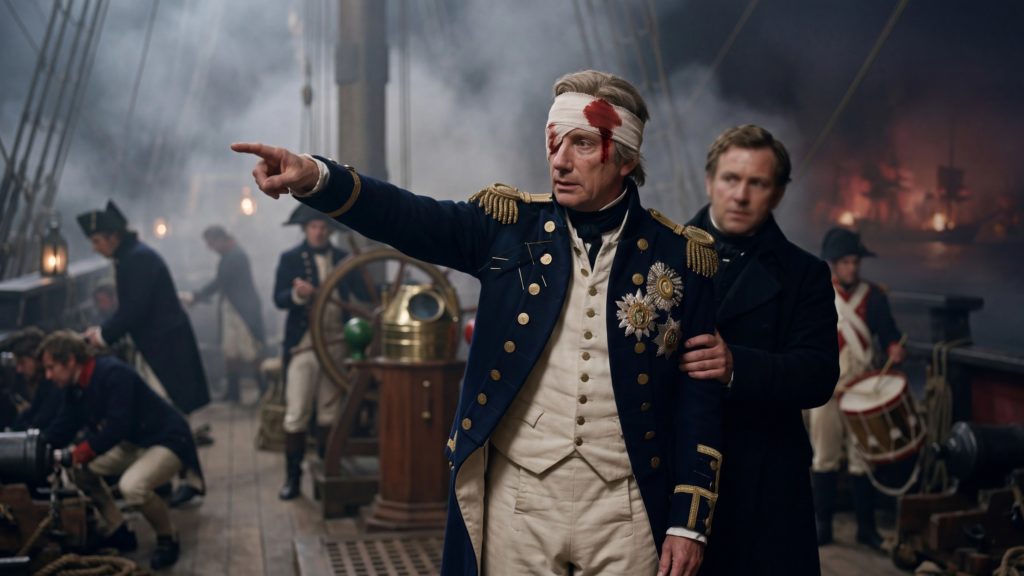
Nelson, wearing the star decorations he refused to hide, paces the deck with his flag captain as the fleet closes on the enemy line at Trafalgar.
Royal Navy Vice-Admiral
The Norfolk rector's son who went to sea at twelve, lost an eye and an arm in separate battles, and then destroyed a French fleet at anchor before dying in the moment of his greatest victory.[1, p. 6]
Bio
Who they were
Horatio Nelson was born on 29 September 1758 in Burnham Thorpe, Norfolk, where his father Edmund Nelson was the local rector[2]. He was one of several children in a modest clergyman's household, without wealth or high connections beyond his mother's family. His path into the Navy came through an uncle, Captain Maurice Suckling, who took the twelve-year-old boy under his wing[3] and had him entered aboard his own ship, the Raisonnable[4], beginning a naval career that would define the rest of his short life.
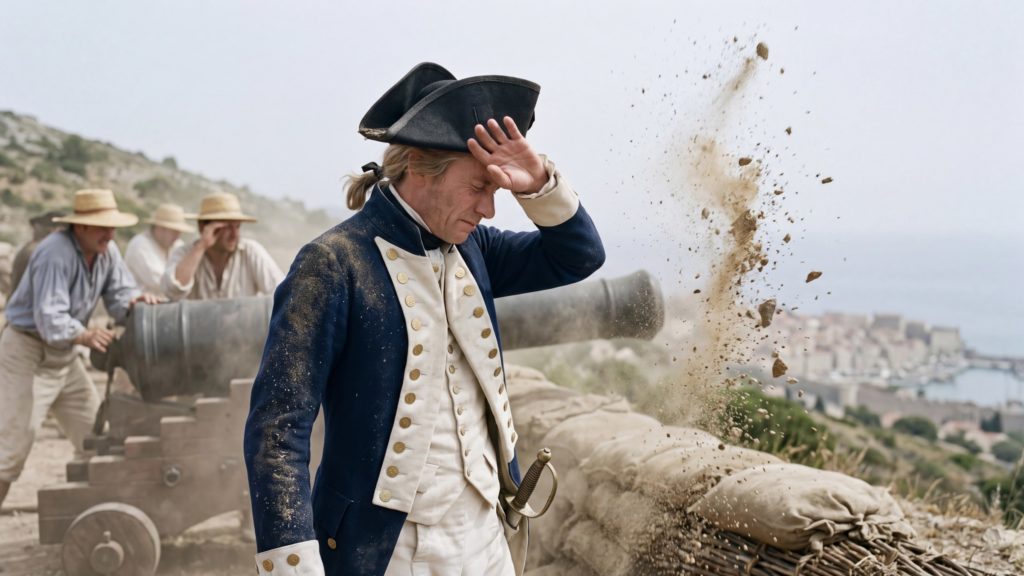
Nelson rose steadily through the ranks of the Royal Navy over the following two decades, gaining a reputation as an aggressive, resourceful commander willing to take risks other captains avoided. That aggression came at a physical cost. At the siege of Calvi in Corsica in 1794 he was wounded in the right eye[5], permanently damaging his sight on that side. Three years later, leading an attack on Santa Cruz de Tenerife in the Canary Islands, he was badly wounded again in a repulsed assault[5] and lost his right arm[6]. Rather than end his career, these injuries only added to his growing legend as a fighting admiral.
Nelson's reputation was sealed by two enormous victories. In 1798 he tracked down and destroyed a French fleet anchored in Egypt's Aboukir Bay at the Battle of the Nile[1, p. 6], trapping and smashing Napoleon's naval support and stranding his army abroad. Seven years later, on 21 October 1805, he commanded the British fleet at the Battle of Trafalgar[7, p. 240], off the coast of Spain, signalling his famous order: "England expects that every man will do his duty"[6] — though he had first drafted it as "England confides that every man will do his duty" before a signals officer suggested the change[8]. The battle crushed the combined French and Spanish fleets, but during it Nelson was shot from the mizzen-top of the enemy ship Redoutable[9].
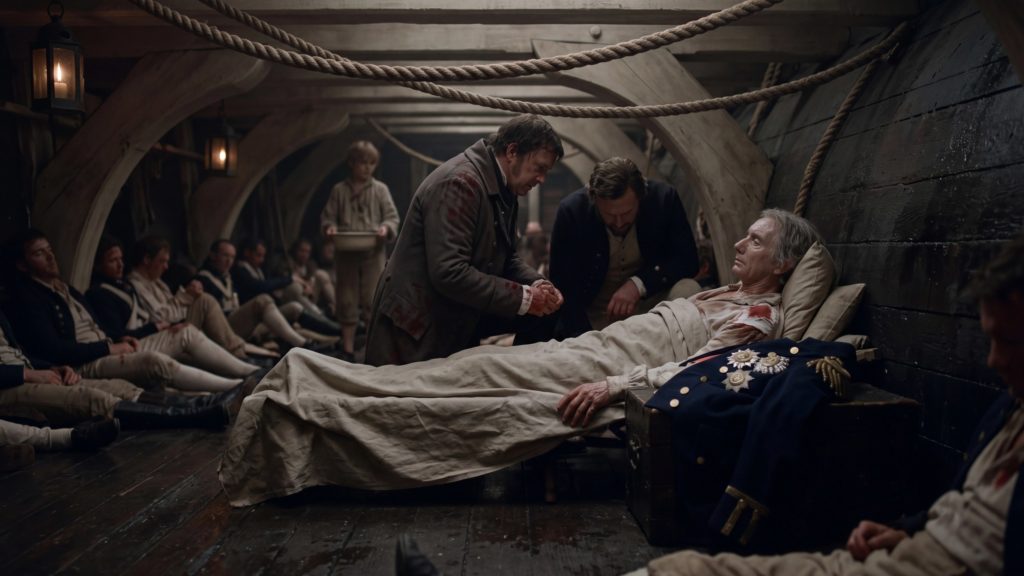
Nelson died aboard HMS Victory a few hours after being shot, having been told the scale of the victory before the end. His last recorded words included, "Thank God, I have done my duty"[9]. His body was brought back to England and lay in state at Greenwich before a huge public funeral[2, p. 328]. The news of Trafalgar combined a total naval victory with a national hero's death, producing an outpouring of public grief unusual for the period.
Trafalgar effectively ended the naval threat of a French invasion of Britain and confirmed British dominance at sea for the following century, underpinning Britain's global trading empire long after Nelson's death. Nelson himself became the era's defining symbol of naval heroism and self-sacrifice, commemorated with Nelson's Column in London's Trafalgar Square and countless ships, streets, and pubs named in his honour. His combination of tactical daring, personal charisma, and a hero's death at the height of victory made him one of the most enduringly celebrated figures in British military history.[7, p. 240]
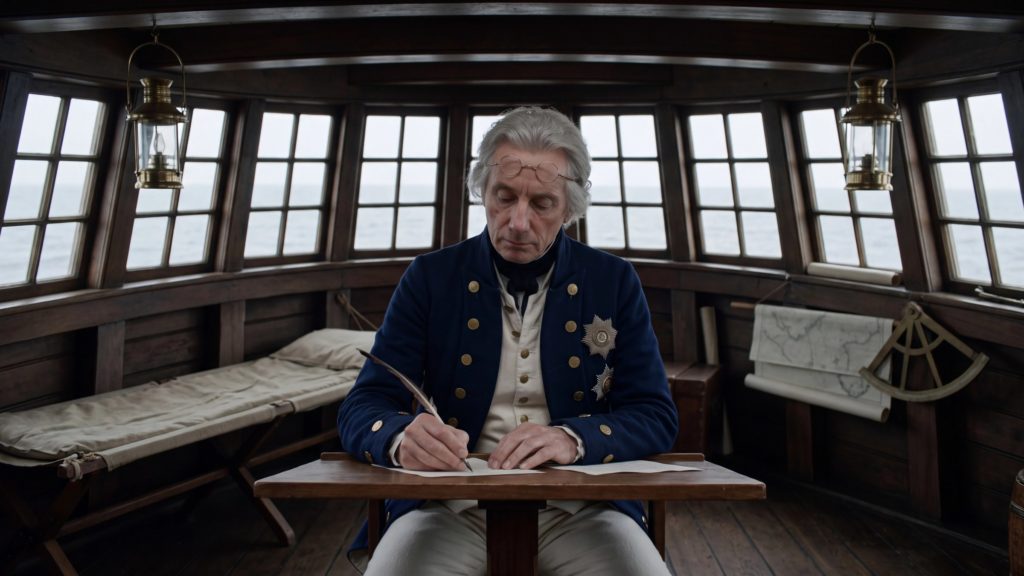
Nelson's famous signal at Trafalgar almost read differently: he originally wanted the fleet told "England confides that every man will do his duty," and only changed it to "expects" after a signals officer pointed out that "confides" would need spelling out letter by letter, while "expects" was already in the signal book[8] — a small edit that became one of the most quoted lines in British history.
Legacy & Reputation
What’s the verdict?
Nelson has long been treated in Britain as an almost unblemished national hero, but historians have increasingly examined his personal life more critically, particularly his public affair with Emma, Lady Hamilton[10], which scandalized society at the time despite his fame. His tactical brilliance at the Nile and Trafalgar is not seriously disputed by historians, but modern reassessments have pushed back against the purely heroic image inherited from Victorian biographers.
Myth-buster
Think you know this one?
Nelson’s famous order is usually quoted as “England expects that every man will do his duty” — but that wasn’t his first choice of words. He initially wanted to signal “England confides that every man will do his duty,” and switched to “expects” only because it was faster to send by flag signal[8].
Quick Facts
The essentials
Quick Facts
Roger would like you to know…
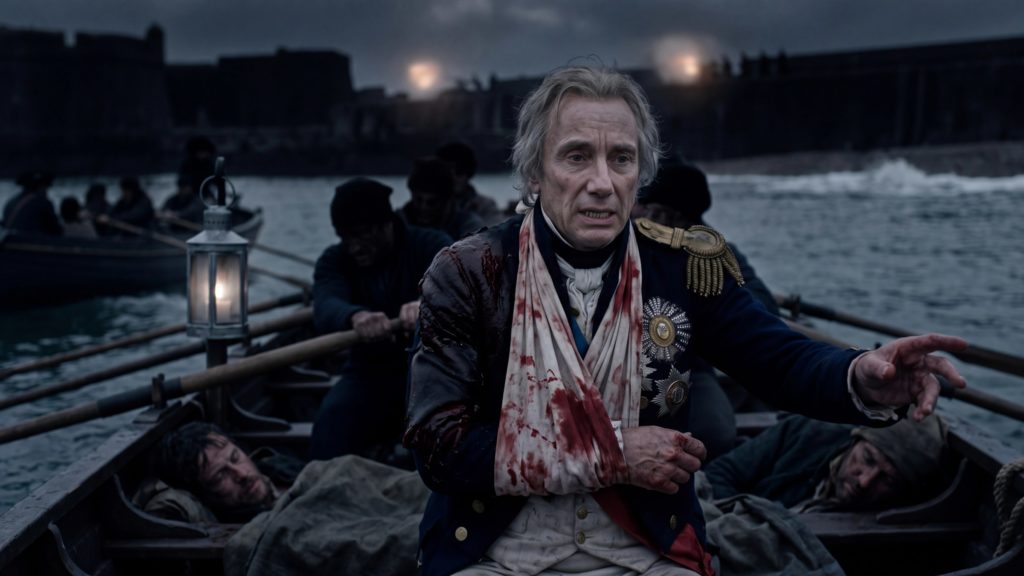
In July 1797, Nelson led a badly bungled night assault on Santa Cruz de Tenerife and paid for it with his right arm, shattered by grapeshot and amputated within minutes of getting back aboard ship[11]. He was writing letters left-handed within days.
Keith checked the sources…
After Nelson died at Trafalgar, there was no coffin ready aboard HMS Victory, so his body was placed in a cask and preserved in brandy for the five-week voyage home[12]. The brandy was topped up twice along the way, without ever disturbing him.
This sounds invented, but…
Sailors later claimed to have drunk the very spirit Nelson's body was preserved in, giving navy rum its nickname 'Nelson's blood.' It's a great story with one flaw: the cask actually held brandy, not rum[12]. The nickname survived the correction rather better than the facts did.
Keith would like to clarify…
At the Battle of Copenhagen in 1801, ordered to withdraw, Nelson reportedly raised his telescope to his blind eye and told his flag captain, 'I really do not see the signal'[5]. He kept fighting, and he won.
History has added a footnote…
Nelson's last general signal before Trafalgar read: 'England expects that every man will do his duty'[6]. It went up the mast as a string of numbered flags, hoisted just before the two fleets closed for battle — a message meant to be seen by every ship at once.
Roger has a theory…
While still married to Frances Nisbet, Nelson fell for Emma Hamilton, wife of the British envoy in Naples — and the affair became one of the most talked-about scandals in Georgian England[13]. Naval glory and personal scandal, it turned out, travelled together rather well.
One for the Ageonauts…
Britain's greatest admiral got seasick. Nelson admitted it himself, writing in 1804 that he was 'ill every time it blows hard,' and historians have traced the complaint back to his very first voyages[14]. He just never let it keep him off a ship.
Roger insists this matters…
Nelson's Column didn't go up in Trafalgar Square until 1843 — nearly forty years after his death at the battle it commemorates[9]. Fame, it seems, can afford to wait for the funding.
Keith has spotted the problem…
Nelson let it be known well before his death that he'd 'rather be buried at St Paul's than any other place'[15]. Westminster Abbey was the more traditional resting place for national heroes — Nelson simply had other plans.
Down the rabbit hole we go…
Nelson went properly to sea at twelve, when his uncle, Captain Maurice Suckling, enrolled him as a midshipman on HMS Raisonable in January 1771[5]. A remarkably early start for a boy who'd spend the rest of his career feeling seasick.
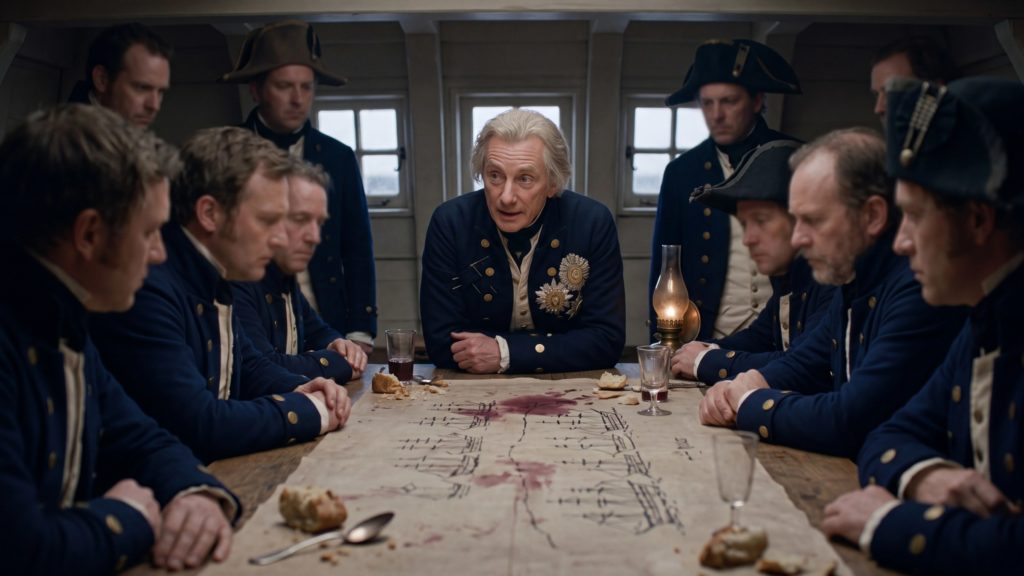
Thank God, I have done my duty.
Horatio Nelson
Spoken as he lay dying below decks aboard HMS Victory after being shot during the Battle of Trafalgar, 21 October 1805[9].
Timeline
How it unfolded
29 September 1758
Birth of Horatio Nelson
Horatio Nelson, fifth son of the Rector of Burnham Thorpe in Norfolk, was born in the village on 29 September 1758.[16]
24 July 1797
Night attack on Santa Cruz de Tenerife
In the disastrous night attack on Santa Cruz de Tenerife, Nelson was shot through the right elbow as he stepped from his boat, and he lost his right arm.[4, p. 40][17][17]
1 August 1798
Battle of the Nile
Nelson's squadron found the French fleet at anchor in Aboukir Bay on the afternoon of 1 August 1798.[18, p. 89] Of thirteen French sail of the line, nine were taken and two burned, a victory Nelson called a conquest.[17]
2 April 1801
Battle of Copenhagen
Serving as second-in-command to Sir Hyde Parker in the Baltic, Nelson won the battle of Copenhagen on 2 April 1801 almost entirely by his own initiative.[19] When Parker signalled to leave off action, Nelson is said to have put his glass to his blind eye and remarked that he did not see the signal.[18, p. 89]
21 October 1805
Battle of Trafalgar
Nelson had said more than once that 21 October, a family festival, would be the day of his battle, and his diary that day finds him in sight of the combined fleets of France and Spain.[17] Twenty of the enemy struck, and Southey judged that after Trafalgar the maritime war was considered at an end.[17][17]
21 October 1805
Death of Nelson
Mortally wounded in the battle, Nelson died at half past four, three hours and a quarter after he was hit, his last repeated words being "Thank God I have done my duty."[17] On examination the wound was found to be mortal, a fact concealed from all except Captain Hardy, the chaplain and the medical attendants.[17]
Dig Deeper
Copy any prompt below into your favourite AI chat to keep exploring.
Explain how Nelson's night attack at the Battle of the Nile in 1798 trapped and destroyed the French fleet at anchor.
What does Nelson's willingness to attack at night, against naval convention, teach us about the value of breaking the rulebook?
Roleplay Nelson explaining to his officers why attacking at night, in unfamiliar waters, was actually the smart move.
Further Reading
Where to read more
Horatio Nelson - Britannica
Reference biography of Nelson's naval career, from going to sea at age 12 through his victories at the Nile and Copenhagen to his death at Trafalgar in 1805.
Why look at this: Establishes the basics fast: how a Norfolk clergyman's son who went to sea at 12 rose to command the fleet that broke French and Spanish naval power for a century.
https://www.britannica.com/biography/Horatio-NelsonThe Pursuit of Victory: The Life and Achievement of Horatio Nelson, by Roger Knight
Acclaimed single-volume biography (2005) placing Nelson firmly within the Royal Navy of his era, drawing on a wide range of sources to look past the myths that grew up around him. Winner of the Anderson Medal and the Mountbatten Award.
Why look at this: Complicates the straightforward-hero story - showing how Nelson's advancement was helped by a relatively weak generation of admirals above him, and how difficult a subordinate he could be even as he charmed his political superiors.
https://www.penguin.co.uk/books/54159/the-pursuit-of-victory-by-roger-knight/9780141007618The life and career of Horatio Nelson - The National Archives (UK)
A primary-document gallery from the UK National Archives, with catalogue links to Nelson's muster book entry, his lieutenancy passing certificate, the medical journal recording the amputation of his arm, HMS Victory's ship's log from Trafalgar, and his will.
Why look at this: You can read the actual HMS Victory ship's log entry recording Nelson's death shortly after 3:40pm on 21 October 1805 - the real record behind the famous last-words story.
https://www.nationalarchives.gov.uk/explore-the-collection/explore-by-time-period/georgians/the-life-and-career-of-horatio-nelson/Related
Keep exploring




Can be seen in
Where this shows up

References
Sources
Sources
- WebsiteHeritage Classical Curriculum - Modern Europe - Napoleon. Page 6. ↑
- BookThe life of Admiral Lord Nelson, K.B., from his lordship's manuscripts : By James Stanier Clarke and John… by James Stanier Clarke and John McArthur. Page 328. ↑
- BookPictures from the life of Nelson by William Clark Russell ↑
- BookRobert Southey's Life of Nelson by Robert Southey. Page 40. ↑
- BookDrake, Nelson and Napoleon by Baron Walter Runciman Runciman ↑
- BookThe sailors whom Nelson led : their doings described by themselves by Edward Fraser ↑
- BookNelson's Hardy : his life, letters and friends by Alexander Meyrick Broadley and R. G Bartelot. Page 240. ↑
- BookThe Life of Nelson, Volume 2 by A. T. Mahan ↑
- BookHoratio Nelson and the naval supremacy of England by William Clark Russell ↑
- BookLady Hamilton And Lord Nelson, vol. 1 (epub) by John Cordy Jeaffreson ↑
- Websitermg.co.uk: Rmgc object 11990 ↑
- Websitermg.co.uk: Rum deal origins nelsons blood ↑
- BookMemoirs of Emma, lady Hamilton : the friend of Lord Nelson and the court of Naples by Walter Sydney Sichel ↑
- Websiteusni.org: Seasick admiral ↑
- BookNelson in England : a domestic chronicle by Esther Meynell ↑
- BookNelson by John Knox Laughton ↑
- BookThe Life of Horatio, Lord Nelson by Robert Southey ↑
- BookThe Life Of Nelson, 2nd edition by Alfred Thayer Mahan. Page 89. ↑
- BookThe Nelsons of Burnham Thorpe : a record of a Norfolk family compiled from unpublished letters and notebooks… by Mary Eyre Matcham ↑
- BookThe Barker collection : manuscripts of and relating to Admiral Lord Nelson by John Knox Laughton and Frederick Barker ↑