
On 23 November 1828, his first day on the east bank at Thebes, Champollion saw the temples of Luxor and Karnak, and wrote that he could not hope to describe them — shown here craning back to take in the columns of the great hall, with expedition members small in the distance.
French philologist and Egyptologist who deciphered Egyptian hieroglyphs
A boy who could read Greek and Latin by ten[1], he began working on the Rosetta Stone in 1808[1] and on 27 September 1822 told the Paris Academy of Inscriptions how to read Egyptian hieroglyphs[1].
Bio
Who they were
Jean-François Champollion was born at Figeac, in south-western France[2], in December 1790[3, p. 251]. He was the youngest of the family and the son of a bookseller, Jacques Joseph Champollion[1]. He was largely brought up by his brother Jacques-Joseph, who was twelve years older[1]. Jacques-Joseph later added the town's name to his own and became Champollion-Figeac[1]. The younger brother was known as Champollion le Jeune, meaning the younger[3, p. 251]. By the age of ten the boy could read Greek and Latin[1]. In 1801 he moved to Grenoble to live with his brother[1]. There Joseph Fourier, the local prefect (the government's regional governor), who had served with Napoleon's army in Egypt, encouraged his interest in the country[1].
From 1807 Champollion studied oriental languages in Paris, including Hebrew, Arabic and Coptic[1]. Coptic, the later form of the Egyptian language, became his passion, because he planned to base his work on Egyptian writing on it[1]. In 1808 he began working on the Rosetta Stone[1]. He returned to Grenoble in 1810 as professor of ancient history[1]. Thanks to Fourier, he was spared military service[2]. In 1814 he published L'Égypte sous les Pharaons[2]. After Napoleon's defeat at Waterloo in 1815 he lost his post and was exiled to Figeac, but he kept working on the Rosetta Stone and other texts[1].
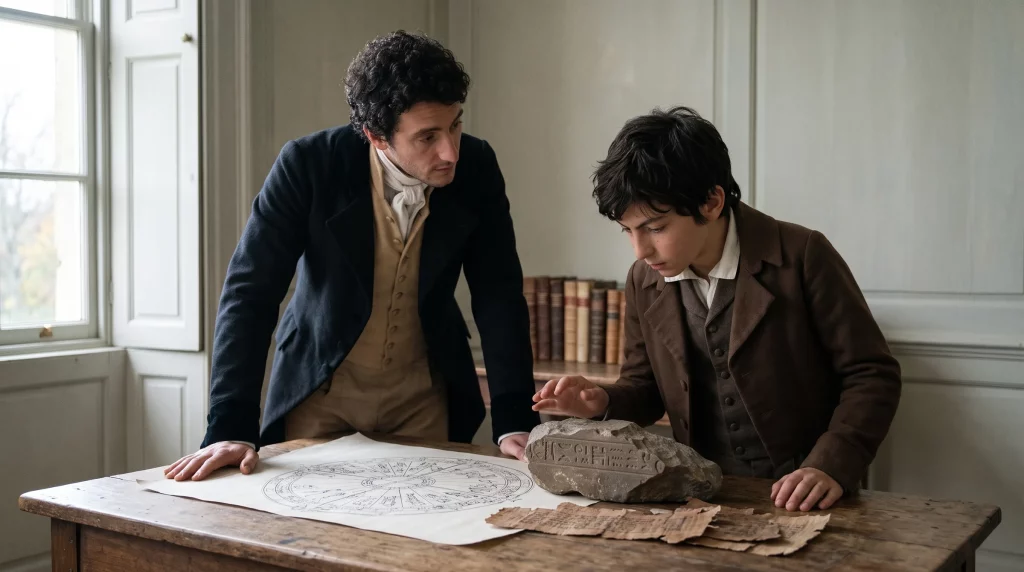
The Rosetta Stone, found by French soldiers in July 1799, carries one decree in three scripts: Greek, hieroglyphs and Demotic, a cursive form of Egyptian[1]. The English polymath Thomas Young was the first to see that hieroglyphs could spell sounds[3, p. 251], and he read the name Ptolemy on the stone[4]. Champollion, better trained in Coptic, applied the idea to royal names such as Ptolemy and Cleopatra and produced a hieroglyphic alphabet[3, p. 251]. On 27 September 1822 he announced his breakthrough to the Academy of Inscriptions in Paris[1]. It was printed as the Lettre à M. Dacier, on the hieroglyphs used to write the names of Greek and Roman rulers[5]. Young sat beside him, impressed, though he later felt Champollion had not credited him enough[1]. Champollion's fuller Précis du système hiéroglyphique followed in 1824[6].
In 1826 Champollion was appointed curator of the Egyptian collections at the Louvre[1]. In 1828 and 1829 he took part in the Franco-Tuscan expedition, which visited Egypt to study its monuments[6]. His protégé Ippolito Rosellini later produced finished engravings from the expedition's notes and sketches[7]. In March 1831 a chair of Egyptian history and archaeology was created for him at the Collège de France, but he gave only three lectures before illness stopped him[1]. He died on 4 March 1832[3, p. 251]. A stroke killed him in Paris at the age of 41[7], and he was buried in Père Lachaise Cemetery[1]. His brother later published his Egyptian grammar, in parts from 1836[3, p. 251].
Champollion is celebrated as the founding father of Egyptology[2]. His decipherment opened hieroglyphic records that had been lost to readers since antiquity[6]. The results of his Egyptian expedition appeared after his death, as the Monuments de l'Égypte et de la Nubie, published by his brother between 1835 and 1845[6]. Later scholars built on his grammar. His student Karl Richard Lepsius found that vowels were not written, and the Decree of Canopus, discovered by Lepsius, was read in 1866 using Champollion's method[8]. Figeac now has a museum devoted to him, and a street in Cairo and a crater on the far side of the Moon are named after him[1].
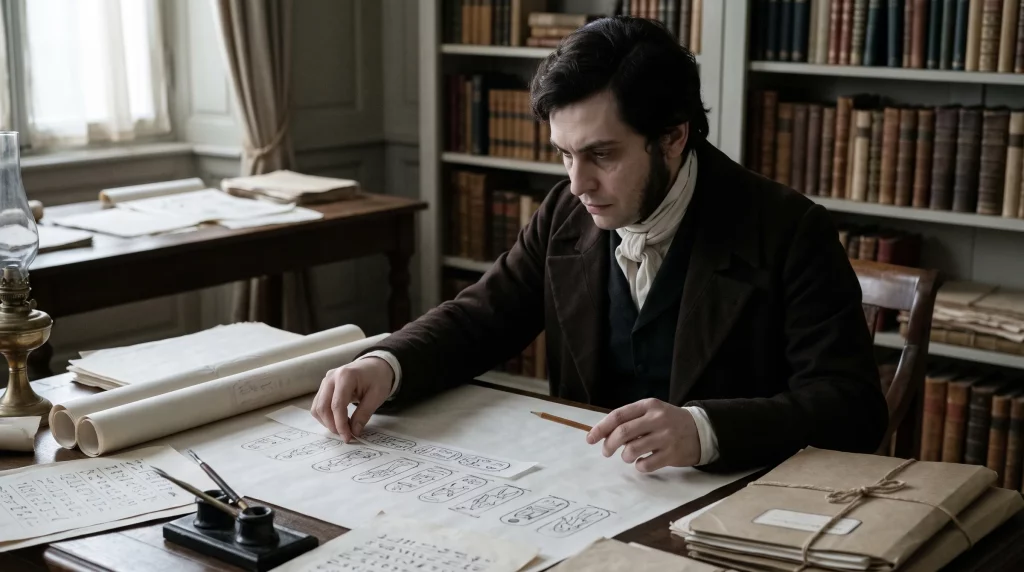
As a young man Champollion made a game of languages. While he was studying Arabic he wore Arab dress and took the nickname al Seghir, Arabic for the younger[1]. Absorbed in Coptic, he wrote to his brother in 1809 that he dreamed in it, and for fun translated everything that came into his head into the language[1]. In 1818 he married Rosine Blanc in Grenoble, and their only child, a daughter named Zoraïde, was born in 1824[1].
Legacy & Reputation
What’s the verdict?
Egyptologists treat Champollion as the founder of their subject[2]. The MacTutor biography calls the idea that Young simply came first and Champollion built on him a vast oversimplification, while saying Champollion came out of the 1821 episode over Young’s work with little credit[1]. Wallis Budge wrote in 1929 that Young first grasped the phonetic principle, but that Champollion, better trained in Coptic, produced the alphabet Egyptologists use today[3, p. 251]. In 1836 George Long, writing on the British Museum’s Egyptian antiquities, argued that Champollion had no claim to have discovered the phonetic values[9, p. 467].
Myth-buster
Think you know this one?
Many tellings have Champollion solving hieroglyphs in one flash from the Rosetta Stone alone. In fact he had been working on the stone since 1808[1], drew on his Coptic and on inscriptions such as the Philae obelisk[3, p. 251], and built on Thomas Young’s earlier reading of the name Ptolemy[4].
Quick Facts
The essentials
Quick Facts
Taught himself to read from a prayer book
Champollion's mother could not read, but she had memorised much of the Mass[1]. At about five, he seems to have taught himself to read by matching what he knew by heart to the printed prayer book[1]. Matching a known text to unknown symbols was good practice for later.
Keith notes a curious maths record
Champollion hated mental arithmetic and soon gave up primary school[1]. Yet in his later schooling he was awarded a prize for mathematics, one of his weakest subjects[1]. Keith would like that framed and hung next to the hieroglyphs.
An obelisk for Paris
In 1829, as Champollion's expedition prepared to leave Egypt, the ruler Muhammad Ali Pasha offered France the two obelisks standing at the entrance of Luxor Temple[8]. Only one was shipped to Paris, where it now stands in the Place de la Concorde[8].
Roger loves a prophecy
A note in the 1909 edition of Champollion's letters says Fourier, his old protector, pointed at the Panthéon's dome as he left for Egypt and said Egypt would one day place him there[10]. Instead Champollion rests in Père Lachaise, a few steps from Fourier's tomb[10].
A chat with the emperor
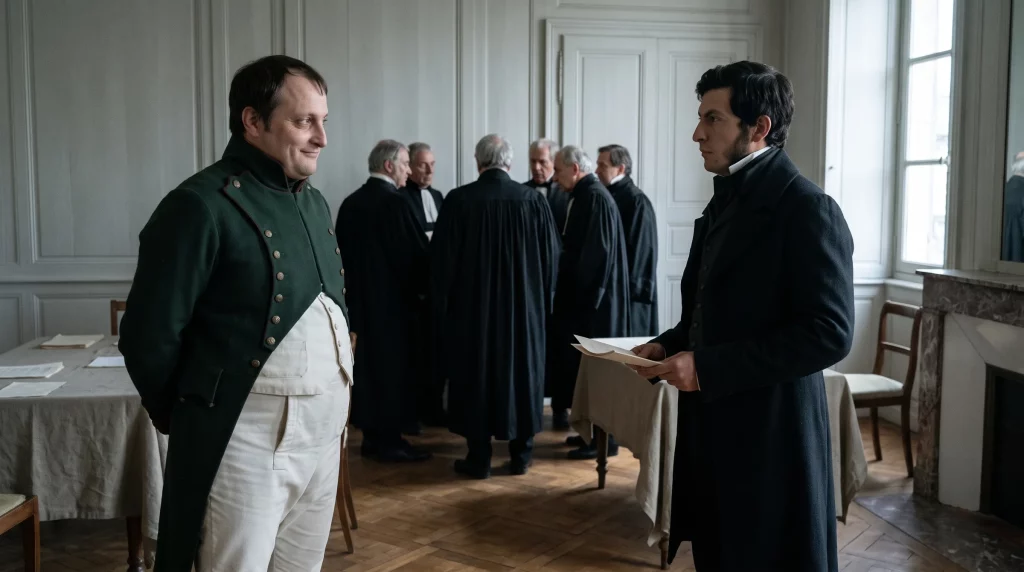
In 1815 Napoleon escaped from Elba and entered Grenoble, where he met Champollion[1]. He remembered that the young scholar had avoided the draft because his Egyptian work mattered, asked how it was going, and requested his Coptic grammar for publication in Paris[1].
Roger insists on the dramatic version
As the story is usually told, on 14 September 1822 Champollion ran down the street to find his brother, shouted 'Je tiens mon affaire!', meaning 'I've got it', and collapsed from the excitement[8]. He then spent about a week writing up his results before the 27 September meeting[8].
Keith points out who sat next to him
Thomas Young sat beside Champollion at the Academy on 27 September 1822 and was very impressed[1]. In his published account, Young wrote that nobody but himself had suspected the meaning of the female ending of royal names[11], and he felt Champollion had not credited him[1]. Keith calls it a fair fight.
Tried for treason and acquitted
In March 1821 Champollion was seen among the rebels in an uprising in Grenoble, and the authorities tried to have him charged with treason, an offence punishable by death[1]. He was tried in a civil court instead and acquitted, though his post at the lycée was lost[1].
Roger's least favourite souvenir
On the expedition Champollion damaged the tomb of Seti I in the Valley of the Kings, KV17, by removing a wall panel measuring 2.26 by 1.05 metres[8]. He also urged Egypt's ruler to control tourism, excavation and the antiquities trade strictly[8]. Roger calls it an own goal.
Keith puts a Persian king on the table
A vase of eastern alabaster in the king's cabinet carried a hieroglyphic cartouche of the Persian king Xerxes beside cuneiform characters[12]. The orientalist Saint-Martin found that the cuneiform spelled the same name[12]. Keith loves a cross-check between two ancient scripts.

il n'y a rien à modifier dans notre Lettre sur l'alphabet des hiéroglyphes; notre alphabet est bon
Jean-François Champollion
Champollion's words in French, from his New Year letter of 1 January 1829 to Dacier, written at Wadi Halfa at the second cataract of the Nile, after he had followed the river from its mouth. In English he says there is nothing to change in his Letter on the alphabet of the hieroglyphs, because the alphabet is good[13].
Timeline
How it unfolded
23 December 1790
Birth of Jean-François Champollion
Champollion was born at Figeac in south-western France on 23 December 1790 according to MacTutor[1]. Budge gives 23 or 24 December[3, p. 251] and the BBC 22 December[2].
27 March 1801
Move to Grenoble
Called to join his brother Jacques-Joseph, the ten-year-old travelled alone to Grenoble, arriving on 27 March 1801[1]. There Fourier, who had served in Napoleon's Egyptian expedition, encouraged his interest in Egypt[1].
1808
Work on the Rosetta Stone begins
In 1808 Champollion first began working on the Rosetta Stone[1]. He wrote that he was totally immersed in Coptic, because his great work on hieroglyphs would be based on that language[1].
1815
Meeting Napoleon at Grenoble
When Napoleon escaped from Elba and entered Grenoble in 1815, he met Champollion and remembered that the young scholar had avoided the draft because his Egyptian work was important[1].
27 September 1822
Lettre à M. Dacier
On 27 September 1822 Champollion announced his breakthrough to the Academy of Inscriptions in Paris[1]. It was printed as the Lettre à M. Dacier, on the phonetic hieroglyphs used for the names of Greek and Roman rulers[5].
1824
Publication of the Précis
Champollion quickly followed his announcement with the Précis du système hiéroglyphique, published in 1824[6]. His discovery marked the birth of modern Egyptology, reopening records unreadable since antiquity[6].
1824
Study of the Turin collection
The King of Sardinia bought the great Egyptian collection on 23 January 1824[14], and by October Champollion was writing to his brother from Turin[14, p. 41]. The museum's defenders said he had free access to everything there[15].
1826
Curator of the Louvre's Egyptian collections
In 1826 Champollion was appointed curator of the Egyptian collections of the Louvre and, with his brother's help, created an Egyptian exhibition in four rooms[1].
1828 - 1829
Franco-Tuscan expedition to Egypt
Champollion was a prominent member of the Franco-Tuscan expedition that visited Egypt in 1828 and 1829 to study its monuments[6]. On 1 January 1829, at Wadi Halfa, he wrote to Dacier that nothing in his alphabet needed changing[13].
4 March 1832
Death of Champollion
Champollion collapsed and died on 4 March 1832[3, p. 251], felled by a stroke in Paris at the age of 41[7]. He was buried in Père Lachaise Cemetery[1].
Dig Deeper
Copy any prompt below into your favourite AI chat to keep exploring.
Explain how Champollion used royal names like Ptolemy and Cleopatra, written in cartouches, to show that Egyptian hieroglyphs could spell out sounds as well as ideas.
Debate whether Thomas Young or Champollion deserves more credit for deciphering Egyptian hieroglyphs, given that Young's early work on the Rosetta Stone was real but Champollion went much further.
Roleplay Thomas Young sitting beside Champollion at the Paris Academy on 27 September 1822, trying to look gracious while his rival explains how to read Egyptian hieroglyphs.
Further Reading
Where to read more
Jean-François Champollion (1790 - 1832) - BBC History, Historic Figures
A short archived BBC biography of the French scholar who deciphered Egyptian hieroglyphs, from his schooling in Grenoble to the Louvre and his expedition to Egypt.
Why look at this: Gives the quickest route from the Rosetta Stone to the Louvre: Fourier's influence in Grenoble, the 1822 Lettre à M. Dacier and the 1824 Précis, then the 1826 museum post and the Egyptian expedition.
https://www.bbc.co.uk/history/historic_figures/champollion_jean.shtmlJean-François Champollion - Biography, MacTutor History of Mathematics Archive, University of St Andrews
A long, well-referenced biography following Champollion from Figeac and Grenoble through the Rosetta Stone work, the September 1822 announcement and the Louvre to the expedition to Egypt.
Why look at this: Treats the Thomas Young question fairly: Champollion began on the Rosetta Stone in 1808, Young only from 1814, and the biography calls the 'Young first' story a vast oversimplification, while noting the credit Young felt he was owed after the 27 September 1822 meeting.
https://mathshistory.st-andrews.ac.uk/Biographies/Champollion/Lettre à M. Dacier ... relative à l'alphabet des hiéroglyphes phonétiques (Paris, 1822) - Champollion le jeune, Internet Archive
A free digitised copy of the 1822 printed Lettre à M. Dacier, issued in Paris by Firmin Didot, with full-text, PDF and EPUB downloads.
Why look at this: Lets you read the founding text of the decipherment itself: the letter on the phonetic hieroglyphs used to write the names and titles of Greek and Roman rulers, announced to the Academy of Inscriptions on 27 September 1822.
https://archive.org/details/bub_gb_7PymbAAf0lcCRelated
Keep exploring
People

Places



Can be seen in
Where this shows up

References
Sources
Sources
- WebsiteJean-François Champollion (1790 - 1832) - Biography - MacTutor History of Mathematics (mathshistory.st-andrews.ac.uk) ↑
- WebsiteBBC - History - Jean-François Champollion (bbc.co.uk) ↑
- BookThe Rosetta Stone in the British Museum: The Greek, Demotic and Hieroglyphic Texts of the Decree Inscribed on… by Wallis Budge. Page 251. ↑
- BookThe Rosetta Stone by Sir E. A. Wallis Budge ↑
- BookLettre a m. Dacier, secretaire perpetuel de l'Academie Royale des inscription et belleslettres, relative a l'alphabet des hieroglyphes… by Jean Francois le jeune Champollion ↑
- WebsiteJean-François Champollion's deciphering of hieroglyphs - BCUL (bcu-lausanne.ch) ↑
- Websiteencyclopedia.com: Jean francois champollion ↑
- WebsiteJean-François Champollion - Wikipedia (en.wikipedia.org) ↑
- BookThe British museum. Egyptian antiquities [by G. Long]. by British museum dept. of or . antiq George Long. Page 467. ↑
- BookLettres de Champollion le jeune by Jean-François Champollion and Hermine Hartleben ↑
- BookAn account of some recent discoveries in hieroglyphical literature, and Egyptian antiquities : including the author's original alphabet… by Thomas Young ↑
- BookEssay on the hieroglyphic system of M. Champollion, jun. : and on the advantages which it offers to… by J.-G.-H. Greppo and I. W. Stuart ↑
- BookLettres écrites d'Egypte et de Nubie by Jean-François Champollion ↑
- BookLettres de Champollion le jeune by Jean-François Champollion and Hermine Hartleben. Page 41. ↑
- BookThe Fragments of the Hieratic Papyrus at Turin: Containing the Names of Egyption Kings, with the ... by Sir John Gardner Wilkinson ↑