
About This Map
What it shows
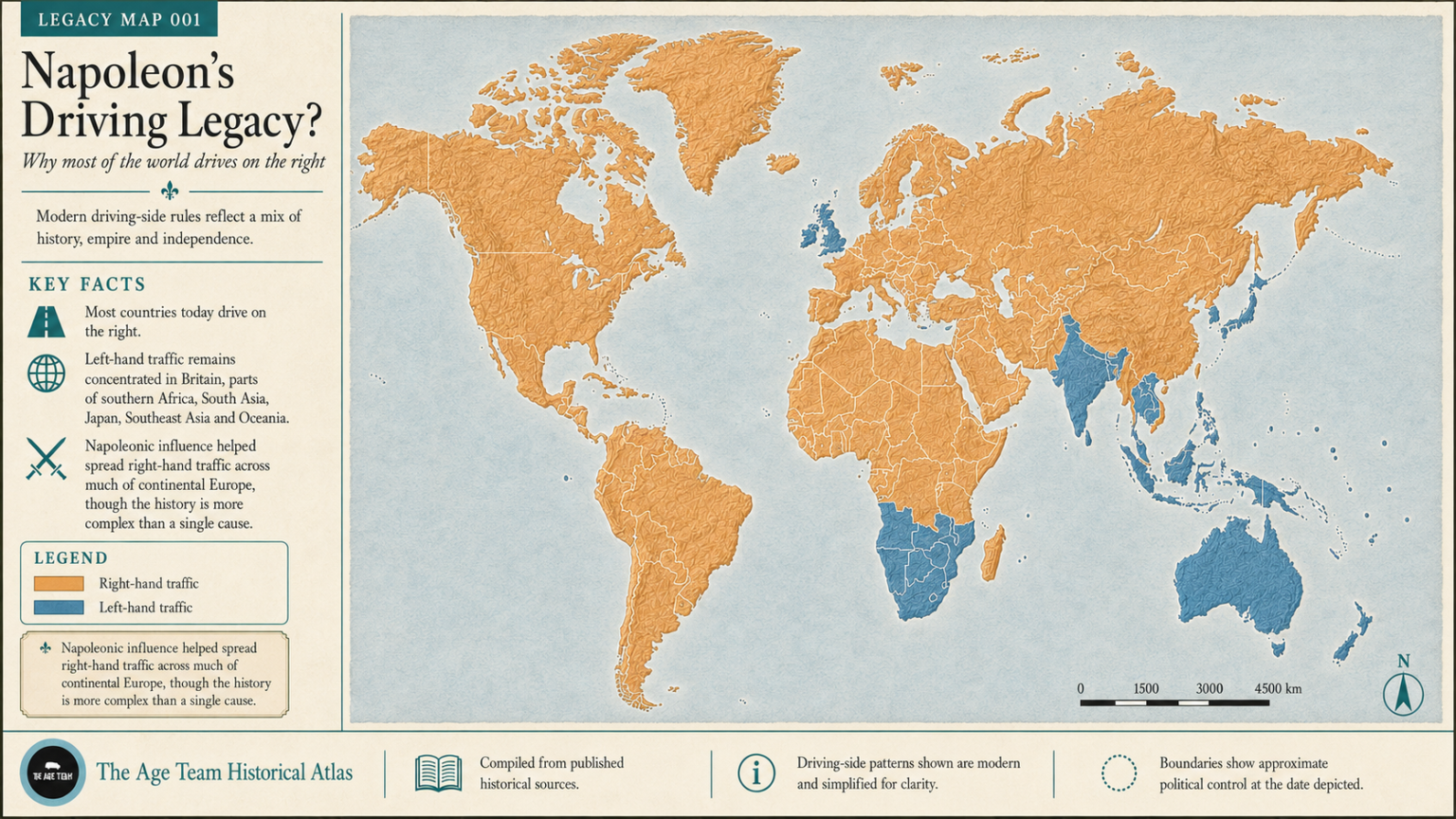
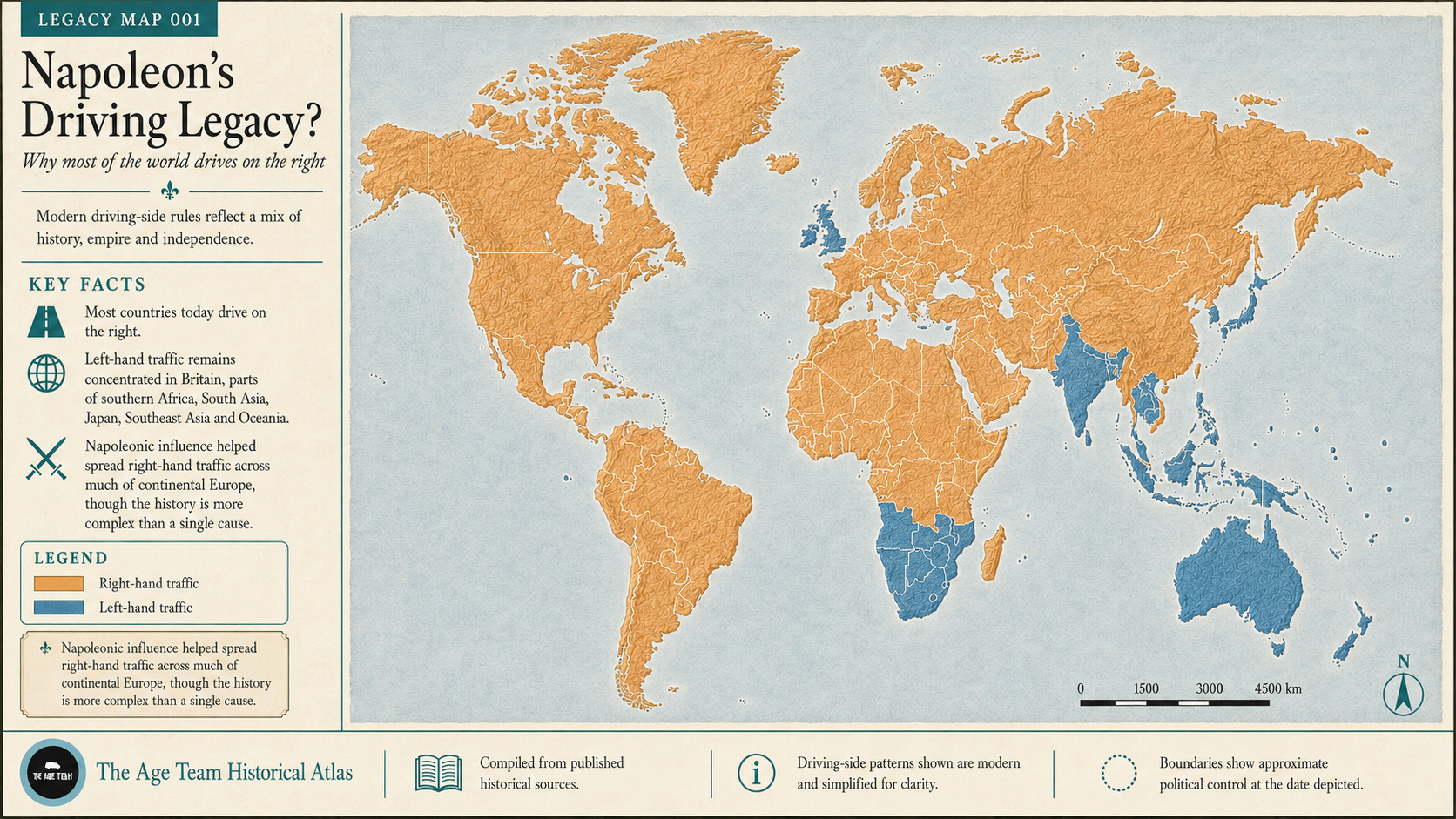
Today's world splits roughly two-to-one for right-hand traffic — around 160 countries and territories drive on the right, against roughly 75, mostly Britain and its former empire, plus Japan, Indonesia and a scatter of islands and southern African states, that keep to the left. The episode's joke credits Napoleon with pushing continental Europe over to the right, and there is a real thread of truth in it: revolutionary France had already begun tilting right before he took power, and his conquests then carried that habit into the Low Countries, Switzerland, and parts of Germany, Italy, Poland and Spain, which still drive on the right today. But no contemporary decree ordering the change has ever surfaced, and historians who study the topic closely, Peter Kincaid chief among them, treat the "Napoleon did it" version as an oversimplification layered onto older and messier causes, from postilion-driven freight wagons to plain local custom. The map is honest about that tangle: it shows where right and left prevail now, not proof of a single Napoleonic cause, and treats Napoleon's real, well-documented legacy, the Napoleonic Code and the metric system's spread, as the sturdier claim to make on his behalf.
Quick Facts
The essentials
Quick Facts
"The left side is the right side, and the right side is suicide."[1]
An unnamed Kingston taxi driver, as retold by "TK" (father of the collector, Luka Karaman) - USC Digital Folklore Archives
A Jamaican folk saying - not a Napoleon quote - collected on 24 April 2017 and posted to the USC Digital Folklore Archives on 29 April 2017.
Timeline
How it unfolded
7 April 1795
Metric System Defined in French Law
The metric system was formally defined in French law on 7 April 1795.[2]
9 November 1799
Coup of 18 Brumaire
The 18th Brumaire fell on 9 November 1799, according to Henry Adams.[3] A decree of the Ancients moved the Councils to Saint-Cloud and placed General Bonaparte in command of the military forces of the capital.[4] That night the Ancients appointed three temporary Consuls, Bonaparte, Sieyes and Ducos.[4]
19 May 1802
Law Organizing the Legion of Honour
The law for organizing the Legion of Honour, passed on 19 May 1802, formed a Legion to reward civil services and virtues as well as military ones.[5] The order was founded by First Consul Napoleon Bonaparte.[6]
30 April 1803
Louisiana Treaty Dated
Napoleon's definitive confirmation of the sale of Louisiana to the United States followed on 30 April 1803, and that date was accepted as the date of the treaty.[7] Henry Adams notes that the documents were antedated to 30 April, the convention on claims not being signed until about the 8th or 9th.[8]
21 March 1804
Civil Code Becomes Law
On 21 March 1804 the Civil Code became law, after its drafts were discussed in council and expounded to the legislature.[9] It was the first modern legal code adopted with a pan-European scope and strongly influenced the law of many countries formed during and after the Napoleonic Wars.[10]
1812
Napoleon's Mesures Usuelles
In 1812 Napoleon revoked the earlier metric law and issued the mesures usuelles, restoring the names and quantities of customary measures but redefining them as round multiples of the metric units.[2]
1840
Metric System Reimposed in France
After the collapse of the Napoleonic Empire, the new Assembly in 1837 reimposed the metric system defined by the laws of 1795 and 1799, to take effect in 1840.[2]
Dig Deeper
Copy any prompt below into your favourite AI chat to keep exploring.
Napoleon right-hand traffic myth Kincaid Rule of the Road
the habit nobody legislated for that conquered the world's roads
the morning ten million swedes swapped sides of the road
Further Reading
Where to read more
Napoleonic Code — Encyclopaedia Britannica
A free, reliable overview of the 1804 civil code Napoleon commissioned — its drafting, content, and lasting influence on legal systems worldwide.
Why look at this: Explains that the Code's roughly 2,281 articles enshrined civil equality and abolished feudal privilege, and still underpin civil law in dozens of countries today — the legacy historians actually credit to Napoleon, unlike the driving-side claim.
https://www.britannica.com/topic/Napoleonic-CodeNapoleon the Great — Andrew Roberts (2014)
A single-volume, 900-plus-page biography (published in the US as "Napoleon: A Life") that gives substantial space to Napoleon's civil, legal and administrative reforms alongside the military campaigns.
Why look at this: Gives the Code and the wider administrative legacy — prefects, the Bank of France, the lycee system — the same weight Roberts gives Austerlitz, which is the fuller context this map's joke skips past.
https://www.penguin.com.au/books/napoleon-the-great-9780141032016The Rule of the Road: An International Guide to History and Practice — Peter Kincaid (1986)
The standard academic study of why individual countries ended up driving on the right or the left — the book nearly every "Napoleon spread right-hand traffic" article is quietly borrowing from, or oversimplifying.
Why look at this: Traces the choice country by country — Revolutionary France's pre-Napoleonic drift right, wagon and postilion design, colonial inheritance — and is the source that shows how thin the single-cause Napoleon version really is.
https://books.google.com/books/about/The_Rule_of_the_Road.html?id=QatPAAAAMAAJRelated
Keep exploring
People

Events


Can be seen in
Where this shows up

References
Sources
Sources
- WebsiteDriving rule in Jamaica - USC Digital Folklore Archives (folklore.usc.edu) ↑
- Websiteen.wikipedia.org: History of the metric system ↑
- BookHistory of the United States of America, Volume 1 (of 9) : $b During the first administration of… by Henry Adams ↑
- BookThe French revolution : a historical sketch by Walter Geer ↑
- Websitenapoleon-series.org: C legion ↑
- Websitelegiondhonneur.fr: Founding principles and history ↑
- BookWho bought Louisiana? An address on the services of Thomas Jefferson in connection with the Louisiana purchase, delivered… by William M. Thornton ↑
- BookHistory of the United States of America during the first administration of Thomas Jefferson [to the second administration… by Henry Adams ↑
- BookA dictionary of Napoleon and his times by Hubert N.B Richardson ↑
- Websiteen.wikipedia.org: Napoleonic Code ↑