
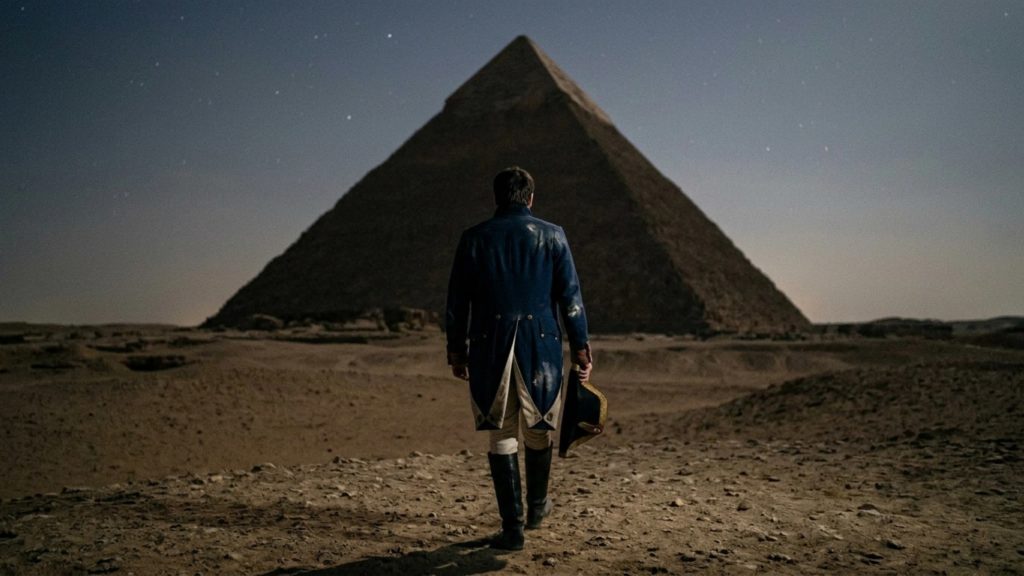
A French officer sleeps by lamplight in a stone chamber - the legend of Napoleon's night inside the pyramid, which his own secretary flatly denied.
Its polished casing stones were jointed no wider than silver paper, and yet medieval Cairo still carried them away.[1, p. 217][2]
About the Place
Why it matters
The Great Pyramid at Giza was built for King Khufu, whom Petrie named as its builder because his cartouches turn up as quarry-marks on the building stones.[3, p. 30] Hart dates it to about 2589 BCE and calls it the largest pyramid of all.[2] The true smooth-sided pyramid had developed in the reign of Sneferu, Khufu's predecessor.[2][4, p. 309] The site was very irregular, so a small rocky mound was roughly cut and enclosed within the building.[4, p. 309] Petrie's survey gave a mean base of 9068.8 inches and a height of 5776 inches.[3, p. 30]
Like the other pyramids, it was meant to protect the body of the pharaoh buried deep inside.[2] The stone tombs of nobles and officials of Khufu's court clustered near it.[4, p. 309] Herodotus was told that Cheops set all the Egyptians to work in gangs of a hundred thousand men, relieved every three months, and that the pyramid itself took twenty years.[5, p. 166] Petrie reasoned that such crowds were possible because the Nile flood left the population idle for about three months, while skilled masons worked throughout.[3, p. 30]
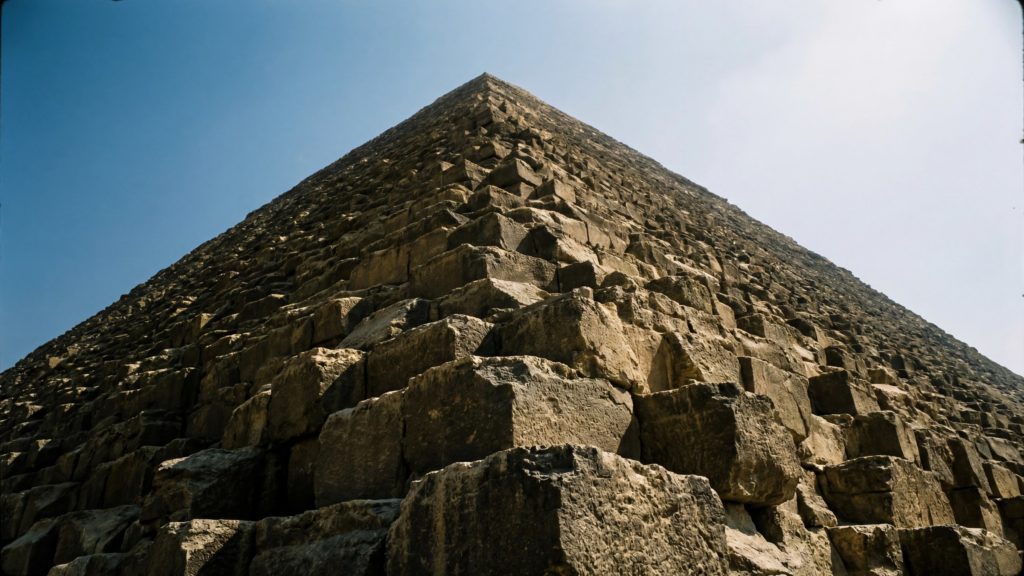
Petrie reconstructed how, under Khalif Mamun, workers forced a great hole through the masonry.[3, p. 30] Hearing a stone drop inside, they turned aside and burrowed about twenty feet eastwards into the entrance passage.[3, p. 30] There they found that the fallen stone had hidden the start of another passage, and they cut round the granite plug-blocks to reach the way up.[3, p. 30] Without that shaking of the masonry, Petrie thought, the upper chambers might have stayed unknown.[3, p. 30] An Arabic manuscript of 850 CE, quoted by Vyse, followed Mamun's entry by only twenty or thirty years, Petrie noted.[3, p. 30]
After Mamun the exterior became a quarry, and Petrie thought Sultan Hasan stripped the casing for his mosque in 1356.[3, p. 30] Stones from the top were thrown down at intervals until the early 1800s.[3, p. 30] On 30 March 1837 Howard Vyse discovered Wellington's chamber, one of the chambers of construction above the King's Chamber.[5, p. 279][1, p. 171][3, p. 30] Hart gives its height as 138 m (450 ft), and visitors are now forbidden to climb it.[2]
Legacy & Reputation
What’s the verdict?
Maspero noted that the pyramids of Khufu, Khafra and Menkaura were anciently reckoned among the wonders of the world.[4, p. 309] Vyse thought the workmanship in the King’s Chamber, the pavement and the casing-stones perfectly unrivalled.[1, p. 217] Petrie, after his own survey, found the casing’s accuracy equal to most modern opticians’ straight-edges.[3, p. 30] He also judged Herodotus as accurate as he professed to be about the base.[3, p. 30]
Myth-buster
Think you know this one?
It is often assumed that the Great Pyramid has always been a rough, stepped heap of stone. It was once smooth: Vyse found casing stones at the base, hewn to the angle and polished to one uniform surface.[1, p. 217] Hart adds that the casing was stripped away in the Middle Ages to embellish Cairo.[2]
Quick Facts
The essentials
Quick Facts
Roger would like you to know the casing joints were thinner than paperwork
Howard Vyse found casing stones at the base in 1837, polished to one uniform surface, with joints no wider than silver paper.[1, p. 217] Petrie later compared the cutting to a modern optician's straight-edge, on faces of about 35 square feet, with cement filling every joint.[3, p. 30]
Keith checked the sources on the coffer, and it never fitted the passage
Petrie measured the granite coffer in the King's Chamber at 42.0 inches wide, against an upper passage only 41.3 inches wide, so it can never have been taken through the passages.[3, p. 30] Hart agrees that it must have been set in place while the pyramid was being built.[2]
This sounds invented, but there was supposedly a garlic bill carved on it
Herodotus reported that an interpreter read him an inscription on the pyramid recording sixteen hundred silver talents spent on radishes, onions and garlic for the workmen.[5, p. 166] Vyse's casing stones showed no trace of inscription or sculpture.[1, p. 217]
Meanwhile, in history, Prussia left a birthday card on the pyramid
On the king's forty-seventh birthday in 1842, the Prussian expedition unfurled a flag on the summit.[6][6] They also left a hieroglyphic tablet, five feet broad and four feet high, near the entrance.[6]
One for the Ageonauts: Petrie took a crowbar to the coffer
In the King's Chamber, Petrie's party raised the coffer, which weighs about three tons, with a couple of crowbars so they could measure its underside.[3, p. 30]
Roger has a theory about the coffer's saw, and Petrie is on his side
Petrie saw sawing lines on the granite coffer showing that a slice 90 inches long had been cut, and reasoned that the saw must have been about nine feet long.[3, p. 30] Once the masons ran the saw too deep and had to back it out.[3, p. 30]
Keith would like to clarify how close Herodotus was
Herodotus gave the base as 8 plethra, or 800 feet, and Petrie found it was actually 747 Greek feet, judging him as accurate as he professed to be, within about half a plethron.[3, p. 30]
File under: surprisingly true, the pyramids were named after a shepherd
Herodotus said the Egyptians would not willingly speak the names of the kings, and called the pyramids after Philition, a shepherd who kept his cattle nearby.[7, p. 41]
Keith found the footnote about the King's Chamber roof
Petrie noted that the roofing-beams are rough-dressed, not the polished granite of earlier descriptions.[3, p. 30] Round the south-east corner, the joint was daubed up with cement laid on by fingers.[3, p. 30]
Roger said it. Keith checked it: taller than the Statue of Liberty
Hart notes that at 138 m (450 ft) it was taller than the Statue of Liberty, at 92 m (301 ft).[2] Maspero gives its original height as about 481 feet.[4, p. 309]
Our flag was unfurled on the summit of the oldest and highest of human works that is known.[6]
Richard Lepsius
Lepsius, of the Prussian expedition, describing the party's ascent of the Great Pyramid.[6]
Timeline
How it unfolded
c. 2600 BC
Great Pyramid built for Khufu
The Great Pyramid was built c. 2600 BC over a period of about 26 years for the pharaoh Khufu, and at 146.6 metres it was the world's tallest human-made structure for more than 3,700 years.[8] Hart's reference work gives the date as c. 2589 BC, a reminder that Old Kingdom dates are modern estimates.[2]
21 July 1798
Battle of the Pyramids
The Battle of the Pyramids was fought on 21 July 1798.[9] Napoleon Bonaparte's army beat the Mamluks under Murad at Embabeh, opposite Cairo, in a fight commonly named after the pyramids.[7] According to Sloane's biography, Bonaparte told his soldiers that forty centuries looked down on them from the summit of the Pyramids.[10]
30 March 1837
Howard Vyse discovers Wellington's Chamber
Colonel Howard Vyse's 1837 operations included the discovery of Wellington's Chamber on 30 March 1837, according to his own published record.[5, p. 279] Four additional relieving chambers were found above the King's Chamber that year.[8]
c. 1880-1882
Petrie surveys the Giza plateau
Flinders Petrie made precise measurements of the Great Pyramid in 1880-1882.[8] Baikie later called his the most complete survey of the Gizeh field, dating the work 1880-1881.[11, p. 2]
1954
Khufu ship pits discovered
In 1954 two boat pits, one containing the Khufu ship, were discovered buried at the south foot of the pyramid.[8]
1979
Pyramid Fields inscribed by UNESCO
The Great Pyramid is part of Memphis and its Necropolis - the Pyramid Fields from Giza to Dahshur, a UNESCO World Heritage Site inscribed in 1979.[8]
Dig Deeper
Copy any prompt below into your favourite AI chat to keep exploring.
Explain why Pharaoh Khufu commissioned the Great Pyramid at Giza around 2600 BCE, and how a colossal tomb was meant to project power and eternity.
Debate whether a monument as colossal as the Great Pyramid secures a king's memory or says more about the state's power than about the king.
Roast Khufu's Great Pyramid as the most over-the-top 'please never forget me' project ever, using only its millions of blocks and decades of building.
Further Reading
Where to read more
The Great Pyramid (Discover Egypt's Monuments, Ministry of Tourism and Antiquities)
Web page. Free online, no login. The Ministry's monument entry for Khufu's pyramid (c.2589-2566 BC): its original height, its three chambers, the Grand Gallery, the boat pits, and the source of the casing stones.
Why look at this: Says the exterior was once entirely covered in high-quality limestone shipped in from Turah, south of Maadi, so it tells you where the smooth casing that later generations stripped off actually came from.
https://egymonuments.gov.eg/en/monuments/the-great-pyramidThe World's Oldest Papyrus and What It Can Tell Us About the Great Pyramids, by Alexander Stille (Smithsonian Magazine, 22 September 2015)
Magazine feature. Free online, no login needed to read. Reports Pierre Tallet's discovery of the Wadi al-Jarf papyri, the oldest known, and how they were written by men who worked on Khufu's pyramid.
Why look at this: Introduces Inspector Merer's logbook: his crew loaded Tura limestone (the stone used for the outer casing) and took it up the Nile to Giza, reporting to Ankh-haf, Khufu's half-brother, in what the article describes as the last known year of Khufu's reign, so it shows the finishing touches being applied.
https://www.smithsonianmag.com/history/ancient-egypt-shipping-mining-farming-economy-pyramids-180956619/Khufu Pyramid (Digital Giza, The Giza Project at Harvard University)
Institutional archive record page. Free online, no login. Harvard's Giza Project gathers for the pyramid (Reisner's G I) 34 excavation-diary pages dated 1914 to 1938, nine maps and plans, three drawings, seven finds including two mortar samples, and 26 published and 12 unpublished documents.
Why look at this: Includes a plan headed 'Khufu Pyramid, Sections' through the five construction chambers above the King's Chamber, with their ancient level marks, the stacked compartments Howard Vyse explored in 1837, so you can compare the survey drawings with the original archive.
https://giza.fas.harvard.edu/sites/1782/full/Related
Keep exploring




Can be seen in
Where this shows up

References
Sources
Sources
- BookOperations carried on at the pyramids of Gizeh in 1837: with an account of a voyage into Upper… by Richard William Howard Howard-Vyse and John Shae Perring. Pages 171, 217. ↑
- BookAncient Egypt (DK Eyewitness) by George Hart ↑
- BookThe pyramids and temples of Gizeh by W. M. Flinders Petrie. Page 30. ↑
- BookManual of Egyptian archaeology and guide to the study of antiquities in Egypt, for the use of students… by Sir Gaston Camille Charles Maspero. Page 309. ↑
- BookOperations carried on at the pyramids of Gizeh in 1837: with an account of a voyage into Upper… by Richard William Howard Howard-Vyse and John Shae Perring. Pages 166, 279. ↑
- BookLetters from Egypt, Ethiopia, and the peninsula of Sinai by Richard Lepsius and others ↑
- BookThe Nile. Notes for travellers in Egypt by E. A. Wallis Budge. Page 41. ↑
- Websiteen.wikipedia.org: Great Pyramid of Giza ↑
- BookThe French revolution from 1789 to 1815 by M. Mignet and James Westfall Thompson ↑
- BookThe Life of Napoleon Bonaparte. Vol. 2 (of 4) by William Milligan Sloane ↑
- BookA century of excavation in the land of the Pharaohs by James Baikie. Page 2. ↑
- Websiteen.wikipedia.org: ScanPyramids ↑
- Websitesciencenews.org: Mystery void discovered great pyramid giza ↑