
AI reconstruction based on Clément-Auguste Andrieux's "La bataille de Waterloo, 18 juin 1815," from inside the British line at the shoulder of a redcoat firing into the cavalry melee, the windmill standing above the smoke behind.
For most of 18 June 1815, Napoleon's army was slowly grinding down Wellington's line at Waterloo - until an entirely different army appeared on his flank[1, p. 38].
What Happened
The story
On the morning of 18 June 1815, Napoleon's army faced Wellington's Anglo-allied force drawn up along a low ridge near the village of Waterloo, south of Brussels[1, p. 38]. Blucher's Prussian army, defeated two days earlier at Ligny, was marching to join Wellington rather than retreating away from him. Overnight rain had turned the ground to mud, and Napoleon delayed his attack until the fields could dry, giving the Prussians more time to arrive[2, p. 39]. The French assault finally opened at thirty-five minutes past eleven that morning[3].
The French attacked Wellington's centre and the fortified farms of Hougoumont and La Haye Sainte, which anchored his line[4, p. 1][1, p. 38]. Repeated infantry assaults and massed cavalry charges hurled themselves at the Allied squares of infantry, which held their formation through charge after charge[5]. Around four o'clock, the first Prussian columns under Blucher finally reached the field on Napoleon's right flank[1, p. 38], forcing him to fight two battles at once.
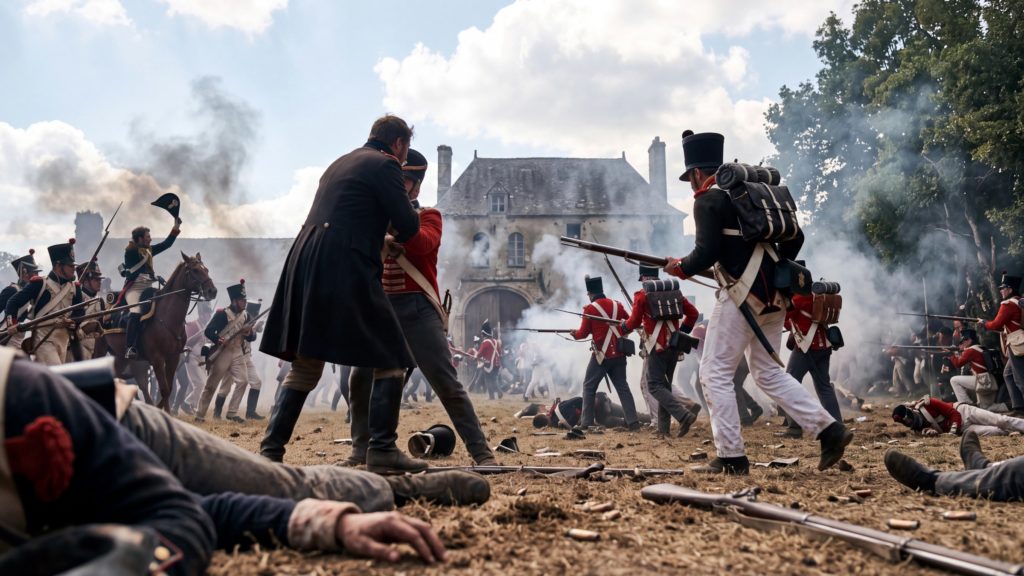
In the early evening Napoleon committed his last reserve, the Imperial Guard, in a final attack on Wellington's line - and it was repulsed[5, p. 382][6, p. 322]. The cry ran along the French line, 'La Garde recule' - the Guard is retreating[7] - and the army's morale broke with it. Wellington's own advance, combined with the Prussian attack on the French right, turned the retreat into a rout. Wellington and Blucher met near the inn of La Belle Alliance as the fighting ended[4, p. 121].
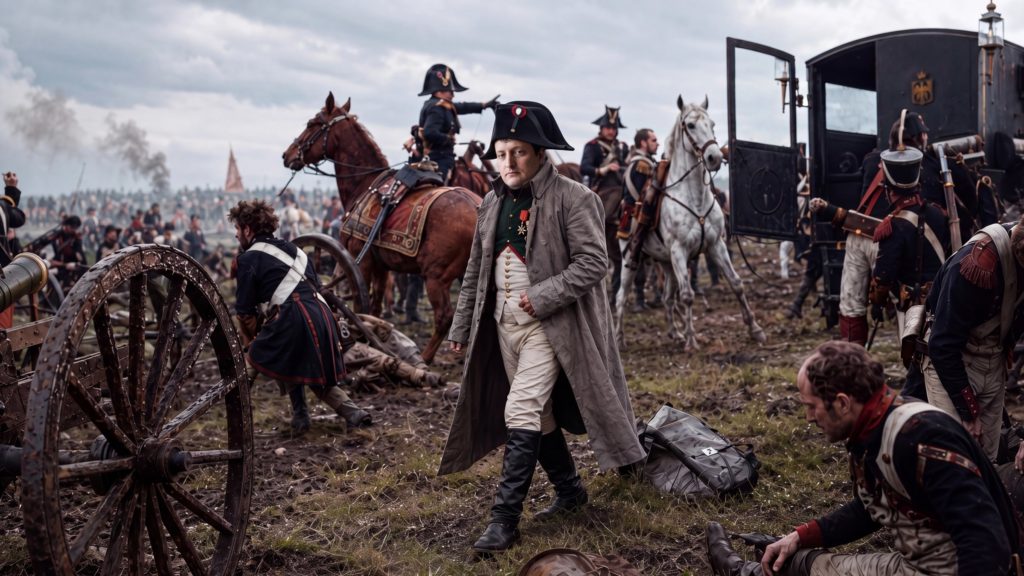
Napoleon's army disintegrated in the retreat, and he himself fled the field for Paris. British casualties alone were later recorded at over five thousand men killed and wounded[8, p. 97]. Wellington, recalling the fight soon afterward, called it 'the nearest run thing you ever saw in your life'[4, p. 121]. Within days, Napoleon's political support in Paris collapsed, and the campaign that had begun with his triumphant return from Elba ended in the wreckage of Mont-Saint-Jean.
Quick Facts
The essentials
Quick Facts
Napoleon's French Army of the North
Leadership
Napoleon Bonaparte[9, p. 68]
Forces
The French Army of the North, including the Imperial Guard[7]
Objective
To defeat Wellington's Allied army decisively before Blucher's Prussians could arrive[10]
Wellington's Allied army and Blucher's Prussian army
Leadership
The Duke of Wellington[9, p. 68]; Field Marshal Gebhard von Blucher[9, p. 68]
Forces
British, Dutch, Belgian and German troops under Wellington[1, p. 38]; the Prussian army under Blucher, arriving on the French right flank[1, p. 38]
Objective
To hold the ridge at Waterloo until the Prussian army arrived, then together destroy Napoleon's army
The Bigger Picture
The climactic battle of Napoleon's Hundred Days and the final campaign of the Napoleonic Wars, fought as the Seventh Coalition moved to end his restored rule for good[10].
How It Came To This
Napoleon's need to defeat Wellington's Anglo-allied army before Blucher's Prussians, mauled but not destroyed two days earlier at Ligny, could rejoin the fight[10]; and the rain-soaked ground that delayed the French attack until nearly midday, giving the coalition more time[2, p. 39].
What Actually Happened
Waterloo turned on timing as much as tactics. Napoleon's entire plan depended on beating Wellington decisively before Blucher's Prussians could rejoin the fight[10]. The rain-softened ground that delayed the French attack until nearly midday bought the coalition exactly the hours it needed[2, p. 39][3]. Wellington's tactic of sheltering his infantry in squares meant that repeated French cavalry charges, however dramatic, could not break the Allied line outright, since cavalry alone cannot force a formed square[5]. That gave the battle enough time to become a race, and Napoleon lost it: by mid-afternoon the Prussians were arriving on his exposed right flank, forcing him to split his dwindling reserves between two fronts at once[1, p. 38]. The final commitment of the Imperial Guard, the army's last uncommitted force and the ultimate symbol of its invincibility, was a gamble to break Wellington's line before the Prussians could finish arriving - and its failure was catastrophic precisely because nothing was left behind it. Once the Guard broke, the rest of the French army had no reserve to rally on, and retreat turned into collapse.
Why It Still Matters
Waterloo ended the Napoleonic Wars outright, arriving just ten days after the Congress of Vienna had already concluded its redrawing of the European map[11]. It closed the door on any further Bonapartist restoration by force, and permanently tied Wellington's and Blucher's names to the battle that ended Napoleon's twenty years in power.
Quick Facts
Keith checked the sources...
Wellington is famous for supposedly shouting 'Up, Guards, and at them!' at the battle's critical moment - except Wellington himself later denied ever saying any such thing[12, p. 198].
Roger would like you to know...
The battle didn't start until twenty-five minutes to twelve in the morning. Overnight rain had turned the ground to mud, and Napoleon delayed his attack to let the fields firm up first[3][2, p. 39].
One for the Ageonauts...
'La Garde recule' - 'the Guard is retreating' - are four of the most consequential words in European history. Once that cry spread down the French line, panic did the rest[7].
History gets strange here...
Wellington's own summary of Waterloo wasn't triumphant. He called it 'the nearest run thing you ever saw in your life' - hardly the confident verdict you'd expect from the winning commander[4, p. 121].
Keith would like to clarify...
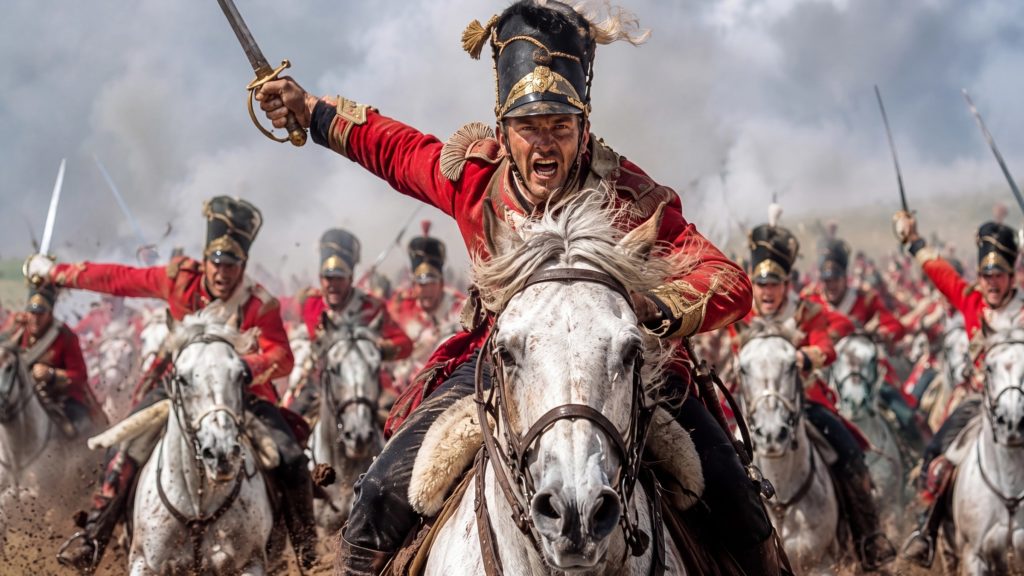
French cavalry charged the Allied infantry squares again and again through the afternoon - but a cavalry charge alone, without infantry or artillery support, genuinely cannot break a formed infantry square, and that is exactly what kept happening[5].
A small fact with a very large consequence...
Napoleon's whole plan hinged on speed: crush Wellington before Blucher's Prussians could reach the field. Around four o'clock, the first Prussian columns arrived on his flank anyway, and he was suddenly fighting two armies at once[1, p. 38].
Meanwhile, in history...
British losses alone at Waterloo were later tallied at over five thousand men killed and wounded - and that's before counting the Prussian, Dutch, Belgian, German and French casualties from the very same day[8, p. 97].
Roger has entered the historical rabbit hole...
Wellington and Blucher are said to have met in person near the farm of La Belle Alliance as the battle ended - though even eyewitnesses later argued over exactly where the two commanders actually shook hands[4, p. 121].
Roger said it. Keith checked it...
Napoleon committed his last reserve, the seemingly invincible Imperial Guard, in one final attack hoping to break Wellington's line outright - and its repulse left the French army with nothing left to rally on[5, p. 382].
Keith has spotted the problem...
Napoleon's failure to finish off the Prussians two days earlier at Ligny turned out to be the single costliest error of the campaign - it left Blucher's army bruised but very much alive, and very much on its way to Waterloo[10].
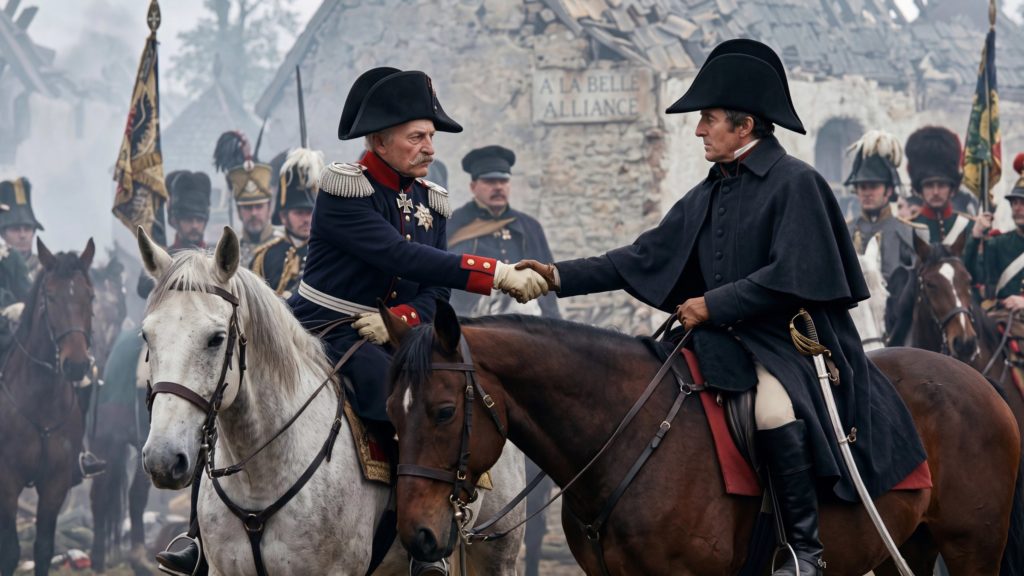
It has been a damned nice thing - the nearest run thing you ever saw in your life.
The Duke of Wellington, on the battle, recalled shortly afterward[4, p. 121]
Wellington's own verdict on how close the battle had come to a French victory, given once the fighting was over.
Timeline
How it unfolded
13 March 1815
Powers at Vienna declare Napoleon an outlaw
On 13 March 1815 the powers assembled at the Congress of Vienna published a declaration on Napoleon's escape from Elba.[13, p. 149] It stated that he had placed himself outside civil and social relations and was liable to public vengeance.[14]
15 June 1815
French army crosses the Sambre
Napoleon crossed the Sambre at Charleroi and Marchienne on the morning of 15 June 1815 and drove back the Prussian covering troops.[15, p. 1826]
16 June 1815
Battles of Ligny and Quatre Bras
On 16 June 1815 Wellington held his own against the French at Quatre Bras but could not come to Blücher's aid at Ligny.[16] Napoleon, after five and a half hours of struggle, broke the centre of the Prussian line at Ligny and forced the Prussians off the field.[17]
17 June 1815
Wellington falls back to Waterloo
On 17 June 1815, once it was clear that the Prussian army had retired on Wavre and that retreat was inevitable, Wellington resolved to march his army back towards Brussels.[17] That night he established his headquarters in a tavern in Waterloo.[18, p. 25]
18 June 1815
Battle of Waterloo opens at Hougoumont
After postponing the attack until the ground dried, Napoleon opened the battle at 11:30 a.m. on 18 June 1815 with an attack by Prince Jerome's battalions on Hougoumont.[18, p. 26]
18 June 1815
Imperial Guard repulsed and Prussians arrive
At about 7 p.m. Napoleon threw his Imperial Guard into the fray.[18, p. 30] It was repulsed with enormous casualties and retreated across the valley, and at about 7:30 p.m. Blücher's Prussians arrived with 60,000 men.[18, p. 31]
18 June 1815
Wellington and Blücher meet after the victory
Wellington and Blücher met in the dark and saluted each other as victors.[10] At the end of the day 40,000 men and 10,000 horses lay dead or wounded on the field.[18, p. 32]
22 June 1815
Napoleon abdicates a second time
Napoleon returned to Paris on 21 June 1815 and, as the Chambers made clear that France would not face Europe on his behalf, abdicated a second time in favour of his son on the 22nd.[11]
8 July 1815
Louis XVIII restored in Paris
With Paris again in the hands of the Allies, the restoration of Louis XVIII followed when he re-entered the capital on 8 July 1815.[11]
15 July 1815
Napoleon surrenders to the British
Napoleon, unable to escape from Rochefort past a watching British squadron, surrendered on board the Bellerophon on 15 July 1815.[11]
Dig Deeper
Copy any prompt below into your favourite AI chat to keep exploring.
Explain why the failure of Napoleon's Imperial Guard attack in the early evening of 18 June 1815 caused the entire French army to collapse, not just retreat.
Debate whether Napoleon's defeat at Waterloo was decided by the Imperial Guard's failed attack in the evening, or was already inevitable once the Prussians reached the field at four o'clock.
Roleplay as a French soldier hearing the cry 'La Garde recule' spread down the line at Waterloo, and tell me what you'd do next.
Further Reading
Where to read more
Battle of Waterloo - World History Encyclopedia
A free, thorough encyclopaedia account of the battle, from the morning attack on Hougoumont to the Imperial Guard's final repulse.
Why look at this: Lays out the battle hour by hour, including the exact time Ney finally captured La Haye Sainte and why that success came too late to matter.
https://www.worldhistory.org/article/2303/battle-of-waterloo/Battle of Waterloo - National Army Museum
A fuller, museum-authored account of the battle's key positions and turning points, from the Guards at Hougoumont to the Imperial Guard's final advance.
Why look at this: Explains exactly why the Imperial Guard's evening attack went up the one stretch of ridge where Wellington's line was strongest - the tactical detail behind this page's climactic moment.
https://www.nam.ac.uk/explore/battle-waterlooWaterloo Letters, ed. H. T. Siborne
An 1891 collection of original, previously unpublished letters from British officers who fought at Waterloo, freely digitised on the Internet Archive.
Why look at this: Assembled from the same veterans' testimony used to build Siborne's famous model of the battle, these letters are the raw eyewitness material behind details like the Prussian arrival and the Guard's final repulse.
https://archive.org/details/waterlooletterss00siboRelated
Keep exploring



Can be seen in
Where this shows up

References
Sources
Sources
- BookAn historical sketch of the campaign of 1815 by Captain Batty. Page 38. ↑
- BookWaterloo letters : a selection from original and hitherto unpublished letters bearing on the operations of the 16th… by H.T. Siborne. Page 39. ↑
- BookThe battle of Waterloo, with those of ligny and Quatre Bras, described by eye-witnesses and by the series… (compiled by John Booth) ↑
- BookNapoleon and Waterloo, the emperor's campaign with the Armée du Nord, 1815; a strategical and tactical study by Archibald Frank Becke. Pages 1, 121. ↑
- Book1815, Waterloo; by Henry Houssaye, Arthur Emile Mann and A. Euan- Smith. Page 382. ↑
- BookQuatre-Bras, Ligny and Waterloo; a narrative of the campaign in Belgium, 1815 by Dorsey Gardner. Page 322. ↑
- BookThe war drama of the Eagles : Napoleon's standard-bearers on the battlefield in victory and defeat from Austerlitz… by Edward Fraser ↑
- BookWith Napoleon at Waterloo, and other unpublished documents of the Waterloo and Peninsular campaigns, also papers on Waterloo… by MacKenzie MacBride and others. Page 97. ↑
- BookThe battle of Waterloo; or, a faithful and interesting history of the unparalleled events connected therewith; from the…. Page 68. ↑
- BookBlücher and the uprising of Prussia against Napoleon, 1806-1815 by Ernest F. Henderson ↑
- BookA short history of Europe from the dissolution of the Holy Roman empire to the outbreak of the… by Charles Sanford Terry ↑
- BookA Voice from Waterloo by Edward Cotton. Page 198. ↑
- BookThe history of the war : from the establishment of Louis XVIII on the throne of France by Hewson Clarke. Page 149. ↑
- BookLife of Napoleon Bonaparte, Volume V. by Walter Scott ↑
- BookWellington by J. W. Fortescue. Page 1826. ↑
- BookWaterloo by Hilaire Belloc ↑
- BookThe Fifteen Decisive Battles of the World: from Marathon to Waterloo by Sir Edward Shepherd Creasy ↑
- WebsiteWaterloo Belgium Historic Trail guide. Pages 25, 26, 30, 31, 32. ↑